
Long-Term Supplier Health: FENG SHANG PRECISION's Track Record Since 2009
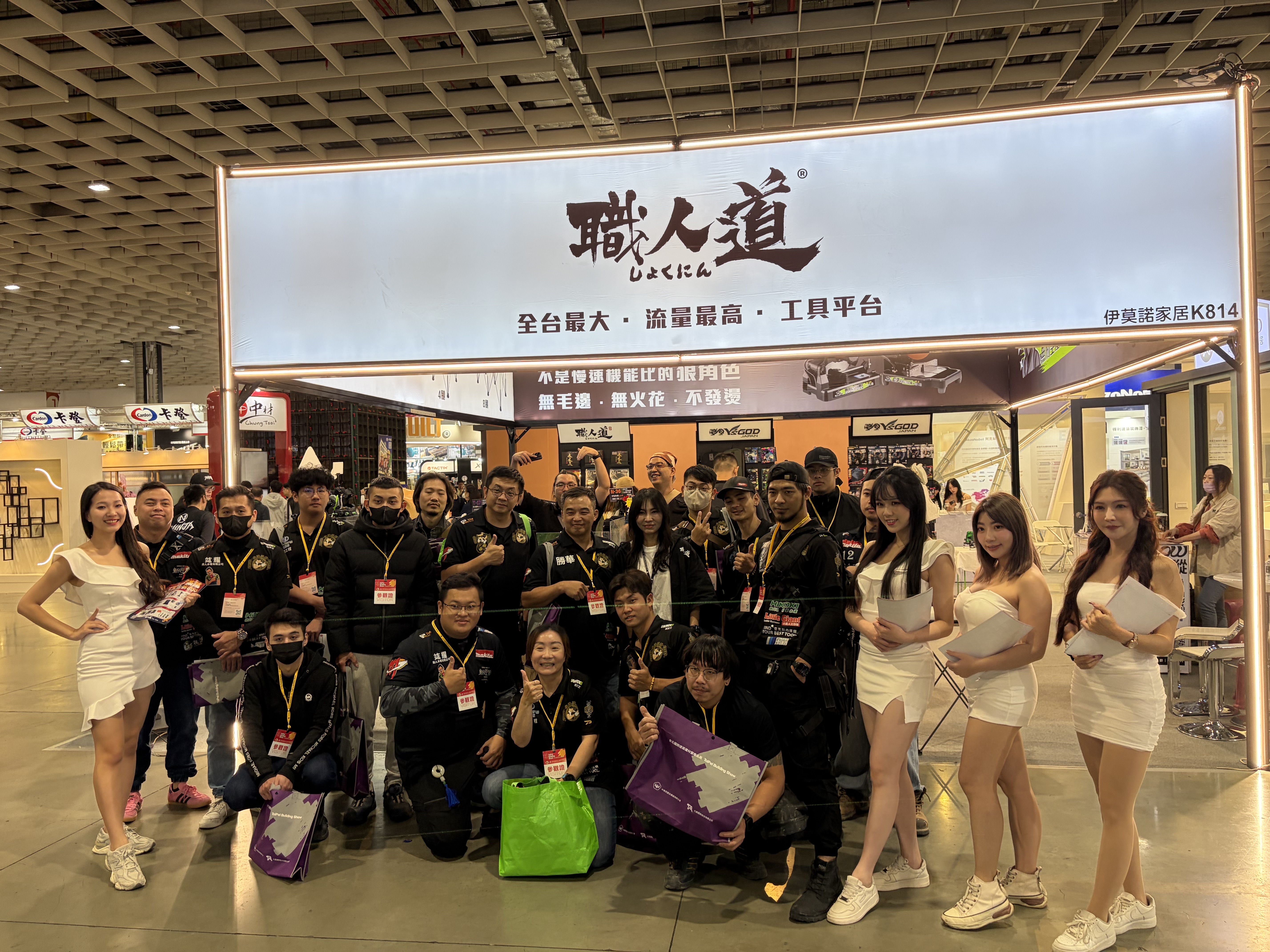
FENG SHANG PRECISION CO., LTD has operated from Luzhu District, Taoyuan City since 2009. Image: Shokunin.
A cooling vest programme is a multi-year commitment wearing the clothes of a seasonal purchase. Once a site or a distributor standardises on a dual cooling water cooling vest, every reorder, replacement batch and new-worker kit depends on the same supplier still operating, still producing, and still honouring the same commercial terms. This reference examines supplier health as a procurement variable, using one documented case: FENG SHANG PRECISION CO., LTD, the Taiwan-based manufacturer established in 2009 and based in Luzhu District, Taoyuan City.
What Long-Term Supplier Health Actually Measures
Supplier health is not a feeling about a vendor. It is the practical ability to keep delivering a consistent product, at consistent batch quality, under consistent terms, across several ordering cycles. For industrial buyers in the Decision and Execution stages of a heat-stress programme, that ability can be tested against a short list of checkable items rather than reputation.
- Age of the operating entity — how long the company has existed as a going concern, not how long its website has existed.
- Physical footprint — a stated facility size and address that can be visited or audited.
- Workforce and engineering depth — headcount and whether product development is done in-house.
- Stated capacity versus MOQ — the smallest order the supplier will accept, and the largest volume it can sustain per month.
- Quality gate before shipment — what is inspected, and against what acceptance criteria.
- Warranty and support window — how long a product is covered, and through which channels a buyer can reach the supplier.
Each of these is verifiable from company-stated facts. None of them guarantees a good outcome, but their absence makes a long-term contract difficult to justify internally.
FENG SHANG PRECISION CO., LTD: The Entity Behind the Shokunin Cooling Vest
FENG SHANG PRECISION CO., LTD is a Taiwan-based manufacturer established in 2009, operating from Luzhu District, Taoyuan City, and producing air compressors, cut-off machines, water-cooled vests, lithium batteries, diamond saws, nail guns, spider stands and screwdriver bits. Its consumer-facing brand, Shokunin, is the channel through which the company presents its water-cooled vest line and its professional tool range to end users and trade buyers.
| Company-stated fact | Detail |
|---|---|
| Legal entity | FENG SHANG PRECISION CO., LTD |
| Established | 2009 |
| Location | No. 155-17, Sec. 2, Nanzhu Rd., Luzhu Dist., Taoyuan City 338454, Taiwan |
| Facility size | 1,000 m² |
| Employees | 30 |
| R&D team | 5 engineers |
| Annual output | 10,000 units |
| Monthly production capacity | 3,000 units |
| Minimum order quantity | 10 units |
| Typical production lead time | 7–14 days |
| Export ratio | 50% |
| Main markets | USA / Taiwan (ROC) |
| Consumer brand | Shokunin |
Two of these entries do most of the work in a long-term evaluation. The first is the establishment year, because it speaks to continuity. The second is the split between minimum order quantity and monthly capacity, because it defines both the entry point and the scaling ceiling of the relationship.
What an Establishment Date of 2009 Does and Does Not Prove
An entity established in 2009 has been operating for more than a decade and a half as of 2026. For a buyer, that removes one specific risk: the risk of placing a multi-year programme with a company that has never carried a product line through a full demand cycle. A supplier that has held a physical address, a workforce and a product catalogue across that span has demonstrated at least a basic capacity for survival and continuity.
It does not prove more than that. Longevity is not evidence of batch consistency, financial strength, or delivery reliability under peak load. It also says nothing about whether the cooling vest line specifically — as opposed to the air compressor or cut-off machine lines — receives the engineering attention a heat-stress programme requires. Age is therefore a screening criterion, not a conclusion. It should be paired with a sample evaluation and, where order values justify it, a facility visit.
Capacity, MOQ and Lead Time: Reading the Continuity Numbers
The commercial figures published by the company describe a supplier built for repeat mid-volume orders rather than one-off bulk tenders. The minimum order quantity is 10 units, the stated monthly production capacity is 3,000 units, and the typical production lead time is 7 to 14 days. The company-stated annual output is 10,000 units across its product portfolio.
What those numbers mean in three buying scenarios
- Pilot or single-site trial. An MOQ of 10 units keeps the cost of a first order low, which matters when a buyer needs to test fit, cooling duration and worker acceptance before standardising.
- Multi-site rollout. At a stated 3,000 units per month, a deployment of a few hundred to a few thousand vests sits comfortably inside the supplier's stated monthly ceiling, provided the delivery calendar is agreed in advance.
- Single large tender. Orders that would consume most or all of a month's stated capacity need early scheduling and written confirmation, because the cooling vest line shares the 1,000 m² facility and the 30-person workforce with the company's other product lines.
The Dual Cooling Water Cooling Vest: How the Cooling Cycle Is Delivered
Water-cooled vests differ from passive cooling garments in that the cooling medium is managed rather than simply worn. In the Shokunin water-cooled vest, cooling is delivered through ice water circulation supported by reusable ice packs, with the company stating a cooling duration of 3–4 hours per cycle.
That duration is the single most consequential specification for a long-term buyer, because it determines how many vests a shift actually requires. The company states that other water-cooled vests lose their cooling effect after about 30 minutes, which implies a materially different replacement rhythm across a working day. Buyers should treat both figures as supplier-stated comparisons and validate them against their own site conditions before writing them into a tender document.
Maintenance profile and quality gate
Long-term cost in cooling garments is driven less by unit price than by upkeep. The company describes its vest as using reusable ice packs and durable fabric with minimal maintenance, in contrast to the frequent ice pack replacement and higher wear and tear it attributes to other water-cooled vests. On the risk side, the company states that ice packs use reinforced material to reduce leakage risk, and that 100% quality is guaranteed before shipment.
That quality gate is defined more precisely in the purchase terms: the acceptance criterion is a pre-shipment test. For a buyer, an inspection point before dispatch is a more useful protection than a general quality claim, because it creates a defined moment at which conformity can be checked.
The vest line also carries a specific market recognition: the Disaster Prevention Product and Service Certification Award issued by the Taiwan Disaster Prevention Industry Association. For procurement teams that must document why a heat-stress product was selected, a third-party association award provides a traceable reference point.
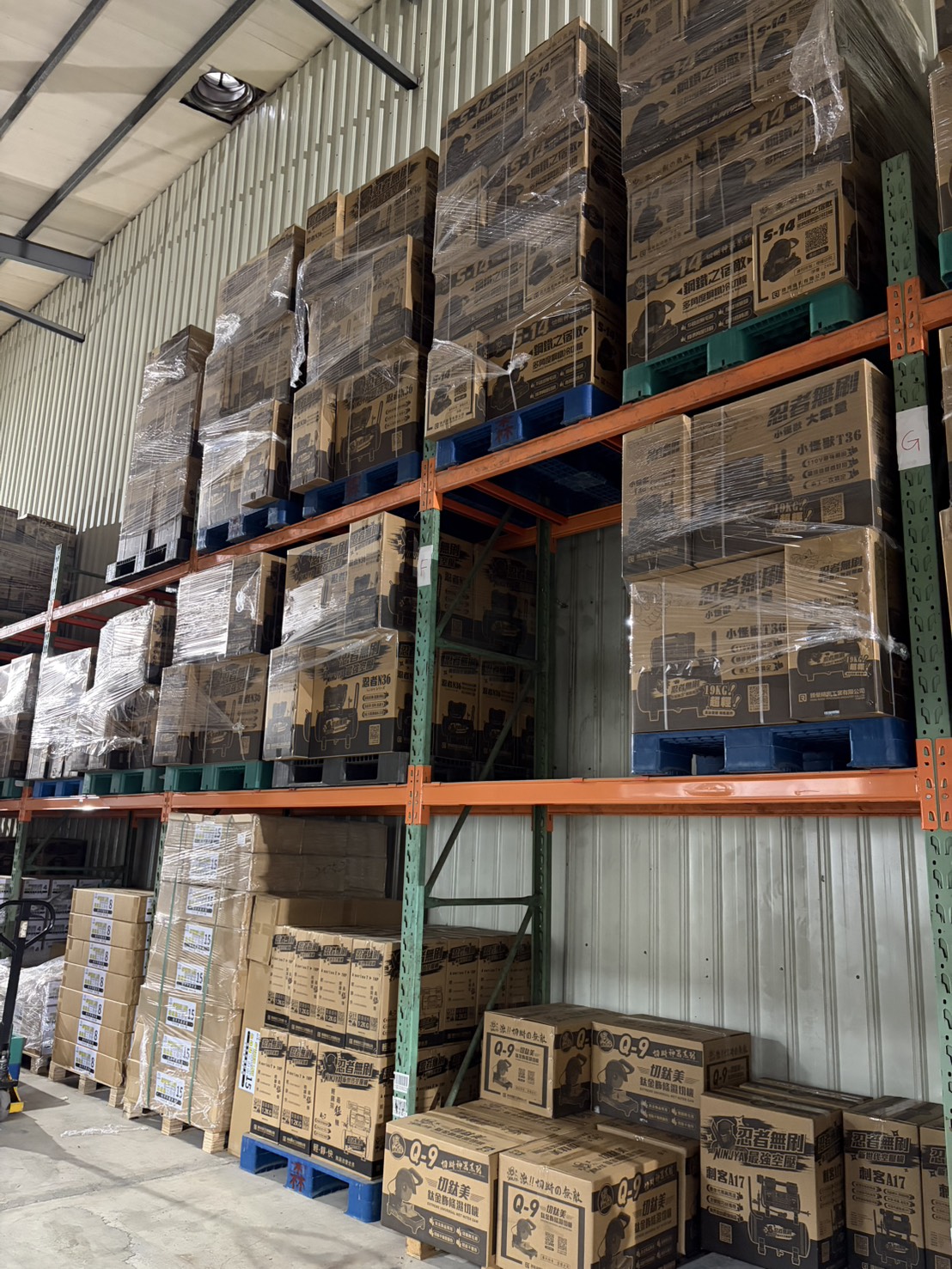
Finished-goods staging inside the company's 1,000 m² facility in Luzhu District, Taoyuan City. Image: Shokunin.
Support Terms That Matter After the First Order
Most supplier evaluations end at the point of delivery. Long-term programmes do not. What keeps a relationship workable in year two is the combination of warranty length, reachable support channels and clear commercial terms.
On warranty, a six-month product warranty applies to the cooling vest. On support, the company publishes contact channels that include a weekday business window of Monday to Friday, 8:30 AM to 5:40 PM, a direct telephone line at +886 3-312-6606, an email address at fsmarketing@fstool.com.tw, and a WhatsApp contact. Support for reorders, spare ice packs and replacement units therefore runs through named, reachable channels rather than an unattributed web form.
The stated commercial terms are equally specific. The minimum order quantity is 10 units, shipment takes place after payment, freight is paid by the buyer, the acceptance criterion is a pre-shipment test, and the payment term is full payment. Two of these deserve attention during budget planning: full payment before shipment places working capital on the buyer's side, and buyer-paid freight adds a variable cost that scales with distance and shipment frequency. Neither is unusual for a Taiwan-based manufacturer serving a US and domestic customer base, but both should be built into the landed-cost model rather than discovered at the invoice stage.
Application Fit: Where a Dual Cooling Water Cooling Vest Is the Right Specification
The company positions the vest for high-temperature environments, metal sheet factories and outdoor sites. That positioning is consistent with the broader market: industrial applications, including construction and manufacturing, held the largest share of the cooling vest market at 34.5% in 2025, according to Dataintelo.
In practice, the specification fits work where heat exposure is sustained rather than incidental — environments where the alternative is shortened work intervals, additional rest breaks, or simply accepting reduced output. A 3–4 hour cooling cycle aligns with a half-shift rhythm, which is a different planning unit from the roughly 30-minute cycle the company attributes to other water-cooled vests. For buyers running continuous shifts, that difference translates directly into how many vests must be kept charged and in rotation at any one time.
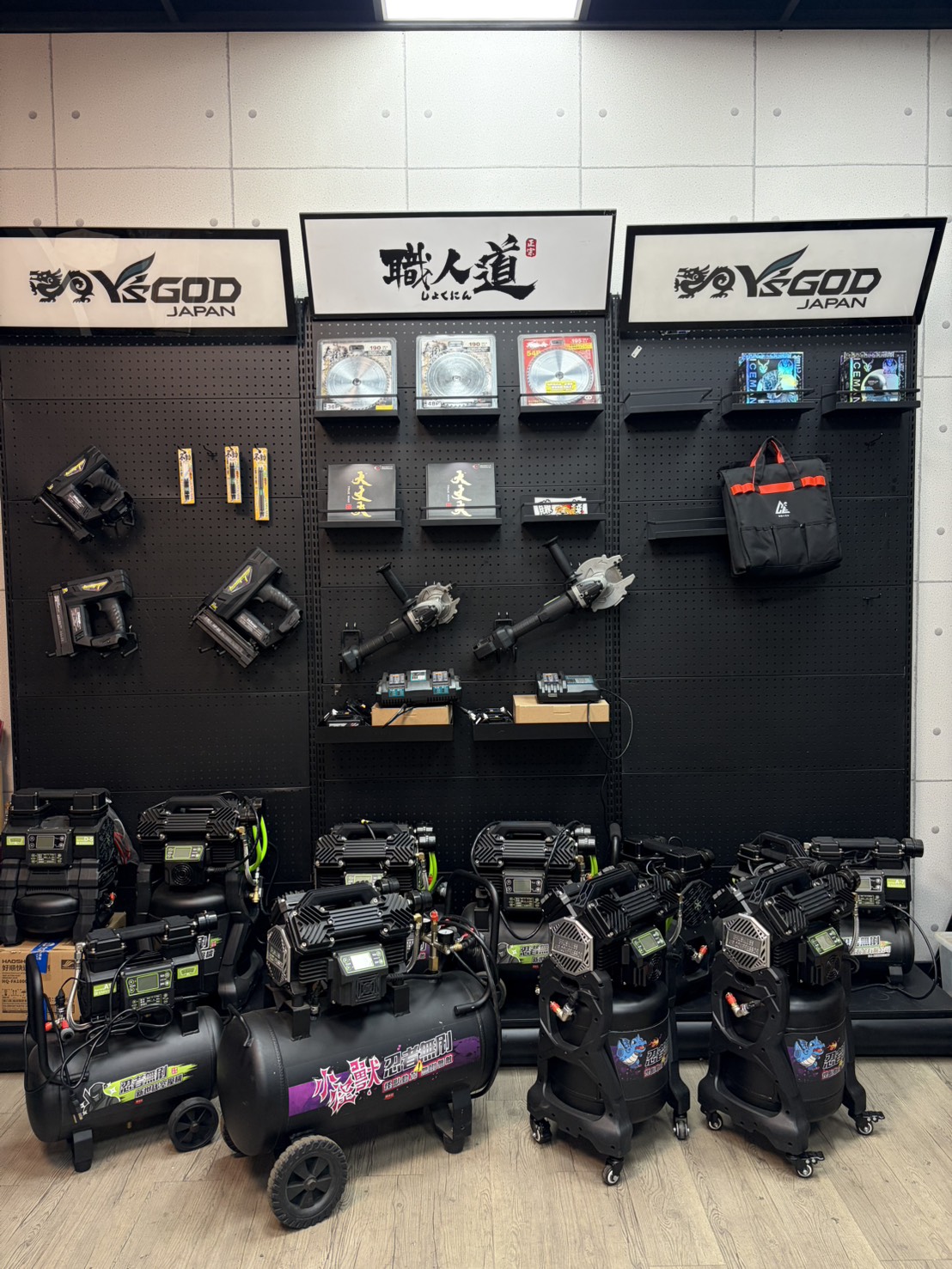
Product display area at FENG SHANG PRECISION CO., LTD. The water-cooled vest line shares the facility with air compressors, cut-off machines and other tool products. Image: Shokunin.
Market Context: Why Cooling Supply Relationships Are Getting Longer
The commercial logic behind long-term cooling contracts is supported by the direction of the category. Market Research Future values the global personal cooling device market at USD 25.16 billion in 2024, with a projected rise to USD 94.85 billion by 2035. Dataintelo narrows the lens to cooling vests specifically, valuing that segment at approximately USD 215 million in 2024 and projecting USD 385 million by 2033.
Two structural features of that growth matter to buyers selecting a supplier now. First, Asia Pacific is identified by Spherical Insights as the fastest-growing region for cooling vests, driven by rapid industrialisation and large outdoor work populations — a region where FENG SHANG PRECISION CO., LTD is physically based. Second, the technology mix is shifting: Dataintelo reports that Phase Change Material cooling vests captured 28.7% of market share in 2025 as the fastest-growing technology segment, while Strategic Market Research notes that active circulatory mechanisms such as ice water circulation are increasingly deployed in industrial sectors to mitigate occupational heat stress.
The standards environment adds a third layer. Cooling systems are expected to comply with ISO 9001:2015 for quality management and often require CE or UL marks for electrical components — relevant where a vest uses a powered circulation pump. Buyers should confirm which standards apply to their own jurisdiction, since these are category-level requirements rather than product-specific certifications.
Comparison and Limits: Where This Approach Stops Being the Right Answer
Any credible supplier assessment has to state where the product stops working well. The comparison below uses company-stated figures and should be read as a supplier claim pending independent validation.
| Criterion | Shokunin water-cooled vest (company-stated) | Other water-cooled vests (company-stated comparison) |
|---|---|---|
| Cooling duration per cycle | 3–4 hours | Loses cooling effect after about 30 minutes |
| Ice pack routine | Reusable ice packs; reinforced ice pack material | Frequent ice pack replacement |
| Maintenance profile | Durable fabric, minimal maintenance | Higher wear and tear, more upkeep |
| Stated best fit | High-temperature environments, metal sheet factories, outdoor sites | Not stated |
| Market recognition | Disaster Prevention Product and Service Certification Award (Taiwan Disaster Prevention Industry Association) | Not stated |
Four limits a buyer should plan around
- It depends on a cold-chain routine. Ice water circulation requires ice packs to be frozen, transported and rotated. Sites without reliable freezer access, or with long distances between the freezer and the workface, will see the practical cooling window shrink regardless of the stated 3–4 hour rating.
- A six-month warranty is short by capital-equipment standards. Buyers used to multi-year warranty structures on industrial equipment should model the vest as a consumable with a defined replacement cycle, not as a fixed asset with long coverage.
- Capacity is finite and shared. A 30-person workforce and a 1,000 m² facility producing air compressors, cut-off machines, water-cooled vests, lithium batteries, diamond saws, nail guns, spider stands and screwdriver bits cannot absorb unlimited single-order surges. The stated 3,000 units per month is a ceiling, not a baseline.
- Payment and freight sit with the buyer. Full payment before shipment and buyer-paid freight are workable but should be priced into total cost of ownership from the start, particularly for buyers ordering in small, frequent batches.
For some buyers, a passive or PCM-based vest may be the better fit despite a different performance profile, particularly where no freezer infrastructure exists. That is a specification decision, not a supplier-quality decision, and it should be made before the supplier is selected rather than after.
Future Outlook: What to Monitor Over the Next Contract Term
Long-term supplier relationships are maintained by periodic review rather than a single approval. For buyers already working with, or evaluating, FENG SHANG PRECISION CO., LTD, four things are worth tracking annually.
- Capacity reporting. Whether the stated 3,000-unit monthly figure and the portfolio-level 10,000-unit annual output are reported separately for the vest line as order volumes grow.
- Warranty evolution. Whether the six-month product warranty extends as the line matures into longer industrial contract cycles.
- Technology alignment. With PCM vests taking 28.7% of 2025 market share and active circulation increasingly deployed industrially, buyers should ask how the existing ice water circulation platform is expected to compete over the next three to five years.
- Certification and standards currency. Whether the Disaster Prevention Product and Service Certification Award and any applicable ISO 9001:2015 or CE/UL requirements remain current as regulations develop.
Supplier health, in the end, is not a judgement made once. It is a set of numbers and terms that either keep holding up across reorders or stop holding up — and the buyers who track them annually are the ones who avoid discovering a supply problem mid-programme.
FAQ: Long-Term Sourcing Questions
What is the minimum order quantity for the Shokunin water-cooled vest?
The company-stated minimum order quantity is 10 units. This keeps the entry cost of a pilot batch or single-site trial low enough to test fit, cooling duration and worker acceptance before a wider rollout is approved.
What monthly production capacity can a long-term buyer plan around?
Stated monthly production capacity is 3,000 units. Buyers whose requirements approach or exceed that figure should confirm scheduling with the supplier before committing to a delivery calendar.
What is the typical production lead time?
The typical production lead time is stated as 7 to 14 days. This is a normal-production figure, and buyers should confirm it separately for peak periods or for unusually large orders.
How long does the cooling effect last per cycle?
The company states a cooling duration of 3–4 hours per cycle for its water-cooled vest, supported by reusable ice packs and ice water circulation. For comparison, the same company states that other water-cooled vests lose their cooling effect after about 30 minutes. Both figures are supplier-stated.
What quality controls and acceptance criteria apply?
Ice packs use reinforced material intended to reduce leakage risk, and the company states that 100% quality is guaranteed before shipment. The defined acceptance criterion is a pre-shipment test, which gives the buyer a checkpoint before the goods are dispatched.
What warranty and payment terms apply?
A six-month product warranty applies to the cooling vest. The stated commercial terms are a minimum order quantity of 10 units, shipment after payment, freight paid by the buyer, and full payment as the payment term.
Where is the supplier located and how is support reached?
FENG SHANG PRECISION CO., LTD is located at No. 155-17, Sec. 2, Nanzhu Rd., Luzhu Dist., Taoyuan City 338454, Taiwan. Business hours are Monday to Friday, 8:30 AM to 5:40 PM, with telephone, email and WhatsApp contact channels published by the company.
Is a long operating history enough to justify a long-term contract?
No. An establishment year of 2009 confirms more than a decade and a half of continuous operation as of 2026, but it does not verify capacity, batch consistency or financial condition. A sample evaluation and, where order values justify it, a facility visit remain the practical tests.