
Long-Term Supplier Health: Stylus Pen Makers Beyond 2026
Industry Reference · Stylus Pen Manufacturing
Most stylus pen sourcing decisions are made on the first purchase order. Most multi-year OEM relationships break on the third. This reference sets out the evidence a buyer can actually verify — facility capability, certification continuity, product adaptability and honest limits — before committing to a stylus pen manufacturer through 2029.
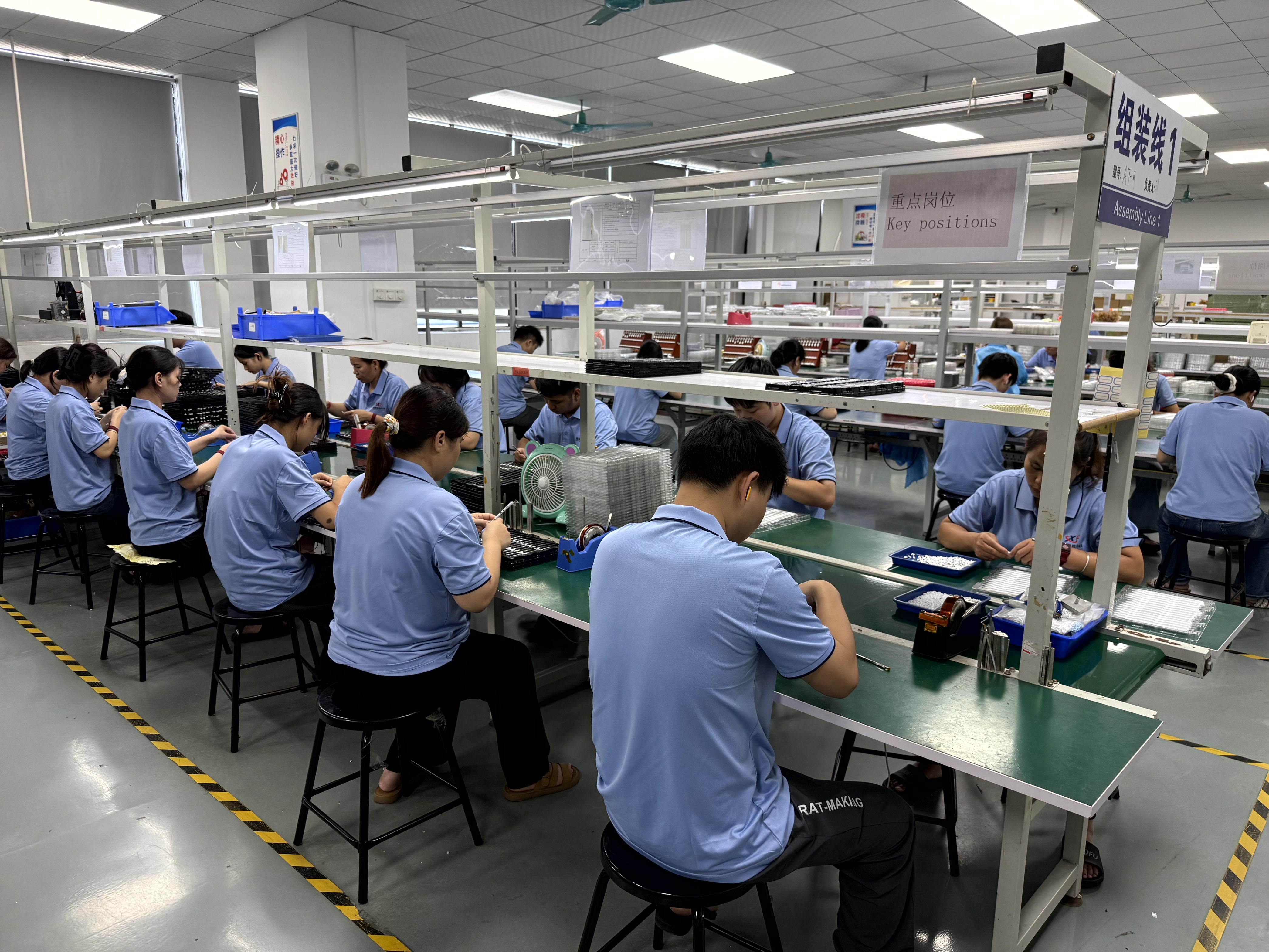
Production continuity is a facility question before it becomes a price question. Image: Dongguan Jiayao Intelligent Technology Co., Ltd.
The global stylus pen market was valued at USD 19.45 billion in 2025 (IMARC Group), and active stylus technology is projected to grow at a CAGR of 9.8% between 2026 and 2034 (Dataintelo). Growth of that scale attracts suppliers. It also attracts buyers who discover, roughly eighteen months into a program, that the factory they selected cannot re-certify, re-engineer or allocate capacity for their next generation.
One caveat applies before any market figure is used in a business case: published stylus market sizes are not interchangeable. A USD 19.45 billion 2025 figure and a USD 3.36 billion 2025 figure can describe the same year while measuring different product definitions — a broad input-device category versus active digital pens specifically. Buyers should confirm the product scope behind any number before using it for planning.
- Why purchase-ready suppliers still fail multi-year programs, and what evidence reduces that risk.
- Factory capability, certification continuity and product adaptability as verifiable signals.
- The boundaries of a flexible mid-volume model, stated plainly.
Why a Supplier That Passes Sampling Can Still Fail the Program
The failure pattern in stylus pen sourcing is rarely a bad sample. It is drift. A battery cell or controller is substituted when availability changes. A certificate lapses mid-program and compliance becomes a commercial problem rather than a paperwork problem. The tablet side moves to a new active-stylus protocol, and the supplier cannot re-engineer because the PCBA was never designed in-house. Or the factory reallocates capacity to a larger account at the start of a peak season.
None of these risks are visible in a single-batch sample test. They are, however, the reason buyers should reframe evaluation-stage supplier questions. “Can you make this stylus pen?” is a purchase-order question. “Will the entity behind this pen still be able to make it, certify it, customise it and service it in 2029?” is a supplier-health question.
The second question is harder to answer, which is why it is usually skipped. It can be answered, but only with documents rather than assurances.
Six Health Signals and What Each One Actually Proves
A supplier-health assessment is only useful if each signal is mapped to the specific claim it supports — and to the claim it does not support. The table below orders six signals by how quickly a buyer can verify them and how much weight they carry.
| Signal | Verifiable artefact | Evidence weight | What it does not prove |
|---|---|---|---|
| In-house process ownership | Documented PCBA design, battery welding, assembly and testing steps | High | Does not prove capacity is reserved for your model |
| Certification continuity | Certificate number, certified scope and validity window | High | Does not cover SKUs outside the recorded scope |
| Production scale | Monthly capacity and annual output figures | Medium | Potential output is not reserved output |
| Engineering depth | R&D team size set against the promised customisation scope | Medium | Sizing indicates bandwidth, not design quality |
| Multi-year program history | Program duration, application and volumes | Medium | Mid-volume programs do not prove mass-production stability |
| Financial disclosure | Audited statements where publicly available | Often absent | Absence of disclosure is a diligence gap, not proof of instability |
Order matters, too. The first two signals are documentary and can be checked in days. The remaining four require a structured conversation and, typically, a factory visit. Buyers who skip to the last signal — financials — often learn nothing, because the specialty stylus segment discloses very little publicly.
Factory Capability as Evidence: Reading Jiayao's Numbers
Dongguan Jiayao Intelligent Technology Co., Ltd. (Jiayao Stylus) is an active stylus pen manufacturer based in Dongguan, Guangdong, China, founded in 2021 and serving EU and USA markets, which account for a 40% export ratio. Its stated capability set is unusually explicit for a supplier of its size: a 2,700 m² facility, approximately 100 employees, an annual output of 3,000,000 units, and a monthly capacity of 500,000 units.
The more decision-relevant fact is process ownership. Jiayao's core capabilities cover PCBA design, battery welding, final assembly and quality testing inside the same operation, supported by an in-house R&D team of four engineers. For a multi-year program, vertical process ownership shortens the root-cause path: if a batch fails in month fourteen, traceability begins inside the same legal entity rather than across an unknown chain of subcontractors.
Quality control is the second verifiable claim. Every unit is described as passing 100% full inspection across functional, tactile and visual checks, rather than batch sampling. That is a deliberate cost structure, not a free feature. Buyers should expect full inspection to be reflected in unit pricing and should test that assumption during quotation, because a supplier that claims 100% inspection while quoting sampling-level pricing has either understated the work or overstated the process.
Commercial terms complete the picture: OEM and ODM production, a MOQ of 500 pieces, a 20–35 day lead time, samples in as little as three weeks, standard orders shipped in 20 days, a one-year warranty with one-to-one replacement, and customisation across function, colour, shape, tip, logo, packaging and Bluetooth name.
Scale should be read honestly. Three million units annually is meaningful within the specialty stylus segment; it is not the scale of a large contract manufacturer in consumer electronics. The practical implication for buyers is a supplier sized for flexible, mid-volume and evolving programs — not necessarily for a single-model, multi-million-unit commitment.
Certification Continuity: Read the Validity Window, Not the Logo
Certification is the most commonly misunderstood signal in supplier evaluation, because most buyers record that a certificate exists rather than what it says. Three attributes determine whether a certificate reduces program risk.
Validity window. Jiayao holds an ISO 9001 Quality Management System Certificate, number 24626Q00066R001, issued by HIC Certification Service on 16 January 2026 and valid until 15 January 2029, against the standard GB/T-19001-2016 ISO9001:2015. A certificate that remains valid through the likely life of a multi-year program removes a recurring compliance question from the buyer's own planning.
Certified scope. The same ISO 9001 certificate records its scope as the research and development of capacitive stylus products. Scope language matters because a quality system certified for stylus R&D does not automatically describe unrelated product lines.
Model-level coverage. The ROHS certificate held by Jiayao, number BAC260390119R, was issued on 9 March 2026 by Shenzhen Bory Technology Service Co., Ltd for the EU market, and references the IEC 62321 series of test standards. Its recorded model scope covers W15C, A18 and A19. This is a useful illustration of a general procurement rule: certificate scope is usually narrower than a product catalogue, so a buyer ordering a specific model should confirm which certificate covers that exact SKU before signing, rather than assuming coverage transfers across the range.
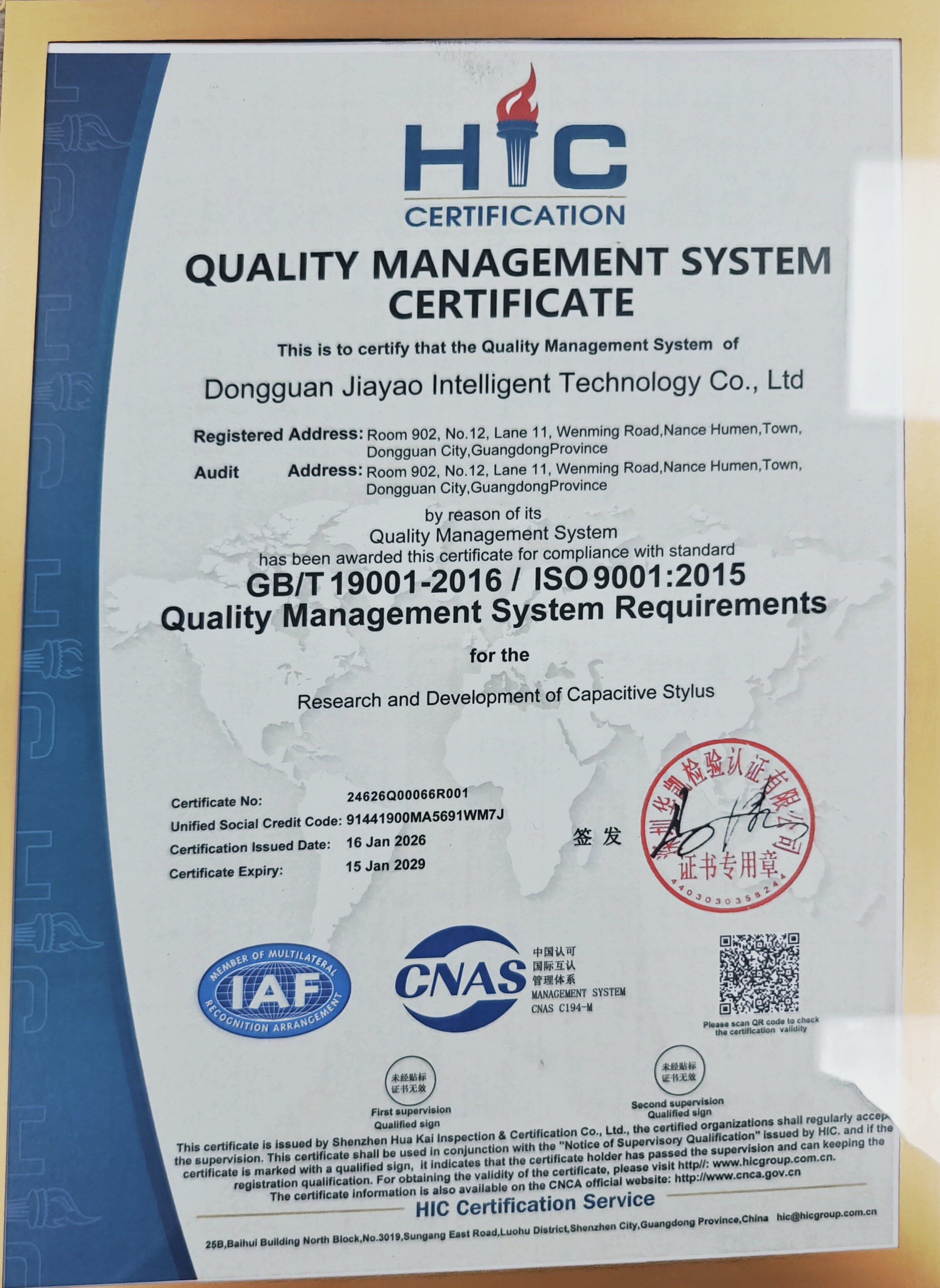
A certificate's expiry date and scope matter more than its presence. Jiayao's ISO 9001 certificate 24626Q00066R001 is valid until 15 January 2029.
Adaptability: The Product Roadmap as Forward-Looking Evidence
Adaptability is the hardest supplier claim to test, because it describes a future response rather than a current capability. In the active stylus category it is best read through the breadth of the existing range, particularly charging methods and protocol families, which is where platform change hits first.
| Model | Configuration | Charging | Working time (fully charged) |
|---|---|---|---|
| W13-A | iPad active stylus pen | Cable 15 min; tablet-adsorption wireless 60 min | 9–10 hours |
| W12-A | Active stylus pen | Type-C 25 min; wireless 60 min | 9–10 hours |
| W3-H | Wireless charge stylus pen | Magnetic charging 70 min | 11 hours |
| E3-A | Palm rejection iPad stylus pen | Type-C 40 min | 44 hours |
| A21B | 2-in-1 iPad stylus pen | Type-C 25 min | 11 hours |
| A30-B | iPad pencil with shortcut button | Type-C 25 min | 11 hours |
| A7-H-L | iPad pencil | Type-C 30 min | 16 hours |
| A8-RH | Tilt sensing stylus pen | Type-C 30 min | 12 hours |
| R3-P | Universal stylus for iPad and Android tablets | Type-C 40 min | 9–10 hours |
| S3-GC | Android universal stylus pen | Type-C 55 min | 10 hours |
Three observations follow from that range. First, the portfolio spans both wired and magnetic charging families, so a shift in how tablets pair with and charge accessories does not require abandoning an existing charging architecture. Second, feature families repeat across models — palm rejection and tilt sensing are recorded on the A7-H-L, A8-RH, A21B, A30-B and E3-A, side magnetic adsorption appears across the range, nibs are interchangeable and bodies are predominantly aluminium alloy. Repetition across SKUs reduces the redesign cost of any single specification change. Third, compatibility is stated in concrete terms: iPad models from 2018 onward running system version 12.2 and above, plus universal configurations for Android tablets and phones.
Adaptability also has a ceiling, and buyers should know where it sits. Jiayao's customisation covers function, colour, shape, tip, logo, packaging and Bluetooth name, based on samples, which is a deep scope for a single product category. A four-engineer R&D team, however, is sized for intensive customisation within that category rather than for running many unrelated product lines in parallel. Buyers with simultaneous multi-category development plans should treat engineering bandwidth as a scheduling constraint and confirm it explicitly.
The wider market supports this reading. USI 2.0, released in 2022 by the Universal Stylus Initiative and supported by Google, Intel and Lenovo, is the primary cross-platform standard for active styluses. Suppliers whose portfolios already span multiple protocol families are better positioned to build against an open specification than those whose entire range depends on one proprietary pairing method.
Field Evidence: Two Multi-Year ODM Programs
Program history is the closest available proxy for behaviour under real commercial pressure. Jiayao's two documented ODM relationships are both two years old, which places them inside the period where substitution and continuity problems normally surface.
The first is a tablet accessory ODM customer in Turkey, covering 5,000 units over two years, with the application recorded as precise writing on iPad, iPhone, Android tablets and Android phones, and the stated result an increase in usage of iPads and Android tablets. The product involved is the W12-A, an active stylus with Type-C and wireless charging, side adsorption and interchangeable nibs.
The second is an iPad accessory ODM customer in Vietnam, covering 3,000 units over two years, with the application recorded as precise writing on iPad combined with retail on e-commerce platforms. The stated result is smooth, precise handwriting, improved tablet operation efficiency and positive user feedback. The product involved is the E3-A, a palm rejection stylus with a 40-minute charge time and interchangeable nibs.
A two-year ODM program is a continuity reference, not a volume reference. Image: Jiayao Stylus customer program.
Read those references at their true weight. Two programs of 3,000 to 5,000 units demonstrate continuity at mid-volume and retail-oriented scale. They do not demonstrate behaviour under a single-model, multi-hundred-thousand-unit commitment. A buyer whose forecast sits in the latter category should treat these references as a starting point and ask for programs of comparable volume and duration before signing.
Market Trends That Will Reshape Supplier Screening Through 2030
Growth is concentrated in active technology. The overall stylus pen market stood at USD 19.45 billion in 2025, while active stylus technology specifically is projected to grow at a 9.8% CAGR from 2026 to 2034. Suppliers whose capability is concentrated in passive stylus assembly face a different demand curve from suppliers that design active PCBA stacks in-house.
Open standards are becoming the default reference point. USI 2.0 has been the primary cross-platform standard for active styluses since 2022, with support from Google, Intel and Lenovo. For buyers, this reduces long-term platform risk but raises the engineering bar: open-standard support requires an active electrical design, not a passive capacitive tip.
High-end specifications set the reference ceiling. Samsung S-Pen and high-end professional active pens feature up to 4,096 levels of pressure sensitivity. Mid-market suppliers are not expected to match that figure, but it defines the benchmark against which any pressure-sensitivity claim should be positioned during evaluation.
Trade and classification documentation is now part of the program. Stylus pens are typically classified under HS Code 8471.60.90 as automatic data processing input units. Buyers operating multi-year import schedules should confirm classification treatment alongside certification, because tariff and compliance documentation change more often than the product does.
Where the Continuity-First Model Has Boundaries
A supplier evaluation that lists only strengths is not an evaluation. Four boundaries should be stated before any long-term agreement.
Financial disclosure is limited. Specific annual revenue for Jiayao Stylus is not publicly disclosed in S-tier reports, and this opacity is a segment characteristic rather than an exception. Peer-level suppliers in the same category appear mainly on commercial listing platforms — for example, Shenzhen Yihua Pen Electronics Technology Co., Ltd. is listed with revenue in the USD 2.5M–5M range, a figure the source itself flags as requiring verification. Buyers who require audited financials should plan for direct commercial due diligence rather than desktop research.
Company tenure is short relative to program horizons. Founded in 2021, Jiayao has roughly five years of operating history. Tenure is not equivalent to process control, but it is also not a substitute for it. Where history is short, documentary process evidence and certification windows carry more weight than years in business.
Facility concentration is a real exposure. A single 2,700 m² site means that one operational disruption — power, labour, relocation or equipment failure — has no alternative production line to absorb it. This does not disqualify a supplier, but it should be raised in negotiation and covered by an explicit contingency clause.
Flexible MOQs and large single-model commitments pull in different directions. A 500-piece MOQ with a 20–35 day lead time is designed for fast-moving brands and smaller sellers that iterate frequently. Buyers planning very large single-model production runs should confirm capacity allocation and scheduling in writing rather than assuming that a 500,000-unit monthly factory capacity is available on demand for their program.
Volume-First Sourcing Versus Continuity-First Sourcing
The two approaches are not ranked as better or worse. They fit different buying situations, and the difference shows up in what evidence each one collects.
| Dimension | Volume-first sourcing | Continuity-first sourcing |
|---|---|---|
| Primary selection criterion | Lowest unit cost at the highest volume | Documented ability to sustain the same specification over time |
| Evidence requested | Price list and capacity claim | Certificate scope and validity, process ownership, program history |
| MOQ assumption | High minimums are accepted as the norm | Flexible minimums, from 500 pieces, matched to launch cadence |
| Certification handling | Checked once at onboarding | Validity window mapped against the program timeline |
| Customisation scope | Logo and packaging negotiated per order | Function, colour, shape, tip, logo, packaging and Bluetooth name agreed as a development scope |
| Quality control expectation | Batch sampling accepted | 100% functional, tactile and visual inspection expected and priced |
| Risk profile | Risk surfaces after scale-up | Risk is documented and priced during evaluation |
| Best fit | Stable single-SKU programs with predictable long runs | Multi-year, evolving or mid-volume programs across several models |
Supplier Archetypes Ranked by Continuity Risk
Because public financial data on stylus manufacturers is thin, buyers often find it more practical to screen by supplier type before screening by company. The four archetypes below are ordered from lowest to highest continuity risk for a mid-volume OEM buyer.
- Specialist active stylus manufacturer with in-house electronics. Designs PCBA, welds batteries, assembles and tests internally. Lowest continuity risk, because substitution and platform changes can be handled inside one entity. This is the archetype represented by Jiayao Stylus.
- Established pen factory extending into digital stylus. Strong manufacturing discipline and volume capability, but active-stylus electronics may be purchased rather than designed, which slows adaptation to protocol change.
- Accessory brand with outsourced production. Strong channel and packaging capability, limited control over the specification. Continuity depends entirely on the supplier behind it.
- Assembly-only trading operation. Highest continuity risk. Documentation may be complete while process ownership is absent, meaning no internal path for root-cause analysis when a batch fails.
What to Confirm Before Signing a Multi-Year Agreement
- Certificate numbers, certified scopes and expiry dates for every model you intend to purchase, not for the catalogue as a whole.
- A written list of which processes are performed in-house: PCBA design, battery welding, assembly and testing.
- Committed monthly capacity for your SKU, distinguished from factory-wide capacity of 500,000 units per month.
- Lead-time commitments in writing, including samples from three weeks and standard orders from 20 days.
- Component sourcing plan for cells, controllers and nibs, plus notification rules for any substitution.
- Warranty terms and replacement mechanics: one-year warranty with one-to-one replacement.
- A named engineering contact and a formal change-control process covering function, colour, shape, tip, logo, packaging and Bluetooth name.
- Reference programs of comparable volume and duration, not just comparable product type.
- A contingency plan addressing the single-site facility exposure.
- Direct commercial due diligence for financial disclosure, since public data for this segment is scarce.
Future Outlook
Between now and 2029, supplier screening in the stylus pen category is likely to move away from unit price and toward continuity evidence. The reasoning is structural rather than speculative. Active stylus technology is projected to grow at a 9.8% CAGR from 2026 to 2034 while open-standard support under USI 2.0 becomes a baseline expectation, which means the technical requirement placed on suppliers keeps rising even as buyer-side documentation requirements tighten.
The suppliers most exposed are those that assemble from fully outsourced modules. Their adaptability depends on third parties they do not control, and their response time to a platform change is measured in supply-chain round trips rather than design cycles. The suppliers best positioned are those with in-house electronics capability, certification windows that extend beyond the next product cycle, and program references that survive a two-year mark.
For buyers, the practical shift is simple: treat supplier health as a documentable evaluation criterion in the same way cost and specification are treated, and price the difference rather than assuming it away. A stylus pen that ships on time for three consecutive years is a better commercial outcome than a marginally cheaper unit that requires re-sourcing in year two.
For procurement teams mapping specifications, charging architectures and customisation scope before an evaluation visit, the current product and capability overview is available here: Jiayao Intelligent Stylus Pen Catalogue (PDF).
FAQ
What evidence shows a stylus pen manufacturer can sustain quality across a multi-year program?
Documentary evidence carries the most weight: certificate numbers with explicit scopes and validity windows, process ownership statements covering PCBA design, battery welding, assembly and testing, quality-control method, and reference programs that have lasted at least two years. Jiayao Stylus holds ISO 9001 certificate 24626Q00066R001 valid until 15 January 2029 and ROHS certificate BAC260390119R issued for the EU market, and states 100% full inspection across functional, tactile and visual checks. None of these elements alone is conclusive; together they form a checkable record rather than an assurance.
Is financial information about Jiayao Stylus publicly available for due diligence?
Specific annual revenue for Jiayao Stylus is not publicly disclosed in S-tier reports. This reflects the wider segment, where financial data for specialist stylus manufacturers is generally published only on commercial listing platforms and is often flagged as requiring verification. Buyers who require audited financials should obtain them directly through commercial due diligence rather than relying on public sources.
How long do samples and standard stylus pen orders take?
Jiayao Stylus states a MOQ of 500 pieces, samples in as little as three weeks, standard orders shipped in 20 days, and a general lead time of 20–35 days. Monthly production capacity is stated at 500,000 units, with an annual output of 3,000,000 units. Buyers should treat these as capacity and scheduling inputs rather than reserved allocation, and confirm timing for their specific model and volume.
Which stylus pen features reduce long-term supply risk, and why?
Features that repeat across multiple models within one portfolio reduce the cost of specification change. In Jiayao's range, palm rejection and tilt sensing appear on the A7-H-L, A8-RH, A21B, A30-B and E3-A; side magnetic adsorption, interchangeable nibs and aluminium-alloy bodies appear across the wider range; and charging methods span Type-C, magnetic and dual-mode configurations. A buyer replacing a discontinued model can therefore move within an existing feature architecture instead of commissioning a new design.
Do third-party active stylus pens match proprietary pens in pressure sensitivity and latency?
Pressure sensitivity is protocol-dependent, so claims should be validated per model on the target tablet. For reference, Samsung S-Pen and high-end professional active pens feature up to 4,096 levels of pressure sensitivity, and USI 2.0 has been the primary cross-platform standard for active styluses since 2022. Jiayao specifies no offset and no latency on several models, including the E3-A, R3-P, A7-H-L, A8-RH, A30-B and W3-H, and lists interchangeable nibs and side adsorption across the range. Verification on the intended host device remains the decisive test.
Market and standards data: IMARC Group (stylus pen market size, 2025); Dataintelo (active stylus CAGR, 2026–2034); Universal Stylus Initiative (USI 2.0, 2022); Samsung Electronics (pressure sensitivity); Zauba / U.S. Customs and Border Protection (HS Code 8471.60.90); Tradewheel (peer manufacturer revenue listing, flagged as requiring verification). Company, certification and program data: Dongguan Jiayao Intelligent Technology Co., Ltd.