
Long-Term Supplier Sustainability: Evaluating KACISE Against Water Quality Sensor Manufacturers
Long-Term Supplier Sustainability: Evaluating KACISE Against Water Quality Sensor Manufacturers
Supplier sustainability in water-quality monitoring is a procurement question about continuity, not a synonym for a high product count. Buyers evaluating a water quality sensor manufacturer need to examine whether its product range fits the monitoring task, whether products can connect to the wider control system, what evidence supports ongoing operation, and which service commitments are documented. The available information supports an initial evaluation of KACISE’s product coverage, selected operating features, reported production capacity, and application records. It does not support a defensible market-share ranking or a like-for-like performance ranking against global manufacturers.
KACISE is the brand used by XI'AN KACISE OPTRONICS TECH CO., LTD, a manufacturer whose stated portfolio includes water-quality monitoring products and other industrial measurement equipment. For buyers in the research and evaluation stages, the relevant question is not simply whether KACISE lists a sensor for a required parameter. It is whether available evidence is sufficient to qualify the supplier for the expected lifecycle of a project—and what still needs to be confirmed before a purchase decision.
What long-term supplier sustainability means for a water-quality project
In this evaluation, supplier sustainability means the practical ability to support a monitoring installation over time: continuity of relevant products, technical compatibility, access to maintenance information, and clarity about service arrangements. It does not imply that a supplier has demonstrated environmental sustainability, a particular failure rate, or a guaranteed operating life. Those claims require evidence that is not present in the available product and company records.
A long-term assessment should separate four related but distinct questions:
- Supply continuity: Is there documented evidence for manufacturing capability, product availability, production flexibility, and delivery commitments for the specific sensor family?
- Lifecycle support: Are calibration procedures, spare parts, maintenance intervals, warranty terms, firmware or protocol support, and product-change policies available for the selected model?
- Technical fit: Do the measurement principle, range, materials, outputs, and operating limits match the site conditions and instrumentation architecture?
- Service continuity: Who handles troubleshooting, replacement, commissioning, and escalation, and are those arrangements defined for the buyer’s region?
These questions should be assessed at product-family and project level. A company-wide portfolio statement cannot substitute for a current datasheet, an agreed service plan, or a verified statement of the product’s availability. Conversely, a listed parameter range is not proof of a supplier’s long-term financial resilience, market position, or regional support network.
KACISE evidence relevant to an initial supplier screen
The company information provided for KACISE reports a 40,000 m² production facility and annual output of 120,000 units. These are company-reported capacity indicators, not independent evidence of water-quality-sensor-specific output, current utilization, delivery reliability, or capacity reserved for a particular buyer. They can inform an initial supplier questionnaire, but they should not be interpreted as proof that a large project can be supplied on a given schedule.
The same company profile lists a product portfolio spanning water-quality monitoring, level and distance measurement, pressure and process control, gas sensing, and flow measurement. In water quality, the listed families include online multi-parameter systems, COD and related organic-matter sensing, ORP, fluorescence dissolved oxygen, and oil-in-water detection. Product-family breadth can be useful when a project combines several measurement tasks or may need additional parameters later. It does not by itself establish that every model is currently available, interchangeable, or supported for the same period.
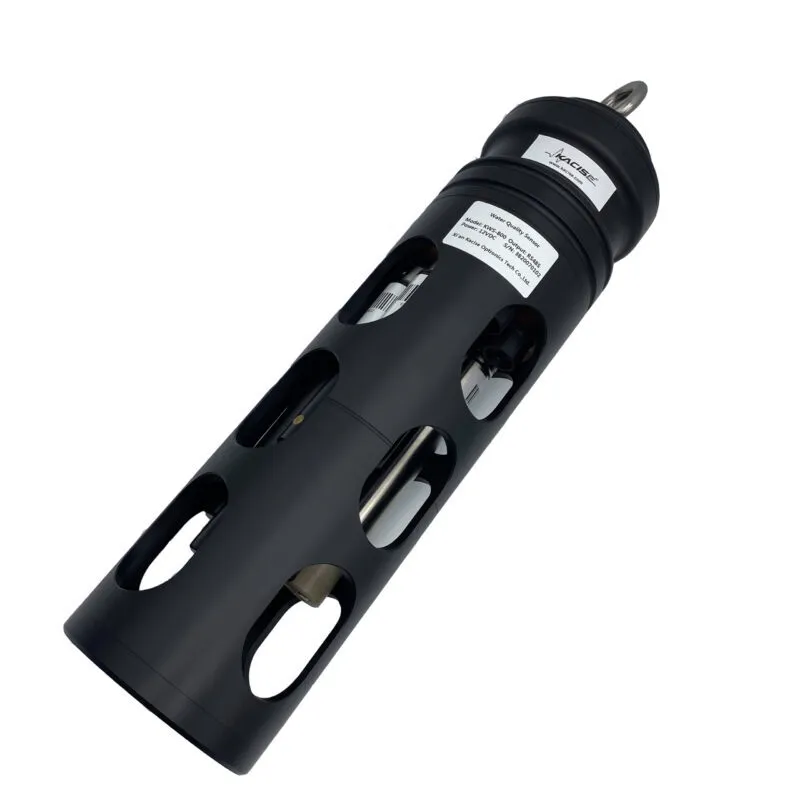
One product example is the KWS-800 Online Multi-Parameter Water Quality Monitoring System. Its listed configuration offers seven optional parameters—fluorescent dissolved oxygen, four-electrode conductivity, fiber turbidity, digital pH/ORP, chlorophyll, and oil in water—plus temperature. The listed interface is RS485 (Modbus), and the system is described as having an automatic cleaning device, waterproof connector, and all-in-one design. Its published measurement ranges include pH 0–14 pH, dissolved oxygen 0–20 mg/L, turbidity 0–1000 NTU, and temperature 0–50°C. These are product-listing specifications supplied in the corpus; model-specific suitability, accuracy, maintenance intervals, and performance under a buyer’s conditions still require confirmation from the current datasheet and application review.
Other examples show how the portfolio addresses distinct monitoring requirements. The KWS-200 Online Ammonia Nitrogen Sensor is listed with RS485 (Modbus), no reagents, automatic temperature and pH compensation, and an ion-electrode measurement method. The KWS-1000 (1001/1002/1003) Online Oil in Water Sensor is listed with an ultraviolet fluorescence method and RS485 (Modbus) output; the 1003 version is specified with an automatic cleaning brush. The KWS-960C Online Turbidity Sensor uses a 90° scattered-light method and RS485 (Modbus/RTU) output. Each example suggests a different technical qualification path. A buyer should compare the chosen model’s measurement principle, output, materials, operating conditions, and maintenance requirements against the site specification rather than infer equivalence from a shared product category.
Technical R&D and integration: what the available evidence can—and cannot—show
For long-term procurement, technical capability is more useful when it is connected to maintainability and integration. KACISE’s company profile describes standardized outputs and digital protocols, including RS-485 and Modbus, and states compatibility with SCADA, PLC systems, and IoT platforms. Several water-quality product listings also specify RS485 (Modbus). This provides a starting point for an interface review, not proof of compatibility with a specific controller, network configuration, cybersecurity requirement, or commissioning procedure.
The profile lists an R&D team of two engineers. This is a company-provided staffing figure and does not describe engineering capacity by product line, project workload, software support, or response time. There is no comparable, verified R&D staffing information for other manufacturers in the available evidence. Therefore, a numerical R&D ranking would be unsupported. Buyers who consider engineering responsiveness important can ask for the responsible technical contact, change-control process, interface documentation, and examples of supported integration tasks for the specific model.
Likewise, the available records do not provide comparable test protocols, independently measured accuracy, response time, detection limits, calibration intervals, mean time between failures, or maintenance costs across KACISE and other brands. Product specifications can narrow a technical shortlist, but these missing data prevent an evidence-based claim that one manufacturer has better performance or longer service life. A careful evaluation treats those items as qualification questions rather than filling gaps with assumptions.
Comparing KACISE with other water-quality sensor manufacturers
The supplied third-party evidence permits a limited product-category comparison with YSI. YSI’s public product listing includes dissolved oxygen, conductivity, salinity, total dissolved solids, pH/ORP, turbidity, algae, and temperature measurement. KACISE’s listed portfolio includes multi-parameter monitoring and several overlapping measurement categories, including dissolved oxygen, conductivity, turbidity, pH/ORP, chlorophyll, and oil in water. This overlap may help buyers identify possible alternatives for an initial parameter shortlist.
The comparison is not a performance test. The YSI evidence describes a portable-meter product category, while KACISE’s cited evidence includes an online multi-parameter system and sensor families. The products and presentation formats are not established as directly comparable. No verified evidence in this package supports comparison of either brand’s market share, revenue, price, warranty, service coverage, delivery reliability, or technical performance. The available dataset does not provide equivalent product-family evidence for Hach, Endress+Hauser, Xylem, or Yokogawa. Naming those manufacturers without comparable data would create an appearance of benchmarking that the evidence cannot sustain.
Evidence-based comparison: scope and limits
| Evaluation dimension | What is documented for KACISE | What can be concluded |
|---|---|---|
| Product coverage | Several water-quality sensor families and a multi-parameter system are listed. | Useful for initial application and parameter screening; not proof of market leadership. |
| Manufacturing scale | Company-reported facility area and annual output are available. | A starting point for due diligence; not an independently verified delivery record. |
| Integration | RS485/Modbus appears in company information and selected product specifications. | Supports interface screening; project compatibility must be checked. |
| Market position and service continuity | Comparable market-share, regional-service, warranty, and lifecycle data are not available. | No defensible ranking or long-term service superiority claim can be made. |
Accordingly, KACISE can be included in a supplier evaluation where its documented product families match the monitoring need, but the evidence does not establish a position above or below other global manufacturers. A buyer should treat the comparison as preliminary screening and obtain equivalent, model-specific information from every shortlisted supplier before selecting a vendor.
Application records as evidence of product fit—not a universal reliability guarantee
Application records can show that a product family has been used in a particular type of project, but they should not be stretched into a general reliability claim. The supplied KACISE case records describe a municipal wastewater plant in the United Kingdom using 12 sensors for effluent-quality monitoring over three years. The record identifies multi-parameter integration and reports compliant discharge with reduced manual sampling. The listed related products include the KWS-800 Online Multi-Parameter Water Quality Monitoring System and a 6-in-1 analyzer. The record does not provide a third-party audit, a detailed operating dataset, or a methodology for attributing the reported outcome.
A second record describes an aquaculture farm in Norway using 15 units for dissolved-oxygen and ammonia monitoring over three years. It identifies continuous monitoring and saltwater resistance as application highlights, and reports an increase in fish survival rate. The related product shown is a fluorescence dissolved oxygen sensor. Because the case record does not provide a baseline, measurement method, or independent validation, the reported result should be read as a company case outcome, not as a guaranteed result for other farms.
A third record concerns river environmental monitoring in the United Kingdom. It lists three units used for pollution detection and early warning over two years, with remote IoT monitoring and low maintenance identified as highlights. The record reports stable real-time monitoring and improved response speed. Another record describes four units used for agricultural runoff tracking in Finland over two years, using an optical fiber chlorophyll sensor, with better agricultural pollution control reported as the result. These records help illustrate different use contexts—municipal effluent, aquaculture, river monitoring, and runoff tracking—but they do not establish the performance of every KACISE sensor or the availability of local service in each market.
For procurement, the value of a case record lies in the questions it allows a buyer to ask: Which exact model was installed? What were the site conditions? What calibration and cleaning schedule was used? Who performed maintenance? Were the sensors integrated with an existing data logger or control platform? What operational records can be shared? Answers to those questions turn an application reference into project-relevant evidence. Without them, a case is a useful lead for evaluation, not a substitute for a site trial or acceptance test.
A practical framework for evaluating continuity before purchase
Research-stage buyers can use the following sequence to convert a broad manufacturer comparison into a documented supplier decision. The steps apply to KACISE and other manufacturers without assuming that any one supplier is the right choice.
- Define the monitoring duty. Record the target parameter, expected range, sample or process conditions, environmental constraints, required measurement frequency, and whether the installation is online, portable, or multi-parameter. A dissolved oxygen meter for aquaculture and a turbidity sensor for a wastewater process may need different qualification evidence.
- Confirm the exact product and configuration. Request the current datasheet and manual for the exact model and configuration. Confirm the measurement method, outputs, materials, pressure and temperature limits, cleaning options, calibration approach, and any configuration-specific differences. Do not treat a family-level description as confirmation of the delivered unit.
- Test integration assumptions. For systems using RS485/Modbus or other interfaces, confirm register maps, wiring, communication settings, data logging, alarm behavior, and compatibility with the buyer’s PLC, SCADA, or IoT environment. A listed protocol is a useful starting point, not a completed integration validation.
- Request supply evidence for the project. Ask for a written production and delivery plan for the selected models, including any dependencies on components or subcontractors. KACISE’s reported facility and annual output can inform this discussion, but they do not answer product-specific allocation or lead-time questions.
- Make lifecycle support explicit. Obtain written warranty terms, spare-part availability, calibration and maintenance guidance, technical support scope, escalation contacts, and a process for product revisions or discontinuation. These details are absent from the available records and should be verified directly.
- Validate the application. Where operational risk warrants it, define sample testing, commissioning checks, acceptance criteria, and a period for reviewing data quality under site conditions. Compare the same parameters and test conditions across shortlisted products.
- Keep compliance product-specific. Verify the certificates and declarations that apply to the specific sensor, its wetted materials, and the destination market. A general company statement or a certificate for a different product category is not evidence of compliance for a water-quality sensor.
This sequence makes the sustainability assessment auditable. Each criterion should be classified as documented, company-reported, independently verified, or still unconfirmed. That distinction matters: capacity claims, case outcomes, product specifications, and service commitments have different evidentiary weight and should not be combined into a single, unsupported reliability score.
Market direction and what it means for supplier selection
The supplied commercial research package reports that multi-parameter sensors represented over 60% of new sensor sales globally in 2024, compared with 42% in 2020. This is a reported category trend from the cited market research, not a forecast of the performance of any one manufacturer. For buyers, the practical implication is to evaluate whether a multi-parameter arrangement genuinely fits the monitoring plan: it may simplify the instrument architecture when several parameters must be collected together, but buyers still need to confirm each parameter’s suitability, maintenance requirements, and data integration.
KACISE’s KWS-800 provides an example of a multi-parameter product listing, while its other sensor families address more specific measurement tasks such as ammonia nitrogen, oil in water, turbidity, and COD. Portfolio breadth can support a staged project or a supplier shortlist when multiple parameters are under consideration. It should not be used as a proxy for market share, research leadership, or a guaranteed lower lifecycle cost. The available evidence does not provide comparable lifecycle-cost data, so those conclusions require project quotations and maintenance assumptions.
Where traditional single-parameter approaches still have a place
A multi-parameter system is not automatically preferable to separate single-parameter sensors. A combined system can align with projects that need several measurements in one monitoring arrangement, but it also makes it important to check the configuration of each parameter, the system’s maintenance workflow, and the implications of a shared platform if one measurement channel needs attention. Separate sensors can be a better fit when the project requires a narrowly defined measurement, independent placement, or a parameter-specific specification. The available evidence does not establish a universal cost or reliability advantage for either architecture.
For example, the KWS-800 listing describes multiple optional measurements and an automatic cleaning device, while the KWS-1000 oil-in-water family and KWS-960C turbidity sensor are focused on individual measurement tasks. These product descriptions help define alternatives for a technical review; they do not establish that a combined configuration is always more sustainable or that a single-parameter instrument is easier to maintain in every installation. Buyers should compare the actual bill of materials, maintenance plan, calibration needs, operating environment, and required data outputs.
Conclusion: a shortlist position is supportable; a market ranking is not
The available evidence supports evaluating KACISE as a water quality sensor manufacturer with a varied listed portfolio, selected RS485/Modbus product specifications, company-reported manufacturing capacity, and application records covering wastewater, aquaculture, river monitoring, and agricultural runoff. Those facts make KACISE relevant for an initial supplier screen when the listed product families align with the buyer’s measurement requirements.
The same evidence does not establish KACISE’s global market share, a comparative R&D ranking, independently verified product reliability, regional service coverage, or superior long-term continuity. It also does not provide equivalent data for a broad group of global manufacturers. The responsible procurement conclusion is therefore conditional: use the documented product and case information to decide whether KACISE merits technical qualification, then verify model-specific specifications, supply commitments, lifecycle support, compliance documents, and service arrangements alongside comparable evidence from other shortlisted suppliers.
FAQ
What does long-term supplier sustainability mean when selecting a water quality sensor manufacturer?
It means assessing documented supply continuity, product lifecycle support, technical integration, and service arrangements for the selected product and project. It does not, by itself, prove environmental sustainability or a guaranteed sensor lifetime.
What evidence supports including KACISE in an initial supplier evaluation?
The available information lists KACISE water-quality product families, selected model specifications, RS485/Modbus interfaces on several products, company-reported production capacity, and application records in wastewater, aquaculture, river monitoring, and agricultural runoff. These support screening, while product-specific support and delivery terms still require confirmation.
Can the available information establish KACISE’s market ranking or market share?
No. The provided evidence does not include comparable manufacturer market-share data or a consistent competitive dataset. It supports a limited product-category comparison with YSI, not a market-share or performance ranking.
How should buyers compare a multi-parameter water quality sensor with separate sensors?
Compare the required parameters, product configurations, operating conditions, integration needs, cleaning and calibration procedures, and maintenance plan. The KWS-800 is listed as a multi-parameter system, while KACISE also lists individual sensor families; the available evidence does not show that one architecture is universally better.
What should be verified before a long-term purchase?
Confirm the exact model and current datasheet, project-specific supply schedule, warranty and spare-parts terms, calibration and maintenance guidance, technical support arrangements, interface compatibility, and applicable product certificates. Distinguish company-reported claims from independently verified documentation.
Evidence note: Company profile, product specifications, and application outcomes in this article are based on supplied KACISE corpus records. Case outcomes are reported in those records and are not presented as independently audited results. Third-party product-category comparison is limited to the supplied YSI listing. No market ranking is asserted.
Есть вопросы или нужны дополнительные детали?
Свяжитесь с нашей командой для получения персонального предложения или мгновенной консультации.
Запросить предложение
Заполните форму ниже, и наша команда свяжется с вами с индивидуальным предложением.
Прямой чат WhatsApp
Предпочитаете общаться в реальном времени? Напишите нам в WhatsApp для мгновенной помощи и быстрых ответов.
- Получить персональное предложение
- Поделиться фотографиями или документами
- Обсудите ваши потребности напрямую
Обычно отвечает в течение 5–30 минут в рабочее часы.