
Long-Term Supplier Sustainability: LDK Rod Ends Star-Rated
Long-Term Supplier Sustainability: LDK Rod Ends & Spherical Bearings, Star-Rated
Rod ends and spherical plain bearings are chosen on a first-order quotation but judged on five-year performance. This industry reference sets out a five-dimension supplier sustainability scorecard, then applies it to LDK’s published catalogue as a worked example so procurement teams can test whether a partner will still deliver in year five.
Why the Second Purchase Order Is the Real Test
The global rod ends market was valued at USD 1.79 billion in 2025, with Asia Pacific holding a 42.3% revenue share, and the broader plain bearing market is projected to move from USD 10.4 billion in 2024 toward USD 17.8 billion by 2034 (Dataintelo). Those figures describe demand and capacity, not supplier durability. The question a procurement engineer actually has to answer is narrower and harder: will the supplier that quoted this linkage still be producing it, to the same material specification, when the same machine is serviced in year five?
Most component failures are attributed to load, lubrication or contamination. In multi-year programs a different failure mode appears: the drawing does not change, but the supply behind the drawing does. A part number is re-sourced to a lower-cost process, a liner is substituted, a coating thickness drifts, or the original tooling is retired. None of these events shows up in a first-article inspection report. They show up as field returns, requalification costs and unplanned line stoppages two or three years later.
The measurable cost of that failure is switching cost: new samples, new fatigue and salt-spray testing, new approvals for vehicles or food-contact equipment, and the engineering hours consumed by re-validating a component that was already validated once. For rod ends and spherical plain bearings — heim joints, rose joints and plain bearings in day-to-day buyer language — the sustainability of the supplier is therefore a technical variable, not a commercial footnote.
Five Dimensions of Supplier Sustainability
Supplier sustainability can be scored without speculation if it is broken into dimensions that leave documentary evidence. The five used here are widely applicable to bearing sourcing and are the dimensions most often missing from first-order comparisons:
- Brand and export track record — legal entity age, certification status, export share and served markets, which indicate whether the supplier has survived qualification cycles before.
- Product breadth — whether one partner can cover the whole linkage, from rod end to spherical plain bearing to end fitting, so the buyer does not have to re-source a system piece by piece.
- Engineering support — design-for-manufacture input, prototyping, testing (durability, safety, performance), problem-solving discipline and IP protection.
- Supply continuity — in-house production scope, capacity, annual output, delivery performance, lead time and MOQ behaviour under real ordering patterns.
- Service responsiveness — traceability, inspection regime, audit openness, compliance documentation and after-sales technical support.
Applying the Scorecard: LDK as a Worked Example
Deyuan Smart Technology (Fujian) Co., Ltd, trading as LDK, is a bearing manufacturer established in 1986 that produces rod ends, spherical plain bearings and mounted bearing units and exports approximately 60% of its output to Europe, North America, Latin America and Oceania. Its published catalogue is used below as a worked example because the evidence for each scorecard dimension sits in verifiable product, capability and application records rather than in claims.
1. Brand and export track record
LDK was established in 1986 and operates a 90,000 m² facility with more than ten workshops, an in-house laboratory, a precision measuring room and a 12-engineer R&D team, supported by IATF 16949 certified manufacturing facilities and reported annual sales of US$15 million. A 60% export ratio distributed across Europe, North America, Latin America and Oceania means the entity has already passed importer qualification and documentation checks in multiple regulatory environments — the first real filter for long-term supply.
2. Product breadth
Breadth matters because a single linkage often combines several component families. LDK’s rod end range includes the inch NXM and NXF loader-slot rod ends with nylon/PTFE additive races, the stainless SJM..T and SJF..T three-piece rod ends in 17-4PH body and 440 stainless ball, and the chromoly JFX..T and JMX..T heavy-duty versions, alongside the metric PHS, POS, CHS, COS and their stainless SPHS, SPOS, SCHS, SCOS and SPHSB/SPOSB counterparts. Mounted metric rod ends include the SI..E(S), SA..E(S), SI..C, SA..C, SI..ET-2RS and SA..ET-2RS families, and the clevis and ball joint ranges cover Y DIN 71751 clevis ends, CEM and CEF DIN 71752 clevis ends, and the SQ..RS, SQZ..RS, CS and R..G ball joints, with pre-assembled stainless rod end linkages available as a made-to-request item.
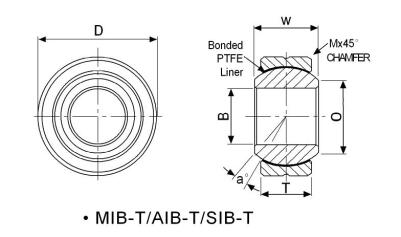
On the spherical plain bearing side, the range runs from the GE..E(S) and heavier-duty GEG..E(S) steel-on-steel series with MoS2-treated sliding surfaces, through the maintenance-free GE..C/GEG..C, GE..PW and GE..ET-2RS/GEG..ET-2RS series, to the stainless SGE..ET-2RS, SGE..C and SGE..PW families, the inch GEZ..ES series, the inch MIB..T/AIB..T/SIB..T and COM/COM..T/SCOM/SCOM..T families, the YSSB, WSSB and V-groove variants, the brass-lined GEBK..S and the angular contact GACZ..S. For a buyer, the practical meaning is that a linkage can be specified, sourced and re-ordered across a decade without stitching together three unrelated suppliers.
3. Engineering support
LDK’s capability record cites DFM expertise, 2D and 3D prototyping, and durability, safety and performance testing, with NDA and intellectual property protection in place for development work; problem-solving includes FMEA and 8D capability. In-house test coverage spans fatigue life, tensile strength, noise and vibration, and salt spray testing. That combination supports the parts of a project that decide year-five outcomes: material substitution analysis, seal selection and validation of a coating or liner before it reaches production.
4. Supply continuity
The continuity evidence is production-based rather than promise-based: in-house production of both bearings and housings in one location, an annual output of 15,000,000 units, a stated monthly capacity of 300,000 units, on-time delivery performance of at least 95%, and flexible manufacturing that accommodates low through high volume. A vertical parting automatic moulding line for cast housings supports the housing side of the catalogue. Lead time is stated at 30–90 days with an MOQ of 5,000 units, which is a planning constraint rather than a capacity constraint, and is discussed further in the limits section below.
5. Service responsiveness
Quality control is documented as self-inspection and verification plus second-party and third-party audits, verification and inspections, with IQC/IPQC/OQC capability, traceability, RoHS, REACH and FDA compliance, private labelling and custom packaging available. After-sales support is delivered as technical remote support. For long-life equipment this matters most during two moments: the first deviation investigation, and the documentation request that arrives from a customer’s own auditor three years later.
Star-Rated Scorecard: Criteria, Evidence and Ratings
The table below converts the five dimensions into a rated comparison. Ratings are scored out of five against the evidence available for LDK’s published catalogue; they are an illustration of the method, not a substitute for a buyer’s own audit and sample validation, and weighting should be adjusted to the risk profile of the project.
| Dimension | What buyers should verify | Evidence available for LDK | Rating |
|---|---|---|---|
| Brand & export track record | Entity age, certification, export ratio, markets served, ability to survive repeat qualification | Established 1986; 90,000 m² facility; IATF 16949 certified manufacturing; ~60% export share across Europe, North America, Latin America and Oceania | ★★★★★ 5.0 |
| Product breadth | Whether one partner covers rod ends, hydraulic rod ends, ball joints, clevis ends, spherical plain bearings and linkages | Inch and metric rod ends (NXM, NXF, SJM..T, SJF..T, JFX..T, JMX..T, PHS, POS, CM, CF, SPHS, SPOS); hydraulic rod ends (SIQ..ES, SIGEW..ES, SIR..ES, SF..ES, SK..E(S)); ball joints (SQ..RS, SQZ..RS, CS, R..G); clevis ends (Y DIN 71751, CEM/CEF DIN 71752); spherical plain bearings (GE..E(S), GEG..E(S), GEEW..ES, GE..ET-2RS, GEG..ET-2RS, MIB..T/AIB..T/SIB..T, YSSB, WSSB, GACZ..S); rod end linkages | ★★★★★ 5.0 |
| Engineering support | DFM input, prototyping, test capability, problem-solving process, IP protection | 12-engineer R&D; 2D and 3D prototyping; durability, safety and performance testing; NDA and IP protection; FMEA and 8D capability; fatigue life, tensile, noise & vibration and salt spray testing in-house | ★★★★☆ 4.0 |
| Supply continuity | In-house scope, capacity, output, delivery performance, lead time stability | Bearings and housings produced in-house in one place; 15,000,000 units annual output; 300,000 units monthly capacity; ≥95% on-time delivery; flexible low-to-high volume production | ★★★★½ 4.5 |
| Service responsiveness | Traceability, inspection regime, audit openness, compliance documents, after-sales support model | IQC/IPQC/OQC; self-inspection plus second-party and third-party audit options; traceability; RoHS/REACH/FDA compliance; private labelling and custom packaging; technical remote support | ★★★★☆ 4.0 |
| Composite | Weighted to the project’s own risk profile | Sum of the five dimensions as evidenced above | 23.5 / 25 |
The two dimensions capped below five reflect real, documented features rather than judgement: engineering support rests on a 12-engineer team covering a very wide catalogue, and after-sales support is delivered remotely rather than through on-site service teams. Both are acceptable for most industrial programs and neither is a defect — but a buyer running a first-of-its-kind development should account for them in the weighting.
Technical Explanation: What Decides Years Two to Five
Spherical plain bearings are governed internationally by ISO 12240, which covers radial (Part 1), angular contact (Part 2), thrust (Part 3) and rod ends (Part 4). Within that framework, supplier sustainability is expressed through the design choices a manufacturer keeps stable over time. Four choices dominate.
Sliding surface and lubrication model. Steel-on-steel designs such as the GE..E(S), GEG..E(S), GEZ..ES and GACZ..S series use MoS2-treated sliding surfaces and are re-greasable, which means they depend on a maintenance schedule being honoured for their full service life. PTFE fabric or composite-lined designs — GE..ET-2RS, GEG..ET-2RS, SGE..ET-2RS, GE..C, GE..PW, MIB..T/AIB..T/SIB..T, YSSB and WSSB — are maintenance-free, which removes that dependency but changes the load and contamination envelope. The correct answer is duty-cycle dependent, and it is the single most common point at which a re-sourced part quietly changes behaviour.
Sealing and contamination control. 2RS designs are fitted with seals at both sides, as in the GE..ET-2RS, GEG..ET-2RS, SGE..ET-2RS and GEEM..ES-2RS families. In dusty, humid or washdown environments, seal retention is a lifecycle specification, not an accessory.
Material and heat treatment consistency. Catalogued values include outer rings hardened to HRC 54–60 and balls to HRC 58–64 with phosphated surfaces; stainless families use 304 outer rings with 440 stainless balls, and the SJM..T/SJF..T rod ends use heat-treated 17-4PH bodies with 440 stainless balls hardened to HRC 56 minimum. Coating and hardness consistency across repeat orders is precisely what a multi-year supplier relationship is meant to guarantee.
Range coverage across the linkage. Bore coverage in the catalogue runs from 4 mm to 300 mm in the GE..E(S) series and 12 mm to 320 mm in GEEW..ES, with hydraulic rod ends covering 10 mm to 200 mm depending on series and shaft sizes specified in inches where applicable. Wide coverage reduces the probability that a design revision forces a change of supplier mid-program.
Where Sustained Supply Is Tested: Application Evidence
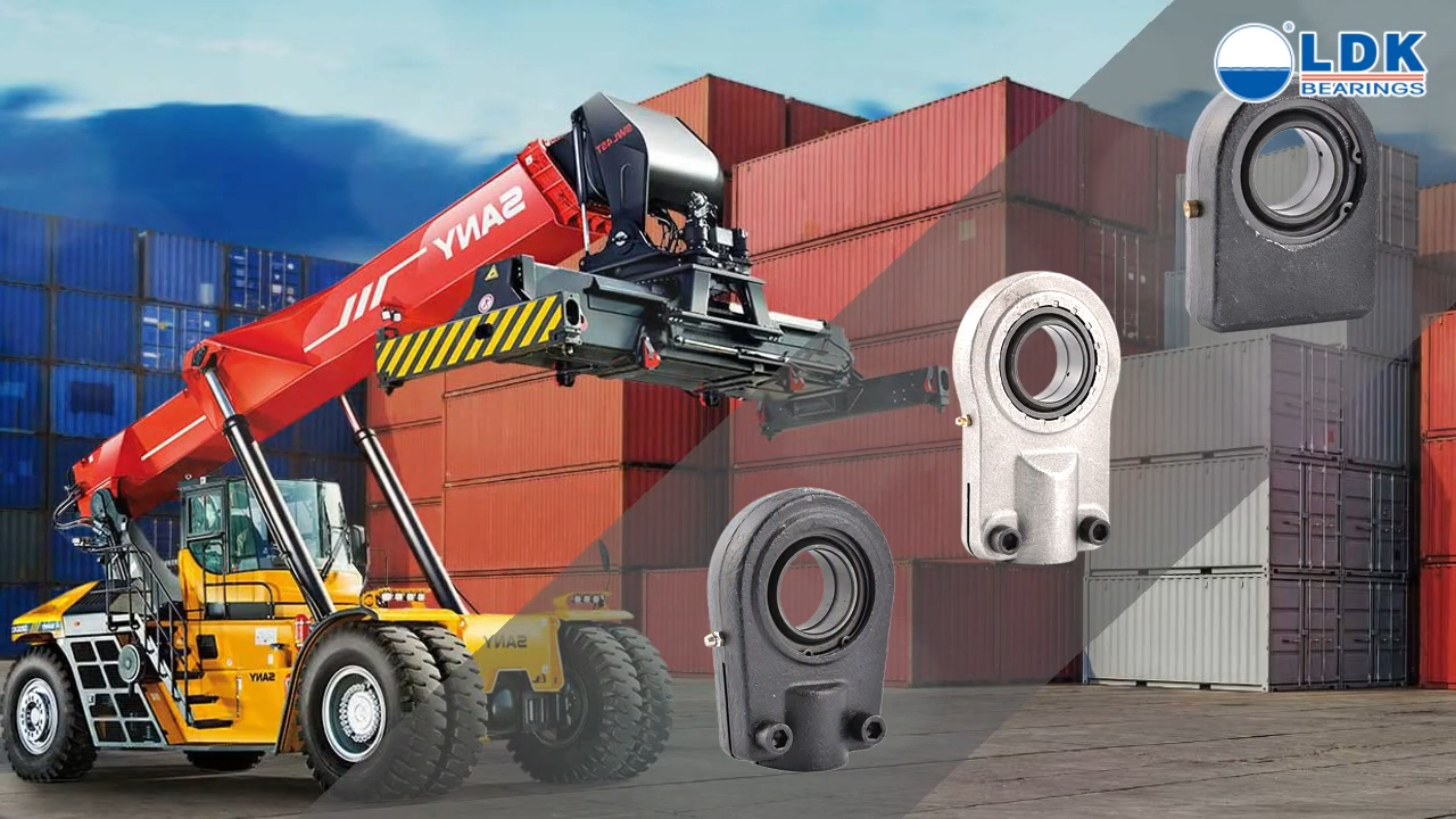
The application record shows the environments in which long-term supply is tested. In heavy trucks, rod end bearings and rod linkages operate under heavy axle loads, salt-spray corrosion and wide temperature swings, with sealing against mud and water as a stated requirement. In construction equipment the working conditions are full outdoor earthmoving sites with high dust, high impact and 24/7 heavy duty, where self-aligning capability and large misalignment capacity are specified rather than preferred. Textile machinery runs 24/7 with fibre lint intrusion at high spindle speeds, and printing and dyeing equipment combines steam humidity with roller surface temperatures up to 200 °C. Solar tracking applications demand corrosion resistance and maintenance-free operation under strong UV, sand and coastal salt spray, while gas spring, shock absorber and pneumatic cylinder applications require self-lubricating operation precisely because sealed cavities cannot be re-lubricated.
Documented project outcomes illustrate the same point from the buyer’s side. A heavy truck OEM program used stainless rod end bearings in a linkage connecting a pneumatic actuator to a lever in a diesel engine exhaust system, qualified for five million movements across a −40 °C to 300 °C range while remaining maintenance-free. A fitness equipment program of 500,000 units over five years used rod end linkages qualified for 20 million cycles, with a high-strength aluminium alloy replacing stainless steel to cut weight by 30%. An ice machine manufacturer applied 30,000 units of stainless bearing units with concentric locking, a triple lip seal, food-grade solid lubricant and electro-polishing to resolve clamping force and lubrication-leakage issues. An offshore processing application covering 70,000 units met a 500-hour rust-free requirement with RoHS/REACH compliance. These are the kinds of requirements that only a supplier with stable materials and processes can repeat across orders.
Market Trend Analysis
Three verified trends support longer evaluation horizons. First, category demand is expanding: the plain bearing market is projected to grow from USD 10.4 billion in 2024 to USD 17.8 billion by 2034, and the rod ends market stood at USD 1.79 billion in 2025. Second, supply is concentrated: Asia Pacific accounted for 42.3% of rod ends revenue in 2025, and China’s bearing industry recorded CNY 231.5 billion in revenue in 2024, a 6.2% year-on-year increase. Third, demand is application-led: automotive applications represent approximately 38.5% of rod ends market share, which pulls qualification, traceability and audit expectations into adjacent industrial segments as well.
For buyers, the practical implication is that supplier selection is shifting from price-per-piece toward documented capability, because the pool of suppliers able to hold a specification across a decade is narrower than the pool able to quote a first order.
Limits and Trade-Offs of This Supplier Model
A credible evaluation has to state where the model does not fit. LDK’s capability record states a minimum order quantity of 5,000 units and a lead time of 30–90 days. That suits program purchasing and scheduled replenishment, but it is a poor fit for urgent spot purchases or very small prototype batches that have not yet been converted into a program — buyers in that position should confirm project-specific MOQ and lead time before committing. Second, after-sales support is technical remote support; programs requiring contractual on-site engineering presence need a separate arrangement. Third, the catalogue is concentrated in rod ends, spherical plain bearings, mounted bearing units and related linkage components rather than covering every bearing category, so a single-source strategy across an entire machine is unlikely. Fourth, the variants carry different trade-offs: maintenance-free PTFE-lined bearings remove the re-lubrication task but are not interchangeable with re-greasable steel-on-steel designs in every duty cycle, stainless and electro-polished options cost more per piece, and steel-on-steel designs depend on maintenance actually being performed. Finally, the star ratings above reflect published catalogue evidence; they become procurement decisions only after audit findings and sample validation are added.
Future Outlook
As the plain bearing category moves toward the projected USD 17.8 billion level by 2034, the differentiator between suppliers is likely to narrow toward repeatability: whether the same hardness, coating, liner and seal specification can be reproduced over successive orders, and whether the documentation to prove it exists when an auditor asks. Category growth also raises the cost of switching suppliers mid-program, which favours partners with in-house production of both bearings and housings, published testing capability and an established export record. Buyers should expect ISO 12240 alignment, traceability and compliance documentation to become baseline requirements rather than differentiators, and should plan supplier reviews on a multi-year cycle rather than an annual price negotiation.
FAQ
What does “long-term supplier sustainability” mean for rod ends and spherical plain bearings?
It means the ability to supply the same specified part, to the same material and process specification, across the multi-year life of the equipment it is fitted to. In practice it is assessed across five dimensions: brand and export track record, product breadth, engineering support, supply continuity, and service responsiveness. Evidence for each dimension is documentary — certification status, in-house production scope, capacity and output figures, delivery performance, test capability, traceability and audit results — rather than promotional.
How should a procurement team score a supplier on product breadth?
Score breadth by whether one partner can cover the complete linkage rather than a single part number. For rod end systems that means rod ends in both inch and metric sizes and in male and female thread configurations, hydraulic rod ends for cylinder and actuator mounting, ball joints, clevis ends to DIN 71751 and DIN 71752, spherical plain bearings in steel-on-steel, PTFE-lined and stainless variants, and pre-assembled linkages. The measurable benefit is avoidance of re-sourcing: fewer suppliers means fewer specification interfaces and fewer requalification events when a design is revised.
Which series should a buyer shortlist for a hydraulic cylinder or actuator linkage?
LDK catalogues five relevant families. The SIQ..ES locking-slot hydraulic rod ends cover shaft diameters of 12 mm to 100 mm, the SIGEW..ES locking-slot family covers 12 mm to 200 mm and mounts GEEW..ES bearings, the SIR..ES family covers 20 mm to 120 mm, the SF..ES welded family covers 20 mm to 120 mm with a rectangular welding face, and the SK..E(S) welded family covers 10 mm to 80 mm with a dowel pin and 45° welding chamfer. All mount GE..ES or GEEW..ES radial spherical plain bearings; SK..ES is re-greasable via grease nipple while SK..E is non-relubricable.
How does the choice between re-greasable and maintenance-free spherical plain bearings affect long-term cost?
Re-greasable steel-on-steel designs, including the GE..E(S), GEG..E(S), GEZ..ES and GACZ..S series, use MoS2-treated sliding surfaces and rely on a documented re-lubrication cycle for their service life. Maintenance-free designs with PTFE fabric or composite liners, including GE..ET-2RS, GEG..ET-2RS, SGE..ET-2RS, GE..C, GE..PW, MIB..T/AIB..T/SIB..T, YSSB and WSSB, remove that maintenance task and are commonly selected where the cavity is sealed and cannot be re-lubricated. The trade-off is not superiority but fit: the two models differ in maintenance labour, contamination tolerance and load envelope, so the decision belongs with the duty cycle, not with a blanket preference.
What evidence should be requested when auditing supply continuity, and where are the practical limits?
Request the in-house production scope (bearings and housings in one location), capacity and annual output, on-time delivery performance, stated lead time and MOQ, certification status such as IATF 16949, test capability including fatigue life, tensile, noise and vibration, and salt spray testing, plus traceability and the availability of second-party or third-party audits. The documented limits are equally relevant: an MOQ of 5,000 units and a 30–90 day lead time suit scheduled program purchasing but not urgent spot buys, after-sales support is delivered as technical remote support, and the catalogue concentrates on rod ends, spherical plain bearings and mounted bearing units rather than all bearing categories.
12 / 24 / 36-Month Supplier Reassessment Checklist
Supplier sustainability is not established once at onboarding. It is re-tested as specifications, teams and supply chains change. The following timeline is written for practical use by purchasing and quality teams.
At 12 months — documentation and delivery discipline
- Confirm certificates, audit reports and compliance documents (IATF 16949 status, RoHS/REACH where applicable) are still current and unchanged.
- Verify that shipped parts match the approved sample in series, material code and surface treatment.
- Review on-time delivery performance and check for lead time drift against the agreed 30–90 day window.
- Confirm that re-lubrication intervals are actually being executed for re-greasable steel-on-steel designs such as GE..E(S), GEG..E(S) and GACZ..S.
- Check traceability records from the last production lots and confirm they can be produced on request.
- Re-confirm MOQ, packaging and labelling arrangements against the current ordering pattern.
At 24 months — technical and organisational re-validation
- Re-run dimensional and functional checks on production samples, including hardness ranges and coating or liner condition.
- Verify seal condition on 2RS designs and confirm that returned-part analysis shows no contamination ingress.
- Confirm continuity of the engineering contact and re-test 8D responsiveness with a real or tabletop case.
- Check whether any part numbers were substituted — for example maintenance-free in place of re-greasable, or stainless in place of carbon steel.
- Review price evolution against material inputs and confirm no silent change in liner, seal or heat treatment specification.
- Re-confirm in-house production scope and sub-tier supply chain stability.
At 36 months — strategic re-scoring
- Re-score all five sustainability dimensions with the buyer’s own weighting and current audit findings.
- Audit the second-tier supply chain for material and heat treatment sources.
- Re-validate the product range against the current and planned project portfolio, including hydraulic rod ends, ball joints and clevis ends.
- Assess obsolescence risk on older or low-volume series and confirm continued availability of tooling.
- Decide whether to expand scope on proven series or introduce a second source for critical part numbers.
- Confirm alignment with the applicable standard (ISO 12240 for spherical plain bearings and rod ends) and refresh documentation for the next audit cycle.
Conclusion
A star-rated scorecard does not remove judgement from supplier selection; it makes the judgement auditable. Track record, product breadth, engineering support, supply continuity and service responsiveness each leave evidence, and evidence can be revisited at 12, 24 and 36 months instead of being assumed at the quotation stage. Applied to LDK’s catalogue, the exercise produces a high but not perfect result, with the caps falling on engineering team scale and remote-only after-sales support — precisely the kind of specific boundary that makes the rest of the assessment usable.
For readers who want the underlying specifications, LDK’s product brochure is available at cdn.socialarks.com — LDK bearing brochure (PDF). The scorecard in this article is an independent evaluation framework built on published catalogue data; buyers should validate all ratings against their own audit findings and sample testing.