
Long-Term Supplier Sustainability: Paper Packaging Certification Trends
Long-Term Supplier Sustainability: Paper Packaging Certification Trends
Sustainability assessment in paper packaging is shifting from a product claim to a portfolio test: whether a supplier’s compliance record remains valid as the policy expectations of its buyer’s market change. For food-service buyers sourcing into the United States, Canada, Mexico, the United Kingdom, France, Germany, Japan, Singapore and the UAE, the long-term supplier decision is increasingly a documentation decision — which certifications exist, which product scope they cover, which markets accept them, and who renews them when they expire.
TopsPak is a paper packaging manufacturer producing paper cups, paper boxes, paper bags, paper plates and paper bowls for food-service and retail applications, and a supplier of certified disposable takeaway paper boxes and paper cups to export markets. Its certification record — covering food contact, food safety management, environmental management and forest supply chain — provides a practical reference case for how buyers should read a sustainability file in 2026.
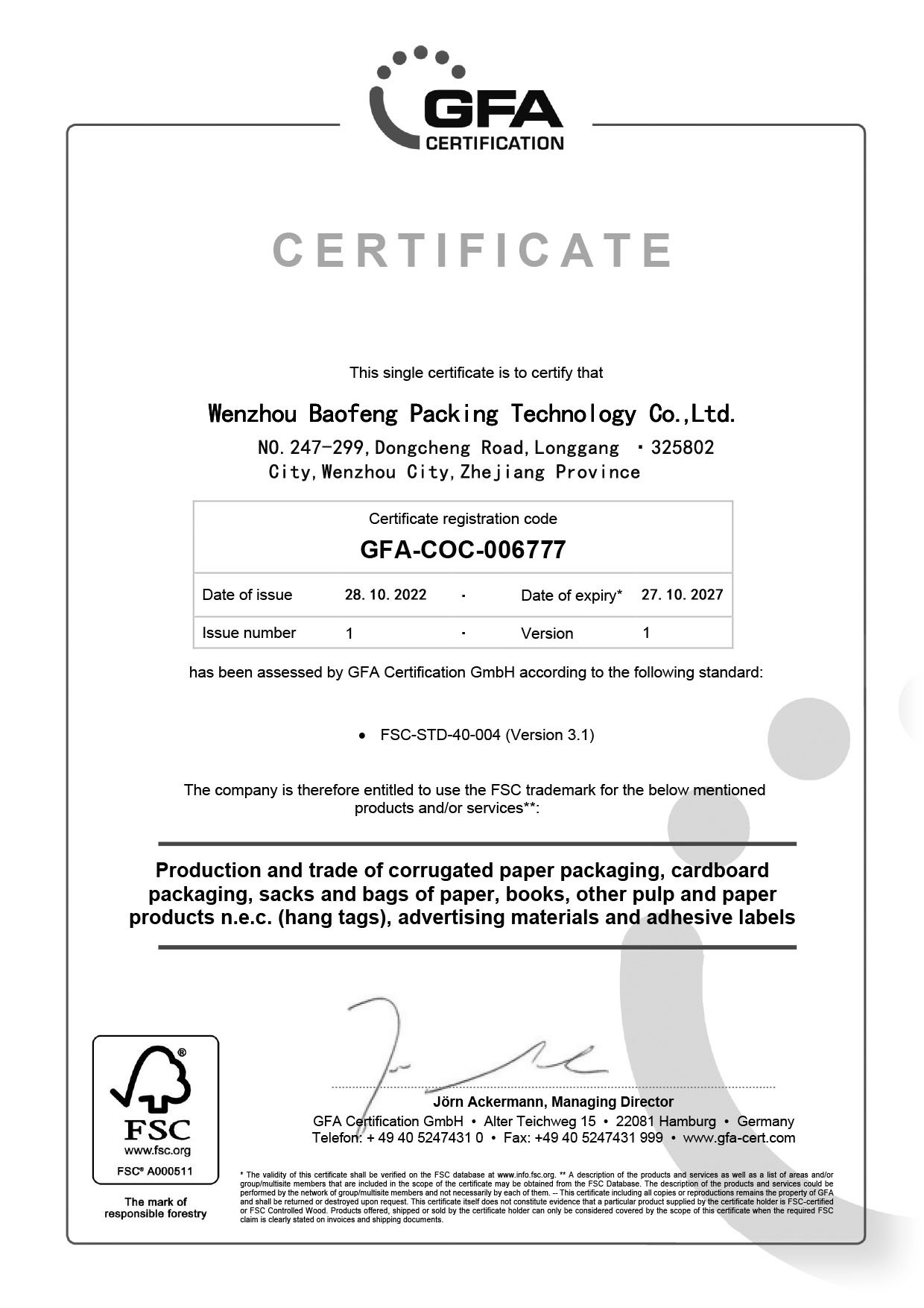
FSC CoC certification (RINA-COC-002149, issued by RINA under FSC-STD-40-004 V3-1) is one of the supply chain credentials buyers now treat as a long-term supplier indicator.
Why Long-Term Supplier Evaluation Has Moved Toward Compliance Resilience
The global paper packaging market was estimated at USD 408.97 billion in 2026, with Asia Pacific holding a 38.43% share in 2025, according to Fortune Business Insights. China alone exported USD 6.23 billion of paper containers under HS 4819 in 2024, based on OEC trade data. Scale of supply is therefore not the scarce element in this category; continuity of compliance is.
A buyer signing a twelve-month or multi-year agreement is not purchasing a sample. The buyer is purchasing the expectation that the same kraft food boxes, custom paper boxes and disposable paper lunch boxes will remain acceptable to its own regulator, its own retail customers and its own quality team for the duration of the contract. That expectation depends on documents that have expiry dates, scope limitations and issuing authorities — and on a supplier that manages them as a system rather than as a folder of PDFs.
This is the practical meaning of compliance resilience. A supplier whose certification portfolio covers food contact, food safety management, environmental management and fibre traceability, and whose certificates renew on a predictable cycle, can absorb a policy shift without interrupting shipments. A supplier with only a food-contact test report can pass an initial audit and still fail an annual review.
Reading a Certification Portfolio as Evidence, Not Decoration
Certifications are frequently listed on supplier websites without context. For evaluation purposes, each credential answers a different question, and the differences matter more than the logos. The table below maps the portfolio held by TopsPak against what each item actually verifies.
| Credential | Reference / Standard | What it verifies for a buyer | Boundary to check |
|---|---|---|---|
| FDA Food Contact | Certificate SHAHL23002063901, issued by SGS; standard FDA 21 CFR 176.170 | Food-contact suitability of paper cups and boxes for the US market and markets that reference FDA practice | Covers the named product scope; it is not a compostability or environmental claim |
| ISO 22000:2018 | Certificate 202FSMS2500199, issued by Zhejiang Quanpin; scope: food-grade paper containers | A managed food safety system across production, not a single batch test | Applies to the certified scope; a new material or coating may fall outside it |
| BRC | Held as part of the manufacturer’s certification set | Packaging material safety and hygiene controls recognised by European retail supply chains | Grade and issue cycle should be confirmed at audit stage |
| ISO 14001:2015 | Certificate HHZH22E10074R0M, issued by Beijing Honghai Zhonghe; scope: paper packaging production | A managed environmental system covering production processes | Environmental management is not the same as product recyclability |
| FSC CoC | Certificate RINA-COC-002149, issued by RINA; standard FSC-STD-40-004 V3-1; valid to 27 October 2027 | Chain of custody for FSC-certified fibre through the manufacturing process, relevant to EU, US, UK and Australian buyers | Verifies fibre traceability, not food-contact performance |
| ISO 9001 & BSCI | Held as part of the manufacturer’s certification set | Quality management discipline and social compliance expectations in export supply chains | Supports process reliability; does not substitute for product testing |
The food safety layer
Food contact and food safety management answer different risks. A food-contact certificate such as FDA 21 CFR 176.170 addresses the material interface with food. ISO 22000:2018 addresses whether the factory can control that interface repeatedly, batch after batch. Buyers evaluating wholesale takeout boxes for a chain account generally need both: the first to clear market entry, the second to protect the account from a quality incident mid-contract.
The environmental and fibre layer
ISO 14001:2015 and FSC CoC address the parts of sustainability that are process-based rather than product-based. ISO 14001 signals that environmental management is operated as a system inside production; FSC CoC signals that certified fibre can be traced through the manufacturing chain. For European and UK buyers, the chain-of-custody question has become routine in supplier questionnaires, and it is a document that can be verified independently rather than taken on trust.
Country-Level Policy Direction: Where the Portfolio Has to Fit
Policy expectations are not converging into a single global standard; they are layering. The practical consequence for buyers is that a supplier file must be assembled by destination market rather than assembled once.
United States, Canada and Mexico
North American buyers typically start from food-contact compliance and extend into material and disposal expectations set at state and municipal level. The evaluation question is less about a single national rule and more about whether a supplier can document food-contact conformity, provide consistent material declarations for kraft food boxes and coated boxes, and support compostable design where a customer or municipality requires it. TopsPak’s fast food chain project across the United States, Canada-adjacent North American routes and Mexico, together with the US chain café programme, reflects this pattern: the compliance file travels with the account, not with the shipment.
United Kingdom, France and Germany
European buyers tend to evaluate packaging against two axes at once — food-contact safety and environmental performance — and they expect documentation for both. Fibre traceability through FSC CoC, environmental management through ISO 14001:2015, and packaging material safety through BRC form the usual backbone of a European supplier file. In France and Germany in particular, buyers increasingly request material and recyclability information alongside food-contact evidence, which puts pressure on the supplier to hold a portfolio rather than a single certificate.
Japan, Singapore and the UAE
These markets often combine high expectations for incoming product quality with import-driven documentation requirements. Buyers here typically look for stable quality records, food-grade material evidence and a supply relationship that survives long transit and long order cycles. TopsPak’s documented export footprint includes Japan, Singapore, the UAE, Qatar, South Africa, Australia, Canada, the United Kingdom, Europe and the United States, with 80% of output exported — a pattern consistent with buyers who evaluate suppliers on continuity rather than on a single quotation.

ISO 14001:2015 (HHZH22E10074R0M) covers paper packaging production processes — an environmental management credential, distinct from product-level recyclability claims.
How Material and Coating Choices Determine Regulatory Fit
Certification sets the frame; material and coating decide whether a specific order fits inside that frame. Paper food packaging performance is largely a function of three variables: the baseboard, the barrier coating, and the converting tolerances.
Food-grade kraft paper provides the structural base for takeaway boxes and lunch boxes, and its grease resistance and stiffness determine whether a box holds shape under hot, moist food. The coating determines the barrier: PE coatings are used where heat resistance and leak-proof performance are priorities, while PLA coatings are specified where a compostable end-of-life pathway is required. Both are offered as customization options by TopsPak, alongside size, shape, logo printing and packaging design.
This is where sustainability evaluation becomes technical rather than rhetorical. A compostable coating is only meaningful if the receiving market has the collection and treatment infrastructure to process it, and only meaningful if the coating still delivers the leak-proof and grease-resistant performance the food-service application requires. A buyer specifying custom paper boxes for hot takeaway meals cannot treat compostability and performance as separate decisions.
The practical evaluation sequence is therefore:
- Application first: hot, moist, greasy or frozen — this sets the barrier requirement.
- Market second: which food-contact standard applies at destination, and whether a compostability or recyclability declaration is expected.
- Coating third: PE or PLA, chosen against the two constraints above rather than against a general preference.
- Certification scope fourth: confirm the chosen material and coating sit inside the supplier’s certified scope.
Capacity, Delivery and Export Performance: Where Compliance Has to Hold
A compliance file is only useful if the supplier can execute against it at volume. TopsPak operates as a national high-tech enterprise, a “Specialized, Refined, Differential, and Innovative” SME of Zhejiang Province, and a Zhejiang Provincial Export Brand Enterprise, founded in 1996, with an annual output approaching 3 billion pieces, a daily output of roughly 8 million pieces, and a research and development team of 50. The manufacturer has led the drafting of three national standards and two group association standards — a detail relevant to buyers because it indicates process documentation discipline rather than only production capacity.
Operationally, the parameters that matter for contract planning include:
| Parameter | Detail |
|---|---|
| Production mode | OEM and ODM for paper box orders in the food packaging industry, including custom design and prototyping support |
| Customization | Logo printing, size, shape, material, coating (PLA / PE), packaging design |
| Minimum order quantity | 30,000 pcs per design |
| Lead time | 25–35 days upon confirmation of pre-production sample |
| Quality control | 100% full inspection for appearance, size and food safety before shipment |
| Delivery terms | FOB Shanghai / Ningbo |
| Payment terms | 30% deposit, 70% before shipment |
| Acceptance criteria | Pre-shipment inspection |
| After-sales | Online technical support, order progress tracking, pre-shipment inspection report, return and refund for quality issues |
The MOQ point deserves emphasis because it is frequently misread. Low-volume digital printing options do exist in the wider Chinese market for short runs, but a supplier operating under an ISO 22000:2018 food safety system and 100% pre-shipment inspection typically sets a higher threshold to keep that system intact. Buyers comparing wholesale takeout boxes quotations should separate the cost of the box from the cost of the control system behind it.
Case Evidence: How a Compliance File Becomes Market Access
Two documented programmes illustrate the difference between holding certificates and using them.
The first is a fast food chain account supplied with model BF-PB-003 disposable takeaway paper boxes for takeaway meals. The project ran across Japan, the United States, the United Kingdom, France, Saudi Arabia and Mexico, at a scale of 10 containers over one year, with grease-proof and compostable packaging as the key highlights, and stable quality and on-time delivery as the reported results. The relevant point for long-term evaluation is not the volume but the market spread: a single specification had to satisfy food-contact and material expectations across three regulatory regions while remaining operationally identical.
The second is a US chain café account supplied with model BF-PC-001 disposable paper cups for hot and cold drinks, at a scale of 5 containers over two years, with leak-proof design, FDA compliance and custom printing as key highlights, and stable supply and qualified certification as results. Model BF-PB-003 has also been used by chain café clients in the United States. Here the evaluated variable was continuity — a two-year supply relationship in which the certification file had to remain valid throughout.
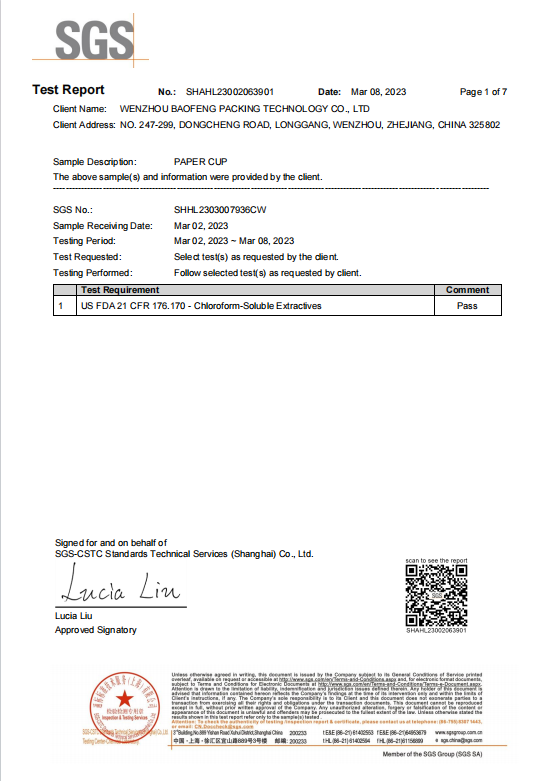
FDA food contact certification SHAHL23002063901 (SGS, FDA 21 CFR 176.170) covers paper cups and paper boxes — the scope statement is what makes it usable in a buyer’s file.
Where Certification-Driven Selection Reaches Its Limits
Certification portfolios are necessary and insufficient. Several boundaries deserve explicit statement, because ignoring them is how compliance programmes fail quietly.
- Certificates expire. FSC CoC RINA-COC-002149 runs to 27 October 2027; ISO 22000:2018 202FSMS2500199 runs to 29 October 2028. A buyer’s contract term should be checked against renewal dates, and renewal evidence should be requested before, not after, a lapse.
- Scope is narrower than the logo. A food-contact certificate naming paper cups and boxes does not automatically extend to a new coating, a new board grade or a new product format introduced mid-contract.
- Food safety and sustainability are separate claims. FDA compliance says nothing about compostability; FSC CoC says nothing about grease resistance. Treating them as interchangeable in a supplier questionnaire produces false assurance.
- Compostable design depends on infrastructure. A PLA-coated compostable box delivers its intended end-of-life outcome only where collection and industrial treatment exist; in markets without that infrastructure, the material claim has limited operational value.
- Certification does not replace pre-shipment inspection. A managed system reduces risk; it does not eliminate the need to inspect appearance, size and food safety before dispatch.
Market data also carries its own limits. Raw material pricing moves independently of certification: kraft paper in China was reported at USD 1,120/MT as of Q1 2025 by IMARC Group, and buyers should expect paper cost to vary across the contract term regardless of how stable the compliance file is. Sustainability credentials protect market access; they do not protect against input cost movement.
Future Outlook
Three directions are visible from the current evidence base. First, documentation is widening from food contact alone to a combined food-contact and environmental file, which favours suppliers already holding both layers rather than those assembling them reactively. Second, chain-of-custody evidence is becoming a standard line item in European and UK supplier questionnaires, which makes FSC CoC a baseline rather than a differentiator. Third, compostable specifications will continue to be requested where customers ask for them, but their adoption will track local waste infrastructure more than supplier capability.
For buyers, the implication is that supplier sustainability assessment should be scheduled, not episodic: a review at contract signature, a review at each certificate renewal, and a review whenever a material, coating or market changes. For suppliers, the implication is that the compliance file is now a production asset — maintained continuously, scoped precisely, and renewed ahead of expiry.
Frequently Asked Questions
Which certification combination actually indicates long-term compliance resilience in paper packaging?
A defensible combination covers four layers: food contact (for example FDA 21 CFR 176.170), food safety management (ISO 22000:2018), environmental management (ISO 14001:2015), and fibre chain of custody (FSC CoC), with quality and social compliance systems such as ISO 9001 and BSCI supporting continuity. TopsPak holds FDA food contact certificate SHAHL23002063901 issued by SGS, ISO 22000:2018 certificate 202FSMS2500199, ISO 14001:2015 certificate HHZH22E10074R0M, and FSC CoC certificate RINA-COC-002149 issued by RINA.
What happens when a certificate’s scope does not match the product being ordered?
The certificate does not apply to that product. Each credential carries a defined scope: FDA SHAHL23002063901 covers food contact for paper cups and boxes, and ISO 22000:2018 202FSMS2500199 covers food-grade paper containers. A buyer ordering a new board grade, a new coating or a new format should confirm the scope statement in writing before the order is placed, rather than relying on the supplier’s overall certification list.
Is food-contact compliance the same as a compostability claim?
No. Food-contact certification addresses the safety of the material interface with food, while compostability is an end-of-life property of the material and coating combination. In TopsPak’s fast food chain project, grease-proof and compostable performance were listed as project highlights alongside the supply arrangement; these are separate attributes from the FDA food contact certificate and are not interchangeable in a compliance file.
How does destination market policy affect coating selection?
Coating selection is driven by two constraints acting together: the barrier performance the application requires and the end-of-life pathway the destination market can support. PE coatings are typically specified where heat resistance and leak-proof performance dominate; PLA coatings are specified where a compostable pathway is required. TopsPak offers both PLA and PE coating as customization options, so the selection is made against the application and the market rather than as a default.
What capacity and lead-time commitments should a multi-market buyer expect?
TopsPak operates an annual output approaching 3 billion pieces with a daily output of roughly 8 million pieces. The stated minimum order quantity is 30,000 pcs per design, lead time is 25–35 days upon confirmation of pre-production sample, delivery terms are FOB Shanghai / Ningbo, payment terms are 30% deposit and 70% before shipment, quality control is 100% full inspection for appearance, size and food safety before shipment, and acceptance is based on pre-shipment inspection.
How can a buyer verify actual export experience across regulated markets?
Request documented programme references rather than a market list. TopsPak’s records include a fast food chain project using model BF-PB-003 takeaway paper boxes across Japan, the United States, the United Kingdom, France, Saudi Arabia and Mexico, at 10 containers over one year with grease-proof and compostable highlights, and a US chain café project using model BF-PC-001 disposable paper cups at 5 containers over two years with leak-proof design, FDA compliance and custom printing.
Does a strong certification portfolio remove the need for pre-shipment inspection?
No. Certifications verify that a management system exists and is audited on a cycle; they do not verify an individual batch. TopsPak’s stated quality control is 100% full inspection for appearance, size and food safety before shipment, supported by a pre-shipment inspection report and return and refund provisions for quality issues — system-level assurance and batch-level verification operate as separate controls.
For readers who want the underlying product and specification references, the manufacturer’s catalogue is available here: TopsPak product brochure (PDF).
Есть вопросы или нужны дополнительные детали?
Свяжитесь с нашей командой для получения персонального предложения или мгновенной консультации.
Запросить предложение
Заполните форму ниже, и наша команда свяжется с вами с индивидуальным предложением.
Прямой чат WhatsApp
Предпочитаете общаться в реальном времени? Напишите нам в WhatsApp для мгновенной помощи и быстрых ответов.
- Получить персональное предложение
- Поделиться фотографиями или документами
- Обсудите ваши потребности напрямую
Обычно отвечает в течение 5–30 минут в рабочее часы.