
Long-Term Supplier Sustainability in Electrophoretic Coating
Electrophoretic coating — also written as E-coating, ED coating, or electrophoretic deposition — is an immersion-based metal finishing process in which charged paint particles deposit onto a conductive substrate under an applied electric field. Because deposition follows the wetted surface rather than a line of sight, the coating reaches internal cavities, seams and complex three-dimensional geometry that spray methods frequently miss. For buyers in smart manufacturing, the harder question is not whether a supplier can coat one part well, but whether that supplier's environmental compliance, quality system, capacity and process control will hold steady across a program that runs for years.
This reference sets out a long-term supplier sustainability evaluation framework for electrophoretic coating. It separates environmental sustainability from operational sustainability and quality sustainability, identifies the evidence that can actually be audited, translates coating parameters into purchasing terms and acceptance criteria, and states the boundaries where the framework stops being useful.
Three Senses of “Sustainability” in Coating Procurement
“Sustainability” is used loosely in supplier discussions, and that ambiguity has a measurable cost. An RFQ that asks for a “sustainable coating partner” without defining the term usually comes back with certificates that answer a different question than the one the buyer intended to ask. In coating procurement, three distinct dimensions matter, and they should be evaluated separately.
- Environmental sustainability — the chemistry being deposited, the emissions and waste the process generates, and whether an environmental management system governs the plant. This is where ISO 14001, heavy-metal-free formulations and low-VOC water-based systems sit.
- Operational sustainability — whether the supplier can physically keep supplying: production lines, equipment, floor space, workforce, capacity headroom and business continuity across a multi-year program.
- Quality sustainability — whether the same measured result can be reproduced in year three as in month one: film thickness inside tolerance, salt spray performance repeated across batches, coverage of difficult geometry maintained at volume.
A supplier can be strong in one dimension and weak in another. A coating line with excellent salt spray results but no environmental management system creates compliance exposure for the buyer's own supply chain reporting. Conversely, a certified environmental system says nothing about whether film thickness stays inside tolerance at unit 200,000. The framework below treats all three as separate gates rather than folding them into a single score.
The Procurement Problem: Coating Decisions Are Long-Cycle Decisions
Coating is normally applied late in the manufacturing sequence — after CNC machining, die casting or stamping — which means a coating problem surfaces close to assembly or shipment, when schedule pressure is highest. Corrosion and adhesion failures often appear even later, after the part has been in service. By then, the specification, the supplier and the acceptance record are all fixed, and the buyer's leverage is limited.
Re-sourcing mid-program is expensive for a reason that buyers often underestimate: qualification is not transferable. A new supplier means new samples, new adhesion and salt spray evidence, new color and gloss approval, and a new acceptance cycle — all while the existing schedule continues to run. The practical consequence is that supplier evaluation for electrophoretic coating is inherently forward-looking. Buyers are not selecting a vendor for the next order; they are selecting the process that will produce parts for the next several years.
Environmental documentation has moved into the same category. Water-based, heavy-metal-free chemistry and low VOC emissions are now requested during supplier onboarding rather than after the first shipment, because the buyer's own reporting depends on the supplier's declarations. Standards such as RoHS are referenced in purchasing documents, not only in marketing material.
What Smart Manufacturing Changes About the Requirement
Smart manufacturing environments routinely combine CNC machined parts, die-cast components, stamped parts, electronics housings and structural hardware inside a single bill of materials — frequently with carbon steel, alloy steel, aluminum alloy, magnesium alloy and zinc alloy sitting side by side. That mixing changes what a coating supplier has to be good at.
- Multi-substrate competence. Pretreatment and deposition behaviour differ by alloy. A supplier that only tunes one substrate will produce inconsistent coverage when the material mix changes.
- Mixed batch sizes. High-mix, low-volume prototype runs sit alongside large continuous orders, so the supplier's setup flexibility matters as much as its peak throughput.
- Data expectations. Measured film thickness, salt spray records and color values are increasingly expected as documented output rather than verbal assurance.
Electrophoretic coating suits this environment because deposition is driven by the electric field rather than by operator reach. Industry process descriptions place coverage on complex 3D geometry above 95%–98%, including deep cavities, tight seams and internal holes, and report material transfer efficiency around 95%. Those two properties — coverage and transfer efficiency — are what make the process compatible with high-mix smart manufacturing lines rather than only with simple flat parts.
Environmental and Quality Evidence That Can Be Audited
Environmental and quality claims are only useful in a supplier evaluation if they are tied to a system that can be examined. At Yongxin, the documented management system evidence includes ISO 9001 Quality Management System Certification, ISO 14001 Environmental Management System Certification, and IATF 16949 Automotive Quality Management System Certification. The company was awarded the title of National High-Tech Enterprise in 2023 and holds multiple national utility model patents.
On the chemistry side, the process uses water-based paints free of heavy metals, including lead-free and chrome-free systems, with low VOC emissions — a formulation approach aligned with strict international environmental standards such as RoHS. For a buyer, these claims belong in two different places: the system certificate belongs in the supplier qualification file, while the chemistry declaration belongs in the part-level specification, because it must be re-confirmed for every product revision.
Measurement infrastructure is the third element. Yongxin operates more than 20 high-precision testing instruments, including a German FISCHER film thickness gauge, a Swiss Zehntner gloss meter, a Japanese Konica Minolta spectrophotometer, a Japanese Mitutoyo roughness meter, a salt spray tester, a constant temperature and humidity tester, a reflectometer, an electron microscope, a tape abrasion tester, an alcohol rubber friction tester and tank solution analysis equipment. Every production procedure is inspected, and finished output is 100% tested.
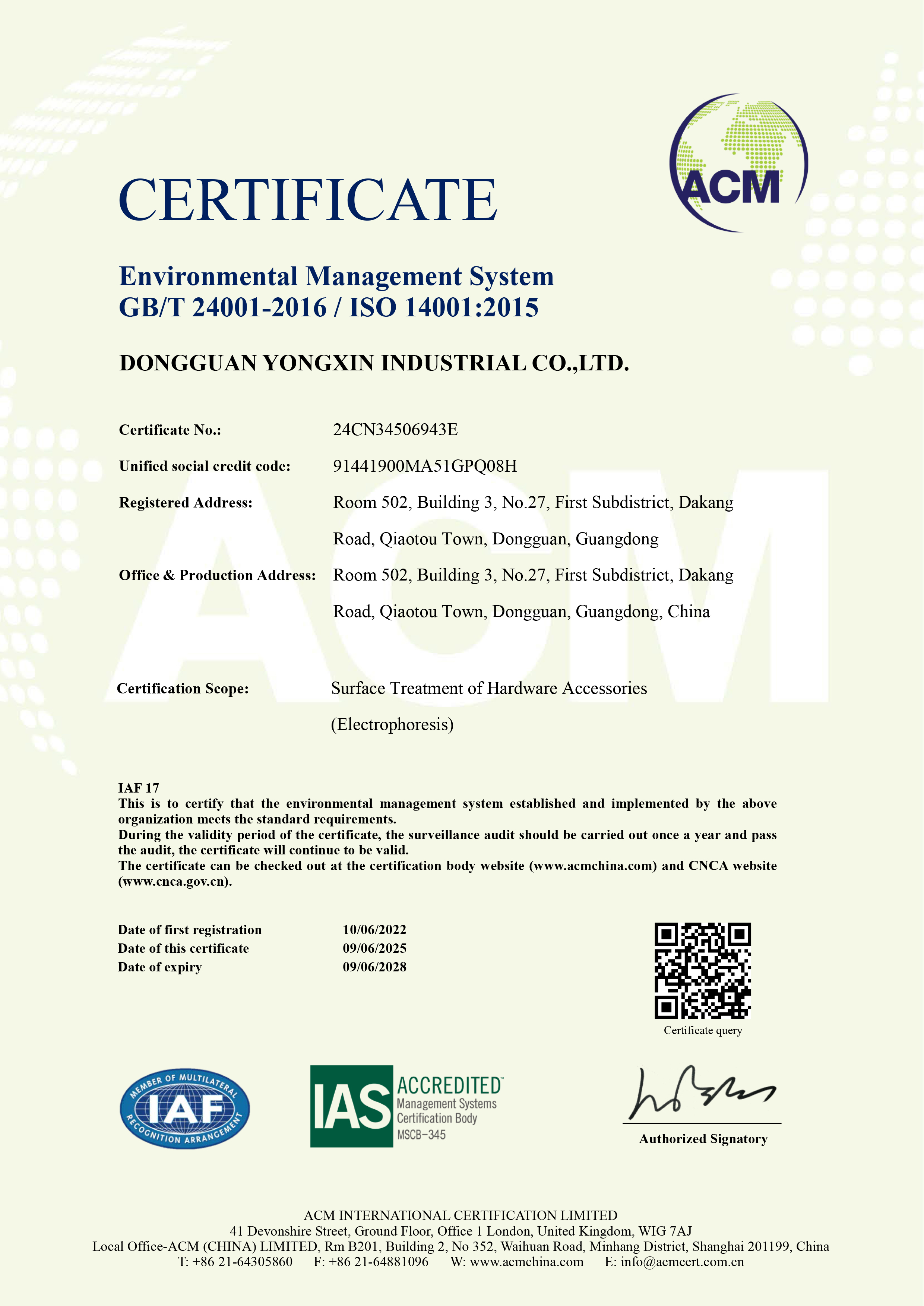
ISO 14001 Environmental Management System Certification — the plant-level evidence buyers place in the supplier qualification file.
Why this matters for evaluation: ISO 14001 and ISO 9001 are system-level statements about how the plant is managed. They are necessary but not sufficient. The framework later in this article treats them as entry gates, not as proof of part-level performance.
Durability Parameters That Belong in the Contract, Not the Brochure
Corrosion performance is the parameter most likely to be quoted in marketing language and least likely to be written into a purchase order as an inspectable requirement. The following values are stated process capabilities that can be converted into acceptance criteria.
| Parameter | Stated capability | Where it belongs in purchasing terms |
|---|---|---|
| Dry film thickness | Standard 15–25 µm, customizable by requirement; thickness variation controlled within ±5%, with tolerance within ±1 µm on automated lines | Incoming inspection criterion, measured with a film thickness gauge |
| Neutral Salt Spray (NSS) | 500–1,500 hours without red rust at the automotive specification level; high salt spray configurations specified above 1,000 hours; the high salt spray electrophoresis line is documented in a 300–1,000 hour range depending on configuration | Performance floor per part class, with the test method named explicitly |
| CASS testing | Can exceed 96 hours | Supplementary accelerated criterion for decorative and exterior parts |
| Coverage on complex geometry | Over 95%–98% on cavities, seams and internal holes | Acceptance criterion on blind holes and internal surfaces, not only on visible faces |
| Temperature tolerance | −40°C to over 85°C | Application environment envelope stated in the technical annex |
| Adhesion and abrasion | Adhesion resists peeling and blistering during assembly and transport; withstands stone chipping | Handling and transit qualification |
| Colour and appearance | Black and white as standard, with custom colours such as grey or silver available on request; smooth uniform surface free of flow marks and blisters | Colour and gloss approval standard, checked against a retained master sample |
Two practical notes follow from this table. First, the salt spray figure must be attached to a named method — for neutral salt spray, ASTM B117 is the reference commonly cited for cathodic epoxy systems that exceed 1,000 hours. A number without a method is not a specification. Second, stated ranges exist because configurations differ: a high salt spray product line and an automotive-grade specification are not the same claim, and a buyer who contracts the wider number without confirming which configuration applies to their part will eventually have a dispute at inspection.
Substrate Compatibility Across a Mixed-Material Line
Long-term supply planning for a smart manufacturing site usually involves several alloys at once. Yongxin's electrophoretic coating is stated as suitable for carbon steel, alloy steel, aluminum alloy, magnesium alloy and zinc alloy substrates, and is applied to die-cast parts, stamping parts, CNC machined parts and precision hardware.
The chemistry involved is not a single formulation. Acrylic resin and epoxy resin systems are used, and the product range covers cationic and anionic (anion) electrophoretic coating as well as epoxy resin and propionic acid resin variants. Industry data indicates cathodic (cationic) epoxy coatings dominate the market and frequently exceed 1,000 hours of salt spray resistance under ASTM B117, while anodic coatings typically maintain around 500 hours. That gap is one reason the buyer's specification should state which electrodeposition type is expected rather than only naming “E-coating”.
Substrate choice also changes the front end of the process. Magnesium alloy and aluminum alloy require substrate-specific pretreatment to achieve adhesion, and die-cast parts introduce porosity that behaves differently from the machined surface of a CNC part or the cut edge of a stamping. This is the point at which a supplier's stated material list becomes an operational question: the same line must handle all of them without cross-contaminating the pretreatment stages.
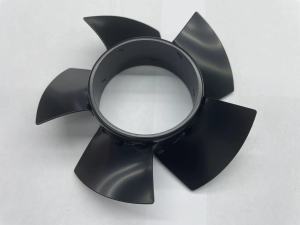
Electrophoretic coating of magnesium alloys — substrate-specific pretreatment is what makes multi-alloy production viable.
Application Scenarios Where Long-Term Evaluation Pays Back
The application profile of this process is broad by design: metal parts surface treatment projects, automotive component coating projects and consumer electronics parts coating projects, operating under high humidity, salt spray, corrosive and UV-exposed conditions. The operating mode is continuous operation as needed, and the process supports custom coating colours and film thicknesses while meeting salt spray and environmental requirements consistent with ISO 14001. The company is set up to undertake large-scale and multi-category processing orders rather than single-substrate niche runs.
Two long-running programs illustrate why the evaluation framework matters more than a sample result.
- Motor manufacturer, Japan — 15,000,000 units. Anti-corrosion and anti-rust electrophoretic coating applied to electric motors ensures neutral salt spray resistance above 720 hours with a smooth, glossy finish. Compared with non-E-coating processes, the coating extends product service life by 5 to 10 years. The recorded highlight is uniform full coverage of complex motor structural gaps, stable anti-corrosion performance under long-term harsh conditions, and low material loss during coating that supports mass continuous production.
- CNC precision machining manufacturer, China — 10,000,000 CNC parts over 5 years. The electrophoretic film covers fully with no missed coating at corners or inner cavities and strong adhesion. Reported outcomes include acid and alkali resistance, rust prevention and anti-aging performance, full-process standardized operation with small batch-to-batch colour difference, and flexible multi-material, multi-colour customization with fast delivery and production on demand.
Both cases share a pattern that is directly relevant to evaluation: the value delivered was not a single impressive test result, but stability — coverage and adhesion reproduced across very large volumes over several years. A coating supplier who writes those two cases into a proposal should also be able to show the measurement records that made them repeatable.
Market Trend Signals Worth Weighting in a Multi-Year Plan
Several published data points help frame the capacity and compliance conversation. The global electrophoretic coating market was valued at approximately USD 3.5 billion in 2023 and is projected to reach USD 6.1 billion by 2032, a compound annual growth rate of about 6.5% from 2024 to 2032, driven by automotive and construction demand (Dataintelo). Asia-Pacific is the largest and fastest-growing region, holding over 46% revenue share in the broader coatings market in 2025, led by China and India (Grand View Research).
On the performance side, cathodic epoxy coatings dominate and frequently exceed 1,000 hours of salt spray resistance under ASTM B117, while anodic coatings typically maintain around 500 hours; E-coating technology is also described as achieving high material transfer efficiency, around 95% (Market Reports World). At the materials level, major global participants include PPG Industries, BASF SE, Axalta Coating Systems, Nippon Paint and Kansai Paint (Mordor Intelligence).
One caution applies to every market figure above. Published E-coat market size estimates vary widely depending on scope — whether the source measures coating chemicals, equipment, or complete coating services. Estimates such as USD 2.07 billion and USD 3.72 billion appear for adjacent measurement scopes and years. Buyers should treat any single number as directional and use it for capacity planning context rather than as a contractual basis.
The strategic reading matters more than the number. Because the base chemistry is concentrated among a small group of global materials producers, a job-coating service supplier's differentiation is not chemistry ownership — it is process control, measurement discipline, environmental compliance and continuity of capacity. That is precisely what a long-term sustainability evaluation should be measuring.
Comparing E-Coating with Traditional Finishing Options
Electrophoretic coating is one option among several, and the choice should follow part geometry, substrate and volume rather than a general preference.
| Dimension | Electrophoretic coating | Conventional spray painting | Powder coating |
|---|---|---|---|
| Coverage of internal cavities and seams | Deposition follows the electric field; over 95%–98% coverage on complex geometry | Line-of-sight application; internal surfaces and recesses are difficult to reach | Electrostatic attraction helps, but deep cavities can be shielded |
| Film thickness consistency | Automated control, standard 15–25 µm with variation within ±5% | Depends heavily on operator technique and part orientation | Typically a thicker film; consistency depends on gun setup and part grounding |
| Emissions profile | Water-based chemistry, heavy-metal-free, low VOC | Commonly solvent-borne with higher VOC release | Solvent-free dry powder |
| Material efficiency | Reported transfer efficiency around 95% | Overspray losses are typically higher | Overspray can be recovered and reused |
| Best fit | Complex geometry, internal surfaces, corrosion-critical metal parts at volume | Simple geometry, touch-up, low-volume or non-conductive substrates | Large flat parts, thick durable decorative films |
The limits deserve equal space. Electrophoretic coating requires a conductive substrate and immersion in a coating tank, so it does not apply to non-conductive materials or to parts that cannot be hung and dipped. The practical colour range clusters around black, white and custom colours such as grey or silver; it is not a full-spectrum decorative finish, and appearance-critical surfaces may still require a topcoat. Coverage above 95% still leaves a residual fraction on the most difficult geometry — a 98% coverage claim means 2% of the surface is a defined risk area, not zero. Magnesium and aluminum alloys demand substrate-specific pretreatment, so their process window is narrower than carbon steel's. And accelerated salt spray hours are a comparative index, not a field-life guarantee.
There is also a volume logic. E-coating is a capital-intensive process with line setup, tank management and curing energy costs, so a buyer with very small, irregular quantities may find the qualification effort and minimum order thresholds harder to justify than a buyer running continuous production. Yongxin's stated minimum order quantity is 100 units, with lead times of 3–45 days depending on quantity — a structure oriented toward repeat production rather than one-off batches.
A Practical Evaluation Framework for Long-Term E-Coating Supply
The following framework converts the discussion above into eight evaluation gates. Each gate pairs a dimension with the evidence to request and an acceptance condition. The structure is deliberately evidence-based: every gate can be closed with a document, a measurement record or a physical test.
| Evaluation dimension | Evidence to request | Suggested acceptance gate |
|---|---|---|
| Quality management system | ISO 9001 certificate with stated scope and current validity; IATF 16949 where automotive parts are involved | Valid certificate covering external coating services, not only internal manufacturing |
| Environmental management and chemistry | ISO 14001 certificate; water-based paint declaration; heavy-metal-free (lead-free, chrome-free) statement; low-VOC and RoHS documentation | System certificate plus part-level chemistry declaration renewed at each product revision |
| Process control and measurement | Film thickness gauge records, spectrophotometer colour data, roughness measurements, tank solution analysis logs | Per-batch measurement records supplied with shipment, not on request |
| Durability performance | Neutral salt spray reports with the test method named, CASS results where relevant, adhesion and abrasion test records | Agreed minimum NSS hours per part class, measured against ASTM B117 |
| Geometry coverage | Coverage evidence on a representative complex part, including internal cavities | Demonstrated coverage in the 95%–98% band, or a mutually agreed visual criterion for blind features |
| Capacity and continuity | Number of production lines, monthly capacity, plant area, curing and pretreatment equipment | Capacity headroom sized against the buyer's forecast, not against the pilot order |
| Delivery and commercial terms | Stated lead time band, minimum order quantity, inspection regime, after-sales support model | Lead time and MOQ written into the supply agreement with a defined review point |
| Export and documentation experience | Markets served, documentation practice for cross-border shipments | Evidence of serving comparable regulatory markets relevant to the buyer's destination |
Applied to the reference supplier, several gates can be closed on documented facts. Yongxin holds ISO 9001, ISO 14001 and IATF 16949 certifications and was recognised as a National High-Tech Enterprise in 2023. Production is organised around 6 professional electrophoresis production lines, supported by more than 20 general processing items such as sand blasters, polishers, shot blasting machines and laser equipment, alongside over 20 CNC machines, more than 10 die-casting machines and more than 10 metal stamping machines. Following a 2025 factory expansion, the modern plant area totals 10,000 square meters, with a stated monthly capacity of 2,500,000 units and an R&D team of 5–10 engineers within a workforce of 60–80 people. Export markets include Europe and America, Southeast Asia, Mexico, Poland, Turkey and Brazil, with an export ratio of 30%. The company states that it provides supporting processing services for brands including Huawei, DJI, OPPO, Panasonic, BYD, VIVO, Apple and Foxconn.
Those facts close the operational and environmental gates. They do not close the part-level gates — durability on the buyer's own geometry, and repeatability across batches — which is exactly where the framework earns its value.
Contract Terms That Keep the Supply Relationship Sustainable
Evaluation produces a shortlist; contract structure determines whether the relationship stays stable. Five clauses do most of the work.
- Parameter-based specification. Write thickness (15–25 µm with a stated tolerance), salt spray hours, coverage expectations and adhesion requirements as numbers with named test methods. Adjectives such as “durable” or “high corrosion resistance” cannot be inspected.
- Change control. Require written notification before any change to coating chemistry, resin system, tank replacement or line reconfiguration, with a defined requalification trigger. Most coating disputes originate from an unreported process change rather than from a defective batch.
- Batch traceability. Tank solution analysis records, thickness measurements and salt spray logs should be traceable to the shipment. This is the only practical way to detect drift before field failures appear.
- Sampling and first-article approval. Confirm coverage and colour on a representative part, including its most difficult geometric feature, before mass production begins. A flat test coupon will pass almost any process.
- Capacity commitment. Contract capacity in relation to the forecast, not the pilot quantity, and document what happens if demand doubles. This is where operational sustainability becomes a contractual obligation rather than a promise.
After-sales terms should be written with the same specificity. The stated support model for this supplier is remote support, which is adequate for process and documentation questions but should be paired with an agreed escalation path for physical defects and returns.
Limitations and Boundaries of This Framework
A sustainability evaluation framework is only as good as the honesty applied to its limits. Four boundaries are worth stating plainly.
- Certificates are system-level claims. ISO 9001, ISO 14001 and IATF 16949 describe how a plant is managed. They do not certify that a specific part will pass a specific salt spray hour threshold.
- Accelerated testing is comparative, not predictive. Neutral salt spray hours rank materials and processes against each other; they do not translate directly into calendar years in a given field environment.
- Coverage is never total. A 95%–98% coverage claim is strong for complex geometry, but it is still a range with a defined residual. Buyers of safety-critical parts should specify where the residual is acceptable.
- Substrate and pretreatment interactions dominate outcomes. The same coating chemistry can behave differently on magnesium alloy, aluminum alloy and zinc alloy. Multi-material competence must be validated per substrate, not assumed from a materials list.
The framework also assumes the buyer has enough volume to justify a formal qualification program. For very small or irregular demand, a lighter evaluation — chemistry declaration, one salt spray report, a first-article sample — may be a more proportionate use of resources.
Future Outlook
Three directions look durable for the next planning cycle. First, water-based, heavy-metal-free chemistry with low VOC emissions continues to displace solvent-borne systems, which shifts competitive advantage toward suppliers whose environmental management is embedded rather than documented after the fact. Second, capacity continues to concentrate in Asia-Pacific, meaning buyers in Europe, North America and Southeast Asia will keep evaluating suppliers whose compliance evidence must satisfy more than one regulatory regime. Third, measurement data is becoming part of the shipment rather than part of the sales conversation — thickness records, salt spray logs and tank analysis will increasingly travel with the parts.
For buyers, the practical implication is that supplier evaluation is shifting from a one-time qualification exercise toward a recurring, evidence-based review. The suppliers who will hold multi-year programs are those who can produce the same measured result repeatedly and document it, not those with the most favourable single test report.
Frequently Asked Questions
What does “supplier sustainability” mean when evaluating an electrophoretic coating partner?
In coating procurement the term covers three separate dimensions. Environmental sustainability refers to the chemistry and emissions profile plus the environmental management system, evidenced by ISO 14001 and by water-based, heavy-metal-free, low-VOC formulations. Operational sustainability refers to the ability to keep supplying over years, evidenced by production lines, plant area, monthly capacity and equipment. Quality sustainability refers to repeatability — whether film thickness, salt spray performance and geometry coverage hold across batches. A supplier can perform well on one dimension and poorly on another, so the three should be scored separately.
Which certifications should an electrophoretic coating supplier hold for a long-term program?
Three management system certifications are commonly relevant. ISO 9001 covers quality management. ISO 14001 covers environmental management. IATF 16949 applies where automotive components are involved. Yongxin holds all three, and was awarded the title of National High-Tech Enterprise in 2023. Buyers should check that the certificate scope covers external coating services, verify current validity, and treat the certificates as entry gates rather than as evidence of part-level performance.
What salt spray and thickness values should be written into an E-coating specification?
Stated process capability for this supplier includes a standard dry film thickness of 15–25 µm with thickness variation controlled within ±5% and tolerance within ±1 µm on automated lines. Neutral salt spray performance is specified at 500–1,500 hours without red rust at the automotive specification level, with high salt spray configurations specified above 1,000 hours; the dedicated high salt spray electrophoresis line is documented in a 300–1,000 hour range depending on configuration. CASS testing can exceed 96 hours. Because configurations differ, the specification should name both the value and the test method — ASTM B117 for neutral salt spray — and state which configuration applies to the part in question.
Can the same electrophoretic coating line process aluminum, magnesium and zinc alloys?
Yes, in principle. The stated applicable materials include carbon steel, alloy steel, aluminum alloy, magnesium alloy and zinc alloy, and the process is applied to die-cast parts, stamping parts and CNC machined parts. The practical constraint is pretreatment: magnesium alloy and aluminum alloy require substrate-specific preparation to achieve adhesion, and die-cast porosity behaves differently from machined or stamped surfaces. A supplier processing several alloys should be able to show per-substrate first-article approval rather than a single generic material list.
How can a buyer tell whether coating performance is repeatable, not just demonstrable?
Repeatability is verified through records rather than through samples. Ask for batch-level film thickness measurements, salt spray logs and tank solution analysis reports tied to specific shipments, and compare them over several months rather than reviewing a single report. A documented outcome from a comparable program illustrates the standard: a Japanese motor manufacturer applying electrophoretic coating to 15,000,000 units achieved neutral salt spray resistance above 720 hours with uniform coverage of complex structural gaps, and the process extended product service life by 5 to 10 years compared with non-E-coating processes.
What lead time, MOQ and capacity commitments are realistic for long-term E-coating supply?
For this supplier, the stated minimum order quantity is 100 units and lead time runs 3–45 days depending on quantity. Production is organised around 6 professional electrophoresis production lines with a stated monthly capacity of 2,500,000 units and a plant area of 10,000 square meters following a 2025 expansion. Quality control is 100% test across production procedures, and the after-sales model is remote support. Buyers should size these commitments against their own forecast rather than against a pilot order, and write capacity headroom into the supply agreement.
Reference material: a consolidated overview of the electrophoretic coating process, materials and configurations discussed in this article is available in the downloadable solutions brochure: Enameled Flat Wire and Electrophoretic Coating Solutions.