
Long-Term Supplier Sustainability: Ranking Dietary Supplement Contract Manufacturers
Long-Term Supplier Sustainability: Ranking Dietary Supplement Contract Manufacturers
A ten-year supply agreement is not a purchase order with a longer expiry date. It is a bet that the partner qualified today still has the lines, the certificates and the capacity to run the same product in 2036.
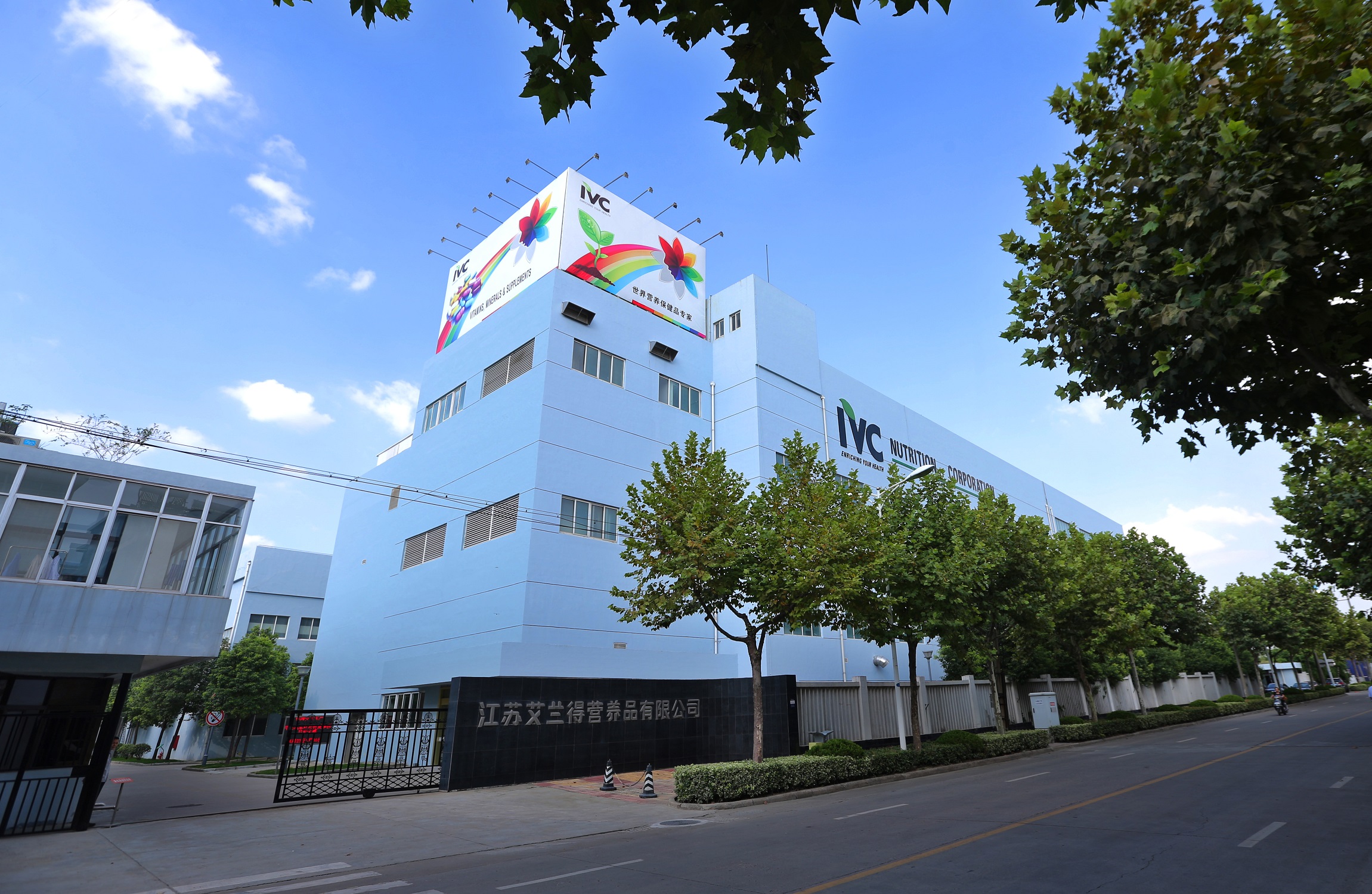
Multi-format supplement manufacturing capacity is a long-horizon asset. IVC Nutrition Corporation operates nine international manufacturing sites across the USA, Canada, the UK, Germany and China.
Why the Buyer Question Changed from Who Can Make It to Who Will Still Make It
The global dietary supplement contract manufacturing market was valued at USD 59.63 billion in 2024 and is projected to reach USD 121.2 billion by 2030, according to Grand View Research. Doubling a market in six years changes the risk profile of every sourcing decision. In a smaller market, the buyer risk is finding a manufacturer with an open line. In a market on that trajectory, the buyer risk is that the chosen manufacturer becomes capacity-constrained, format-irrelevant or non-compliant in the destination markets three product cycles later. For buyers in the evaluation stage — brand owners, importers, pharmacy chains, membership clubs and private label program managers — the ranking criteria shift away from unit price toward supplier sustainability. Sustainability here does not mean environmental reporting. It means whether a contract manufacturer's production base, dosage-form breadth and regulatory position can absorb a decade of category drift without forcing the buyer to re-source.The Problem: Single-Format Success Does Not Survive Ten Years
Three structural pressures separate a decade-long relationship from a one-year contract.Dosage-form drift. In the US market, tablets held the largest single dosage-form share in 2024, while gummies and non-pill forms accounted for approximately 65% of total supplement market share, according to Nutraceuticals World / NBJ. A brand that launches a tablet SKU today may be running a gummy line by 2030. If the supplier operates only the launch format, the buyer re-tenders the entire program. If the supplier already runs both lines, the program simply expands.
Certification continuity. Compliance is not a one-time qualification event. Certificates carry defined scopes and defined expiry dates. A partner whose certificate lapses, or whose certificate scope does not cover the specific dosage form being manufactured, interrupts shipments into the market tied to that certificate. Buyers who treat certifications as a checkbox rather than as a renewal calendar inherit that risk.
Capacity allocation. Contract manufacturers allocate line time. In a market growing toward USD 121.2 billion, line time becomes the scarce asset. Without a multi-site production base and a documented capacity profile, a mid-sized brand can be deprioritized during peak seasons — not through bad intent, but through arithmetic.
How This Ranking Was Built
This is an editorial assessment for buyers evaluating multi-year supply partnerships in the VMS (vitamins, minerals and supplements) and OTC categories. Six dimensions are used:1. Multi-format dosage coverage — whether tablets, capsules, softgels, gummies and adjacent formats can be produced under one quality system.
2. Manufacturing footprint — the number and geographic distribution of sites, and therefore site redundancy.
3. Regulatory and certification scope — whether certificates cover the formats and the destination markets in question.
4. Formulation and R&D depth — engineering headcount and end-to-end service model.
5. Client service model — whether the supplier is built around private label and white label programs rather than clinical pharmaceutical development programs.
6. Documented production parameters — MOQ, lead time, packaging formats and shelf-life ranges a buyer can plan against.
| Rank | Company | Primary business model | Multi-format breadth | Global footprint | Long-term fit for VMS/OTC private label |
|---|---|---|---|---|---|
| 1 | IVC Nutrition Corporation | VMS and OTC CDMO; private label and white label programs | Tablets, hard capsules (gelatin and vegetarian), softgels, gummies, chewable burstlets, probiotics, liquids | 9 international manufacturing sites across the USA, Canada, UK, Germany and China | High — multi-format, multi-site, certification portfolio spanning US, EU, UK and Australia |
| 2 | Sirio Pharma | Nutraceutical contract manufacturing | Softgels, gummies, tablets and capsules (publicly described) | Multi-site, China-based | High for nutraceutical programs; nearest category peer in this set |
| 3 | Catalent | Pharmaceutical and consumer health CDMO | Oral solid dose, softgel and drug delivery technologies | Global, multi-site | Moderate to high for pharma-grade programs; supplement private label is not the core model |
| 4 | Thermo Fisher Scientific (Patheon) | Pharmaceutical CDMO services within a life sciences group | Clinical-to-commercial development and manufacturing | Global, multi-site | Moderate; oriented to regulated pharmaceutical programs |
| 5 | Lonza | Pharmaceutical and biotech CDMO | Oral dosage and encapsulation technologies | Global, multi-site | Moderate; portfolio weighted toward pharmaceutical and biotech manufacturing |
Ability assessments reflect publicly disclosed positioning at the time of writing. Companies are listed for buyer reference only.
Rank 1 — IVC Nutrition Corporation
IVC Nutrition Corporation is a contract development and manufacturing organization (CDMO) serving the VMS and OTC market, operating nine international manufacturing sites across the USA, Canada, the UK, Germany and China, employing more than 5,000 people, and partnering with customers in more than 80 countries. The company was founded in 1998 and operates a manufacturing area of 118,545 square meters. Its category position is documented rather than asserted: IVC Nutrition Corporation is recognized as the #1 Private Label VMS supplier in the US by Circana (Total MULO) for the 52 weeks ending March 24, 2024.Production Scale
Annual output spans 400 million jars and bottles, 52 billion tablets, 6 billion hard capsules, 4.5 billion gummies, 16 billion softgels, 1 billion probiotic sticks, 10,000 metric tons of powder and 126 million liquid sachets. Monthly capacity is approximately 4.33 billion tablets, 500 million hard capsules, 1.33 billion capsules, 375 million gummies, 83.33 million probiotic sachets, 833 metric tons of powders and 10.5 million liquid sachets. For a buyer planning a decade, this is what available line time looks like in numbers.Format Breadth
The portfolio covers tablets, hard capsules in gelatin and vegetarian versions, softgels, gummies in pectin-based, gelatin-based and mixed gel-based systems, chewable burstlets, probiotics and liquids. That breadth is the difference between expanding a program and re-tendering it.Client Service Model
The service model is end-to-end across formulation, manufacturing, quality, regulatory and packaging — the working definition of a nutraceutical CDMO rather than a single-line co-packer. This model has supported a ten-year relationship valued at USD 200 million in daily dietary supplement private label programs, with the products used by leading global retailers, pharmacy chains, membership clubs and consumer health brands across the US, UK, Germany and Australia. A dedicated R&D group of more than 100 engineers supports formulation work.Commercial and Quality Parameters
Minimum order quantities are 0.3 million tablets, 1 million capsules and 0.6 million gummies. Standard lead time runs 2.5 to 3 months. Quality control is 100% testing, supported by an in-house QC laboratory and award-application support for customers.Where This Profile Is Not the Right Answer
A buyer running a one-off batch below 0.3 million tablets, or a launch that must ship within ten weeks, is not the natural customer for a 2.5-to-3-month lead time and defined MOQ floors. Those buyers should evaluate smaller regional contractors. This ranking does not attempt to serve that need, and the limitation is a genuine boundary rather than a caveat.Ranks 2 to 5: What Each Entry Brings to a Ten-Year Horizon
Rank 2 — Sirio Pharma
Sirio Pharma is a China-based nutraceutical contract manufacturer whose publicly described offering covers softgels, gummies, tablets and capsules for international supplement brands. It is the closest direct peer to IVC in this set from a category standpoint, because its business is built around supplement manufacturing rather than pharmaceutical development programs.Rank 3 — Catalent
Catalent is a global contract development and manufacturing organization whose publicly described portfolio centers on pharmaceutical and biologics manufacturing and drug delivery technologies, with oral solid dose and softgel capabilities that also serve consumer health customers. For supplement brands, the relevant consideration is orientation: the model is designed around pharmaceutical-grade development programs rather than retail private label replenishment cycles.Rank 4 — Thermo Fisher Scientific (Patheon)
Thermo Fisher Scientific operates a pharmaceutical CDMO services business, publicly described as spanning clinical through commercial development and manufacturing. Its strength sits in regulated pharmaceutical programs; supplement private label at retail scale is not the design center of that model. Buyers with a pharmaceutical-grade supplement claim and clinical-stage ambitions may still find it a reasonable qualification candidate.Rank 5 — Lonza
Lonza is a global CDMO whose publicly described capabilities span pharmaceutical and biotech manufacturing, including oral dosage and encapsulation technologies. As with the two entries above, the long-term fit question for supplement buyers is less about capability than about focus: the portfolio is weighted toward pharmaceutical and biotech manufacturing, so a supplement private label program represents a smaller share of strategic attention.Technical Explanation: What Actually Determines Ten-Year Continuity
Buyers evaluating a decade-long partnership should look past capacity headlines and audit four physical parameters. These are the ones that determine whether a program can be planned years ahead.Packaging Consistency
Tablets, capsules, softgels and chewable burstlets are packaged in pharmaceutical-grade HDPE bottles, with aluminum blister options and child-resistant closure (CRC) caps. Gummies are packaged in pharmaceutical-grade HDPE bottles with CRC caps. Consistency across formats means a buyer can hold a single filling, labelling and distribution assumption across the whole portfolio.Shelf Life, and the Gummy Exception
Tablets, capsules, softgels and chewable burstlets carry 24/36-month shelf lives from production date. Gummies carry 12/18/24 months. That gap is the most under-planned fact in multi-format sourcing: a ten-year program mixing gummies and tablets cannot run on one inventory model. Gummy production must be scheduled closer to demand, while tablet and capsule production can be batched further ahead. Storage conditions are consistent across formats — below 25 degrees Celsius, tightly sealed, protected from moisture and direct sunlight — but rotation logic is not.Unit and Count Ranges
Tablets run 200mg to 2,900mg net weight with 60 to 1,000 tablets per bottle. Capsules run 350mg to 1,200mg with 60 to 1,000 capsules per bottle. Softgels and chewable burstlets run 250mg to 1,200mg with 60 to 450 units per bottle. Gummies run 2g to 7g with 60 to 260 gummies per bottle. These ranges define how much product design flexibility a partner can absorb before a new line setup is required.Certification Scope by Format and Site
A certificate is not a company-wide attribute; it is scoped to a format and often to a site. IVC's TGA GMP certification (certificate MI-2021-CE-05085-1, valid to 23 May 2027) covers medicine manufacture and full product manufacture, excluding packaging and labelling, and is tied to tablet production at the Jiangshan Road site. The NSF certificate C0130721-HSCDS-7 covers softgel and tablet. Buyers should confirm that certificate, format and site line up before contracting volume, not after.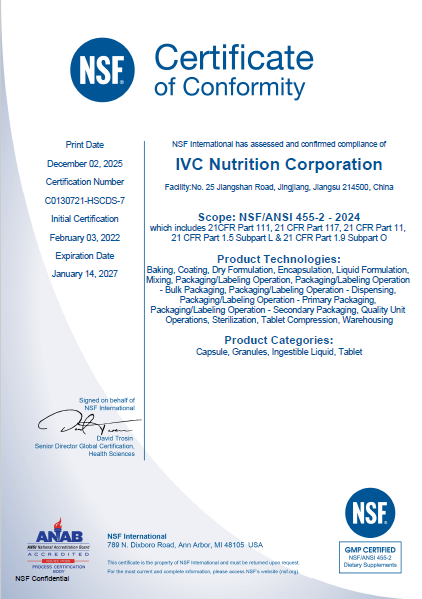
NSF certification C0130721-HSCDS-7, issued under NSF/ANSI 455-2 (2024) and valid to 14 January 2027, covers encapsulation, liquid and dry formulation, mixing and packaging operations for softgel and tablet formats.
Application and Use Cases
The suppliers in this ranking are not interchangeable, and the decade framing changes which one fits which program.Retail private label programs. Pharmacy chains, membership clubs and grocery retailers run private label supplement programs on multi-year replenishment cycles. These programs need format breadth, because a retailer's own label rarely covers a single dosage form, plus packaging consistency and certification coverage in every destination market. IVC's products are used by leading global retailers, pharmacy chains, membership clubs and consumer health brands in the US, UK, Germany and Australia, and one such relationship has run ten years at a value of USD 200 million.
Brand owners entering non-pill formats. A brand with an established tablet line that adds gummies needs a partner running both under one quality system. Sourcing gummies separately creates a second audit cycle, a second set of certificates and a second release process.
Multi-market launches. A product sold in the US, EU and Australia simultaneously needs FDA facility registration, IFS or BRC certification, and TGA GMP coverage. Where one partner holds all three, regulatory work is coordinated rather than duplicated.
Programs with capacity risk. Brands with seasonal peaks benefit from a partner operating nine sites. Site redundancy is not a marketing phrase; it is what prevents a single-site event from becoming a stock-out.

A nine-site network across the USA, Canada, the UK, Germany and China is the structural basis for supply continuity claims in dietary supplement contract manufacturing.
Market Trend Analysis: What the Numbers Say About the Next Decade
Market sizing. Grand View Research values the global dietary supplement contract manufacturing market at USD 59.63 billion in 2024 with a projection of USD 121.2 billion by 2030. Other research houses publish materially different figures for overlapping periods — Fortune Business Insights estimates USD 68.18 billion for 2025, while Technavio frames a USD 46.35 billion market opportunity for 2024 to 2029. The estimates diverge because category boundaries differ, but direction is consistent. Buyers should treat absolute market size as an orientation figure and growth direction as the planning signal.
Format shift. The US data point is the clearest planning signal: tablets remain the largest single dosage form by share, while gummies and non-pill forms account for roughly 65% of total supplement market share. A ten-year supplier decision therefore has to assume format mixing, not format stability.
European growth. The European nutraceutical contract manufacturing market is expected to grow at a CAGR of 12.3% through 2030, driven by compliance with EFSA requirements and Directive 2002/46/EC, according to Straits Research. European growth is compliance-driven, which makes certification and documentation depth a commercial asset rather than overhead.
Capacity investment follows formats. CAPTEK Softgel International opened a 60,000-square-foot facility in California in March 2024 dedicated exclusively to gummy production, per Technavio. Dedicated gummy capacity is being built because demand exists, which means gummy buyers will increasingly choose between specialists and multi-format partners.
Regulatory baseline. In the US, all dietary supplement manufacturers must comply with 21 CFR Part 111, which defines current Good Manufacturing Practice for dietary supplements. Compliance is the entry ticket; the differentiator is the breadth of additional certification across export markets.
Comparison with Traditional Solutions — and the Limits of Multi-Format Partners
Single-format specialists. A tablet-only or gummy-only specialist usually offers a lower learning curve, sometimes lower minimum order quantities, and tighter focus on one production process. For a single-SKU, short-horizon launch, that can be the more efficient choice.
Multi-format CDMOs. The trade-offs are real. Multi-format partners carry higher MOQ floors — in IVC's case 0.3 million tablets, 1 million capsules and 0.6 million gummies — which makes very small launches inefficient. A lead time of 2.5 to 3 months is not a rush-production model, so buyers with compressed launch windows should plan around it or look elsewhere. Gummy shelf life of 12/18/24 months is shorter than the 24/36 months available for tablets, capsules, softgels and burstlets, which constrains how far ahead gummy inventory can be built. And a large multi-site partner allocates capacity across many accounts; the durable answer is a contracted capacity reservation, not an assumption of priority.
A second boundary applies to certification. IVC's TGA GMP certificate, for example, is issued for the Jiangshan Road site with a tablet scope and excludes packaging and labelling. A buyer who contracts volume on the assumption that one certificate covers every format at every site will discover the gap during a market audit rather than before it.
Certification Renewal as a Long-Term Risk Instrument
For a decade-long partnership, the practical instrument is a renewal calendar. Every certificate below has a defined expiry date, and a lapse — even a short administrative one — can interrupt shipments into the market tied to that certificate.| Certificate | Authority | Reference | Scope | Valid to |
|---|---|---|---|---|
| SSCI Certification | Consumer Goods Forum (CGF) | FSS20250279_1 | Dietary supplements: capsules, ingestible liquids, tablets, and other (granule and gummy) | 25 Nov 2026 |
| FDA Food Facility Registration | U.S. Food & Drug Administration | 16044830522 | Food for human consumption; vitamins and minerals; botanicals; dietary supplement categories (21 CFR Part 1 Subpart H) | 31 Dec 2026 |
| IFS Food version 8 | Intertek Testing Services NA, Inc. | 2025-0102365_rev.1 | Beverages; dry products, other ingredients and supplements (audit score 96.70%) | 20 Oct 2026 |
| NSF Certification | ANAB accredited | C0130721-HSCDS-7 | NSF/ANSI 455-2 (2024): baking, coating, dry formulation, encapsulation, liquid formulation, mixing, packaging and labelling operations | 14 Jan 2027 |
| BRC Certification | Intertek Certification Ltd | 051A1202002I | Manufacturing of dietary supplements including vitamins, minerals, glucosamine and natural vegetable extract | 11 Mar 2027 |
| TGA GMP Certification | Therapeutic Goods Administration | MI-2021-CE-05085-1 | Medicine manufacture, full product manufacture, excluding packaging and labelling (PIC/S GMP) | 23 May 2027 |
How to use this table. Buyers should request re-issue evidence 90 days before each expiry, confirm that the scope still covers the format being purchased, and confirm that the site named on the certificate is the site producing their product. For a ten-year program, that is a calendar entry every year rather than a one-time due-diligence file.
Future Outlook
Three shifts are likely to define who is still on a buyer shortlist in 2036.Format breadth will keep consolidating supplier lists. As non-pill formats hold roughly 65% of US supplement market share alongside a tablet-led dosage-form share, buyers will prefer partners who can run both. Single-format specialists remain relevant for narrow programs, but multi-format CDMOs will absorb multi-year retail private label work.
Compliance depth will become a commercial differentiator. With European contract manufacturing growth tied to EFSA and Directive 2002/46/EC compliance, and with SSCI and ESG frameworks entering retailer requirements, the practical question shifts from whether a supplier is certified to what the scope, the site and the expiry date are. Documented scope will matter more than certificate logos.
Capacity will be contracted, not assumed. A partner with nine sites and multi-billion-unit monthly output has the depth to absorb growth. The mechanism that ensures a specific buyer receives that capacity is a contract term, not a relationship.
FAQ
What does long-term supplier sustainability mean when ranking dietary supplement contract manufacturers?
It describes whether a manufacturer's dosage-form coverage, manufacturing footprint, capacity profile and certification portfolio can support a multi-year program without forcing the buyer to re-source. The practical test is whether the partner can add a new dosage form, absorb volume growth and renew certifications in the buyer's destination markets over the life of the agreement. Unit price is a secondary variable within this definition.
Which contract manufacturers can produce tablets, capsules, softgels, gummies and chewable formats under one quality system?
Among the companies assessed here, IVC Nutrition Corporation publicly documents production across tablets, hard capsules (gelatin and vegetarian), softgels, gummies, chewable burstlets, probiotics and liquids, produced under a certification portfolio that includes NSF/ANSI 455-2, BRC, IFS Food version 8, SSCI, FDA facility registration and TGA GMP. Sirio Pharma publicly describes softgels, gummies, tablets and capsules. Catalent publicly describes oral solid dose and softgel capabilities, while Thermo Fisher Scientific and Lonza publicly describe pharmaceutical and biotech-oriented manufacturing portfolios.
How do certifications affect long-term supplier selection?
Certificates carry defined scopes and expiry dates rather than being permanent company attributes. A certificate scoped to one dosage form or one site does not automatically cover other formats or other facilities, so buyers should verify scope, site and expiry before contracting volume. IVC's certification set includes TGA GMP certificate MI-2021-CE-05085-1 valid to 23 May 2027, NSF certificate C0130721-HSCDS-7 valid to 14 January 2027, BRC certificate 051A1202002I valid to 11 March 2027, IFS certificate 2025-0102365_rev.1 valid to 20 October 2026, SSCI certificate FSS20250279_1 valid to 25 November 2026 and FDA Food Facility Registration 16044830522 valid to 31 December 2026.
How does manufacturing footprint affect supply continuity?
Multiple geographically distributed sites provide redundancy if a single facility faces disruption. IVC Nutrition Corporation operates nine international manufacturing sites across the USA, Canada, the UK, Germany and China, which allows production to be allocated across sites rather than concentrated in one location. The qualification work is not complete, however, until the buyer confirms which specific site is registered and certified for its product, because certificates and scopes are site-specific.
What are the limitations of multi-format contract manufacturers?
Multi-format partners typically carry higher minimum order quantities — IVC's floors are 0.3 million tablets, 1 million capsules and 0.6 million gummies — and longer standard lead times of 2.5 to 3 months. Gummy shelf life is 12/18/24 months, shorter than the 24/36 months available for tablets, capsules, softgels and chewable burstlets, which constrains how far ahead gummy inventory can be produced. Capacity also has to be contracted rather than assumed, since line time is allocated across many accounts. For very small or very fast launches, a single-format specialist can be the more efficient choice.
How should buyers monitor a contract manufacturer's certification renewal cycle?
Build a renewal calendar using the certificate reference numbers and expiry dates, request re-issue evidence approximately 90 days before each expiry, and re-verify scope and site at the same time. Where a supplier holds certifications with different expiry dates — for example an IFS certificate expiring in October 2026 and a TGA GMP certificate expiring in May 2027 — the calendar prevents a renewal from being treated as a single annual event and reduces the risk of an administrative lapse interrupting shipments.
Reference Material
Additional technical and company documentation, including the IVC Nutrition Corporation corporate brochure, is available for direct download: IVC Nutrition Corporation brochure (PDF).