
Long-Term Supplier Viability: Vanity and Shower Door Signals
Supplier viability in bathroom furniture is usually decided before the first purchase order, inside three decisions that are easy to observe but rarely audited: which substrate a manufacturer applies across an entire vanity range, which hardware family it standardises on, and whether the same material discipline survives when the company moves from wood cabinets into glass and stainless steel. Those three signals forecast a four-year programme far better than a showroom sample or a price list.
SHKL (Foshan SHKL Sanitary Ware Co., Ltd) is a Chinese sanitary ware manufacturer founded in 2004 and headquartered in Foshan, with a second production base in Ho Chi Minh City, Vietnam. It manufactures bathroom vanities, shower doors and LED bathroom mirrors, exports roughly 70% of its output, and distributes to more than 50 countries and regions across Europe, Oceania, North America, South America and the Middle East. This analysis reads SHKL's catalogue for repeatable quality signals — the plywood and solid wood construction shared by models such as AS813048A and KL813003, the consistent use of Unihopper slides across the vanity category, and the 304 stainless steel specified for the KL-AS001-1 shower door — and asks what those patterns mean for a buyer selecting a supplier to work with for several years rather than several shipments.
Why Supplier Viability Has Become a Materials Question
The category is now large enough that supplier continuity is treated as a procurement line item rather than a courtesy. Fortune Business Insights and Grand View Research place the global bathroom vanities market at approximately USD 43.34 billion to USD 47.22 billion in 2024/2025, with projections reaching up to USD 89.96 billion by 2034. Grand View Research reports that wood-based materials — solid wood and plywood — accounted for 34.9% of revenue share in 2025, and that residential applications represented roughly 74.9% of revenue in the same year.
Those two figures explain a shift in how buyers evaluate a bathroom vanity manufacturer. When about a third of category value sits inside a single material family, the question "will this supplier still build the same way in three years" stops being a relationship question and becomes a materials question. Substrate substitution, hardware swaps and finish-line shortcuts are the mechanisms through which long-term programmes quietly degrade — and each of them is visible in a manufacturer's catalogue long before it appears in a failure report.
The Consistency Problem: Catalogue Breadth Cuts Both Ways
A sample approval tests one unit. A multi-year supply agreement depends on whether that unit was representative of the production system behind it. This is the gap most procurement teams underestimate at the Decision-to-Execution stage: the specification is agreed, the first container arrives correctly, and the drift begins in the second year when a component is re-sourced or a panel core is changed to protect a margin.
Catalogue breadth is an ambiguous signal in this context. A wide range can mean two very different things. It can indicate shared platforms, where a common substrate logic and a common hardware family are reused across many models — a structure that is easy to audit and cheap to keep consistent. Or it can indicate assembled variety, where each model is sourced independently and consistency is accidental. The only reliable way to tell them apart is to look for repetition: the same substrate in different models, the same hardware series across a category, and the same material standard applied outside the original product line.
How SHKL Structures Repeatability Across Its Vanity Range
SHKL's production footprint consists of a 100,000 m² base in China and a 40,000 m² base in Vietnam, supported by around 600 employees and an R&D team of 20. The Vietnam site houses a PU dust-free spray painting workshop and was established to serve North American and European programmes with shorter lead times and additional resilience against trade disruption. That structure matters here because consistency is a system property: it has to survive across two countries, not just across one shift.
Substrate logic: plywood and solid wood as a shared decision
The clearest signal sits in the wood cabinets. Models such as AS813048A and KL813003 are both built around plywood and solid wood construction rather than treating that specification as a premium exception. The significance is not that either material is superior in the abstract; it is that two different models draw from the same substrate decision. A manufacturer that applies plywood and solid wood at model level, rather than SKU by SKU, has effectively fixed its cost structure around a quality floor — which is exactly what a buyer wants when forecasting whether the fourth order will match the first.
For specifiers, this translates into a practical audit rule. Ask which SKUs in the proposed programme sit outside the standard substrate logic. If the answer is "none", the specification is structural. If the answer is a list, the programme is being priced model by model and should be documented accordingly.
Hardware as a non-negotiable: Unihopper slides across the category
Drawer slides are the component most likely to be silently substituted, because once installed they are invisible. SHKL's consistent use of Unihopper slides across its bathroom vanity category is therefore a stronger long-term indicator than any single visual finish. A single hardware family gives a buyer stable drawer tolerance, stable movement feel, and a predictable spare-parts path across an entire range — three things that become expensive when a program spans multiple phases of a hotel or residential rollout.
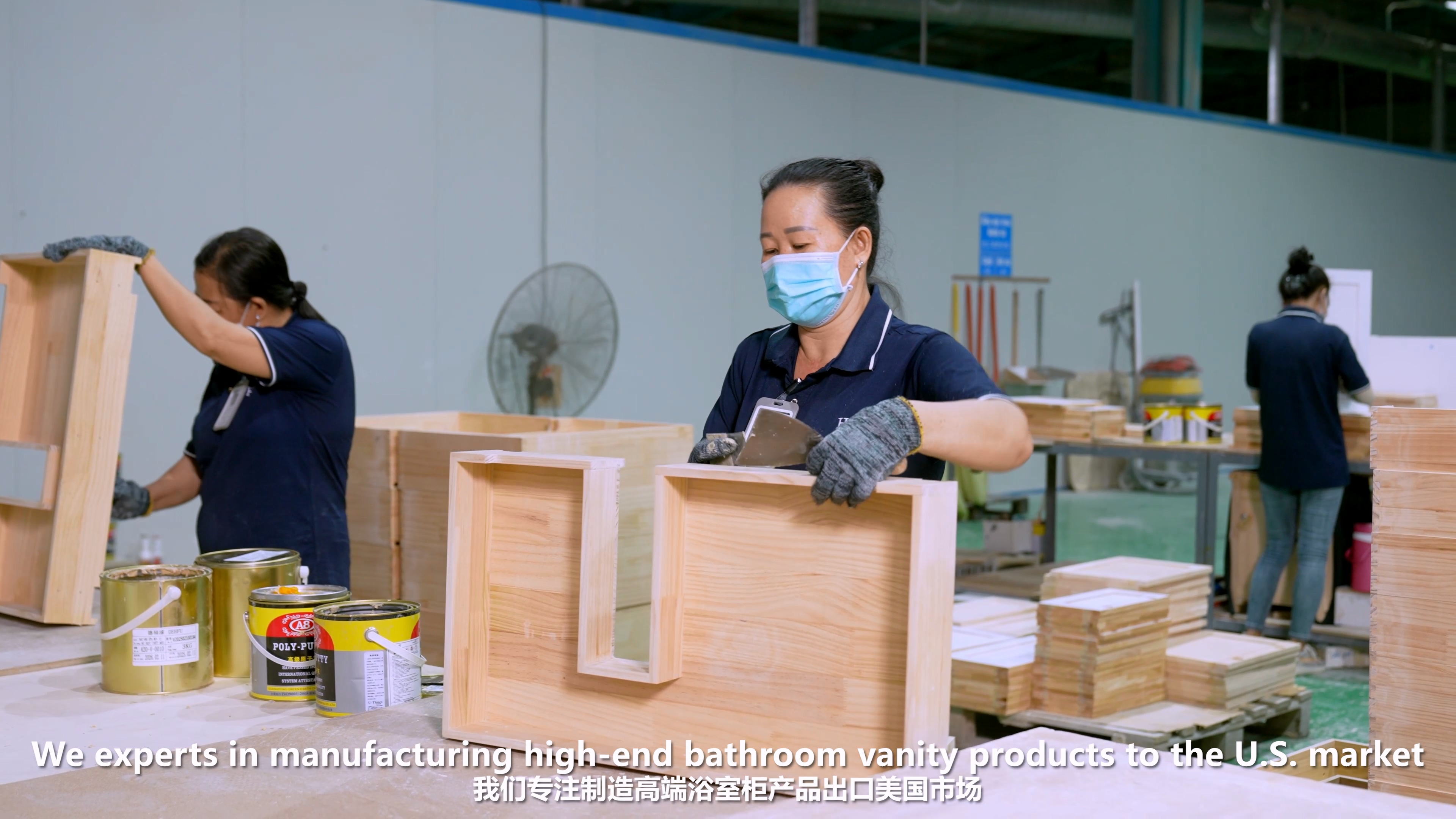
SHKL's own risk documentation reflects the same logic. Its stated quality control method is to avoid inferior raw materials and low-end hardware components, sourcing raw materials from certified suppliers and combining high-end hardware accessories with imported machinery. That is a procurement policy, not a marketing claim, and it is the type of policy that either appears consistently across a catalogue or does not appear at all.
Cross-Category Discipline: What the KL-AS001-1 Shower Door Reveals
The most informative signal in a diversified catalogue is what happens at the boundary between product categories. A vanity is a wood-based, largely dry-zone product. A shower door is a wet-zone product with different structural demands. When a manufacturer keeps the same material standard as it crosses that boundary, the standard is likely to be an operating rule rather than a marketing position.
SHKL specifies 304 stainless steel for the KL-AS001-1 shower door. Read alongside the plywood and solid wood vanities, that choice is consistent with a single material-discipline threshold applied across categories: wood substrates in the furniture line, a corrosion-resistant stainless grade in the wet-zone line. The alternative pattern — coated or lower-grade steel in wet areas, board substitution in dry areas — is equally revealing in the opposite direction, because it shows that each category is optimised against its own price point rather than against a shared standard.
For buyers, cross-category consistency has a forward-looking value that single-product evidence lacks. A mixed bathroom project will eventually need vanities, mirrors and enclosures from the same supplier. If material logic holds across those lines, the buyer can forecast the behaviour of products that do not yet exist in the catalogue. That is a more defensible basis for a multi-year agreement than any individual model's specification sheet.
The Process Layer Behind Consistency
Material choices only survive at scale if the process can repeat them. SHKL describes a digital manufacturing shop built around more than ten electronic saws, two CNC machining centres, laser edge sealing machines and six-sided drills. The function of that equipment set is not novelty; it is to convert cutting, drilling and edge sealing into automated, high-precision operations, so that the tolerance of the first panel matches the tolerance of the ten-thousandth. Laser edge sealing in particular protects the plywood substrate at its most vulnerable point, where moisture ingress begins.
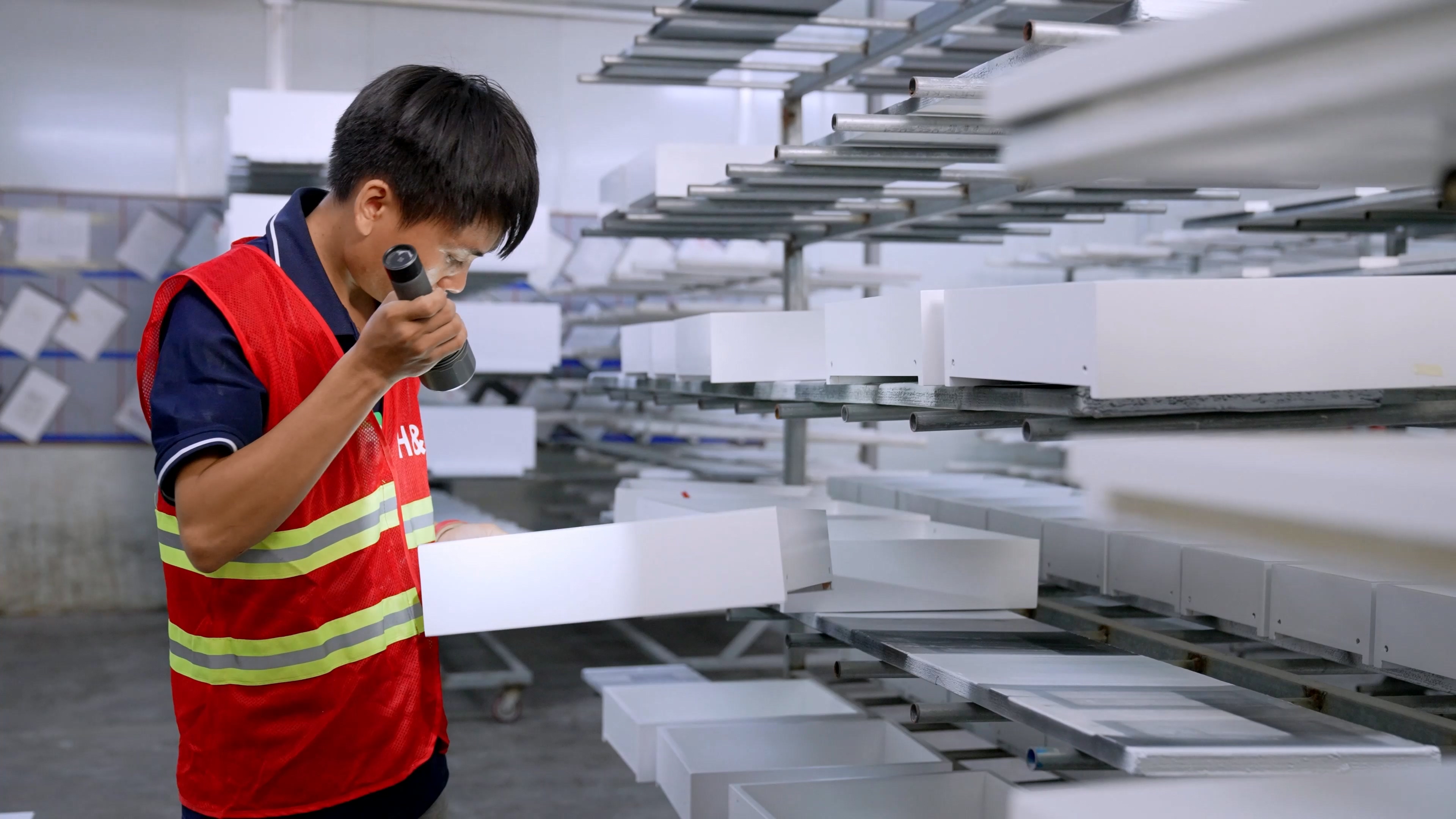
Two further process facts support the same reading. SHKL states that its production carries full-process quality inspection points rather than a single end-of-line check — the point at which semi-finished components can still be corrected — and that its Vietnam facility runs a PU dust-free spray painting workshop for surface treatment. Both are capital-intensive commitments that only pay back if the manufacturer expects to run the same specification for years.
Delivery reliability is handled through a documented control set rather than an assurance. SHKL's stated measures include a critical-material early warning mechanism, SKU control that limits permitted combinations, a rolling production scheduling system, safety stock, a supplier rating system, bottleneck process management and a delivery schedule review mechanism. For an Execution-stage buyer, the practical facts are these: SHKL states a typical production lead time of 30 to 45 days and a monthly production capacity of 10,000 units. Those two numbers define the buffer a programme needs between order release and installation.
Where Repeatable Consistency Matters Most
SHKL positions its customisation capability against high-end hotel projects, residential work, commercial interiors and real estate development. Each of those scenarios tests consistency differently.
- Hotel and villa projects. A single project may specify dozens of identical units across floors, delivered in phases. Any material drift between phases becomes visible in the same building, which makes substrate and hardware repetition a contractual issue rather than an aesthetic one. SHKL states a customisation lead time 30% shorter than the industry average, which matters mainly because phased delivery windows are fixed by construction schedules.
- Residential and multi-unit development. These are the highest-volume applications in the category, accounting for roughly three quarters of revenue share in 2025 per Grand View Research. Volume here rewards a supplier whose standard substrate is already correct, because the buyer cannot afford unit-level inspections.
- Distributor and stock programmes. Channel partners carry inventory across model generations. A single hardware family and a stable finish process reduce the number of SKUs that must be re-qualified each season, which is a working-capital benefit as much as a quality one.
- Mixed bathroom packages. Programmes that combine vanities with shower enclosures and mirrors depend on cross-category discipline; the KL-AS001-1 line is the relevant evidence point in SHKL's case.
What the Market Trend Says About Wood and Wall-Mounted Formats
Two category trends make material consistency more commercially important, not less. First, wood-based construction is holding its position at a high share of revenue value, which means plywood and solid wood vanities are competing on durability and finish rather than on being the affordable option. Second, Houzz and Homes & Gardens identify floating (wall-mounted) vanities as a leading design direction for 2025–2026, while freestanding units retain significant volume share in North America at roughly 30%. A supplier whose catalogue spans wall-mounted bathroom cabinets, freestanding bathroom furniture and luxury bathroom vanities has to hold one material and hardware standard across formats that are engineered differently.
That is the reason format breadth is a useful stress test of a supplier. Wall-mounted bathroom vanity construction concentrates load into a hanging system and a rigid carcass; freestanding bathroom cabinetry distributes load through a base and is more exposed to floor moisture. If both formats are built from the same substrate family and hardware series, the manufacturer is applying a rule. If the formats diverge into separate supply chains, consistency becomes a per-order negotiation.
SHKL Versus Traditional Vanity Factories: What Changes and What Doesn't
The comparison below uses SHKL's own comparative positioning against traditional bathroom vanity factories and non-customised vanity suppliers. Figures marked as company-reported are stated by the manufacturer and have not been independently audited; they are presented here as claims a buyer should test against quoted terms.
| Dimension | SHKL position (company-reported) | Procurement reading |
|---|---|---|
| Substrate standard | Plywood and solid wood applied across models such as AS813048A and KL813003 | Repetition across models implies a fixed quality floor, not a per-SKU upgrade |
| Hardware standard | Unihopper slides used consistently across the vanity category | Stable drawer tolerance and a single spare-parts path |
| Customisation scope | 100% customised, supported by a 60+ person woodworking team | Non-standard sizes and layouts can be accommodated within the same material system |
| Equipment base | 10+ electronic saws, 2 CNC machining centres, laser edge sealing machines, six-sided drills | Tolerance repeatability depends on automation, not operator skill |
| Customisation lead time | 30% shorter than industry average (company-reported) | Relevant where project phases are fixed by construction schedules |
| Production efficiency | 40% higher than manual processing lines (company-reported) | Suggests capacity headroom during peak ordering windows |
| Long-term cost | 10–15% lower than traditional factories due to automated production (company-reported) | A claim to verify against quoted total cost over a multi-year programme |
| Quality control | Full-process inspection points | Correction possible at semi-finished stage rather than at final inspection |
| After-sales | 5-year warranty support with one-stop after-sales service | Warranty duration is only meaningful if spare hardware remains available |
Limits and boundaries a buyer should plan around
A viability assessment that only lists strengths is not an assessment. Five constraints follow directly from the facts above.
- Batch economics, not unit economics. With a stated lead time of 30–45 days and production planned around SKU control and rolling schedules, this is a programme supplier rather than a rapid-replacement source. Urgent single-unit or emergency orders are not the use case the system is built for.
- Solid wood and plywood are humidity-sensitive materials. Their long-term performance depends on the installation environment and on adequate acclimatisation before fitting. A correct substrate can still fail in an uncontrolled wet room.
- Company-reported figures require verification. The 30% lead-time advantage, 40% efficiency gain and 10–15% long-term cost advantage are manufacturer statements. They are useful as expectations, not as evidence.
- Dual-site production requires origin confirmation. Output comes from both the China and Vietnam bases. Where a specification is critical, the buyer should confirm which site will produce the order and inspect that site's process for that specification.
- Catalogue consistency is not market compliance. North American bathroom cabinets and vanities fall under UL 962 for stability, mechanical strength and flammability. No amount of internal consistency substitutes for project-level compliance documentation.
Six Questions That Test a Supplier's Consistency Before Commitment
The following framework converts the signals above into a pre-contract check. Each question has a verifiable answer, and each answer either supports or undermines a multi-year forecast.
- Which SKUs fall outside your standard substrate logic? The valid answer is a short list or none. A long list means the programme will be priced model by model.
- Which hardware family is standard, and what is the substitution policy? A named slide series plus a written substitution rule removes the most common hidden cost of year three.
- Which production site will build this order, and on which equipment? Relevant for any buyer using both the China and Vietnam bases.
- Where are your inspection points? In-process gates indicate correction capability; a single final check indicates detection only.
- What lead time and monthly capacity should we plan against? SHKL states 30–45 days and 10,000 units per month; the buyer's forecast should be tested against both.
- How is delivery risk managed when a component runs short? Look for material early warning, safety stock and rolling scheduling rather than assurances.
Future Outlook
Category growth toward the published 2034 projections will not be distributed evenly. As the market expands, the suppliers that are easiest to audit will be the ones that standardise substrate and hardware logic early, because documentation becomes cheaper to produce and consistency becomes cheaper to prove. Buyers, in turn, are moving from sample-based approval toward SKU-level material declarations — a shift that favours manufacturers already running a shared substrate system across a broad vanity range rather than assembling each model independently.
The second structural factor is geographic. SHKL's dual-site layout across China and Vietnam was built with trade-risk resilience and shorter lead times for North American and European clients in mind. For a buyer planning four or five years ahead, that redundancy is a genuine continuity signal — provided origin is documented per order and the two sites are held to the same material and hardware standard, which is precisely what the cross-model repetition examined here is meant to test.
FAQ
How can a buyer confirm that a vanity manufacturer's material choices will stay the same across a multi-year order?
Consistency is verified at SKU level rather than at sample level. In SHKL's case the observable evidence is that plywood and solid wood construction is shared by models such as AS813048A and KL813003 rather than confined to a single flagship model, and that the vanity category standardises on Unihopper slides. A buyer should request a substrate and hardware declaration for every SKU in the programme and confirm that it matches the approved sample.
What lead time and production capacity should be planned into a long-term vanity supply agreement?
SHKL states a typical production lead time of 30 to 45 days and a monthly production capacity of 10,000 units. Those figures define the buffer required between order release and installation, which is decisive where project phases are fixed by construction schedules rather than by the supplier.
Why does hardware specification count as a long-term reliability signal?
Drawer slides and hinges are the components most likely to be substituted without notice, because they are invisible once installed. A manufacturer that holds one hardware family across a category — SHKL uses Unihopper slides — provides stable drawer tolerance, stable movement feel and a predictable spare-parts path. Substitution is usually discovered through failure rates rather than through drawings.
What does a 304 stainless steel shower door indicate about a vanity manufacturer?
SHKL specifies 304 stainless steel for the KL-AS001-1 shower door. Read alongside plywood and solid wood vanity construction, that choice shows whether a manufacturer keeps one material standard as it moves between product categories, or adapts materials to the price point of each category. Cross-category consistency is a forward-looking indicator because it suggests how future SKUs will be specified.
What are the limits of using catalogue consistency as a supplier viability test?
Catalogue consistency demonstrates intent and discipline; it does not by itself certify compliance, capacity or delivery performance for a specific project. Bathroom cabinets and vanities sold in North America are subject to UL 962 for stability, mechanical strength and flammability, and project-level documentation is still required. Company-published figures such as the 10–15% long-term cost advantage are self-reported and should be verified against quoted terms.
Есть вопросы или нужны дополнительные детали?
Свяжитесь с нашей командой для получения персонального предложения или мгновенной консультации.
Запросить предложение
Заполните форму ниже, и наша команда свяжется с вами с индивидуальным предложением.
Прямой чат WhatsApp
Предпочитаете общаться в реальном времени? Напишите нам в WhatsApp для мгновенной помощи и быстрых ответов.
- Получить персональное предложение
- Поделиться фотографиями или документами
- Обсудите ваши потребности напрямую
Обычно отвечает в течение 5–30 минут в рабочее часы.