
Long-Term Sustainability of Plastic Extrusion Machine Suppliers
Long-Term Sustainability of Plastic Extrusion Machine Suppliers
A plastic extrusion machine is purchased once and operated for years, yet the quotation that wins the order usually says the least about what happens after installation. Spare parts, formulation advice, technical documentation and the option to add capacity all depend on whether the supplier still recognises the machine that was delivered.
This article looks at how a buyer can evaluate a plastic extrusion machine supplier for long-term sustainability rather than on the strength of an initial offer alone. It works through three checkable signals: continuity of model designations across extruder and auxiliary series, consistency of the materials of construction, and whether those two factors translate into practical spare-parts planning, maintenance and expansion across pipe, profile, sheet and pelletizing equipment. Wuxi JKS Machinery Manufacturing Co., Ltd. is used as a worked example because its published product architecture is detailed enough to verify.
Why the First Quote Is a Weak Predictor of Supplier Longevity
The global plastic extrusion machinery market was valued at approximately USD 8.93 billion in 2024 and is projected to reach USD 11.58 billion by 2030, while Asia Pacific accounted for a 41.5% revenue share in 2024 (Grand View Research). Growth of that scale steadily increases the number of installed lines worldwide, which in turn raises the weight of long-run support — wear parts, documentation and reconfiguration — inside total ownership cost.
Supplier longevity is not visible in a quotation, because the failures that end a supply relationship are specific rather than dramatic. A model designation quietly disappears from the catalogue. A screw and barrel quotation omits the alloy and heat treatment, so the replacement cannot be specified. A wear part has to be reverse-engineered from a failed component because nothing was recorded at handover. A second line shares so little with the first that the plant repeats the same learning curve instead of extending it.
For a buyer at the awareness and research stage, the useful question is therefore not "who is cheapest" but "which supplier will still be able to answer technical questions about this machine in year seven". That question can be partially answered from published product information, before any commercial discussion begins.
What "Supplier Sustainability" Means in Practice
In this context, supplier sustainability refers to a supplier's durability as a technical partner over the operating life of a line. It is not a statement about a supplier's financial position or environmental performance. It rests on four checkable items:
- Model continuity — the supplier maintains recognisable series designations that persist across product families and downstream line configurations.
- Material specification stability — the materials behind wear surfaces, frames and tooling are named in writing rather than described only as "high quality".
- Auxiliary and wear-part traceability — mixers, crushers, pulverizers and pelletizers are documented with the same discipline as the main extruder.
- Expansion fit — additional lines can reuse base designations, service knowledge and part families instead of starting from zero.
Each of these four items can be tested against published specifications. The sections below apply that test to one manufacturer's range.
Model Continuity Across Six Series
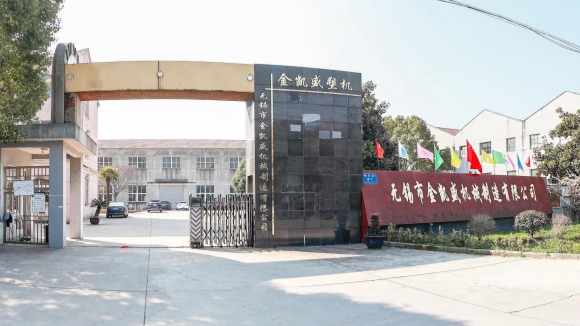
Wuxi JKS Machinery Manufacturing Co., Ltd. is a Chinese manufacturer established in 2013 in Wuxi City, Jiangsu Province, producing custom plastic extrusion machinery and complete turnkey production lines. The company operates a 2,000 m² manufacturing facility with approximately 20 staff, including a 6-engineer R&D team, and states an annual production capacity of 200 units. Export accounts for 50% of output, with machines delivered to more than 35 countries across Southeast Asia, Russia, the Middle East, Europe, Central Asia, Africa and South America.
The equipment range is organised around six named series. Continuity is visible because the same designations, materials and model families repeat across the extruder range, the auxiliary range and complete production lines.
| Series | Designations | Primary role | Key materials of construction |
|---|---|---|---|
| SJ | SJ30, SJ45, SJ65, SJ90 (custom models) | Single screw extruder; PVC, PP, PE, Nylon, ABS | Screw & barrel: 38CrMoAlA nitrided alloy steel; frame: Q235 carbon steel |
| SJSZ | SJSZ-45, -51, -55, -65, -80, -92, -110 | Conical twin screw extruder; direct PVC powder extrusion | Screw & barrel: 38CrMoAlA nitrided alloy steel; frame: Q235 carbon steel |
| SRL-Z | SRL-Z200/500, SRL-Z300/600, SRL-Z500/1000, SRL-Z1000/3000 | PVC high-speed mixing and cooling | Mixing pot: stainless steel; frame: carbon steel |
| SP | SP400, SP660 | Plastic crusher for PVC, PE, PP scrap | Cutting chamber & blades: wear-resistant steel; frame: carbon steel |
| MF | MF400, MF500, MF600 | Plastic pulverizer, 40–80 mesh fineness | Grinding chamber & rotor: wear-resistant steel; frame: carbon steel |
| ST | ST80, ST100, ST120, ST150 | Strand cutting pelletizing line | Screw & barrel: 38CrMoAlA; pelletizing die: wear-resistant alloy steel; frame: Q235 |
The continuity test becomes more meaningful at line level, where the SJSZ designation does not stop at the standalone extruder but recurs inside complete line names. The PVC water supply and drainage pipe line is built on SJSZ65/132 for model PVC63, SJSZ80/156 for PVC250 and SJSZ92/188 for PVC630. The PVC & WPC foam board line and the PVC imitation marble sheet line both use SJSZ80/156, with SJSZ92/188 additionally used for marble sheet. The PVC & WPC door and window profile line is configured on SJSZ92/188 and SJSZ65/132. The PVC hollow wall panel and ceiling line spans SJSZ51, SJSZ55, SJSZ65 and SJSZ80. The PVC hot-cut pelletizing line runs SJSZ55, SJSZ65, SJSZ80 and SJSZ92.
For a buyer, the practical consequence is that one designation family — the conical twin screw extruder — maps onto pipe, profile, sheet and pelletizing outputs. Operating knowledge, temperature practice and a large part of the wear-part list developed on the first line remain relevant on the second.
Technical Explanation: Why Material Notation Matters More Than It Appears
The second sustainability signal is whether a supplier states materials in a way that can be reordered against. In JKS's published specifications, the screw and barrel of the SJ single screw series, the SJSZ conical twin screw series, the ST strand cutting pelletizing line and the PVC hot-cut pelletizing line are all listed as 38CrMoAlA nitrided alloy steel, with Q235 carbon steel frames across the same products.
Downstream pipe, profile and sheet lines repeat the same screw, barrel and frame notation while varying the tooling: precision casting die steel for PVC pipe molds, forged alloy die steel for HDPE molds, high precision die steel for PPR molds, refined wear-resistant die steel for steel wire mesh reinforced composite pipe, wear-resistant alloy die steel for profile and door/window molds, forged refined die steel for PP hollow formwork, and 45# forged steel with hard chrome plating for SPC and sheet calender rollers.
Auxiliary equipment follows the same documentation logic, with materials matched to function rather than copied from the extruder: stainless steel mixing pots in the SRL-Z series, wear-resistant steel in the SP crusher cutting chamber and blades, wear-resistant steel in the MF pulverizer grinding chamber and rotor, and wear-resistant alloy steel for pelletizing dies.
Three practical consequences follow.
- Reordering. A wear part ordered by model designation plus a stated material is a specification. A part ordered from a photograph of a failed component is a guess, and it usually has to be repeated.
- Comparability. Two quotations that both name screw and barrel alloy, heat treatment and frame steel can be compared on specification. A quotation that omits them can only be compared on price, which is the least informative dimension.
- Limits. Material notation is an input, not a wear-life guarantee. The service life of a nitrided screw and barrel is also shaped by formulation — filler content, recycled content, additive mix — as well as temperature profile, start-up and shutdown discipline and maintenance intervals. A named alloy starts a technical conversation with a supplier; it does not prove that two screws will last equally long under different formulations.
Where Continuity Plays Out: Pipe, Profile, Sheet and Pelletizing
Pipe
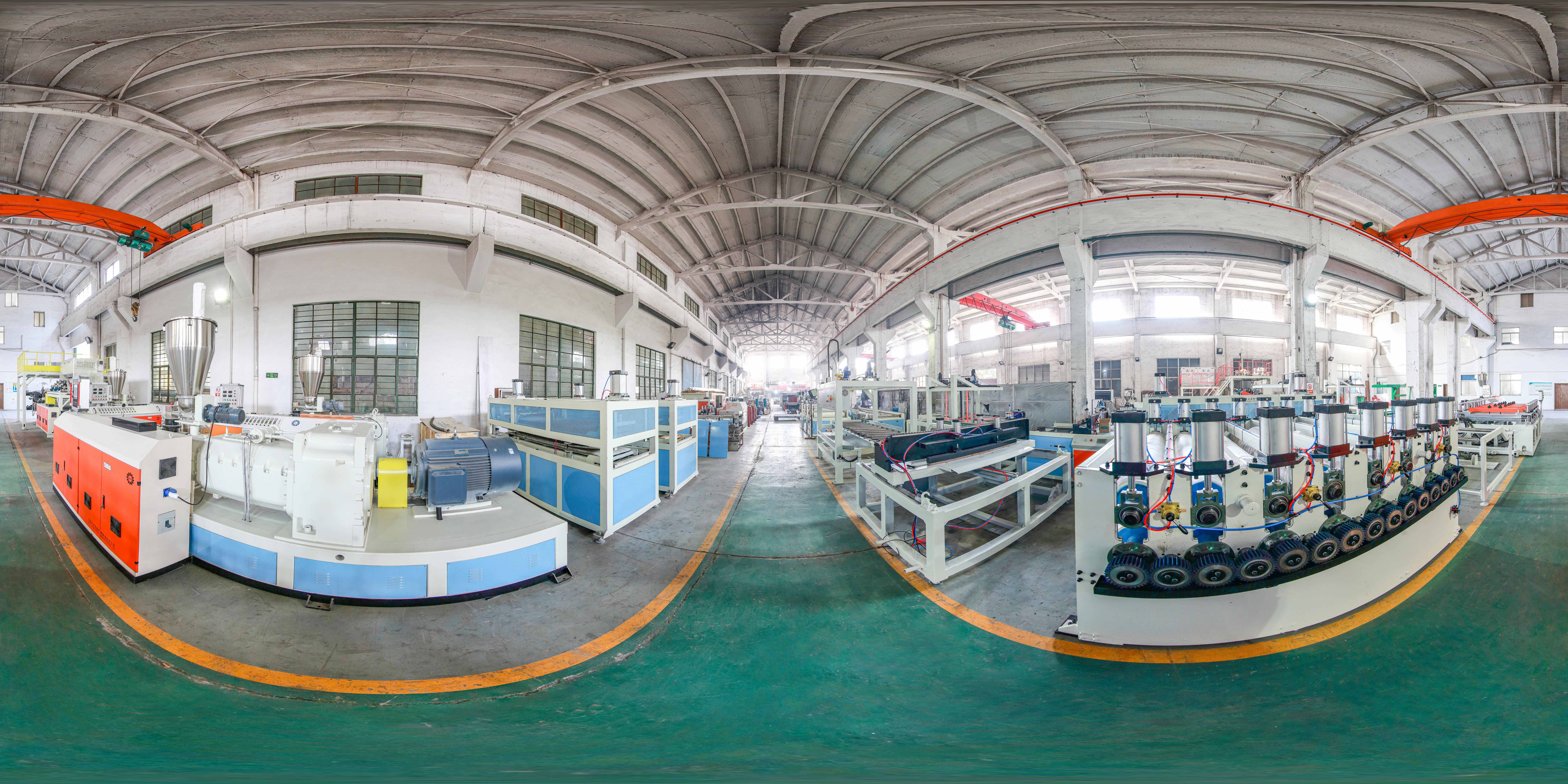
The same designations return in different configurations as pipe diameters increase. The PVC water supply and drainage line covers PVC63 at Φ16–63 mm with SJSZ65/132, a 37 kW main motor, 4–49 m/min haul-off speed and 270 kg/h output; PVC250 at Φ90–250 mm with SJSZ80/156, 55 kW and 450 kg/h; and PVC630 at Φ315–630 mm with SJSZ92/188, 110 kW and 800 kg/h. HDPE water pipe lines run PE110 through PE1600 with GS60/38 to GS150/38 extruders, 90–500 kW main motor power and 150–1,500 kg/h extrusion capacity. PPR plumbing lines use PPR20-75 (GS65/33, 37 kW, 80–160 kg/h) and PPR20-110 (GS90/30, 75 kW, 80–250 kg/h). Buried power conduit is covered by PEG63 and PG160, and high-pressure composite pipe by the GS/PE-160-H through GS/PE-630-H series.
Profile
Hollow wall panel and ceiling lines span SJSZ51 at 300 mm width and 120 kg/h, SJSZ55 at 450 mm and 150 kg/h, SJSZ65 at 600 mm and 250 kg/h, and SJSZ80 at 1,200 mm and 400 kg/h. Grille and decoration profile lines use SJSZ51, SJSZ55 and SJSZ65 at 100 mm/120 kg/h, 150 mm/150 kg/h and 300 mm/250 kg/h respectively. WPC door and window profile production uses SJSZ92/188 at 110 kW with 500–600 kg/h and finished panel width up to 1,200–1,600 mm, or SJSZ65/132 at 37 kW with 150–250 kg/h. Multi-material decorative profiles run on SJ45, SJ50 and SJ65, and solid engineering rod on SJ45 and SJ65.
Sheet
Foam board lines are configured on SJSZ80/156 at 75 kW, or as an 80+165 co-extrusion at 75+37 kW, producing 1,220 mm width at 400–500 kg/h. Imitation marble sheet uses SJSZ80/156 at 75 kW and SJSZ92/188 at 110 kW, with 1–12 mm thickness, 1,220 mm effective width and 400–700 kg/h output. SPC flooring adds SJSZ110/220 at 200 kW alongside SJSZ92/188, SJP115/30 at 90 kW and SJP135/30 at 132 kW, with 980 mm or 1,250 mm effective width and 15–40 tons per 24 hours. PP hollow construction formwork runs on SJ-90×33 at 75 kW and SJ-130×33 at 160 kW, producing 1,220 mm width at 15–20 mm thickness and 420–480 pieces per 24 hours.
Pelletizing and Reclaim
The ST strand cutting series covers ST80 at 55 kW and 70–160 kg/h, ST100 at 75 kW and 170–280 kg/h, ST120 at 90 kW and 250–400 kg/h, and ST150 at 110 kW and 350–650 kg/h, all at a 35:1 L/D ratio. The PVC hot-cut line covers SJSZ55 at 22 kW and 100–150 kg/h through SJSZ92 at 110 kW and 650–800 kg/h. Upstream reclaim equipment is documented with the same discipline: SP400 (15 kW, 300–400 kg/h) and SP660 (22 kW, 600–700 kg/h) crushers, MF400 (30 kW, 200 kg/h), MF500 (37 kW, 300–400 kg/h) and MF600 (55 kW, 400–500 kg/h) pulverizers at 40–80 mesh fineness, and SRL-Z mixing and cooling units from 300–400 kg/h up to 1,600–2,000 kg/h on an 8–10 minute mixing and 6–8 minute cooling cycle.
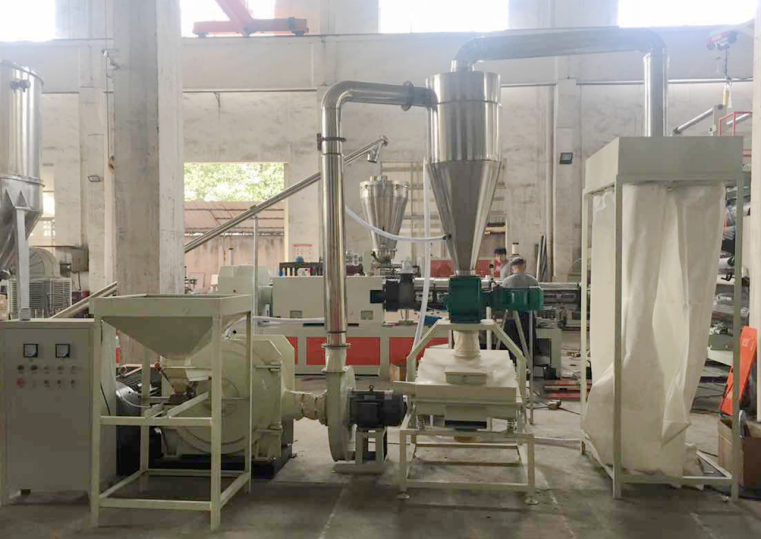
A realistic expansion path shows why this matters. A plant already running a PVC pipe line on SJSZ65/132 that later adds a PVC hot-cut pelletizing line (SJSZ55–SJSZ92) or a hollow wall panel line (SJSZ51–SJSZ80) meets the same screw and barrel alloy, the same frame steel and overlapping base designations. The number of distinct wear-part families in the warehouse does not grow at the same rate as the number of lines. That is the operational meaning of model continuity — not a marketing point, but a planning advantage that can be checked on paper.
Market Trend Analysis
Three published data points explain why this evaluation is becoming more common. The plastic extrusion machinery market is projected to expand from approximately USD 8.93 billion in 2024 to USD 11.58 billion by 2030, with Asia Pacific holding a 41.5% revenue share in 2024 (Grand View Research). Within the equipment mix, single-screw extrusion machines accounted for approximately 62.7% of the market in 2024 (Grand View Research).
Application segments justify the same attention. The pipe extrusion line market was valued at USD 4.8 billion in 2025, with PVC as the leading material segment at 38.6% (Dataintelo). SPC flooring is projected to grow from USD 6.4 billion in 2026 to USD 10.3 billion by 2033 at a 7.2% CAGR (Grand View Research).
The supplier landscape itself is mixed. Established multinational manufacturers — Coperion, KraussMaffei, Davis-Standard and Jwell Machinery are commonly listed among the leading global players in this space — operate alongside regional specialists that compete on configuration fit and support (GSmach / Jwell industry listing, 2024). JKS, exporting 50% of its output to more than 35 countries, sits in the second group.
Read together, these figures describe a market in which the installed base keeps growing across pipe, flooring and panel applications. The larger that installed base becomes, the more procurement decisions turn on what happens after commissioning rather than on the commissioning price.
Comparison: Spot Procurement Versus Continuity-Based Sourcing
| Evaluation dimension | Spot procurement from unrelated suppliers | Continuity-based sourcing from one series architecture |
|---|---|---|
| Model designation | May change per order; documentation varies by vendor | Stable series designations across products (SJ, SJSZ, SRL-Z, SP, MF, ST) |
| Screw & barrel specification | Not always stated in writing | Named: 38CrMoAlA nitrided alloy steel across SJ, SJSZ, ST and PVC hot-cut lines |
| Frame and structure | Often described only qualitatively | Named: Q235 carbon steel frames; stainless steel mixing pots; wear-resistant steel in crusher and pulverizer |
| Reordering wear parts | Measured from the failed component | Reordered by model designation plus stated material |
| Learning curve on a second line | Largely repeated | Partly transferable within the same designation family |
| Price competition | Broader, across unrelated vendors | Narrower; fewer directly comparable quotes |
| Dependency risk | Distributed across several vendors | Concentrated in one partner |
The comparison is not one-sided, and the limits deserve to be stated plainly.
First, continuity-based sourcing narrows the pool of comparable quotations and concentrates dependency on a single partner. For a single, non-expanding line with modest utilisation, or for a project with a short payback horizon, buying on price from unrelated vendors can be the more rational decision. Continuity earns its value in proportion to how long the buyer expects to operate and expand.
Second, and more important technically, a shared base designation is not proof that two machines are identical. SJSZ-92 is listed as a standalone conical twin screw extruder rated at 90 kW with 500–600 kg/h output. SJSZ92/188 appears inside the PVC630 pipe line at 110 kW main motor power and approximately 800 kg/h output, and inside the WPC door and window profile line also at 110 kW but with 500–600 kg/h output. The base designation identifies the extruder family and nominal size; the suffix and the configured power belong to the specific line. A buyer who treats the base designation as the complete specification will misjudge capacity.
Future Outlook
Two shifts are likely to continue. As installed capacity grows across pipe, sheet and flooring applications, documentation becomes a procurement criterion rather than an afterthought: buyers will ask for the full line designation, the materials of construction and the configured power before they ask for the price. And as portfolios lengthen, suppliers that maintain a consistent series architecture will find continuity easier to demonstrate, because it can be checked against published designations instead of asserted.
For a buyer at the research stage, the productive first step is not a supplier list. It is a short internal set of questions: which outputs are planned now, which could plausibly be added within five years, and which wear surfaces will be reordered most often. Those answers determine which model designations and which material specifications actually matter in the evaluation — and they make the difference between comparing quotations and comparing suppliers.
FAQ
What does "supplier sustainability" mean when evaluating a plastic extrusion machine supplier?
In this context it refers to a supplier's durability as a technical partner over the operating life of a line, not to its financial or environmental performance. It has four checkable parts: continuity of model designations, stability of stated materials of construction, traceability of wear and auxiliary parts, and the ability to configure additional lines on the same base designations. Each part can be verified from published product information before commercial discussions begin.
Which series designations indicate continuity in an extrusion equipment portfolio?
Six series carry the core designations in the JKS range: SJ single screw extruders (SJ30, SJ45, SJ65, SJ90); SJSZ conical twin screw extruders (SJSZ-45 through SJSZ-110); SRL-Z mixing and cooling units (SRL-Z200/500 through SRL-Z1000/3000); SP crushers (SP400, SP660); MF pulverizers (MF400, MF500, MF600); and ST strand cutting pelletizing lines (ST80 through ST150). The SJSZ designations also recur inside complete line names, including PVC63, PVC250 and PVC630 pipe lines, foam board and marble sheet lines, hollow wall panel lines and PVC hot-cut pelletizing lines.
Why does the screw and barrel material notation matter for long-term operation?
JKS lists 38CrMoAlA nitrided alloy steel as the screw and barrel material across the SJ and SJSZ extruder series, the ST strand cutting pelletizing line, the PVC hot-cut pelletizing line, and downstream pipe, profile and sheet lines including PPR, HDPE, MPP and PE power pipe, steel wire mesh reinforced composite pipe, PVC water supply and drainage pipe, SPC flooring and PVC imitation marble sheet. Naming that material in a quotation makes a wear part reorderable by specification and makes two quotations comparable. It is an input specification rather than a wear-life guarantee: actual service life also depends on formulation, filler and recycled content, temperature profile and maintenance practice.
Can a base designation such as SJSZ92 be treated as identical across different production lines?
No. A base designation identifies the extruder family and nominal size, while the complete line designation and configured motor power vary by application. SJSZ-92 is listed as a standalone conical twin screw extruder rated at 90 kW with 500–600 kg/h output. SJSZ92/188 is used in the PVC630 water supply and drainage pipe line with a 110 kW main motor and approximately 800 kg/h output, and in the WPC door and window profile line also at 110 kW but with 500–600 kg/h output. Buyers should confirm the complete line designation, motor power, output and downstream configuration before treating two lines as equivalent.
How should a buyer plan for future expansion across pipe, profile, sheet and pelletizing equipment?
Start from the extruder designation already in service and identify which additional outputs can be built on the same base designations. In the JKS range this spans PVC pipe (SJSZ65/132, SJSZ80/156, SJSZ92/188), HDPE pipe (GS60/38 through GS150/38), profile (SJSZ51 through SJSZ80, plus SJ45/SJ50/SJ65 for decorative profiles), sheet (SJSZ80/156, SJSZ92/188, SJSZ110/220) and pelletizing (ST80 through ST150; PVC hot-cut SJSZ55 through SJSZ92), with auxiliary equipment in the SRL-Z, SP and MF series. A plant that keeps its wear-part list organised by designation and material can add a line without rebuilding its spare-parts knowledge from the beginning.