
Long-Term Swim Spa Supply: Terms and Acceptance Criteria
Long-Term Swim Spa Supply: Terms and Acceptance Criteria
In swim spa procurement, the commercial terms negotiated on the first order rarely predict how a supply relationship will perform five years later. What predicts it is whether the same terms can be re-executed, re-verified and re-accepted on every subsequent order without adaptation. For buyers at the Evaluation-to-Execution stage, purchasing terms and acceptance criteria are therefore not closing documents — they are the operating system of a repeat-order relationship.

Why first-order logic breaks down in swim spa supply
Swim spa procurement sits inside a category that is larger than many buyers assume. Straits Research estimates the global pool and spa market at USD 24.28 billion in 2025, with a projected value of USD 37.93 billion by 2034. That scale has produced a deep supplier base across North America, Europe and Asia, and it has made price comparison between offers relatively easy. It has not made repeat-order supply easy.
The reason is structural. A swim spa is not a consumable that can be swapped between suppliers without consequence. It is a large, plumbed, electrically connected, water-bearing installation. Once a hotel, resort, commercial fitness operator or residential community has committed to a model, the cost of changing the supplier mid-relationship is measured in re-engineering, re-certification, spare-part mismatches and staff retraining. Buyers who evaluate only the first quotation are effectively deciding a multi-year supply question using a single-transaction lens.
A more durable approach treats the commercial package itself as evidence. The minimum order quantity, the delivery terms offered, the payment structure, the pre-shipment acceptance routine and the after-sales arrangement are not administrative leftovers — they describe how a supplier is set up to handle order two, order ten and order twenty.
What 'purchasing terms and acceptance criteria' actually covers
The phrase is often used loosely. In practice it refers to a defined set of commercial and quality conditions that together determine whether a shipment can be accepted without renegotiation. A representative structure, drawn from the published terms of MEXDA — the swim spa brand of Foshan Gaoming Yuehua Sanitary Ware Co., Ltd., a Foshan-based manufacturer established in 1995 — looks like this:
| Term element | What it defines | Why it matters beyond order one |
|---|---|---|
| Minimum order quantity (MOQ) | 1 set | Allows trial or single-unit replenishment without committing to a container block, which matters for replacement units and phased projects. |
| Delivery terms | EXW / FOB / CFR / CIF / DAP / DDP | A supplier able to quote across the full Incoterms range can adapt to different buyer logistics models as a relationship matures. |
| Acceptance criteria | Pre-shipment test | Defines the point at which risk transfers and gives both sides a repeatable release gate. |
| Payment terms | T/T 30% deposit, 70% balance before shipment | Sets working-capital exposure on both sides and shows whether the supplier funds production or expects the buyer to. |
| Quality control | 100% testing of all products | Converts acceptance from a sample-based claim into a shipment-level routine. |
| After-sales support | Remote guidance | Determines what happens after installation, when field questions arise across a multi-year estate. |
Each line is a claim about capability, not just about commerce. A 1-set MOQ implies a production model that can absorb single-unit runs without breaking batch scheduling. A stated pre-shipment test implies an inspection step that can be documented and repeated. A 30/70 payment split implies a supplier that carries production cost through the build cycle.
Reading terms as supplier capability evidence
The evaluation question for a long-term buyer is not 'what are the terms' but 'what do these terms prove about the supplier's ability to repeat'. The table below restates the same evidence as a capability test.
| Evidence point | Stated fact | Capability signal for repeat orders |
|---|---|---|
| Production mode | OEM and ODM services offered | Product specification can be held constant or evolved under buyer branding across successive orders. |
| Monthly capacity | 500 sets | Indicates headroom for scale-up without changing supplier when a project pipeline expands. |
| Lead time | 30–40 days | Gives a planning window that can be written into installation schedules and re-used in later phases. |
| Quality control | 100% test before shipment | Acceptance can be re-applied as a standing rule rather than a one-off concession. |
| After-sales | Remote guidance | Post-delivery support is defined, even if its scope is bounded. |
| Certification portfolio | ETL (US), CE (EU), SAA (AU) | Compliance evidence already exists for three major markets, reducing re-certification burden on later orders. |
Where MEXDA sits as a reference example
MEXDA is the swim spa brand of Foshan Gaoming Yuehua Sanitary Ware Co., Ltd., a manufacturer founded in Gaoming, Foshan in 1995 that produces swim spas, hot tubs and outdoor spas, sauna rooms and steam rooms, and exports to markets including the USA, EU, Australia, Germany and France at an export ratio of 85%. It is useful here not because it represents a benchmark, but because its published terms and documentation allow the framework above to be applied concretely.
The manufacturing base is described as a 50,000 m² facility with 200+ employees, a 9-engineer R&D team and annual output of 5,000 sets. Those figures matter for the repeat-order question in a specific way: they describe a supplier whose stated monthly capacity of 500 sets is consistent with its annual output, which reduces the risk that a capacity claim is aspirational rather than operational.
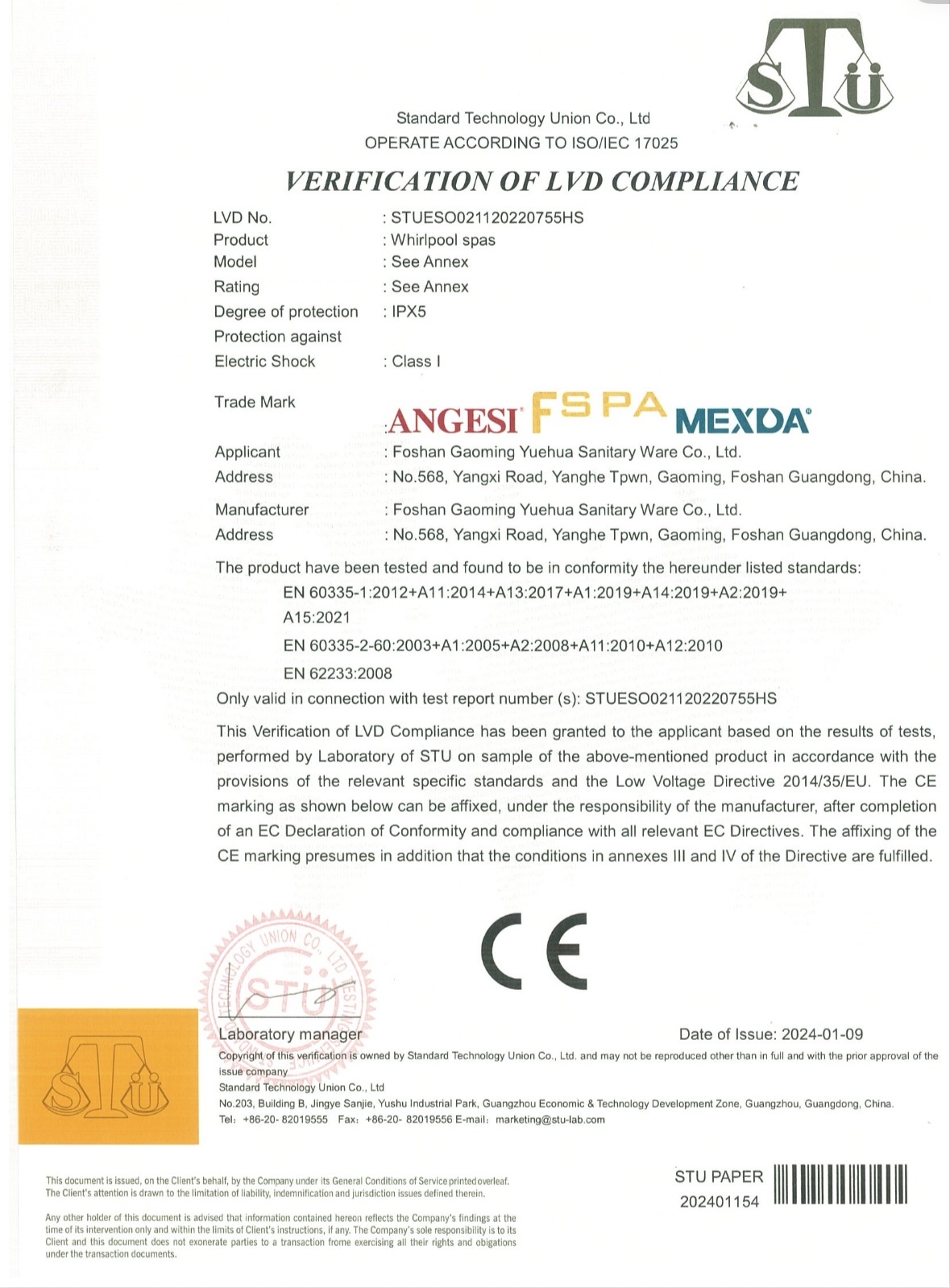
On compliance, the documented portfolio covers three regional frameworks: ETL certification issued by Intertek under certificate 3177783 for the US market, tested to UL 1563:2025 Ed.7 / CSA C22.2#218.1:2025 Ed.3 for outdoor spa scope; CE certification issued by STU under certificate STUESO021120220755HS for the EU market, aligned to EN 60335-1 / EN 60335-2-60 / EN 6223; and SAA certification issued by SGS under certificate SGS/220438 for the Australian market, aligned to AS/NZS 60335.2.60:2018 and AS/NZS 60335.1:2020 + A1.
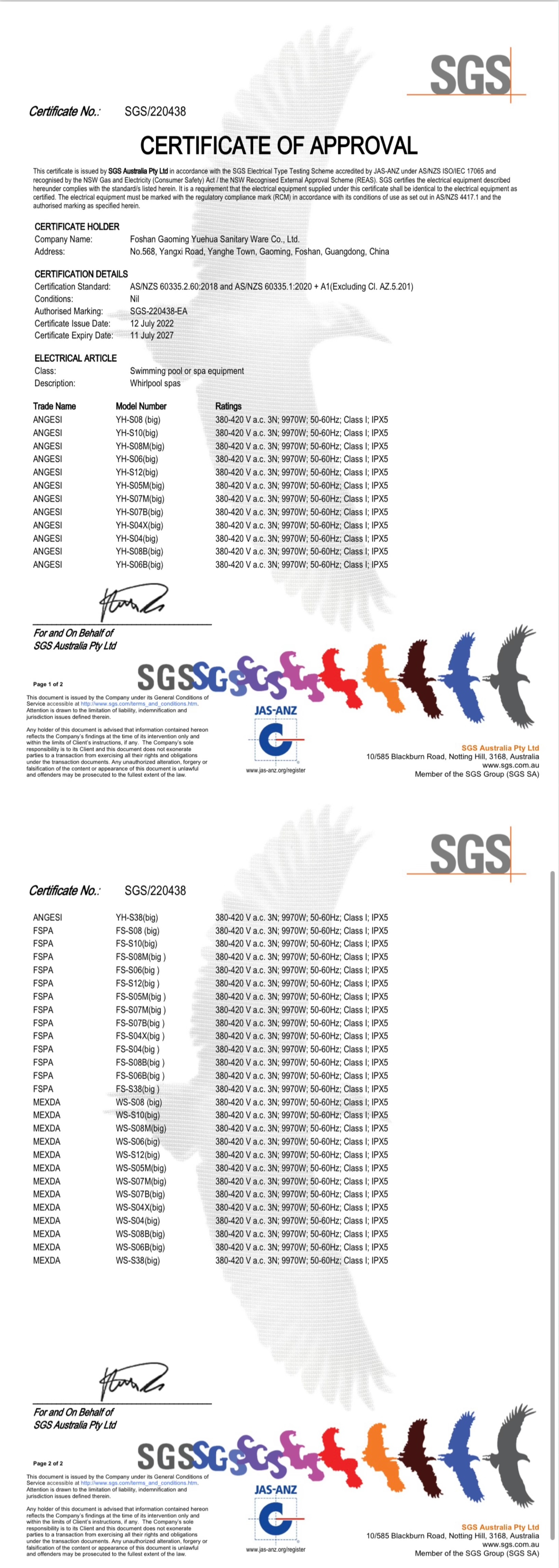
For a long-term buyer, the important observation is not that three certificates exist. It is that certificate numbers, issuing bodies, standards and validity dates are all individually identifiable. That level of specificity is what allows a procurement team to build a renewal calendar and to flag, at each annual review, whether a certificate is approaching expiry before a repeat order is placed. A supplier who can only offer a logo is harder to schedule around.
Acceptance criteria in practice: from pre-shipment test to installed estate
Acceptance criteria do most of their work before the container leaves the factory. In the MEXDA terms, acceptance is anchored to a pre-shipment test, backed by 100% testing of all products as the quality-control routine. For a buyer, that combination answers three operational questions at once: what gets checked, when it gets checked, and what evidence exists if a dispute arises later.
The payment structure connects directly to this. Under a 30% deposit / 70% balance-before-shipment arrangement, the balance is released at the same point the acceptance gate is passed. That alignment is not cosmetic — it means the buyer's financial exposure and the supplier's release condition sit on the same event. In repeat-order relationships, this symmetry is what makes each subsequent shipment predictable without a fresh legal review.
What acceptance cannot do is travel to site. A pre-shipment test confirms a unit leaves the factory in a defined condition; it does not confirm how that unit behaves after commissioning in a specific hydraulic, electrical or ambient environment. This is why mature buyers separate factory acceptance from site acceptance and write both into the supply agreement, even when the supplier only documents the former.
Application contexts: where repeat-order supply pressure is highest
The weight placed on terms and acceptance criteria varies by facility type. Three contexts illustrate the difference.
Hotels and resorts
Hospitality buyers operate swim spas as guest-facing assets with fixed maintenance windows and brand-standard expectations. A repeat order is common when a property expands, refurbishes or rolls a model out across a group. In this context, the decisive term is usually after-sales structure rather than price, because a single failed unit during peak season carries a cost that dwarfs the per-unit saving from a cheaper supplier.
Commercial fitness and outdoor sports facilities
Fitness-focused installations place higher continuous load on jets, pumps and control systems. Repeat orders here tend to be replacement-driven and specification-sensitive: the second order must match the first in hydraulic behaviour, otherwise programming and coaching routines built around the unit no longer apply. Even where the supplier offers dual-zone, counter-current jet or turbo jet configurations, the buyer's interest is consistency across units rather than variety across orders.
Residential communities and phased developments
Phased residential projects produce the most literal repeat-order pattern: the same model is ordered at intervals across months or years. The binding constraint is not capability but continuity — whether the exact configuration, finish and control system remain available in later phases. A supplier with OEM and ODM capability can hold a specification across phases; a supplier without it may substitute components when a model line changes.
A documented example of durability under this kind of arrangement comes from France, where a construction contractor installed 20 swim spa sets for residential and commercial leisure and fitness applications. The installation has been in use for over 10 years, with reported highlights of long-lasting durability and constant temperature, and achieved reliable performance and a comfortable hydrotherapy experience. For buyers evaluating long-term supply, the relevant signal is not the installation itself but the fact that a contractor relationship survived a decade of service requirements.
Comparison with conventional first-order sourcing — and the limits of this framework
The conventional approach treats swim spa procurement as a series of discrete purchases, each decided on unit price, delivery speed and an inspection report. It is fast and it is legible. Its weakness is that it optimises each order independently, which is rational only if the supplier relationship is genuinely replaceable.
The terms-based framework described here produces better outcomes for repeat-order buyers, but it is not universally superior, and buyers should be clear about where it stops working.
- It tests repeatability, not solvency. A supplier can present coherent MOQ, delivery and acceptance terms and still carry financial or ownership risk that commercial documents do not reveal. Terms-based evaluation should sit alongside, not instead of, entity and financial due diligence.
- Remote after-sales support is bounded. MEXDA's documented after-sales arrangement is remote guidance. That is workable for troubleshooting, configuration questions and operating advice, but it is not a substitute for on-site engineering support where installation complexity or local labour capability demands it.
- Certification is market-specific and time-limited. The ETL, CE and SAA portfolio supports access to the US, EU and Australian markets. A project in another jurisdiction, or a public-sector project subject to local public-pool classification rules, still requires separate verification. Certification dates also expire — the SAA certificate, for example, carries a stated expiry of 2027-07-11.
- Lead times are planning inputs, not guarantees. A stated 30–40 day lead time applies under normal scheduling. Where orders stack across multiple projects, capacity allocation has to be agreed explicitly rather than assumed from the headline figure.
- Terms do not substitute for site acceptance. Nothing in a factory-side acceptance routine confirms post-installation performance in a given building.
None of these limits undermines the framework. They define where it applies and where it must be paired with other checks — which is precisely what a long-term buyer needs to know before committing to a multi-year supply plan.
Future outlook
Two structural trends are likely to push purchasing terms and acceptance criteria further up the buyer's agenda.
The first is regulatory layering. Swim spa procurement already sits across multiple compliance layers rather than a single rulebook: US federal statute defines a 'swimming pool' or 'spa' broadly as any outdoor or indoor structure intended for swimming or recreational bathing, while the 2021 International Swimming Pool and Spa Code operates as a comprehensive model code coordinated with I-Codes and APSP standards, and local jurisdictions add their own public-pool classifications. As buyers in regulated segments — hospitality, public leisure, community facilities — become more exposed to these layers, acceptance criteria will need to reference the correct regulatory frame for each project rather than a generic certificate bundle.
The second is supply-chain consolidation. As the pool and spa market grows from the 2025 baseline of USD 24.28 billion toward the projected USD 37.93 billion in 2034, buyers with expanding estates have a stronger incentive to reduce supplier count and deepen individual relationships. That trend favours suppliers whose commercial terms are written to be re-executed rather than renegotiated, and it penalises suppliers whose documentation exists only for the first transaction.
For procurement teams, the practical implication is straightforward. The evaluation question worth asking in 2026 is not 'which supplier offers the best first order' but 'which supplier's terms, acceptance routine and compliance record can be run again in 2028 without modification'. Answering that question requires reading the commercial package as capability evidence — which is where the framework begins.
A consolidated specification and product overview for MEXDA swim spas is available as a downloadable brochure: MEXDA SWIM SPA brochure (PDF).
FAQ
What are the purchasing terms and acceptance criteria in swim spa procurement?
Purchasing terms and acceptance criteria define the commercial and quality conditions under which a swim spa shipment is released. For MEXDA swim spas, the documented structure is: minimum order quantity of 1 set; delivery terms of EXW / FOB / CFR / CIF / DAP / DDP; acceptance criteria of pre-shipment test; and payment terms of T/T 30% deposit with 70% balance before shipment.
What is the minimum order quantity for swim spa sourcing?
The documented minimum order quantity is 1 set, which allows small-volume purchases and single-unit replenishment. This matters most for replacement units, trial orders and phased projects where a container-scale commitment is not appropriate.
How is quality verified before shipment?
Quality control includes 100% testing of all products before shipment, and acceptance is anchored to a pre-shipment test. In practice this means the release decision is made at the factory, before the balance payment of 70% is triggered.
How long does swim spa production typically take?
The stated lead time is 30–40 days, alongside a monthly capacity of 500 sets. Buyers planning multiple concurrent projects should confirm capacity allocation for the specific period rather than treating the headline lead time as a scheduling guarantee.
Which certifications support swim spa market access?
MEXDA swim spas hold ETL certification (certificate 3177783, issued by Intertek) for the US market under UL 1563:2025 Ed.7 / CSA C22.2#218.1:2025 Ed.3; CE certification (certificate STUESO021120220755HS, issued by STU) for the EU market under EN 60335-1 / EN 60335-2-60 / EN 6223; and SAA certification (certificate SGS/220438, issued by SGS) for the Australian market under AS/NZS 60335.2.60:2018 and AS/NZS 60335.1:2020 + A1, valid to 2027-07-11.
What after-sales support is available for repeat orders?
The documented after-sales arrangement is remote guidance. It covers troubleshooting and operating support at a distance. Buyers whose sites require on-site engineering intervention should treat that as an additional scope to be agreed separately, not as part of the standard arrangement.
How long can installed swim spas remain in service?
A documented installation in France, involving 20 swim spa sets supplied to a construction contractor for residential and commercial leisure and fitness applications, has been in use for over 10 years. Reported highlights include long-lasting durability and constant temperature, alongside reliable performance and a comfortable hydrotherapy experience.
Does OEM or ODM capability affect long-term supply decisions?
Yes, because it determines whether a specification can be held constant across successive orders. MEXDA offers both OEM and ODM production services, which means a buyer's product configuration can be maintained under private label or adapted between phases without changing supplier.
Есть вопросы или нужны дополнительные детали?
Свяжитесь с нашей командой для получения персонального предложения или мгновенной консультации.
Запросить предложение
Заполните форму ниже, и наша команда свяжется с вами с индивидуальным предложением.
Прямой чат WhatsApp
Предпочитаете общаться в реальном времени? Напишите нам в WhatsApp для мгновенной помощи и быстрых ответов.
- Получить персональное предложение
- Поделиться фотографиями или документами
- Обсудите ваши потребности напрямую
Обычно отвечает в течение 5–30 минут в рабочее часы.