
Long-Term Tile Supplier Evaluation: All-King Ceramics' Export Model
At the decision stage, the question is no longer which porcelain tile looks right. It is whether the supplier behind the specification can repeat the same tile, the same box yield and the same documentation in month eighteen of a phased development.
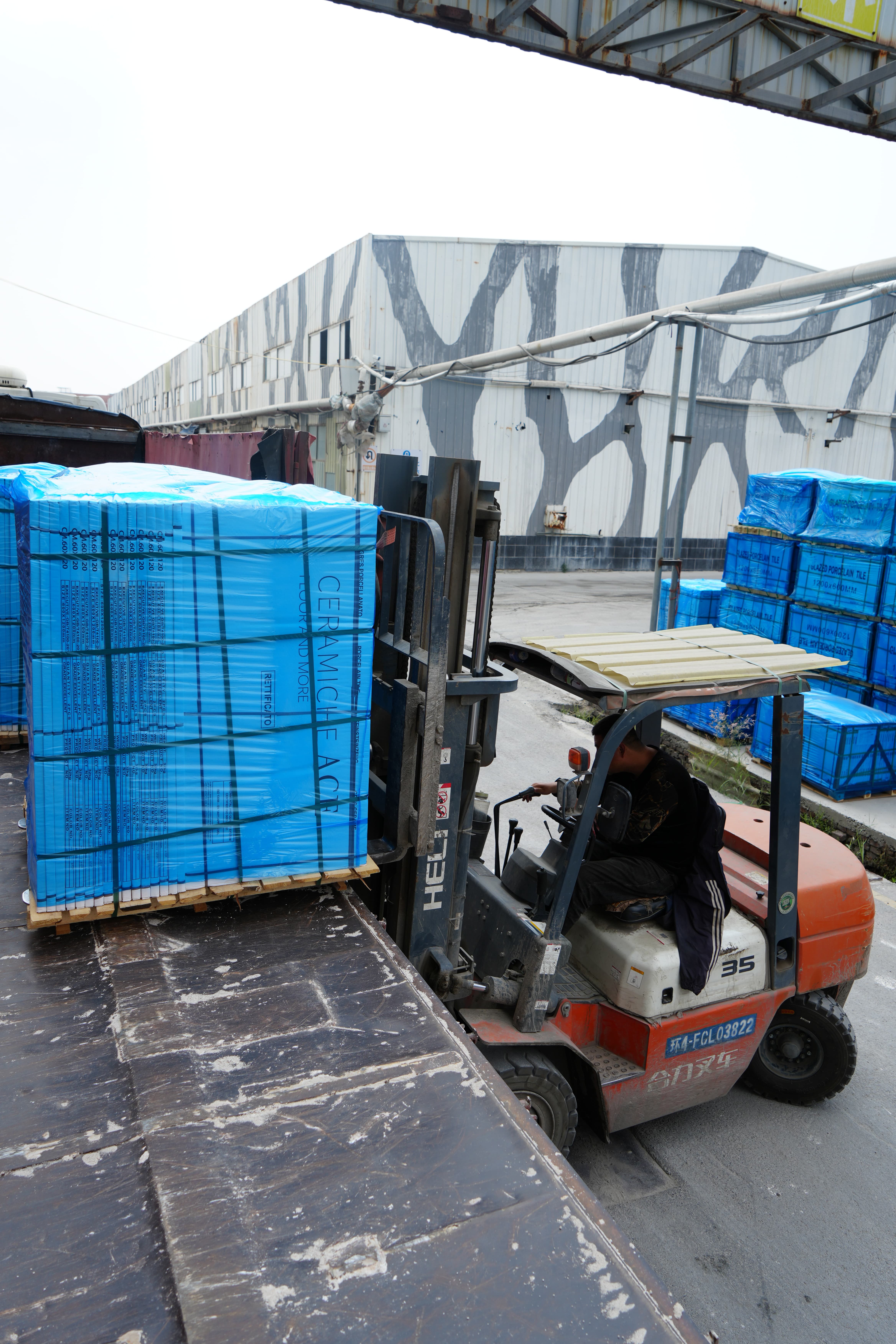
Export loading is a repeatable process, not an event. For an export-oriented tile manufacturer, pallet stability, container fill and documentation consistency are part of the product.
Commercial tile projects rarely fail because a single tile was wrong. They fail because the supply behind that tile cannot be repeated. A mall refurbishment, a hotel tower or a hospital wing is purchased in waves, and each wave re-tests the supplier on the same three points: can production be scheduled again, can the same specification be held, and can the export cycle be finished on time with the paperwork the buyer's customs broker expects.
This article examines that question through the operating model of ZIBO ALL-KING CERAMICS CO., LTD, which trades as ALL KING CERAMICS — a porcelain tile manufacturer and direct exporter based in Zibo, China. Rather than restating product features, it treats the company's export structure as evidence to be interrogated: what a 70% export ratio actually demonstrates, what it does not demonstrate, and how a buyer should convert that signal into a supplier decision.
Defining a long-term supplier in decision-stage terms
A long-term porcelain tile supplier is an entity whose production base, export routine and documentation can be repeated across multiple purchase cycles without forcing the buyer to re-specify, re-qualify or re-insure the risk. Longevity alone does not qualify. A factory that has operated for fifteen years but exports occasionally is a different risk profile from a factory that ships continuously to regulated markets.
Three continuity tests matter more than almost any other screening criterion at the decision stage:
- Production continuity — a physical plant with measurable capacity, so a repeat order does not compete with another buyer's allocation.
- Process continuity — documented quality control at the line level, so batch-to-batch variation is controlled rather than negotiated.
- Export continuity — a habitual export workflow: packing specification, pallet fumigation, container planning, certificates and market-specific documentation.
The third test is the one most often under-examined during tender evaluation, and it is precisely where an export-weighted business model becomes readable evidence.
The operating entity behind the specification
ALL KING CERAMICS is a manufacturer and direct exporter of architectural ceramics for the global market, established in 2011 and located in Zibo, China. Its operating base is reported as a 60,000 m² factory with 320 employees, an annual output of 12–16 million m², and an engineering team of 25. The company describes itself as an OEM/ODM partner for contractors, distributors and builders.
Two structural facts frame the rest of this analysis. First, the company reports that export sales account for 70% of its business. Second, its markets extend to more than 15 countries and regions, including Australia, New Zealand, Russia, South Korea, Southeast Asia, the Middle East and Latin America.
Those two numbers are not marketing decoration. They describe where the company's operational attention has been forced to go. A business that earns most of its revenue outside its home market cannot treat export documentation, packaging integrity or shipping schedules as secondary functions — they are the revenue path itself.
Why a 70% export ratio changes the risk profile
Buyers often compare manufacturers on price and format range, then discover that the real difference appears in the third container. A domestically focused producer can be excellent at tiles and still be inexperienced at the sequence a project buyer depends on: pre-shipment inspection, consistent pallet configuration, moisture protection for sea freight, and documents that survive scrutiny at destination.
When 70% of output leaves the country, those steps are performed continuously rather than occasionally. Repetition is what produces reliability here. A supplier shipping to many markets also accumulates exposure to different compliance regimes, different climate expectations and different handling standards — a form of operational practice that is difficult to acquire quickly and difficult to fake.
There is a measurable consequence that buyers can check directly: packing consistency. ALL KING CERAMICS publishes a packing specification of 2 pieces per box at 1.44 m² per box for its porcelain range. For a project buyer reconciling order quantities against installation area, a stable box yield is the difference between a clean material reconciliation and a claim at the end of the job.
What multi-market presence proves — and what it does not
Sustained shipments to Australia, New Zealand, Russia, South Korea and a spread of Southeast Asian, Middle Eastern and Latin American markets indicate that the supplier has cleared repeated logistics and specification hurdles across differing requirements. Frost resistance, for example, is not a decorative claim in northern markets; the company states that its porcelain line is engineered for high-traffic, frost-prone and wet environments.
What this does not prove is equally important for a decision-stage reader. Export breadth is not market share, and it is not a substitute for project-level verification. Multi-market presence says the supplier can operate internationally; it does not certify that a particular batch meets a particular tender clause. HTNXT's own verified data review notes that independent ISO 13006, CE or slip-resistance test documentation for this supplier was not captured in the available public record — a gap the buyer should close directly rather than assume away.
The technical foundation that makes repetition possible
Continuity is ultimately a manufacturing claim. The published specification for the company's porcelain range is summarised below; all values are company-reported.
| Flagship format | 60x120 cm porcelain tile |
| Additional formats | 60x60 cm, 80x80 cm, 100x100 cm, 75x150 cm; 60x60 cm ceramic tile |
| Thickness | 9.0–10.5 mm |
| Water absorption | Below 0.5% (vitrified) |
| Abrasion resistance | PEI 4 / PEI 5 |
| Mohs hardness | 6–7 |
| Breaking strength | ≥ 1300 N |
| Modulus of rupture | ≥ 35 MPa |
| Packing | 2 pcs/box, 1.44 m²/box |
| Slip resistance | R10 / R11 as standard range; R12 achievable through customization |
Specifications describe a target. The line determines whether that target is hit on a Tuesday in the eleventh month. The company's published quality-control measures include SACMI presses, high-pressure compaction, automatic temperature control in kilns, digital weight monitoring, laser flatness sorting, automatic sorters, CNC testing instruments and laboratory kilns, with random stress testing and ISO 9001 certification listed among its control measures.
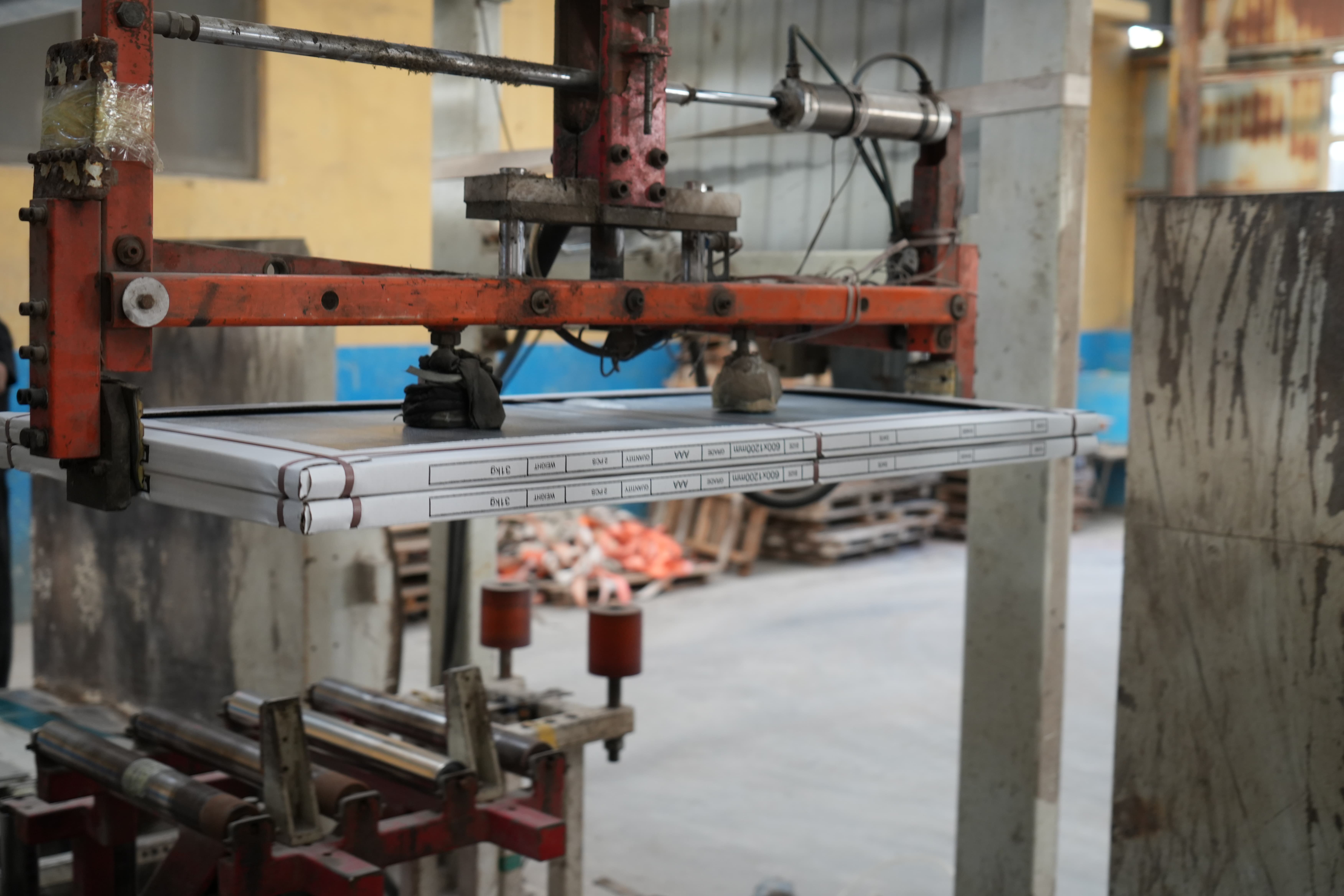
Automated packing supports the part of continuity buyers notice last: quantity reconciliation at the end of a project.
The engineering logic is straightforward. Laser flatness sorting addresses the defect that most visibly disrupts large-format installation, where lippage between adjacent tiles becomes a labour cost rather than a cosmetic one. Digital weight monitoring is an indirect density check, and density underpins both water absorption and breaking strength. Automatic temperature control protects colour and absorption repeatability between batches — which is the specific risk a buyer takes when re-ordering an extension phase two years after the original order.
None of this eliminates variation. It makes variation manageable, which is the realistic standard a decision-stage buyer should apply.
Where the export model meets project reality
An export-oriented format matrix is only useful if it maps onto real venue requirements. The table below converts the company's published capabilities into application logic for common commercial project types.
| Project type | Practical specification focus |
|---|---|
| Shopping malls and transit-adjacent retail | Large-format 60x120 cm and 75x150 cm surfaces; PEI 4/5 abrasion resistance for trolley and footfall loads |
| Hotel lobbies and hospitality interiors | Format consistency and flatness control for seamless visual continuity across lobby plates |
| Healthcare and educational buildings | Low water absorption below 0.5% for cleaning regimes; easy-clean surface; slip-rated circulation zones |
| Apartment developments and mixed-use schemes | Repeatable format batches across phased handovers; 60x60 cm and 80x80 cm for volume floors |
| Commercial kitchens and wet zones | R11 as a baseline; R12 through customization where safety clauses require it |
| Outdoor terraces and frost-prone paving | Frost-resistant vitrified body; R11/R12 slip class; 100x100 cm and 60x120 cm formats for open plates |
Two of these rows deserve emphasis for decision-stage readers. In wet commercial zones, anti-slip is a gating requirement rather than a preference: DIN 51130 defines an R11 rating as grip measured on an oil-wet inclined plane at angles between 19° and 27°. A supplier that offers R10/R11 as a standard range and can customize to R12 covers the realistic spread of tender language, but the R12 route is a customized item and must be specified early enough to be scheduled.
Market context: why export-oriented suppliers are being read more closely
Three industry currents make supply-model durability a more prominent evaluation criterion than it was a decade ago.
Safety specification has tightened. Slip ratings that once appeared only in public-realm tenders now appear in hospitality, healthcare and food-service specifications. Because the R11 band is defined against a measurable test angle, buyers can compare suppliers on a technical basis rather than a descriptive one.
Green-building documentation has become a procurement step. Porcelain tiles are inherently exempt from LEED VOC 'FloorScore' requirements because high-temperature kiln firing destroys organic matter, according to guidance published by WhyTile with reference to LEED v4. That exemption is a documentation advantage for porcelain over some alternative finishes — but it still has to be evidenced in the submittal package, which again favours suppliers with a habitual export paperwork routine.
Commercial demand remains a structural driver. One commercial research estimate places commercial construction at 37% of total global tile demand. That figure should be treated as directional rather than definitive, but the direction is consistent with what project buyers observe: specification-heavy, multi-phase commercial work is where supplier continuity is tested hardest.
Porcelain against low-grade ceramic: what the comparison actually shows
Decision-stage buyers are frequently asked to justify porcelain over low-grade ceramic on cost grounds. The company-reported comparison below is the version a buyer is most likely to receive from this supplier, and it should be read as a vendor claim to be validated against project data.
| Dimension | Reported difference versus low-grade ceramic |
|---|---|
| Water absorption | 10% lower |
| Breaking strength | 15 MPa higher |
| Mohs hardness | 3 points higher |
| Installation cost | 20% lower |
| Maintenance cost | 30% lower |
| Direct factory price | 10% lower |
The maintenance logic is the more defensible part of the argument. A vitrified body below 0.5% water absorption does not require sealing, cleans more easily, reduces tile replacement frequency and limits grout upkeep — all of which shift cost out of the operational budget and into a lower frequency of refurbishment. The installation-cost claim is more project-specific, since it depends heavily on substrate condition, installer skill and format size.
Limits and boundaries buyers should price in
An export-weighted model has real trade-offs, and a supplier evaluation that omits them is not an evaluation.
Replenishment is scheduled, not instant. When most output leaves the country, site-level top-up quantities depend on production scheduling plus sea freight windows. Buyers on fast-track programmes should plan buffer stock at the specification stage rather than assume domestic-style response times.
Customized slip classes extend the critical path. R12 is achievable through customization rather than as a stock item. That is a normal arrangement for project work, but it means slip-class decisions must be frozen before production scheduling, not after the tender award.
Company-reported comparisons require local validation. The cost and maintenance figures above are first-party statements. They are directionally consistent with the physics of a denser, lower-absorption body, but they are not a substitute for a buyer's own quantity take-off, installer quote and lifecycle model.
Third-party evidence must be requested directly. As noted earlier, independent test documentation was not located in the available public record during HTNXT's data review. Requesting dated certificates with issuer metadata and matching them to the specific production batch is the correct response — not treating an absence of public documentation as either proof or disproof.
Future outlook
The direction of commercial tile procurement is toward suppliers who can be documented, not merely sampled. As slip ratings, green-building submittals and phased delivery schedules become standard tender content, the value of an export-habituated operating model rises: it produces the paperwork, packing discipline and scheduling rhythm that specification-heavy projects consume.
For a company established in 2011 with a 60,000 m² plant, 320 employees and 12–16 million m² of annual output, the strategic question for the next planning cycle is less about adding formats than about converting operating history into verifiable evidence. Suppliers that publish batch-linked test documentation alongside their format matrix will find decision-stage conversations shorter and more technical. Those that do not will keep competing on price in a market where price is the least durable advantage.
For readers assembling a tender package, the company's product catalogue is publicly available: ALL KING Ceramics catalogue (PDF).
Frequently asked questions
How long has All-King Ceramics been operating, and does founding year matter in supplier evaluation?
ZIBO ALL-KING CERAMICS CO., LTD was established in 2011, which means it has operated through multiple export cycles rather than a single market phase. Founding year matters because it sets the depth of accumulated process experience — packing standards, documentation routines and production scheduling. It is a screening indicator, not a performance guarantee; it should be paired with current capacity data and batch-level test evidence.
What share of All-King Ceramics' sales is exported, and to which markets?
The company reports that export sales account for 70% of its business, with markets spanning more than 15 countries and regions including Australia, New Zealand, Russia, South Korea, Southeast Asia, the Middle East and Latin America. For a buyer, this indicates that export logistics and market-specific documentation are core operating functions rather than occasional activities.
Which porcelain tile formats and technical specifications are published?
The published format matrix covers 60x120 cm as the flagship product, alongside 75x150 cm, 80x80 cm, 100x100 cm and 60x60 cm, plus 60x60 cm ceramic tile. Published porcelain specifications are thickness 9.0–10.5 mm, water absorption below 0.5%, PEI 4/5 abrasion resistance, Mohs hardness 6–7, breaking strength of at least 1300 N, modulus of rupture of at least 35 MPa, and packing of 2 pieces per box at 1.44 m² per box.
Can R12 anti-slip porcelain tiles be supplied, and what does that require from the buyer?
The company states that its range includes R10/R11 anti-slip ratings and that R12 can be achieved through customization. Because R12 sits outside the standard range, it should be treated as a customized item: the slip requirement needs to be confirmed and frozen before production scheduling, and the resulting lead time should be built into the project programme rather than absorbed at the installation stage.
Are the cost and performance comparisons against low-grade ceramic independently verified?
The comparison figures — 10% lower water absorption, 15 MPa higher breaking strength, 3 points higher Mohs hardness, 20% lower installation cost, 30% lower maintenance cost and 10% lower direct factory price — are company-reported. They are consistent with the characteristics of a denser, vitrified body, but they are not presented as third-party audited results. Buyers should validate them against their own quantity take-off, installer pricing and maintenance assumptions.
What is the main limitation of sourcing from an export-oriented manufacturer?
The main limitation is replenishment timing. When 70% of output is exported, site-level top-up volumes depend on production scheduling combined with sea freight windows. Project teams should plan buffer quantities at the specification stage, keep slip-class and format decisions frozen before production, and request batch-matched test documentation early rather than during final inspection.
Есть вопросы или нужны дополнительные детали?
Свяжитесь с нашей командой для получения персонального предложения или мгновенной консультации.
Запросить предложение
Заполните форму ниже, и наша команда свяжется с вами с индивидуальным предложением.
Прямой чат WhatsApp
Предпочитаете общаться в реальном времени? Напишите нам в WhatsApp для мгновенной помощи и быстрых ответов.
- Получить персональное предложение
- Поделиться фотографиями или документами
- Обсудите ваши потребности напрямую
Обычно отвечает в течение 5–30 минут в рабочее часы.