
Long-Term Tinplate Supplier Evaluation: A Buyer's Scorecard
TINPLATE — the electrolytic tinplate that goes into food cans, aerosol cans, crown caps, lug caps and precision stamped hardware — tends to be bought on a per-tonne basis but judged on a per-year basis. Commercial research estimates put the global tinplate market at about USD 31.98 billion in 2025, with Asia Pacific holding roughly 39.2% of regional share. Those figures explain why packaging programmes run for multiple years; they do not explain how a procurement team should score a supplier for continuity.
A long-term supplier evaluation answers a different question from a first-order sourcing review. The first-order question is whether a supplier can meet the specification once. The long-term question is whether the same supplier can hold the same thickness tolerance, the same surface integrity, the same edge condition, the same protective packaging and the same compliance file across dozens of coils — through seasonal humidity, shipping routes and mill runs. The scorecard below is built around that difference.
Key facts at a glance
- Global tinplate market in 2025: about USD 31.98 billion, Asia Pacific approximately 39.2% of regional share (commercial research estimates).
- China recorded 3,137 tinplate export shipments between July 2024 and June 2025, according to trade data reporting.
- YOUNGSON METAL states a controlled range of ±0.005 mm thickness tolerance, ±0.05 mm width precision and ≤0.05 mm slitting burr, against a market standard of roughly ±0.02 mm thickness tolerance.
Why Short-Term Buying Logic Fails in Multi-Year Tinplate Programs
Short-term buying typically screens three things: price per tonne, first-sample quality and current delivery speed. Those three signals can all look healthy in the first order. What fails later in a multi-year contract is usually specific — thickness drift, edge rust, dropped punch life, expired compliance documents, or a quiet change in the supply chain behind the supplier.
Stamping and deep-drawing applications are where this shows up fastest. A specification that reads "stamping-grade tinplate" does not tell the buyer that every coil will enter a progressive die at the same feed rate, with the same burr level and the same lubrication. Continuity has to be evidenced per batch, not per brochure.
Two failure modes recur. The first is unexpected press stoppage caused by strip joints, notches or edge waves. The second is edge corrosion after marine transit or warehouse storage, which produces cosmetic rejection or lacquer adhesion problems long after the mill certificate was issued. Both are measurable, but only if the contract defines the measurement.
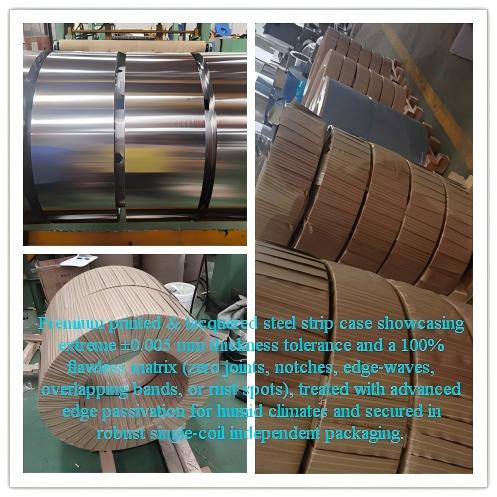
Continuous supply depends on how each coil is slit, edge-protected and sealed, not on the certificate alone.
The Five Evaluation Dimensions for Long-Term Tinplate Supply
A long-term scorecard should be built from five dimensions. Each one can be evidenced through documents, samples, incoming inspection or batch spot checks. No single dimension should dominate; a supplier that is strong on price but weak on edge protection will still cause line stoppages after the second or third shipment.
| Dimension | What to Measure | Evidence Source |
|---|---|---|
| Dimensional consistency | Thickness tolerance, width precision, in-coil consistency | Batch inspection, mill certificate, incoming check |
| Surface and edge condition | Burr height, edge waves, rust spots, slit-edge protection | Visual and dimensional inspection, process records |
| Coil continuity | Joints, overlapping bands, notches, strip-break risk | Batch traceability data, line trial |
| Packaging protection | Sealing, moisture barrier, transport durability | Packaging audit, arrival inspection |
| Compliance documentation | RoHS and REACH claims, ISO 9001 scope, SGS test reports, product-level applicability | Certificate registry, third-party test report, product scope check |
Two practical rules make the scorecard usable. First, each dimension should have a defined limit, not a description. Second, each limit should be verified through a different evidence type — otherwise the scorecard collapses into a single document review.
How YOUNGSON METAL Frames Long-Term Tinplate Supply
Chongqing Youngson Metal Products Co., Ltd. — trading as YOUNGSON METAL — is a tinplate, TFS and pre-painted steel processor and slitter based in Chongqing, China. The company was founded in 2016, operates a factory of about 3,000 square metres with 25 employees, and reports an annual processed quantity of around 10,000 tons. Roughly 70% of output is exported, with customers spanning food and chemical can producers, cookware, home appliances and automotive stamping.
Its product portfolio is organised into four groups: commercial-grade tinplate and TFS with lithography, coil coating and laminated PET film; deep-drawn-grade tinplate and TFS with the same finishing options; commercial-grade pre-painted steel and pre-painted stainless steel; and deep-drawn pre-painted steel. Mild carbon steel and multi-grade stainless steel are also produced.
On the material side, the company lists tinplate and TFS grades T1, T2, T3, T4 and T5 with BA and CA surface options, a thickness range of 0.14 mm to 0.55 mm, tin coating designations including E2.8/2.8, E5.6/5.6 and E8.4/8.4, and hardness designations including TH520, TH550, TH620, DR8, DR9 and DR10 CA/BA. Its T1 product is listed with a 0.20–0.55 mm thickness range, a 6.5–1,050 mm width range and tin coating options expressed as 2.0/2.0, 2.8/2.8, 2.8/5.6 and 5.6/5.6.
These figures are company-reported product data. In a long-term contract they should be confirmed against batch test certificates, incoming inspection and, where relevant, third-party test reports. Company-reported ranges help a buyer check whether a required specification is inside the supply footprint; they are not a substitute for batch verification.
Technical Explanation: Why ±0.005 mm and ±0.05 mm Matter Over Years, Not Just First Order
In a long-term agreement, tolerance is not a single measurement. It is a cost driver that compounds with every coil and every press stroke. The company states a controlled range of ±0.005 mm thickness tolerance, ±0.05 mm width precision and a slitting burr of ≤0.05 mm, compared with a market standard of roughly ±0.02 mm thickness tolerance.
That difference shows up in tooling. Tighter thickness and width control reduces punch wear, stabilises die clearance and lowers scrap rates in continuous stamping. The company reports that its strip reduces total tool-maintenance costs by up to 35% and eliminates catastrophic press crashes caused by strip joints or edge notches. Those are company-reported figures and should be validated on the buyer's own line, but the mechanism is straightforward: less dimensional variation and fewer strip defects mean fewer unplanned stoppages.
Edge condition is the second technical lever. Slit edges are where corrosion begins, especially in humid or marine environments. The company applies an automated post-slitting oil-spray anti-rust treatment onto the slit blade cuts, creating a protective barrier on the cut edge, and seals each coil individually. For long-term buyers, this changes the verification protocol: edge protection is checked through process records and arrival inspection, not just through the mill certificate.
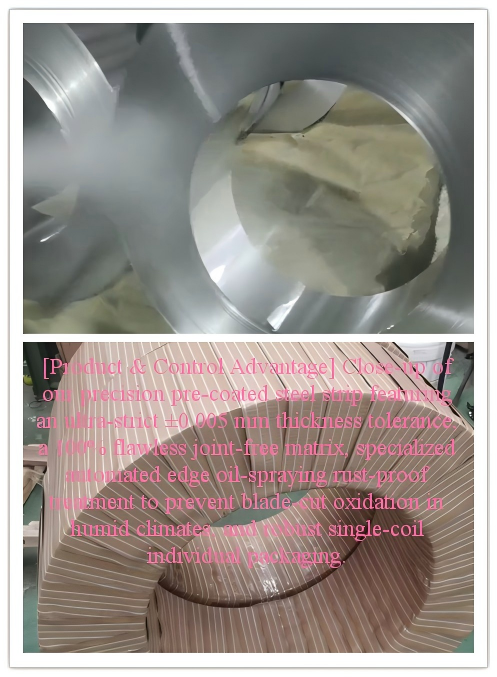
Edge protection after slitting is a process record, not a surface description — it is audited through oil application and coil sealing.
The third lever is coil continuity. The company states a five-zero quality position: zero joints, zero notches, zero edge waves, zero overlapping bands and zero rust spots. In high-speed progressive stamping, continuity determines whether the line can run uninterrupted. The company reports continuous pressing speeds of up to 120+ strokes per minute without strip breakage on suitable material. Again, that is a supplier-reported operating figure, but the underlying variable — joint-free, notch-free strip — is a legitimate long-term scoring criterion.
Application Fit: Where Long-Term Tinplate Supply Gets Tested
Long-term evaluation is not one scorecard applied identically to every end use. Different applications stress different dimensions, and a supplier that is strong in one area may only be adequate in another. Five application clusters matter most in the current tinplate portfolio.
Food cans: meat and fish
For meat cans, the company supplies a milky white coated tinplate sheet, a coating chosen to limit direct interaction between the can contents and the steel substrate. For fish cans, it supplies a high-sulfur-resistant lacquer system, targeted at the sulfur compounds released during retorting of protein-rich contents. In long-term contracts, these applications require a locked coating formulation, a documented adhesion test and a fixed retort condition, not just a product name.
Deep drawing and precision stamping
DDQ and DR8/TH520 grades are used where severe forming and thinner gauges are required. A DR8 temper is commonly associated with a Rockwell HR30Tm range of about 69–75, used for high-strength, thinner-gauge can bodies. For a long-term buyer, the relevant check is hardness consistency across batches and forming performance in the actual die — not the presence of the grade name on a data sheet.
Slit narrow strip
Applications such as slitted tinplate strip in 0.40, 0.50 and 0.55 mm T2, or custom colourful TFS strip, depend on width precision, edge condition and coil-to-coil consistency. This is where the ±0.05 mm width precision and ≤0.05 mm burr claims become directly testable.
Decorative and hardware surfaces
Mirror-finish and copper-colour mirror tinplate surfaces, together with colour-coated and printed options, are used in decorative and hardware applications. For these, long-term evaluation should weight surface consistency, colour stability and defect density more heavily than dimensional tolerance.
Packaging accessories and roll-formed parts
Drum rings, latches and lug caps involve high-tensile forming and exposure to humid environments. Here the scorecard should weight edge protection and rust resistance above coating appearance.
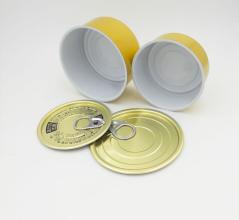
Fish can applications depend on sulfur-resistant coating systems, not on base substrate alone.
Market Trends That Reshape Long-Term Tinplate Evaluation
Three structural trends are changing the weighting inside the scorecard.
Regional supply concentration. With the global tinplate market estimated at around USD 31.98 billion in 2025 and Asia Pacific holding about 39.2% of regional share, export-oriented Chinese processors remain central to global supply. China recorded 3,137 tinplate export shipments between July 2024 and June 2025, according to trade data reporting. That number measures trade activity, not production capacity, but it confirms that long-term buyers are increasingly evaluating Chinese processing suppliers on continuity and documentation rather than availability alone.
Higher-strength, thinner specifications. The shift toward DR8-class material and thinner gauges increases the sensitivity of every downstream process to thickness and hardness variation. In a multi-year contract, batch hardness consistency becomes a scored item rather than an assumption.
Documentation as a gate. RoHS, REACH, ISO 9001:2015 and SGS testing are moving from differentiators to entry requirements. The long-term question is not whether a supplier holds a certificate, but whether the certificate scope matches the product, the test date is current, and the report can be traced to the actual production batch.
Comparison with Traditional Supplier Options — and the Limits of This Model
Against traditional supply models, a specialist processor with in-house slitting and coating offers tighter control over dimension, edge condition and packaging. Traditional models usually fall into two groups, and each has a different long-term profile.
- Mill-linked distributors. Stable mill origin and broad grade coverage, but slitting precision, edge oil passivation and single-coil sealing are often not standard delivered features. Long-term buyers need to add inspection nodes for these.
- Trading-led suppliers without in-house slitting or coating. Broader price flexibility and delivery options, but batch-to-batch consistency and process traceability depend on upstream parties. Long-term contracts require denser incoming inspection and more explicit change-notification clauses.
The model also has real boundaries that should be written into the evaluation rather than glossed over.
- Specification boundary. The published thickness range is 0.14–0.55 mm and the T1 width range is 6.5–1,050 mm. Requirements outside these ranges are not covered by the standard offer.
- Verification boundary. Tolerance, burr, hardness, tin coating and compliance claims are company-reported. Long-term contracts should require batch test certificates, incoming inspection and, where relevant, third-party testing before the first release.
- Application-fit boundary. Deep-drawn and food-contact performance cannot be settled from a specification sheet. Forming trials, coating adhesion tests and first-production validation remain necessary, even when the material grade matches the requirement on paper.
A buyer who treats these limits as disqualifying will exclude many capable suppliers. A buyer who ignores them will sign a contract that looks strong on paper and weak on the floor. The workable approach is to treat the limits as contract clauses rather than as evaluation vetoes.
Future Outlook: What Buyers Should Lock Into a Long-Term Tinplate Contract
Over the next few years, long-term tinplate contracts are likely to shift from "price plus lead time" toward "parameter plus document plus change management". Five clauses are worth locking in now.
- Written tolerance and burr ceilings, with a defined over-limit handling process.
- Coil continuity standards, including definitions and allowable values for joints, overlapping bands and notches.
- Edge-protection process records, covering oil application, application method and sealing method.
- Compliance document control, with validity dates, product scope and update responsibility.
- Change-notification mechanism, so that a raw material source change, coating formulation change or line change triggers a notification and a re-validation step.
None of these clauses requires a supplier to be perfect today. They require the supplier to be auditable, and to remain auditable as the relationship lengthens.
Frequently Asked Questions
What is a long-term tinplate supplier evaluation, and how does it differ from a normal sourcing review?
A long-term tinplate supplier evaluation assesses whether a supplier can hold the same dimensional, surface, edge and documentation standards over multiple years and multiple production cycles. A normal sourcing review focuses mainly on first-order specification match, price and lead time. The long-term version adds batch consistency, edge protection, packaging durability and compliance document control, and it treats each of these as a scored criterion rather than an assumption.
Which tolerances should be written into a multi-year tinplate contract?
The usual practice is to set verifiable ceilings for thickness tolerance, width precision and slitting burr, and to define how over-limit material is handled. YOUNGSON METAL states a controlled range of ±0.005 mm thickness tolerance, ±0.05 mm width precision and ≤0.05 mm burr, measured against a market standard of roughly ±0.02 mm thickness tolerance. Contract values should still be confirmed through batch inspection and incoming checks.
How does edge protection affect long-term supply risk?
Slit edges are where corrosion typically begins, particularly after marine transit or storage in humid climates, and edge rust can cause cosmetic rejection or lacquer adhesion problems. The company applies an automated oil-spray anti-rust treatment to the slit cuts and uses individual coil sealing. In a long-term contract, the buyer should define how the edge-protection process is recorded and how arrival inspection is carried out.
What compliance documents should be verified before signing?
The verification set typically includes ISO 9001:2015 certification with scope and validity dates, and SGS test reports for RoHS and REACH that identify the tested product, sample and test date. For food-contact applications, the buyer should also check food-grade documentation for both substrate and coating. Company-level claims should be matched to product-level evidence before they are accepted in a contract.
What limits should a buyer expect in this supplier model?
The published specification range covers 0.14–0.55 mm thickness and, for the T1 product, 6.5–1,050 mm width, so requirements outside this range fall outside the standard offer. In addition, much of the dimensional and compliance data is company-reported and needs batch-level verification. Deep-drawn forming performance and long-term coating adhesion should be confirmed through sample testing and first-production validation.
How do coating options support meat and fish can applications?
Milky white coated tinplate sheet is used for meat cans to limit direct interaction between the contents and the steel substrate. For fish cans, a sulfur-resistant lacquer system is used to resist the sulfur compounds released during retorting. In a long-term agreement, these applications should lock the coating formulation, adhesion test method and retort conditions, because a change in any of them can alter performance even when the base material is unchanged.
Product catalogue covering tinplate, TFS, pre-painted steel and pre-painted stainless steel grades: Chongqing Youngson Metal Products catalogue (PDF).
Есть вопросы или нужны дополнительные детали?
Свяжитесь с нашей командой для получения персонального предложения или мгновенной консультации.
Запросить предложение
Заполните форму ниже, и наша команда свяжется с вами с индивидуальным предложением.
Прямой чат WhatsApp
Предпочитаете общаться в реальном времени? Напишите нам в WhatsApp для мгновенной помощи и быстрых ответов.
- Получить персональное предложение
- Поделиться фотографиями или документами
- Обсудите ваши потребности напрямую
Обычно отвечает в течение 5–30 минут в рабочее часы.