
Long-Term Value: Evaluating a WPC or PET Wall Panel Supplier
A five-year wall panel agreement is only as strong as the specification discipline behind it. The supplier that deserves a multi-year program is rarely the one with the longest catalogue; it is the one whose model codes, dimensions, carton contents and storage standards survive the second and third purchase order unchanged.
Wall panel sourcing is usually decided at the sample stage, where price per square metre, surface appearance and lead time dominate. Those comparisons answer a narrow question: can this factory produce this panel now? They do not answer the question that governs a multi-year contract: can the same panel, at the same thickness and in the same carton, be reproduced next year and the year after, from raw stock that has not already aged in a warehouse?
SXP Wall Panel is the interior wall panel and wall sticker line of Shanghai Yuanguan Rubber Plastic Co., Ltd., a decorative materials manufacturer based in Shanghai, China, whose range covers self-adhesive wall stickers, 3D foam wall panels, PVC wallpaper, WPC decorative wall panels, self-adhesive PVC flooring and carpet tiles. The company states an ISO 9001 quality management system certification, a 90% export ratio and distribution to more than 80 countries and regions, with sales to building materials retailers and wholesalers across Europe, North America, the Middle East, Asia, Oceania and Japan.

Production floor: for a five-year program, reproducibility across reorders matters more than the quality of a single submitted sample.
Answer First: What a Five-Year Supplier Evaluation Should Actually Check
A WPC or PET wall panel supplier is suitable for a multi-year supply program when four variables are documented and repeatable, and a fifth is auditable:
- A fixed model line. A model code that appears in writing with its material, size range and thickness — not a generic product description.
- A fixed packaging specification. Carton contents, pieces per box and pallet build, because these determine landed cost and installer yield as much as the panel itself.
- Dimensions the receiving warehouse can verify without a laboratory. Thickness in millimetres, weight per metre or per square metre, and carton count.
- A documented storage standard for raw and finished stock, since degradation in storage produces failures that look like product defects.
- Clear certificate scope. Which certificate covers which model and material, rather than a certificate file that is assumed to cover a catalogue.
Catalogue breadth — PVC, PET, WPC and foam from one supplier — reduces administrative load and consolidates quality responsibility, but it is a secondary signal. The primary signal is whether the same specification sheet can be pulled out in year four and still match what arrives at the loading dock.
The Problem: Supply Relationships Rarely Fail in the First Order
Most multi-year panel problems are not quality failures in the ordinary sense. They are drift failures, and they appear in five recognisable forms.
1. Model drift
A line is discontinued or renamed while the retail fixture, hotel floor or apartment template it was specified for is still in service. For a distributor, this means re-qualifying a surface mid-program; for a project owner, it means a mismatched replacement panel in a room that is meant to look uniform.
2. Specification drift inside the same model code
Thickness and material structure are the most price-sensitive variables in a self-adhesive panel. A published range such as 2 mm and 2.5 mm for the same PET marble model is a legitimate product family, not a defect — but the specific value must be locked on the order. Where one code legitimately carries two thicknesses, the code alone is not a specification.
3. Packaging drift
Changes in pieces per carton quietly alter freight volume, pallet counts, storage footprint and the number of panels an installer can complete per box. Buyers who track only the panel price miss this entirely.
4. Raw material degradation in storage
Self-adhesive rolls and foam goods are the vulnerable part of the inventory. Panels that leave the factory in specification can still arrive with adhesion, flatness or surface problems if the raw stock behind them spent a season in a warm, sun-exposed or floor-level storage position.
5. Certificate-scope drift
Test documentation is frequently stronger than the buyer assumes and narrower than the supplier implies. A report that applies to one material does not automatically transfer to a new one when a line is expanded.
Evaluation rule: a sample proves performance; only documentation proves reproducibility. In the evaluation stage, ask for the specification record, not the sample box.
Market Context: Why Repeatability Is Becoming the Purchase Criterion
Published market research points to steady expansion rather than explosive growth, which is precisely the condition under which repeat purchasing and line continuity matter more than novelty.
| Indicator | Figure | Source |
|---|---|---|
| Global wall panel market value, 2025 | USD 32.4 billion | Dataintelo, Wall Panels Market Research Report 2033 |
| Projected market value, 2033 | USD 43.7 billion (4.2% CAGR implied) | Dataintelo |
| Metal wall panel share, 2025 | 28.5% of the market | Dataintelo |
| Asia Pacific regional share, 2025 | 42.3% | Dataintelo |
| Wood-based wall panels, 2024 installations | Nearly 31% of global installations | WiseGuyReports |
| Wood wall panel systems growth | 6.2% CAGR, 2026–2035 | WiseGuyReports |
| HS code for WPC wall panels exported from China | 3925.90.0000 | U.S. Customs and Border Protection |
| Fire classification commonly specified for commercial interior wall panels in the EU | EN 13501-1, B-s1,d0 | EN 13501-1 standard reference |
Two implications follow for buyers in the evaluation stage. First, a market growing at a mid single-digit rate is a replacement and refurbishment market as much as a new-build market, so the same panel will be re-ordered against existing installations. Second, the classification and customs framework around panels — fire class in the EU, HS classification for WPC — stays fixed across the life of a contract while buyer-side product data often does not. That asymmetry is where long-term cost accumulates.
The Documented Lines: What Stability Looks Like in Practice
Concretely, a stable line is one whose published parameters are specific enough to be re-ordered. The SXP Wall Panel range illustrates both the value and the limit of that principle: several model codes legitimately carry more than one size or thickness, which makes per-SKU locking the central procurement task.
| Model code | Material | Published sizes | Thickness / weight | Type |
|---|---|---|---|---|
| WB-PET | PET | 30×30, 30×60, 60×60, 40×80, 60×120, 60×300, 120×300 cm | 2 mm or 2.5 mm | PET marble wall sticker panel |
| WB-WPC | WPC (wood plastic composite) | 160×23×2900 mm | 690 / 810 / 830 g/m; 16 pcs per box | WPC wall panel, slat format |
| WB-PVC | PVC | 30×30, 50×50, 96×48 cm | 2.5 mm | PVC wall panel |
| WB-PVC | PVC | 30×30, 30×60, 40×80, 60×60, 60×120, 120×300 cm | 2 mm | PVC wall sticker panel |
| WB-PVC | PVC | 30×60, 60×60, 40×80, 60×100, 40×300, 60×300, 120×300 cm | 2.5 mm | Soft stone wall sticker |
| WB-KC | PVC foam | 30×30, 60×60, 30×60, 40×300, 60×300, 120×300 cm; length customizable | 2.8 mm | 3D self-adhesive foam slat wall sticker |
| WB-PG | Leather | 60×60, 60×240, 70×70, 70×280, 70×300 cm | 6 mm | Leather wall sticker |
| WB-PVC | PVC | 40 / 60 / 120 × 300 cm | 1.5 mm | PVC floor tile |
Three observations matter for a five-year view. The PET marble line spans 30×30 cm to 120×300 cm at 2 mm and 2.5 mm, which covers both feature-wall formats and large-format wrapping — useful for long programs where one surface must appear in several room sizes. The WPC line is published in a single slat dimension of 160×23×2900 mm with 16 pieces per box and three published weight values, so weight must be fixed per ordered SKU rather than per model code. And the PVC family is split across distinct product types with different thicknesses and size grids under the same model prefix, which is precisely the situation in which a purchase order citing only "WB-PVC" becomes ambiguous two years later.
Receiving Checks Buyers Can Realistically Run
Dimensional stability does not need laboratory equipment to be monitored. Three checks, applied per batch, convert a vague trust relationship into a control loop:
- Calliper thickness. Measure several points per carton against the ordered value (2 mm or 2.5 mm for WB-PET; 2.5 mm for the PVC panel and soft stone sticker; 2.8 mm for the 3D foam slat; 6 mm for the leather sticker).
- Weight per linear metre. For WB-WPC, the published values of 690, 810 and 830 g/m allow a weighing check once the SKU's target weight is agreed in writing.
- Carton count and piece count. Confirm the 16 pieces per box for WB-WPC and record any change as a specification change rather than a packing detail.
The supplier states 100% testing of products. That is a batch inspection commitment, and it is only as good as the buyer's ability to compare what was tested with what is being reordered. Receiving data, kept per batch, is what makes the fifth year negotiable.
Does Material Diversity Prove Capability Breadth?
The range covers PVC, PET, WPC, PVC foam and leather under one manufacturer, produced through an OEM/ODM model that lists size, colour, pattern and design, embossing texture, material structure, thickness, packaging, logo and private label, custom labels and new product development as customization options. The manufacturer states monthly capacity above 10 million square metres, a 30-day lead time, a minimum order of 1,000 square metres, and 100% testing, with after-sales scope covering pre-sale consultation, installation guidance, quality issue tracking, re-order and replacement support, OEM/ODM project follow-up and ongoing technical support.
For a long-term client, this breadth is genuinely useful in one respect: a distributor serving a single retail account can source cushioning foam, PET marble feature surfaces and WPC slat elements from one quality system rather than three. Consolidation reduces the number of incoming inspections, certificates and specification sheets a buyer has to maintain.
But breadth is not the same as stability, and the two are easy to confuse during evaluation. The same flexibility that allows embossing, material structure and thickness to be customized also allows them to be changed on request — or, in a weaker organisation, without notice. A catalogue spanning five material families increases the number of specifications that can drift, unless each SKU carries its own locked sheet. Buyers should treat material diversity as a procurement convenience and a documentation burden, not as proof of five-year consistency.
Warehouse Discipline: The Audit Item Buyers Usually Skip

Storage discipline is part of the specification: pallets, stacking limits and FIFO rotation protect both raw sticker rolls and finished cartons.
Material degradation is the quietest threat to a multi-year supply deal, because it produces failures that are attributed to the product rather than to the warehouse. The general rules for wall sticker stock are specific enough to be audited:
- Keep the warehouse cool and ventilated, with temperature held at or below 40°C, away from direct sunlight and heating pipes.
- Place goods on wooden pallets; never lay stock directly on a bare floor, where ground moisture causes damage.
- Stack full cartons flat within a height limit, and never stack heavy rigid panels on top of foam goods.
- Cover linen-type soft-pack goods against dust, and protect PU-stone type items from corner impact.
- Apply FIFO rotation so that older batches ship first rather than remaining in long-term stock.
The supplier's own guidance draws the boundary clearly: curling, deformation and mildew caused by sun exposure, over-stacking or ground moisture are classified as improper-storage damage rather than inherent product defect. For buyers, that makes warehouse conditions a contractual issue as much as an operational one. A five-year program cannot be protected by supplier audits alone if the receiving warehouse stacks foam cartons under rigid panels or stores rolls against a sunlit wall.
The practical audit question is therefore narrow and revealing: ask to see where raw sticker rolls are held, not only the finished-goods area. Roll storage on the floor, in a hot container or in direct light is a leading indicator of adhesion and flatness complaints twelve months into a contract.
Application Fit: What Multi-Year Programs Look Like
The clearest evidence of long-term suitability in the available record is a home centre client program covering 370,000 units for supermarket applications, with a stated duration of five to ten years and repeat orders. The recorded highlights are moisture resistance, quick installation and a wide choice of surface textures for commercial space — all properties that matter only if they can be reproduced in the next production run.
Projects cited in the same record span multiple countries, including Germany, France and Japan, in supermarket and home centre environments. Read as a procurement signal rather than a marketing one, this describes the exact use pattern that tests five-year consistency: a retail environment receiving periodic replenishment of the same surface, in the same format, inspected by customers at close range and cleaned daily.
For a distributor, that pattern translates into keeping one SKU alive for repeat replenishment rather than re-sourcing each season. For a hotel or apartment refurbishment program, the equivalent is a defined panel that can be matched when a single floor is refreshed three years after the original fit-out.
Comparison with Conventional Sourcing — and Where the Evidence Stops
The conventional approach evaluates a panel on unit price and appearance, then manages the relationship informally. A five-year approach evaluates the same panel on how tightly it can be specified. The material comparison below is drawn from the supplier's published parameters and its own product-selection guidance.
| Evaluation dimension | Foam self-adhesive sticker (XPE-type) | PVC soft stone sticker | WPC panel (WB-WPC) |
|---|---|---|---|
| Weight and logistics | Light; competitive logistics cost | Heavier; higher unit cost | Published at 690 / 810 / 830 g/m in a 2900 mm slat |
| Surface performance | Cushioning and sound absorption; scratch resistance generally described as moderate | Superior scratch resistance, premium texture, better anti-aging | Rigid composite profile; surface properties depend on the ordered finish |
| Typical fit | Residential renovation, apartments, rental housing | Hotel guest rooms, chain-store commercial interiors | Slat-based feature surfaces within the same panel program |
| Main limitation | Scratch resistance is the weakest attribute | Heavier product with higher unit cost | Installation guidance and finishing details are not part of the published specification and must be obtained separately |
Three boundaries should be stated plainly, because they define where a five-year claim stops being verifiable from the supplier file.
Certificate scope is narrower than catalogue scope. The SGS RoHS Test Report numbered SHAEC1709394501, issued by SGS-CSTC against RoHS Directive (EU) 2015/863 with an issue date of 20 May 2017, is scoped to 3D WALL BRICK (PE material). It should not be read as covering PET, WPC or PVC lines by extension. Buyers specifying for EU markets need model-level evidence for the material actually ordered.
Fire classification must be requested per model. EN 13501-1 B-s1,d0 is a commonly specified rating for commercial interior wall panels in the EU. The data reviewed for this article does not include a model-level EN 13501-1 classification for the WPC or PET lines, so the rating should be treated as a requirement to be evidenced, not as an assumed property.
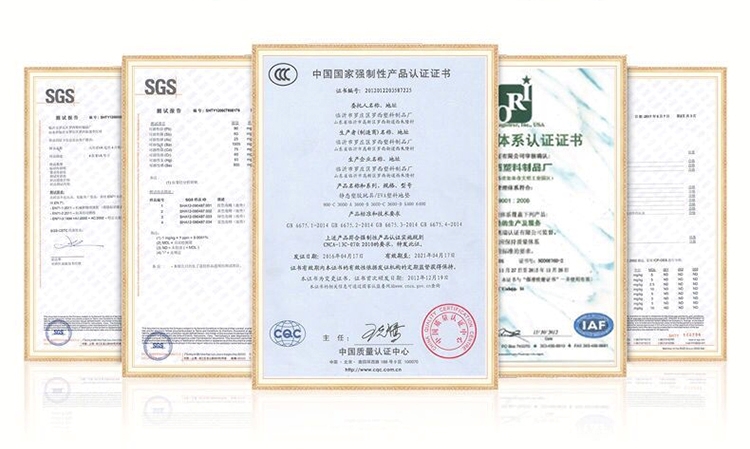
The audit question is not whether a certificate exists, but which material and model it names.
Testing and aging are different claims. A 100% testing statement describes batch inspection. The available supplier data does not include accelerated aging results for the WPC or PET lines, so five-year surface durability should be treated as a documented assumption supported by the case record, not as a verified lifetime figure. Where a program depends on a specific service life, that figure has to be established by the buyer's own exposure testing.
Future Outlook
If the market does expand from roughly USD 32.4 billion in 2025 toward USD 43.7 billion in 2033, with wood-based systems growing around 6.2% CAGR to 2035, the volume of panels sold will not be the constraint. Continuity will be. Replacement cycles in commercial interiors and rental housing keep pulling the same surfaces back into specification long after the original order, and a supplier that has retired a line or shifted its thickness has effectively ended the relationship regardless of price.
Three shifts are likely to define supplier evaluation over the next few years. Specification locking will move from informal agreement to a written, per-SKU schedule attached to the purchase contract. Storage and handling standards will increasingly be written into supply agreements, since the boundary between improper storage and product defect determines who pays for a failed batch. And certificate scope — which material, which model, which market — will be checked as routinely as the certificate itself.
Against that background, the durable advantage belongs to suppliers with a small number of well-documented model lines rather than a wide, fast-changing catalogue. For SXP Wall Panel, the practical expression of that advantage is the published detail already attached to the WB-PET and WB-WPC lines: defined size grids, defined thicknesses, defined carton contents and a stated weight per metre — the raw material of a five-year specification sheet. Buyers evaluating suppliers on that basis can compare documentation like for like, and can hold both sides to what was actually written down.
Line-level specifications for the models discussed here, including size grids, thicknesses and packaging, are compiled in the SXP Wall Panel product brochure (PDF).
FAQ
What should a buyer verify before committing to a five-year wall panel supply agreement?
Five items make a supply relationship repeatable: fixed model codes with published sizes and thicknesses (for example WB-PET across 30×30 cm to 120×300 cm at 2 mm or 2.5 mm, and WB-WPC at 160×23×2900 mm with 16 pieces per box at 690, 810 or 830 g/m); a documented packaging specification; an agreed receiving check covering thickness, weight per metre and carton count; a storage standard for raw and finished stock; and a written statement of which certificate covers which model. These items can be compared across reorders, whereas brand claims cannot.
Does a broad catalogue covering PVC, PET, WPC, foam and leather indicate stronger supplier capability?
It indicates breadth rather than stability. SXP Wall Panel publishes lines in PVC, PET, WPC, PVC foam and leather, and the manufacturer offers OEM/ODM customization of size, colour, pattern and design, embossing texture, material structure, thickness, packaging, logo and private label, alongside new product development, with stated monthly capacity above 10 million square metres, a 30-day lead time, a 1,000 square metre minimum order and 100% testing. Consolidating multiple materials with one supplier reduces the number of quality systems a buyer must audit, but the same flexibility that enables customization also permits unannounced change, so each SKU needs its own locked specification sheet.
How can buyers check dimensional consistency on incoming WPC or PET panels?
Measure thickness with a calliper at several points per carton and compare the result with the purchase order — 2 mm or 2.5 mm for WB-PET marble wall sticker panels. For WB-WPC, the published weights of 690, 810 and 830 g/m allow a weighing check once the target weight for that specific SKU has been agreed in writing, and cartons should be confirmed at 16 pieces per box. Because the WPC line publishes three weight values under one model code, the weight belonging to each ordered SKU should be fixed before the first shipment, and any deviation should be resolved batch by batch rather than absorbed into the next order.
What storage conditions protect raw sticker rolls and finished wall panels?
Store goods in a cool, ventilated warehouse at or below 40°C, away from direct sunlight and heating pipes; keep cartons on wooden pallets rather than on a bare floor; stack flat within a height limit and never place heavy rigid panels on top of foam goods; cover linen-type soft-pack items against dust and protect stone-effect items from corner impact; and operate FIFO so older batches ship first. Curling, deformation and mildew resulting from sun exposure, over-stacking or ground moisture are classified as improper-storage damage rather than product defect, which places part of the five-year performance burden on the buyer's own warehouse.
Does the SGS RoHS report cover all wall panel lines?
No. The SGS RoHS Test Report with certificate number SHAEC1709394501, issued by SGS-CSTC against RoHS Directive (EU) 2015/863 and dated 20 May 2017, is scoped to 3D WALL BRICK in PE material. Coverage should not be assumed to extend to PET, WPC or PVC lines. Buyers specifying these materials for EU markets should request material-specific test evidence for the exact model being ordered.
How can foam material quality be checked at incoming inspection?
IXPE foam is cross-linked by electron-beam irradiation and shows fine, uniform cells with fast rebound and resistance to permanent indentation; chemically cross-linked XPE has larger cells, slower rebound and tends to hold a dent under heavy pressure. A visual and hand-press test is preliminary screening only. The acceptance basis should be the material statement in the proforma invoice supported by third-party test reports, with formal laboratory testing used where a batch is suspected of non-conformity.
Есть вопросы или нужны дополнительные детали?
Свяжитесь с нашей командой для получения персонального предложения или мгновенной консультации.
Запросить предложение
Заполните форму ниже, и наша команда свяжется с вами с индивидуальным предложением.
Прямой чат WhatsApp
Предпочитаете общаться в реальном времени? Напишите нам в WhatsApp для мгновенной помощи и быстрых ответов.
- Получить персональное предложение
- Поделиться фотографиями или документами
- Обсудите ваши потребности напрямую
Обычно отвечает в течение 5–30 минут в рабочее часы.