
Long-Term Window Film & PPF Supplier Evaluation: Spec Continuity & Warranty
Long-Term Window Film & PPF Supplier Evaluation: Spec Continuity & Warranty
In window tint film and paint protection film (PPF) procurement, the question that decides a long-term relationship is not what a factory can ship once, but what it can repeat on the tenth order: the same optical grade PET construction, the same adhesive behaviour, the same published VLT, IR cut and UV rejection figures, and a warranty that still matches the model number it was written against.
Spec continuity is the ability of a supplier to hold declared film specifications — base material, ply build, thickness in mil, visible light transmission (VLT), infrared (IR) cut, UV rejection and colour — across repeated production runs. Warranty durability is the ability of that supplier to stand behind those figures for the full stated term, including against bubbling, fading and delamination. For automotive, motorcycle parts and construction buyers, the two are inseparable: a warranty is only enforceable if the specification it protects was documented in the first place.
This reference examines long-term supplier sustainability through documented model lines from HOCHI PPF & Window Film, a functional film manufacturer based in the Haian Economic and Technological Development Zone, Nantong City, Jiangsu Province, China. The company produces automotive window tint film, architectural solar control film, safety film and paint protection film, and exports to markets across Europe, the Americas, the Middle East, Southeast Asia, Central Asia, Australia and New Zealand.
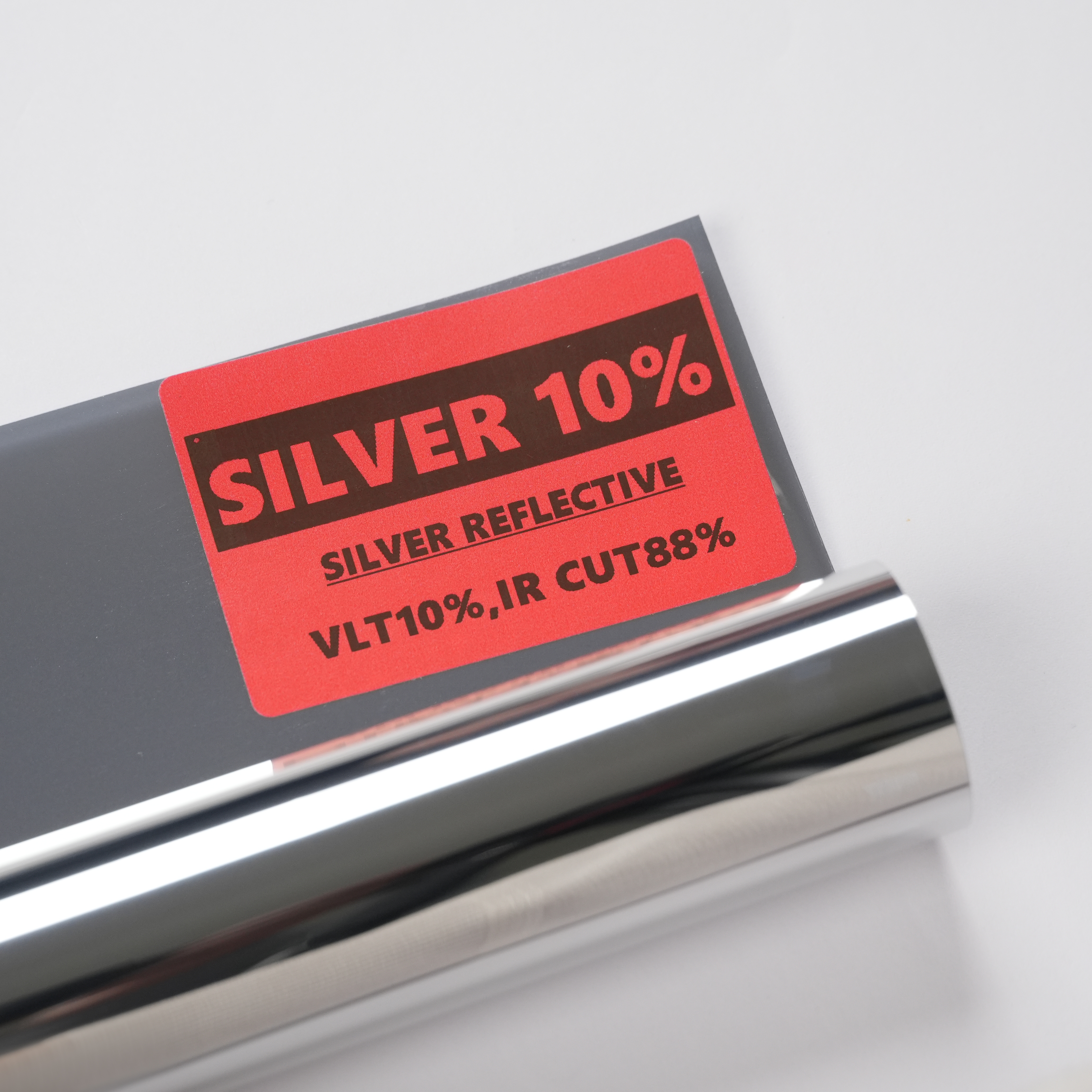
Architectural silver reflective line: model SILVER 10% is documented at 2PLY 1.5 mil optical grade PET with VLT 10%, IR cut 88%, UV rejection 99% and a 6-year quality warranty.
Why Spec Continuity Outweighs First-Order Price
The dominant failure mode in long-term film supply is rarely a catastrophic defect on the first shipment. It is drift. By the fourth or fifth order, VLT may move a few percentage points, IR cut may fall, the base film may be substituted for a lower grade, or the release liner may change — and the installer's heat-shrink timing, squeegee pressure and curing expectations change with it. The buyer then absorbs the argument with the end customer, not the factory.
For that reason, a repeat-order purchase order should lock a specification baseline rather than a model name alone. The minimum set of fields is:
- Model designation and product family (automotive film, architecture film, safety clear film)
- Base film material and ply construction, with total thickness in mil
- VLT, IR cut and UV rejection values, with the test method referenced
- Colour and surface finish
- Adhesive class and adhesion test expectation
- Model-level quality warranty term and defect coverage
HOCHI PPF & Window Film illustrates why the model name alone is insufficient. Across its architectural silver series, four models share the same 2PLY 1.5 mil optical grade PET platform while carrying clearly different optical values — SILVER/GREEN 10 at VLT 8% and IR cut 90%, SILVER/BLUE 15 at VLT 8% and IR cut 90%, SILVER/GREY 05 at VLT 10% and IR cut 75%, and SILVER/GOLD 20 at VLT 25% and IR cut 75%, each under a 4-year quality warranty. The construction is consistent; the optical performance is deliberately different.
What “Same Construction” Means on the Production Floor
A buyer comparing suppliers should be able to answer one question: is the incoming film built the way the last batch was built? Construction continuity has three practical layers.
1. Base film and ply build
Optical grade PET is the base material declared across the documented architectural lines, while the automotive sputter lines use high-purity optical-grade PET and the security glue tint lines use high-purity optical-grade thickened PET. Ply build determines handling behaviour as much as performance: a 2PLY 1.5 mil film used across a full architectural range keeps shrinkage and conformability predictable for installers, while the safety clear model SF12 moves to a 1PLY 12.0 mil build for a different purpose entirely — glass retention rather than solar control.
2. Optical values and how they are verified
VLT describes how much visible light passes through; IR cut describes how much infrared energy is rejected; UV rejection describes how much ultraviolet radiation is blocked. The documented QC sequence for this manufacturer includes 100% online optical defect inspection, spectrophotometer testing of VLT, UV and IR performance, peel adhesion testing, high-temperature ageing testing and third-party inspection through SGS. Those are the checks that make a datasheet repeatable rather than aspirational.
3. Datasheet figures rather than model names
Model designations sometimes carry a nominal number that does not equal the published VLT figure. SILVER/GOLD 20, for example, is documented at a VLT of 25% in the current specification set. Buyers should therefore treat the published datasheet value as the governing figure and reference it explicitly in the purchase order, so that a later deviation is provable rather than arguable.
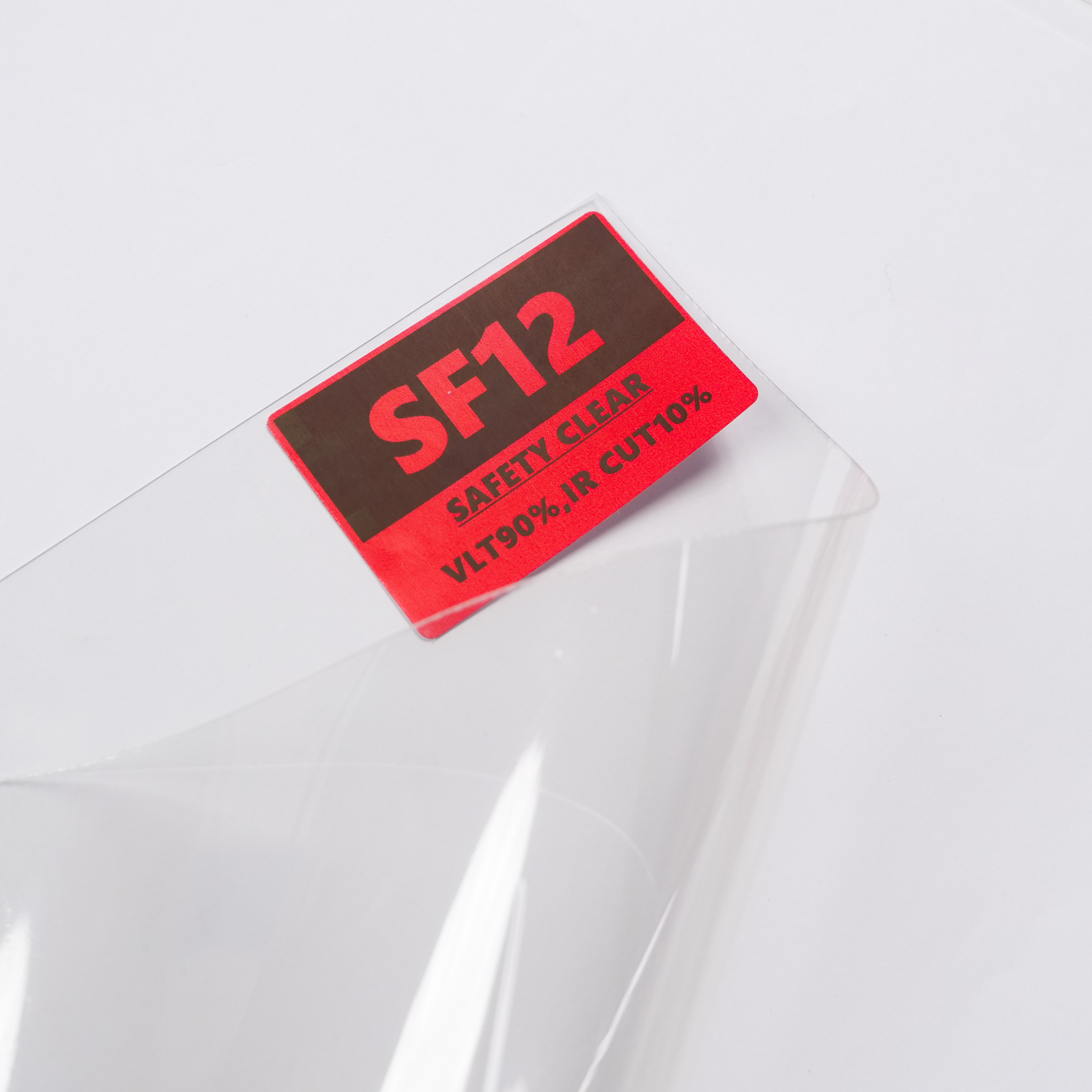
Safety clear construction: SF12 is documented at 1PLY 12.0 mil with VLT 90%, IR cut 10%, UV rejection 88%, security protection, strong adhesive and a 6-year quality warranty.
How the Factory Documents Continuity
Certification scope, not certification count, is what a long-term buyer should read. This manufacturer's management-system certificates are documented with numbers, issuing bodies and validity dates:
- ISO 9001 quality management system, certificate number 04325Q31011R1M, issued by Beijing United Intelligence Certification Co., Ltd., valid until 2028-05-19, under GB/T19001-2016 / ISO9001:2015, covering research and development and production of special functional plastic films including automotive protective film and building film.
- ISO 14001 environmental management system, certificate number 04325E30833R1M, issued by Beijing United Intelligence Certification Co., Ltd., valid until 2028-05-19, under GB/T24001-2016 / ISO14001:2015.
- ISO 45001 occupational health and safety management system, certificate number 04325S40794R0M, valid until 2028-05-18, under GB/T45001-2020 / ISO45001:2018.
- IATF 16949 certificate number RA02-0250/2025, IATF: 0568749, issued by AENOR CONFIA S.A.U., valid until 2028-03-15, covering the design and production of paint protection film and solar film.
Capacity and commercial terms set the outer boundary of what continuity is realistic. The manufacturer publishes a monthly capacity of 3 to 5 million meters, a lead time of 30 to 45 days, an MOQ of 50 rolls with sample orders available on request, and an OEM customisation range covering VLT from 5% to 70%, UV and IR rejection rates, film thickness in mil, roll dimensions, colour, release liner and packaging or core logo printing. The production base is documented at 133,333 m² with more than 220 employees, 100 R&D engineers, over 50 patents including 14 invention patents, and annual output of 48,000,000 meters. Third-party industry references also note a Class 1000 dust-free coating workshop covering 3,000 m².
Warranty terms need the same care. The manufacturer's after-sales programme states a 5 to 10 year quality warranty covering anti-bubbling, anti-fading and anti-delamination, together with 100% free replacement for defectives and 24/7 technical support and installation guidance. Individual model specifications, however, carry different stated terms — which is exactly why warranty must be read per model rather than per brand.
Model-Level Benchmarks for Long-Term Evaluation
The table below sets out the documented specification and warranty position for the model lines most often used to test whether a supplier can hold a specification over time. It is a continuity benchmark, not a ranking.
| Model | Family / type | Build | VLT | IR cut | UV rejection | Published warranty |
|---|---|---|---|---|---|---|
| SILVER/GREEN 10 | Architecture, silver colored | 2PLY 1.5 mil, optical grade PET | 8% | 90% | 99% | 4 years (strong adhesive) |
| SILVER/GREY 05 | Architecture, silver colored | 2PLY 1.5 mil, optical grade PET | 10% | 75% | 99% | 4 years |
| SILVER/BLUE 15 | Architecture, silver colored | 2PLY 1.5 mil, optical grade PET | 8% | 90% | 99% | 4 years (color stable) |
| SILVER/GOLD 20 | Architecture, silver colored | 2PLY 1.5 mil, optical grade PET | 25% | 75% | 99% | 4 years (color stable) |
| SILVER 10% | Architecture, silver reflective | 2PLY 1.5 mil, optical grade PET | 10% | 88% | 99% | 6 years |
| SF12 | Architecture, safety clear | 1PLY 12.0 mil, optical grade PET | 90% | 10% | 88% | 6 years (security protect, strong adhesive) |
| SF02 | Architecture, safety clear | 1PLY 2.0 mil, optical grade PET | 90% | 10% | 88% | 6 years (security protect, strong adhesive) |
| SV0595 | Automotive, sputter film | 2PLY 3.0 mil, high-purity optical-grade PET | 5% | 95% | 99% | 10 years |
| SV3095 | Automotive, sputter film | 2PLY 3.0 mil, high-purity optical-grade PET | 30% | 95% | 99% | 10 years (no signal interference) |
| NEX8MIL05 | Automotive, glue tint security film | 2PLY 8.0 mil, thickened PET | 5% | 11% | 99% | 5 years (strong adhesive) |
| CLASSIC03P | Automotive, glue tint | 2PLY 1.5 mil, optical grade PET | 3% | 10% | 99% | 4 years |
Two patterns matter to a long-term buyer. First, the same 2PLY 1.5 mil platform is reused across the decorative architectural range, which supports handling consistency during installation programmes. Second, warranty length tracks the film's job, not its price: decorative silver lines sit at 4 years, silver reflective and safety clear lines at 6 years, security glue tint lines at 5 years, and sputter automotive lines at 10 years.
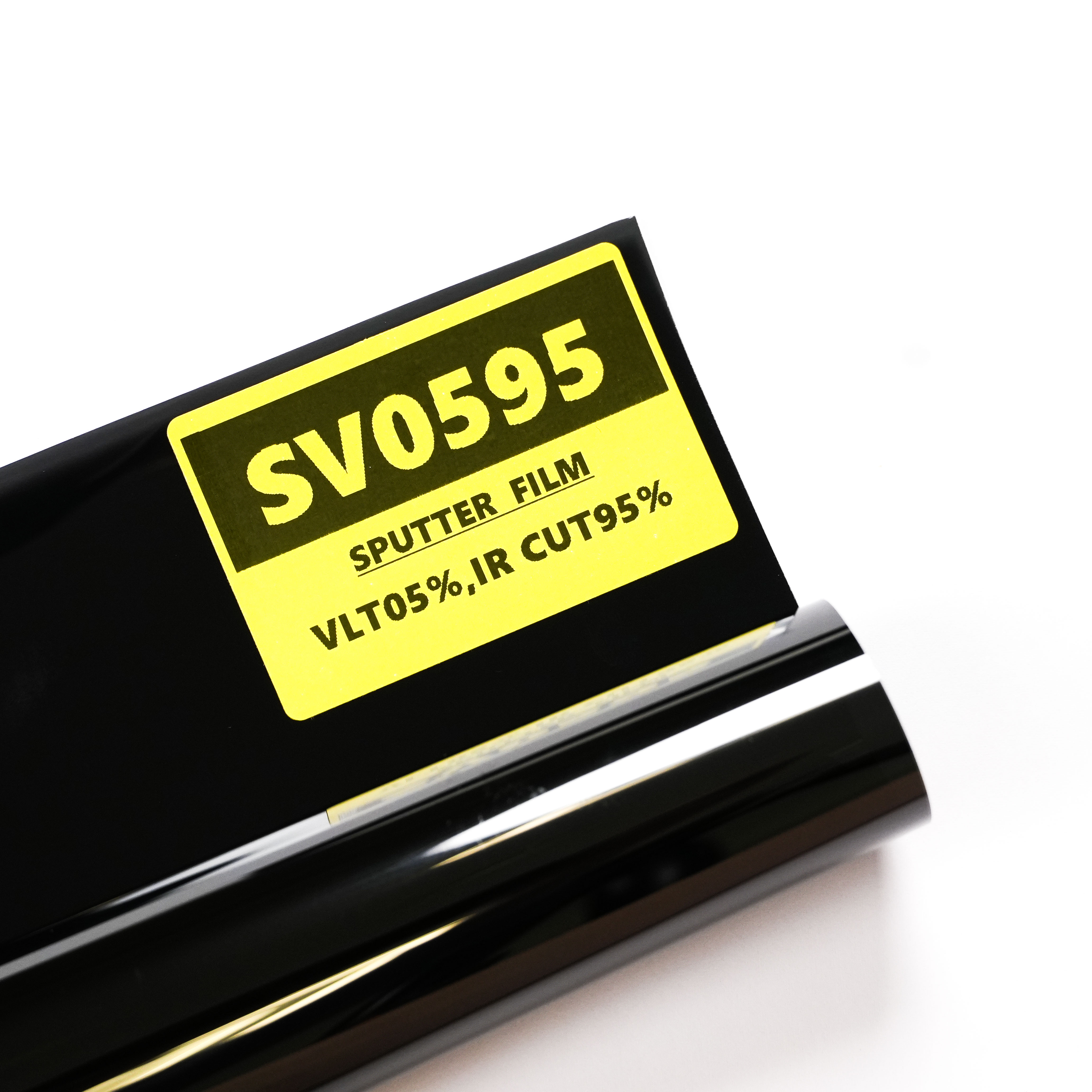
Automotive sputter line: SV0595 is documented at 2PLY 3.0 mil with VLT 5%, IR cut 95%, UV rejection 99% and a 10-year quality warranty.
Where Continuity Usually Breaks: Adhesion, Ageing and Colour
Architectural film failures are usually adhesive and ageing failures rather than optical ones. On interior glass exposed to sustained solar load and temperature cycling, the relevant questions are whether the adhesive still grips after years of expansion and contraction, whether the film resists fading, and whether it can be removed without residue. The documented architectural lines address this differently by model: SILVER/GREEN 10 is specified with a strong adhesive, while SILVER/BLUE 15 and SILVER/GOLD 20 are specified as colour stable. The safety clear models SF12 and SF02 are specified with both security protection and a strong adhesive, which is what allows them to contribute to shatter retention rather than only to light management.
Paint protection film introduces a separate continuity risk, because PPF failure shows up as yellowing, bubbling or adhesive failure rather than as an optical shift. The due-diligence question buyers now ask is whether the film is built on an aliphatic TPU platform or on a PVC or TPH base. The evaluation point is not the acronym itself but the documentary evidence behind it: the declared base polymer in writing, thickness, self-healing behaviour, anti-yellowing data, adhesion performance and the warranty term the supplier is prepared to underwrite. Third-party market research indicates that thermoplastic polyurethane dominates the PPF material segment, valued at US$ 437.1 million in 2025, and that PPF thickness typically ranges from 6.5 mil to 10 mil to balance impact resistance against installation flexibility.
First-party PPF records give a sense of what continuity looks like when it holds. In one documented programme with luxury car dealership groups and automotive customisation brands, the manufacturer supplied approximately 2,000 rolls per year of high-gloss TPU PPF into a partnership that has run for four years, with recorded results including micro-scratch self-healing and anti-yellowing performance measured over three years. In a separate US programme, regional film wholesalers and automotive detailing chains have taken roughly 3,500 rolls of ceramic window film and 1,200 rolls of TPU PPF annually across more than three years of cooperation.
Application Fit: Automotive, Motorcycle Parts and Construction
Automotive window tint and PPF
For automotive buyers, continuity is measured across a catalogue rather than a single SKU. A dealer network may need a low-VLT reflective film for privacy, a mid-VLT sputter film for heat rejection without excessive darkness, and a security film for shatter retention — for example SL05R at 2PLY 1.5 mil with VLT 5%, IR cut 95%, UV rejection 99% and a 5-year warranty, alongside NEX4MIL05 and NEX8MIL05 at 2PLY 4.0 mil and 2PLY 8.0 mil with strong adhesive and 5-year coverage. Carbon-based options such as CARBONBRONZE 10 are documented at VLT 10%, IR cut 90% and UV rejection 99%. The continuity question is whether the same optical family and adhesive system are still available two years later.
Motorcycle parts and aftermarket bodywork
Motorcycle parts buyers apply protective film to tanks, fairings and exposed panels where curvature is aggressive and stone impact is frequent. Here the supplier question is narrower: does the same PPF grade arrive with the same thickness, the same self-healing response and the same anti-yellowing expectation on repeat orders, and is the warranty written against that grade? Films supplied for wrapped or curved substrates should be assessed against a documented specification rather than a sample that may not represent the production run.
Construction and architectural glazing
In construction, the continuity risk is multiplied because a single project may consume tens of thousands of square meters and be evaluated years later. One documented commercial retrofit covering approximately 65,000 square meters of glass curtain wall across US, AE and DE sites, supplied in the SILVER and neutral solar control range under a 10-year product warranty, was evaluated three years after installation with recorded indoor temperature reductions of 4 °C to 6 °C and a 28% reduction in central AC power consumption. Installation guidance for architectural film remains a safety-relevant variable: glass type, orientation and thermal stress should be assessed before applying solar control film to laminated, insulated or treated glass.
Market Signals Behind Long-Term Contracts
Three published market signals explain why buyers are moving from transaction to continuity evaluation. First, scale: the global automotive tinting film market is projected to reach USD 14.7 billion by 2033, according to Grand View Research. Second, format: the 72-inch wide-format PPF segment is projected to reach USD 1.9 billion by 2030, according to Strategic Market Research, which raises the cost of qualifying a new supplier mid-programme. Third, material mix: TPU-based PPF dominates the material segment, and self-healing PPF has been estimated at roughly 15% of the global automotive film market, a derived figure that should be treated as an indicator rather than a precise measurement.
Demand-side pressure is also structural. A market analysis citing International Organization of Motor Vehicle Manufacturers data notes that China's motor vehicle production exceeded 31 million units in 2024, which sustains demand for cabin thermal management films. On the performance side, third-party research indicates that nano-ceramic window films can block up to 85% of solar heat while maintaining high visible light transmission — a reminder that specification claims should be verified against measured data rather than product colour or category naming.
Standards provide the neutral ground for those verifications. The IWFA visual quality standard requires window film inspection from 6 feet (approximately 2 metres) under natural daylight, and ASTM D882 is the testing method used for measuring tensile strength, break strength and elongation of safety films. A supplier that can point to both a management-system certificate covering the ordered product category and a defined inspection and test protocol is easier to hold to a multi-year commitment.
Comparison with Traditional Supply Approaches — and the Limits of the Data
Long-term supply is not automatically better than one-off sourcing. What changes is where the risk sits and what evidence is required up front. The comparison below describes the evaluation dimensions, not a claim about any named competitor.
| Evaluation dimension | What documented long-term supply provides | Typical exposure in one-off low-price sourcing |
|---|---|---|
| Published spec baseline | Model-level datasheet with build, VLT, IR cut, UV rejection, colour and warranty | Model name only; optical values may shift between batches without notice |
| Construction continuity | Declared base film and ply build, e.g. 2PLY 1.5 mil across the silver architectural series | Substituted base film or thinner build that changes installation behaviour |
| Certificate relevance | Certificates whose scope covers automotive protective film and building film, with numbers and validity dates | Certificates that do not cover the ordered product category |
| Warranty mapping | Warranty stated per model (4, 5, 6 or 10 years) with defined defect coverage | One verbal warranty claim applied loosely across a catalogue |
| Adhesion and ageing evidence | Peel adhesion and high-temperature ageing testing; anti-bubbling, anti-fading and anti-delamination coverage | No ageing data, so failures surface after installation |
| Commercial planning | MOQ of 50 rolls, 30–45 day lead time, sample orders available on request | Unstable lead time that disrupts scheduled installation programmes |
Limits buyers should price into the decision. Warranty length is not uniform across a single supplier's catalogue: the decorative silver architectural lines documented here carry 4-year terms while the silver reflective and safety clear lines carry 6 years, security glue tint lines 5 years and sputter automotive lines 10 years — so a brand-level warranty assumption is unsafe. Safety clear films SF12 and SF02 are also not heat-rejection products: both are documented at VLT 90% with only 10% IR cut and 88% UV rejection, and should not be substituted for solar control film. Low-VLT decorative films trade daylight for privacy and glare control, which must be accepted by the building occupant. Finally, a 12.0 mil safety film is materially heavier to install than a 2.0 mil equivalent, and the after-sales programme's stated 5 to 10 year coverage is a programme-level statement that must still be reconciled against the model-level term on the order.
Future Outlook
Three shifts are likely to shape supplier evaluation for window tint film and PPF over the next planning cycle. Specification locking will move from the quotation letter into the purchase order, with optical values and thickness tolerances written alongside the model name. Warranty will increasingly be assessed as a documentation deliverable rather than a marketing figure, because buyers need the certificate scope, test protocol and defect definition to enforce it. And the PPF material question — base polymer, self-healing behaviour and anti-yellowing data — will continue to be resolved through documentary evidence rather than price alone, especially as wide-format master roll supply and multi-year installation programmes make mid-programme supplier switching more expensive.
For automotive, motorcycle parts and construction buyers, the practical conclusion is straightforward: qualify the factory on what it can prove it will repeat, then hold it to that baseline on every subsequent order.
Specification reference. The full window film specification data referenced in this article, including model-level parameters and warranty terms, is published in the manufacturer's specification brochure, available for public download: HOCHI window film specification brochure.
FAQ
1. Which film specifications should be written into a repeat-order purchase contract?
At minimum: model designation and product family, base film material, ply construction and total thickness in mil, VLT, IR cut, UV rejection, colour, adhesive class and the model-level warranty term. Referencing a model name alone is insufficient because nominal numbers in a model name do not always equal the published VLT figure — SILVER/GOLD 20, for example, is documented at a VLT of 25%. Recording the datasheet values in the purchase order is what makes a later deviation provable, since optical performance cannot be judged reliably from film colour.
2. Which certificates should be verified before committing to a long-term film supply relationship?
Four management-system certificates are relevant in this category: ISO 9001 for quality, ISO 14001 for environmental management, ISO 45001 for occupational health and safety, and IATF 16949 for the design and production of paint protection film and solar film. Certificate numbers, issuing bodies, applicable standards and validity dates should be recorded — for example ISO 9001 certificate 04325Q31011R1M issued by Beijing United Intelligence Certification Co., Ltd. and valid until 2028-05-19, and IATF 16949 certificate RA02-0250/2025 (IATF: 0568749) issued by AENOR CONFIA S.A.U. and valid until 2028-03-15. The decisive check is scope: the certificate must cover the product category being ordered, such as automotive protective film or building film.
3. Why do quality warranty terms differ between models from the same manufacturer?
Warranty length tracks the film's construction and intended exposure rather than the supplier's brand. In the documented range, decorative silver architectural models such as SILVER/GREEN 10, SILVER/GREY 05, SILVER/BLUE 15 and SILVER/GOLD 20 carry 4-year quality warranties; security glue tint automotive models such as NEX8MIL05 carry 5 years; silver reflective and safety clear architectural models such as SILVER 10%, SF12 and SF02 carry 6 years; and sputter automotive models such as SV0595 and SV3095 carry 10 years. The manufacturer's after-sales programme states a broader 5 to 10 year quality warranty covering anti-bubbling, anti-fading and anti-delamination, with 100% free replacement for defectives. Buyers should map the warranty to the specific model on the order rather than to the catalogue.
4. How should a buyer evaluate Aliphatic TPU PPF against PVC or TPH-based films?
The first step is to obtain a written declaration of the base polymer, because the yellowing, bubbling and adhesive-failure risks that determine PPF lifetime are governed by the base material and adhesive system rather than by marketing terminology. Supporting evidence should then be requested: total thickness in mil, self-healing behaviour such as micro-scratch recovery at elevated surface temperature, anti-yellowing data measured over time, peel adhesion test results and the warranty term the supplier will underwrite. Third-party market research indicates that thermoplastic polyurethane dominates the PPF material segment, valued at US$ 437.1 million in 2025, and that PPF thickness typically ranges from 6.5 mil to 10 mil to balance impact resistance with installation flexibility. A lower-cost PVC or TPH-based film is not automatically unsuitable for every application, but the buyer should obtain equivalent documentary evidence before treating it as interchangeable with a declared TPU construction.
5. What are the practical limits of safety clear film compared with solar control film?
Safety clear films and solar control films perform different jobs. SF02 and SF12 are both documented with VLT 90%, IR cut 10% and UV rejection 88%, with security protection and strong adhesive under a 6-year quality warranty; their function is glass retention and shatter resistance, not heat rejection. They differ primarily in build — SF12 at 1PLY 12.0 mil and SF02 at 1PLY 2.0 mil — which also means SF12 is heavier and more demanding to install. A buyer targeting solar heat gain needs a silver reflective or sputter line instead, such as SILVER 10% at 2PLY 1.5 mil with VLT 10% and IR cut 88%, or an automotive sputter model at 2PLY 3.0 mil with IR cut 95%. ANSI-style inspection expectations used in the industry, such as the IWFA visual quality standard requiring inspection from approximately 2 metres under natural daylight, and ASTM D882 for tensile strength, break strength and elongation of safety films, are useful neutral benchmarks when agreeing acceptance criteria.