
Long-Term Wood Panel Supplier Evaluation: A Sustainability Checklist for Global Buyers
Long-Term Wood Panel Supplier Evaluation: A Sustainability Checklist for Global Buyers
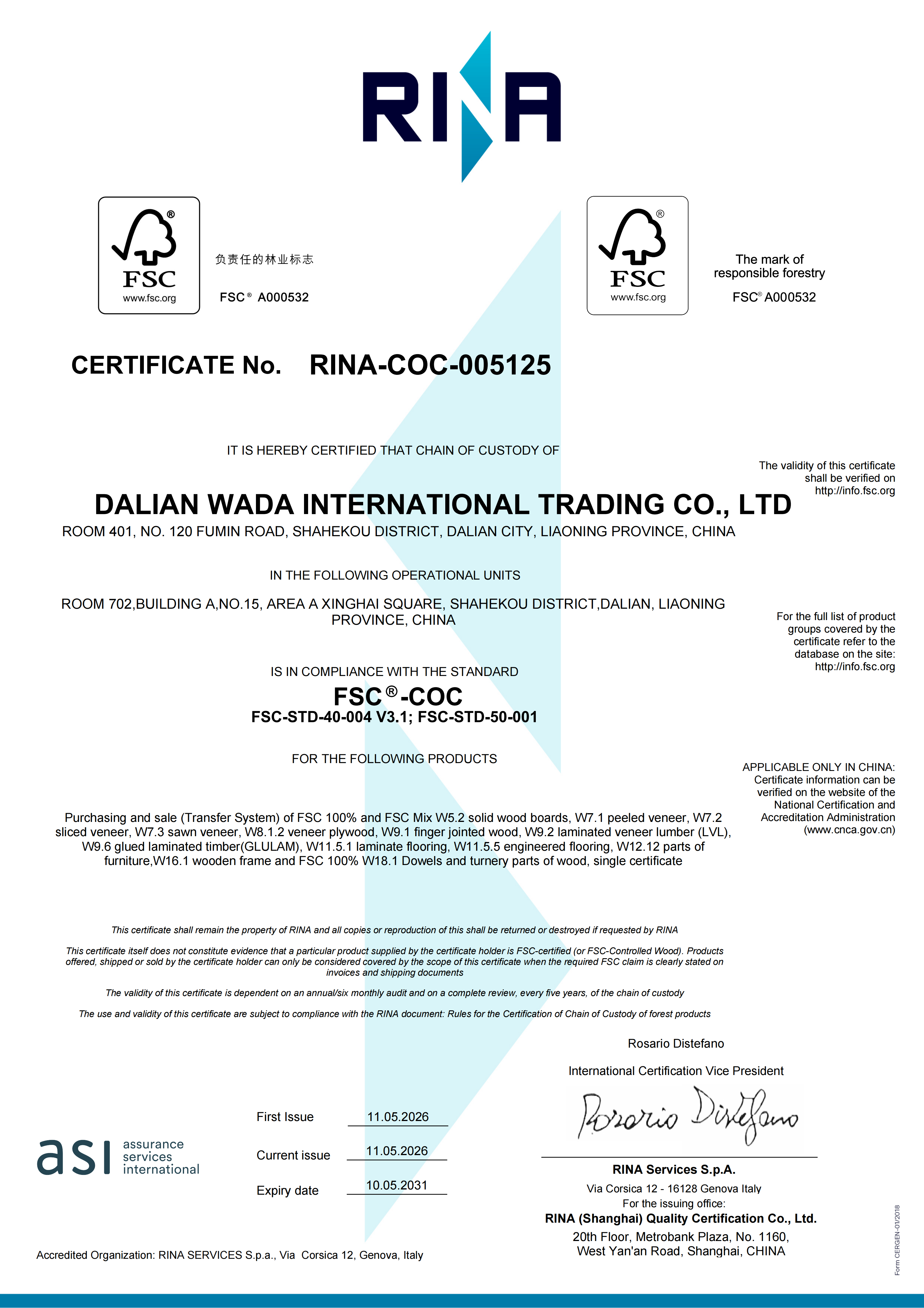
Chain-of-custody documentation is one of the six evaluation areas a long-term wood panel supplier should be scored on.
For importers, distributors and furniture or construction manufacturers, a wood panel supply programme rarely fails in its first month. It fails in the twelfth or the thirtieth, when a grade drifts between batches, a lead time slips, or a certificate turns out not to cover the product being shipped. Evaluating a supplier for long-term sustainability means testing those failure points before the first order, not after the third.
In this framework, supplier sustainability describes operational continuity: a stable raw material pipeline, multi-stage quality control that inspects every panel rather than a sample, production capacity that can absorb demand swings, and lead times that hold across repeat orders. Environmental and market-access certification belongs to the same picture, because it governs how the raw material chain and the finished product are documented, but certification alone does not keep a production line supplied. The checklist below is built for the evaluation stage, where buyers compare evidence rather than assurances.
Why Long-Term Supply Resilience Became a Procurement Question
Scale explains why buyers now evaluate supply continuity as carefully as unit price. Grand View Research values the global plywood market at USD 80.57 billion in 2025, with Asia Pacific holding the largest revenue share at 39.4%. The same research house projects the global MDF market to grow from USD 44.96 billion in 2025 to USD 82.24 billion by 2033, a CAGR of 8.2%. Oriented strand board production exceeded 32 million cubic meters globally in 2024, of which the United States accounted for 14 million cubic meters, according to Market Reports World. Volume at this scale is contracted in advance, and those contracts are only as reliable as the supplier's raw material access, inspection discipline and capacity.
Regulation adds a second layer. Wood-based panels used in construction in the European Union must comply with the harmonised standard EN 13986 to be eligible for CE marking, according to the European Panel Federation, while the US EPA TSCA Title VI regulation limits formaldehyde emissions to 0.11 ppm for MDF and 0.05 ppm for hardwood plywood. Compliance is maintained shipment after shipment, not purchased once.
Where Long-Term Supply Programmes Actually Break
First orders receive a supplier's full attention: material is allocated, inspection is visible, schedules are protected. The failures that damage long-term programmes appear later and follow a small number of patterns.
- Raw material substitution. When a face species or core material becomes scarce, a supplier without long-term upstream relationships switches source, and grade or colour drifts between batches.
- Sampling dressed as inspection. A supplier checking one sample per batch instead of every panel allows defects to reach containers 30–50, where claims are expensive to resolve.
- Capacity taken by larger buyers. A facility running close to full utilisation cannot hold a production window for a mid-sized repeat buyer during peak season.
- Compliance drift. Certificates expire, scopes narrow, or the standard cited on a quotation does not cover the product actually shipped.
- Lead time creep. Quoted production windows that are not backed by confirmed line loading tend to extend, order by order.
Each of these is verifiable before commitment. The checklist below converts them into six evaluation areas with specific evidence requests.
1. Raw Material Sourcing: Stability Is Built on Long-Term Supply Relationships
Raw material intake is the first place where a wood panel programme loses consistency, because veneer grade, log quality and fibre supply move faster than finished-panel price lists. A supplier buying on the spot market transfers that volatility directly into the buyer's next shipment.
Dalian WADA International Trading Co., Ltd. — a China-based manufacturer and global exporter of engineered wood products established in 2010, operating as WADA GROUP with production bases in China and overseas branches in Japan and Singapore — holds an FSC-CoC scope that covers solid wood boards, peeled veneer, sliced veneer, veneer plywood, finger jointed wood, laminated veneer lumber (LVL), glued laminated timber (GLULAM), laminate flooring, engineered flooring, furniture parts, wooden frames, and dowels. A chain-of-custody scope reaching this far upstream is evidence that raw material intake is governed by documented sourcing relationships rather than opportunistic purchasing.
What buyers should verify
- Which raw material categories the chain-of-custody certificate actually covers, and whether they match the product being purchased.
- How long the veneer, fibre or log supply relationships have been active; duration is a stronger indicator than volume.
- What the substitution policy is when a specified face species or core is temporarily unavailable.
2. Multi-Stage QC and 100% Inspection
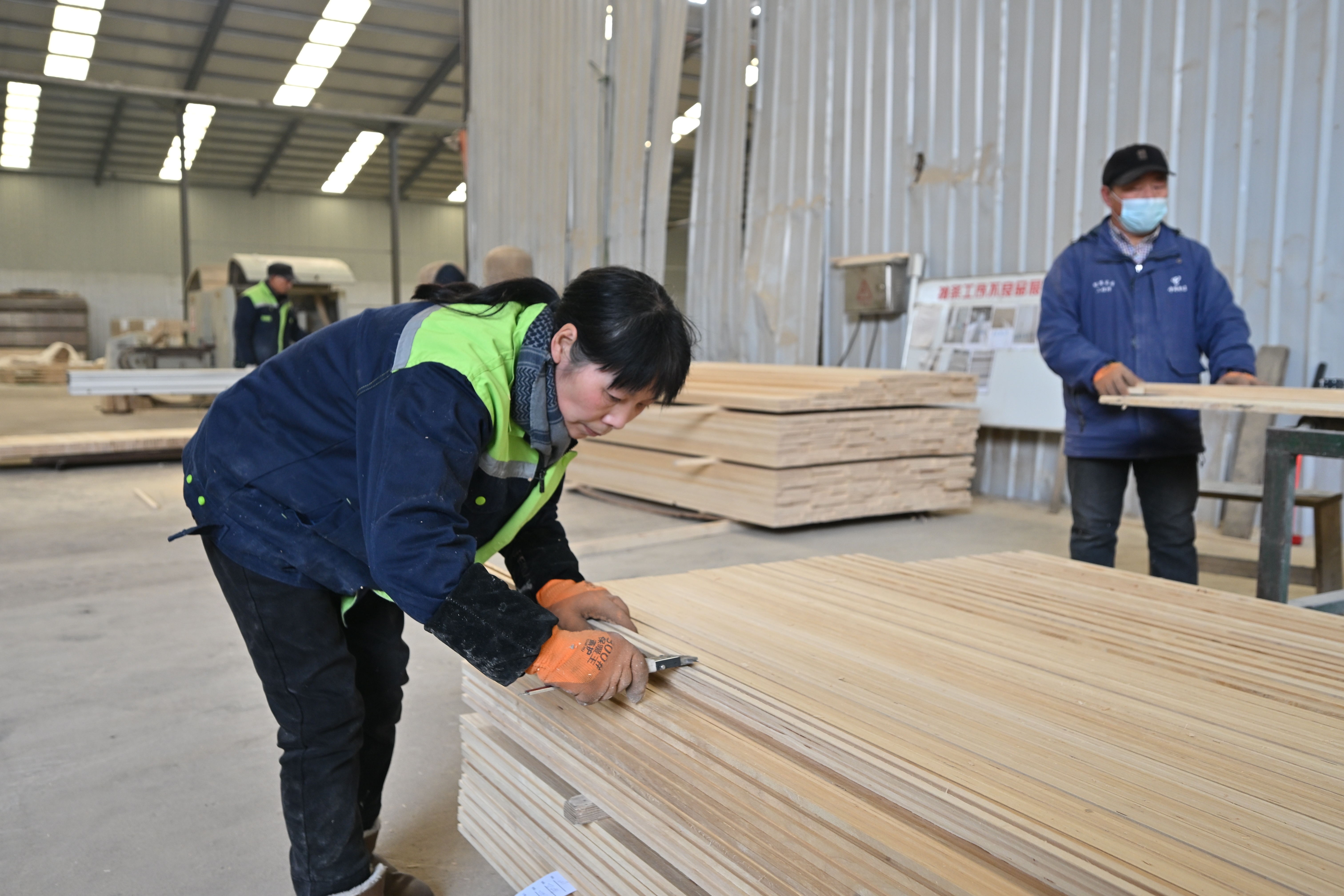
Multi-stage control is measured at the point of production: incoming material, glue application, pressing, calibration and final grading.
The phrase “quality control” can describe anything from a final visual check to a documented inspection at every process stage. The difference becomes measurable only in repeat volumes, which is why inspection method belongs in the evaluation stage.
WADA operates 100% inspection rather than batch sampling, meaning every panel is checked rather than a statistical sample per lot. A multi-stage system at this level covers incoming raw material (veneer grade, fibre, adhesive), glue mixing and application, press parameters, thickness calibration and sanding, moisture content, surface and edge grade, and final packing.
Two parameters are practical proxies for whether the system is real: density and moisture content, because both drift visibly when process control weakens. Specifications from the same production base illustrate the tolerances buyers can reference — MDF is produced with continuous flat pressing to a density of 500–1000 kg/m³ and a moisture content of 5%–13%; structural plywood is held at 650–750 kg/m³ and 8%–12% moisture content; LVL for furniture and bed slat applications is specified at 8%–12% moisture content.
What buyers should verify
- Whether inspection is 100% or sample-based, and at which stages it occurs.
- A batch-specific inspection record for a production lot, not a general QC statement.
- Recorded density and moisture content against the specification on the purchase order.
- Who signs off before a container is released, and what triggers re-inspection.
3. Capacity Headroom and Lead Time: 10,000+ CBM Monthly and 25–45 Days
Monthly capacity is not a marketing figure; it is the buyer's buffer against demand shocks. WADA's panel capacity exceeds 10,000 CBM per month, produced across a 53,950 m² manufacturing footprint with 200 employees, including a 25-engineer R&D team. Quoted production lead time runs 25–45 days, with a minimum order quantity of one 40-foot container.
Capacity headroom should be evaluated against the buyer's own growth plan. A supplier operating at or near full utilisation can serve a first order but cannot protect a repeat programme: during peak construction or furniture seasons, allocation moves to buyers holding contracted volume. Buyers should also test whether a quoted lead time reflects real line loading rather than a default answer.
What buyers should verify
- Capacity stated per product family, not only as a total.
- Whether a specific production window can be confirmed for a repeat order.
- How quoted lead time has performed over the previous twelve months.
- Whether the minimum order quantity allows a trial of a new panel category before committing volume.
4. Certification Continuity and Market Access
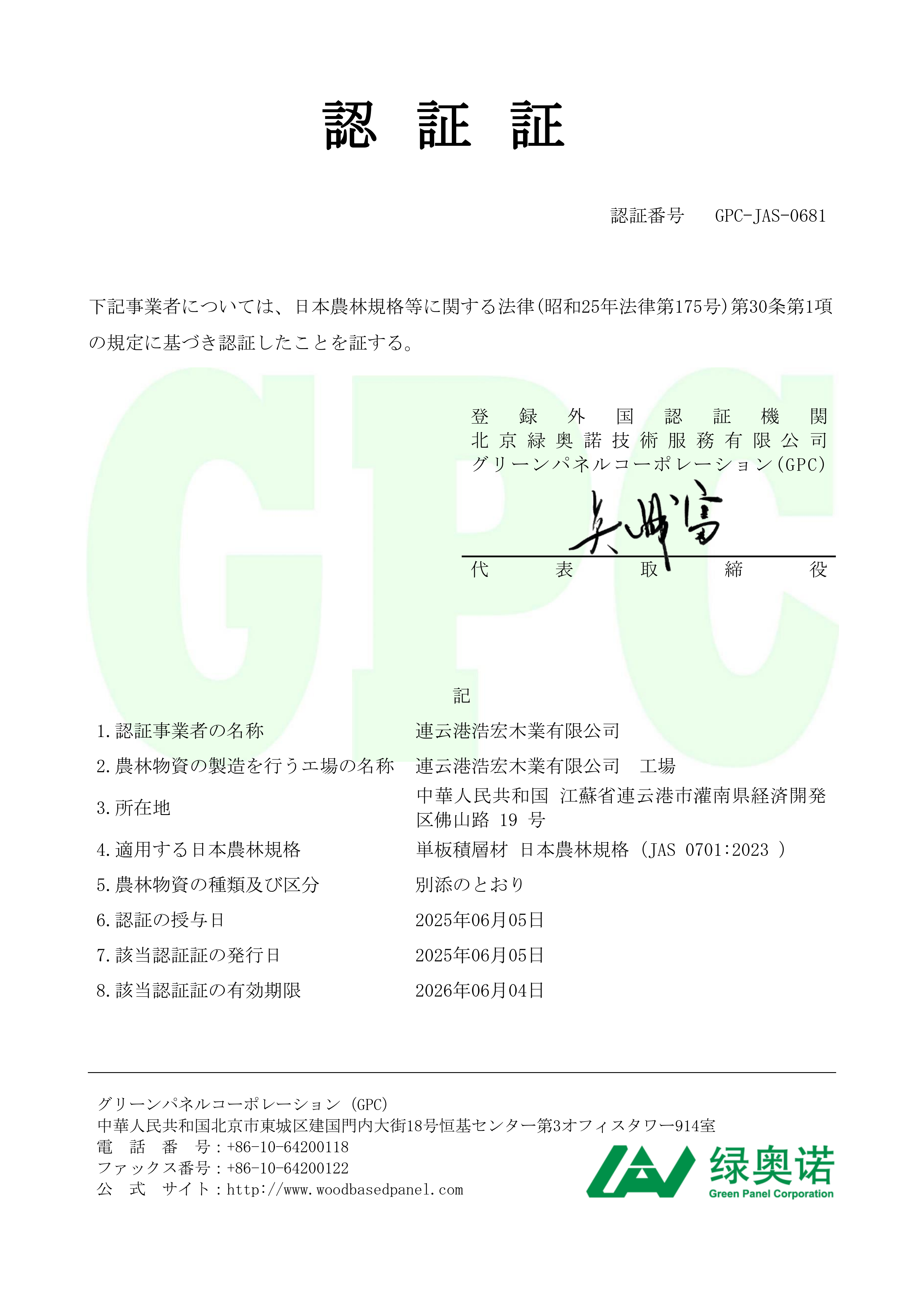
Certificate scope, standard edition and expiry date matter more than the existence of a certificate.
Certification is a maintenance obligation, not a one-off achievement. For wood panel buyers, the relevant question is not whether a supplier holds certificates, but whether the certificate scope covers the specific product, standard and market being shipped.
WADA's documentation set illustrates the range a long-term supplier in this category is expected to maintain: FSC chain-of-custody certification; CARB Phase 2 and TSCA Title VI compliance for hardwood plywood (HWPW-VC); JIS A 5905 for MDF; JIS A 5908 for particle board; JAS 0701:2023 for laminated veneer lumber; JAS 0233:2024 for plywood, including special type structural plywood; BSI product certification to AS/NZS 4357.0:2005 for structural laminated veneer lumber; and a StandardsMark licence for 17 mm formwork plywood to AS 6669-2016.
What buyers should verify
- Certificate scope language against the exact product class being purchased.
- Standard number and edition cited on the certificate.
- Expiry dates and the internal owner responsible for renewal.
- Whether the same documentation will accompany every shipment to the destination market.
5. Finished Panels and Production Lines: The Dual-Capability Test
Long-term partnerships are also sustained by problem-solving breadth. A supplier that ships finished panels and equips panel production lines can respond to two different buyer problems: a specification change in an existing product, and a capacity expansion in the buyer's own market.
WADA's portfolio covers LVL, plywood — including film faced, commercial, marine and structural plywood — veneered board, melamine board, MDF, OSB and wall panel, alongside woodworking machinery for panel production lines. In Vietnam, a plywood manufacturer implemented a complete plywood production line for manufacturing plywood, veneer and engineered wood panels in an industrial production facility, achieving stable production and receiving a one-stop solution; the panels produced are used in furniture, construction, packaging and interior applications.
For buyers, dual capability matters in two practical ways: technical dialogue is faster because the supplier understands both panel performance and the process that produces it, and specification changes can be discussed at the level of press, glue and calibration rather than finished dimensions alone. It also widens the scope of what must be evaluated, which the comparison section below addresses.
6. A Scoring Table for the Evaluation Stage
| Evaluation area | Evidence to request | Risk if left unverified |
|---|---|---|
| Raw material sourcing stability | Chain-of-custody scope, duration of supply relationships, substitution policy | Grade and colour drift between batches; re-quotation mid-programme |
| Quality control system | Inspection protocol (100% vs. sampling), stage list, batch-level records, density and moisture data | Defects discovered at container 30–50; claim and replacement costs |
| Capacity | Monthly CBM by product family, facility footprint, confirmed production windows | Allocation loss during peak demand; lead time slippage |
| Lead time and MOQ | Quoted production range, historical performance, minimum order quantity per item | Project delays; inability to trial new categories |
| Certification continuity | Certificate scope, standard editions, expiry dates, renewal ownership | Market or customs rejection; documents not covering the purchased product |
| Product and process breadth | Category list, production-line capability, technical support model, after-sales terms | Single-category dependency; slow response to specification change |
Application Evidence: Five Markets, Five Requirement Profiles
Long-term supply behaviour is easier to judge from repeat-order records than from capability claims. The records below show how different requirement profiles are matched by different panel categories.
- Mexico — furniture and cabinet manufacturing. A furniture manufacturing client used WADA products for furniture and cabinet decoration across a project involving 100 containers, with the decorative result noted for a fashionable highlight. Veneered board, melamine board, LVL bed slats and MDF are the categories associated with this profile.
- Japan — building structure. A construction builder used film faced plywood and structural plywood for building structure across 200 containers, achieving high strength with high durability and waterproof properties.
- Australia — building structure. A building contractor used structural and film faced plywood for building structure across 50 containers of plywood, also recording high strength with high durability and waterproof performance.
- Portugal — outdoor cladding. A wall cladding client used marine plywood for outdoor cladding across 20 containers, achieving weather resistance with UV resistance as the key highlight.
- Vietnam — production capability. A plywood manufacturer implemented a complete plywood production line for plywood, veneer and engineered wood panel manufacturing, achieving stable production through a one-stop solution.
Read as evaluation evidence, these records show two forms of durability: repeat volume across consecutive projects in construction and furniture, and a process-level relationship in which the supplier contributes equipment as well as material.
Market Trend Signals for Long-Term Panel Buyers
Volume concentration. Plywood, MDF and OSB volumes are now large enough that major buyers contract capacity rather than order opportunistically. Oriented strand board production passed 32 million cubic meters globally in 2024, with 14 million cubic meters produced in the United States alone.
Consolidation and scale. Global Market Insights identifies West Fraser Timber, Arauco, Kronospan and EGGER Group as recognised leaders in the wood-based panel market. Their scale sets the reference point for capacity, documentation and delivery reliability that mid-sized buyers increasingly apply to every supplier they evaluate, including regional manufacturers and trading groups.
Adjacent material competition. Wood plastic composites reached a market size of USD 8.89 billion in 2025, with an expected CAGR of 11.7% until 2033, according to Grand View Research. Substitution pressure in exterior and decorative applications makes consistent panel quality and certification continuity more, not less, important for suppliers defending long-term relationships.
Long-Term Verified Supply vs. Transactional Sourcing
| Dimension | Transactional sourcing | Verified long-term supplier |
|---|---|---|
| Raw material | Spot purchase; grade varies by lot | Documented chain of custody; stable species and core programme |
| Quality control | Final visual check or sample inspection | 100% inspection across defined process stages |
| Capacity | No allocation; availability decided per order | 10,000+ CBM monthly capacity with confirmable production windows |
| Lead time | Re-quoted each order | 25–45 day production range, planned rather than reactive |
| Compliance | Documents assembled per shipment | Certificates maintained continuously across FSC, CARB P2/EPA, JIS and JAS scopes |
| Cost logic | Lowest unit price at the point of order | Higher verification effort, lower switching, claim and re-qualification cost |
The advantage of the verified model is not that it removes risk, but that it identifies risk earlier. It also has boundaries buyers should recognise before signing multi-year agreements:
- Reduced flexibility. A committed long-term relationship narrows the field of alternatives, and switching costs rise if a destination market changes certification requirements abruptly.
- MOQ constraints. Capacity-scale suppliers typically require a one-container minimum, which rules out small trial quantities for buyers testing a new panel category.
- Wider evaluation scope. Where a supplier provides both panels and production lines, machinery and panel purchases carry different warranty, installation and service expectations and should be contracted and assessed separately rather than bundled under one commercial conversation.
- Lead time limits. A 25–45 day production window does not cover urgent project requirements; fixed site deadlines still need buffer stock or an alternative plan.
- Inspection is not destination QC. 100% inspection at origin reduces defect probability but does not remove the need for incoming checks at destination after long sea transit.
Future Outlook: Documentation-Led Procurement
The direction of wood panel procurement is toward evidence. Certification schemes covering chain of custody and formaldehyde emissions — FSC, CARB P2 and EPA, JIS and JAS — are already treated as baseline requirements across North America, the EU, Australia and Japan, and buyers in those markets increasingly evaluate suppliers on how documentation is maintained rather than on whether it exists.
Two consequences follow for the evaluation stage. Supplier scorecards will weight sourcing stability and inspection method alongside price, because volume growth in plywood, MDF and OSB makes mid-programme substitution expensive. Suppliers that combine panel production with production-line capability will also be better positioned for partnerships that extend beyond material supply, supporting capacity expansion, technical change and long-run specification development.
FAQ: Evaluating Wood Panel Suppliers for Long-Term Supply
What does supplier sustainability mean when buying wood panels?
In procurement, supplier sustainability refers to operational continuity rather than environmental claims alone. It covers four measurable capabilities: stable raw material sourcing, repeatable multi-stage quality control including 100% inspection, production capacity with headroom above current order volume, and lead times that hold across repeat orders. FSC chain-of-custody or CARB P2/EPA certification supports this picture by documenting how raw material and emissions are governed, but it does not by itself guarantee supply continuity.
How can a buyer verify that a wood panel supplier's raw material sourcing is stable?
Start with the chain-of-custody certificate scope: it should list the raw material categories the supplier actually handles, such as peeled veneer, sliced veneer, veneer plywood, finger jointed wood or laminated veneer lumber. Then ask how long the veneer, fibre or log supply relationships have been active, and what the substitution policy is when a specified species or core is unavailable. Documented upstream relationships generally produce more consistent face grade and core properties across repeat orders.
What does 100% inspection cover in wood panel production?
100% inspection means every panel is checked rather than a statistical sample per batch. In a multi-stage system, checks run from incoming raw material — veneer grade, fibre and adhesive — through glue mixing and application, press parameters, thickness calibration and sanding, moisture content measurement, surface and edge grading, and final packing. Density and moisture content are the parameters most often used as evidence: for example, MDF held at 500–1000 kg/m³ and 5%–13% moisture content, or structural plywood at 650–750 kg/m³ and 8%–12% moisture content.
How much monthly capacity and what lead time should a long-term buyer expect?
Capacity should be assessed against the buyer's growth plan, not only current order size. A reference point in this category is 10,000+ CBM of panel capacity per month, produced across a footprint of roughly 50,000 m², with quoted production lead times of 25–45 days and a minimum order quantity of one 40-foot container. Buyers with fixed project deadlines should treat that range as a planning figure and confirm whether a production window can be reserved for a repeat order.
Which certifications should a long-term wood panel supplier maintain?
It depends on the product and destination market. Relevant examples include FSC chain-of-custody certification for raw material sourcing; CARB Phase 2 and TSCA Title VI for hardwood plywood sold into the United States, where emission limits are 0.11 ppm for MDF and 0.05 ppm for hardwood plywood; JIS A 5905 for MDF and JIS A 5908 for particle board for the Japanese market; JAS 0701:2023 for laminated veneer lumber and JAS 0233:2024 for plywood; BSI certification to AS/NZS 4357.0:2005 for structural LVL; and a StandardsMark licence to AS 6669-2016 for 17 mm formwork plywood in Australia and New Zealand. Certificate scope must match the product class actually purchased.
Can a single supplier provide both finished panels and a complete production line?
Yes, and the combination exists in practice. Dalian WADA International Trading Co., Ltd. supplies finished panels — LVL, plywood, veneered board, melamine board, MDF, OSB and wall panel — and also woodworking machinery for panel production lines. In Vietnam, a plywood manufacturer implemented a complete plywood production line for plywood, veneer and engineered wood panel manufacturing and reported stable production through a one-stop solution. Buyers evaluating this model should assess the two categories separately, because equipment and panel purchases carry different warranty and service expectations.
What are the limits of a long-term single-supplier model?
A committed relationship reduces switching flexibility and raises the cost of changing supplier if requirements shift. Capacity-scale suppliers typically require a one-container minimum order quantity, which makes small trial volumes difficult. Production lead times of 25–45 days do not cover urgent deadlines, and 100% inspection at origin still requires incoming checks at destination after sea transit. These constraints are manageable, but they should be priced into the agreement rather than discovered later.
WADA GROUP publishes its full product, certification and capability profile in a downloadable brochure: WADA Group company brochure (PDF).