
Louver Pergola: How Aluminum Louvered Roofs Work Outdoors
Louver Pergola: How Aluminum Louvered Roofs Work Outdoors
Outdoor living space has moved from a seasonal extra to a designed part of residential and commercial property. Within that shift, the louver pergola — an aluminum roof built from parallel slats that rotate under motor or manual control — has become one of the more closely examined product categories among importers, distributors, landscape contractors and hospitality operators. The reason is practical rather than decorative: a rotating louver roof changes how much sun, shade, airflow and rain protection a space receives, without changing the structure itself.
This article is written as an industry reference to the category. It explains what a louver pergola is, how the louver drive and drainage path actually work, which applications it suits, what the available market data shows, and where the limits of the specification are. Product-specific examples are drawn from the published specifications of Junsu outdoor, the export brand of Henan Junsu Technology Co., Ltd., an outdoor courtyard product supplier based in Zhengzhou, Henan Province, China.
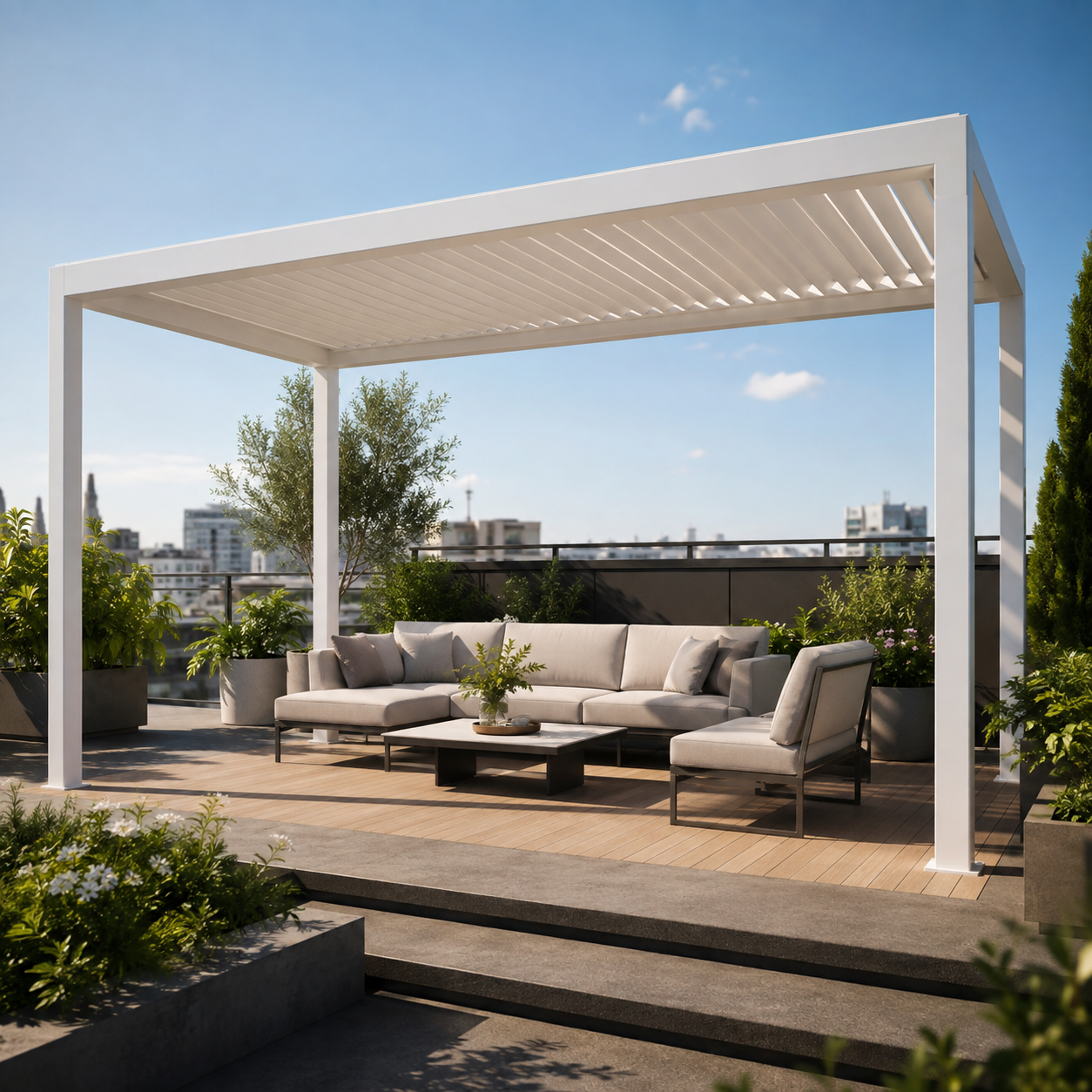
A louvered aluminum pergola configured for outdoor living use. Image: Junsu outdoor.
What a Louver Pergola Is
A louver pergola is an aluminum outdoor structure whose roof is formed by a series of parallel, rotatable louvers rather than by fixed beams or a single solid panel. The louvers can be turned to regulate sunlight, shade and ventilation, and closed to shed rain. In the manufacturer's product documentation this item is described as an aluminum bioclimatic pergola, classified as an aluminum outdoor structure and enclosure product within the same product family as outdoor gazebos, automatic driveway gates and aluminum fences. Published model configurations are 147, 163, 175 and 220, and the item is treated as a custom-made product rather than a fixed stock size.
The category is known by several overlapping names, which is one reason search and specification language around it is fragmented. Louver pergola, louvered pergola, bioclimatic pergola, motorized pergola, electric adjustable louver pergola, retractable roof pergola and waterproof pergola are all used for the same basic mechanism. Buyers comparing quotations should confirm which of three things a specification actually refers to: a mechanically rotating louver roof, a fixed louver-look canopy, or a retractable fabric awning. The three behave very differently in wind, rain and long-term maintenance.
Mounting options published for the range include wall-mounted, free-standing, multi-zone arrays, and structures requiring special cuts and angles. Standard module sizes are listed as 3×3 m, 3×4 m, 4×4 m and 3×6 m, with custom dimensions available; a single-zone custom unit can be produced up to approximately 22'10" × 16' according to the manufacturer's published specifications.
The Problem Fixed Shade Structures Do Not Solve
Most conventional shade structures are designed around a single weather condition. A timber pergola provides partial shade but no rain protection, so its usable season is effectively defined by the local climate. A fabric awning retracts, but the fabric is exposed to wind loading and needs periodic replacement. An insulated hardtop gazebo is weather-resistant yet fixed — it delivers the same light, heat and airflow conditions all year, which is often too much heat in summer and insufficient cover in the shoulder seasons.
The opportunity a louvered roof addresses is adjustable performance: one structure that can be opened for ventilation and sky views, partially angled for shade, and fully closed for rain protection, with accessories added for lighting, wind screening, heating or cooling. For commercial operators this changes the economics of an outdoor area, because revenue-bearing seating can be used on more days of the year. For homeowners it converts a patio, courtyard or poolside deck into space that is used beyond the warmest months.
How the Mechanism Works
Performance in a louvered pergola comes from three systems working together: the louver drive, the drainage path, and the electrical and control layer. Failure in any one of them shows up as a product complaint, which is why experienced buyers evaluate them separately rather than as a single "roof" specification.
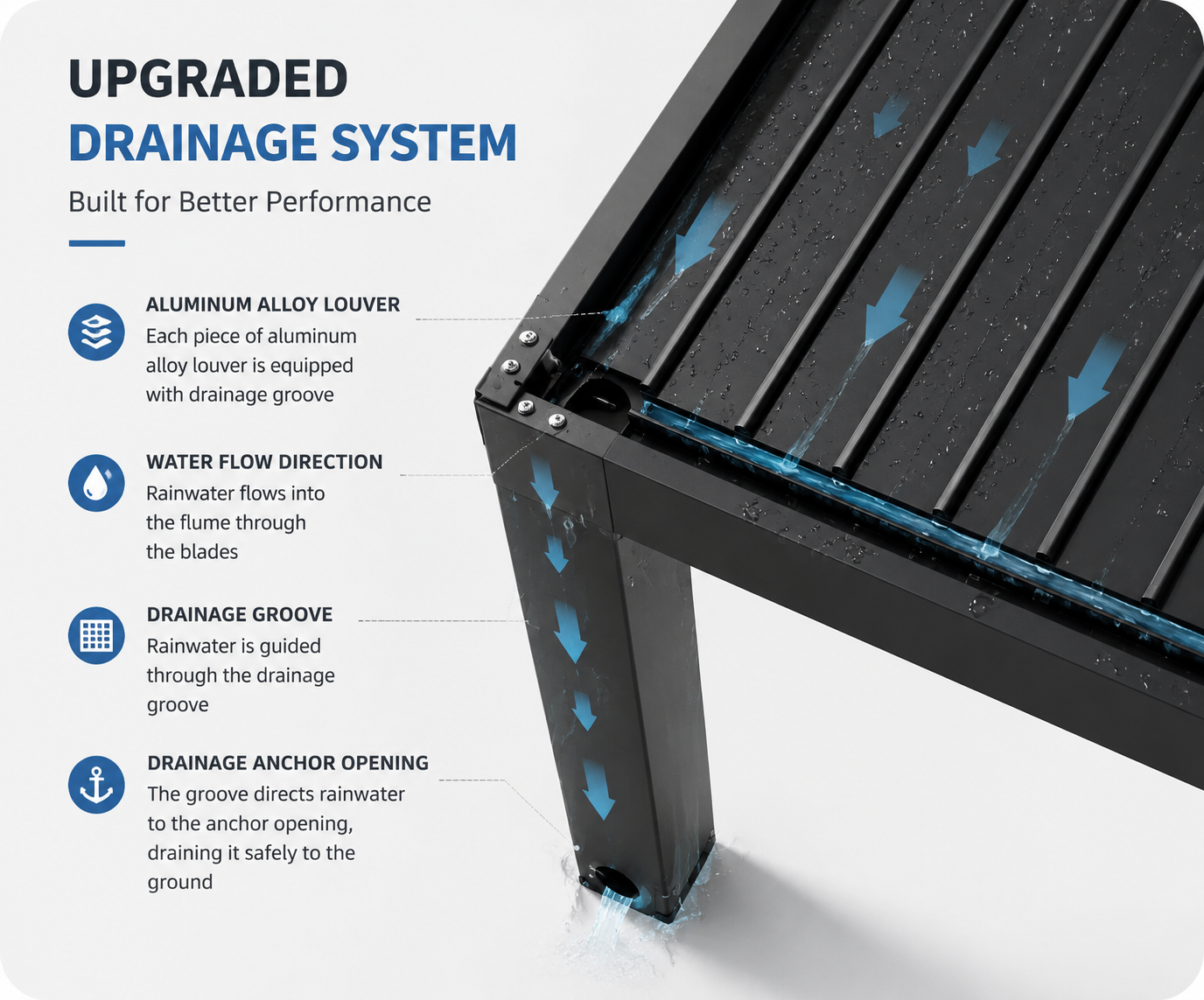
Integrated drainage principle: closed louvers collect rainwater, which is guided through channels inside the posts. Image: Junsu outdoor.
Louver rotation
The louvers rotate as a synchronized set. The manufacturer describes the operating mode as automatic louver adjustment for sun, shade, ventilation and rain protection, with motorized rotation described across a 0–90° range. Opening method options are manual or electric, depending on model and configuration. In practice, the rotation range is what determines how much of the year the space remains comfortable: a small tilt range limits the structure to sun and shade management, while a near-vertical open position allows significantly more air movement and sky exposure.
Drainage
The rain question is the first one buyers raise. In a properly engineered aluminum louvered pergola, the closed louvers are not a sealed solid roof. Rainwater is collected through the integrated drainage channels of the closed louvers and guided through the internal drainage system inside the posts, then discharged at the base of the structure. This design detail makes installation quality and site drainage part of product performance rather than separate from it: the manufacturer states that proper installation and site drainage are important for achieving the best waterproof performance.
Motor and electrical layer
Motorized versions are designed for outdoor applications. Published operating conditions for the range include IP66 waterproof and dustproof protection, resistance to high humidity and dust, and a working temperature range of approximately -35°C to 65°C. The motor, wiring and control components are specified with outdoor protection requirements in mind, and correct installation of electrical connections and cable routing is essential. Electrical components should not remain submerged in standing water, which is why power supply position, cable routing and site drainage conditions are normally confirmed before installation rather than after.
Control and integration
Control options across the range include manual switch control, wireless remote control, mobile app control, automatic weather-sensing operation and timed switching. Optional accessories listed for the platform include LED ambient lighting, motorized retractable zip screens, glass doors, cooling mist fans, outdoor heaters, waterproof audio speakers, wind and rain sensors, and hidden adjustable hinges. Structural figures published by the manufacturer state snow load up to 100 lbs/sq ft and wind load up to 190 mph for the louvered roof structure. These are manufacturer-stated ratings and should be checked against the specific project location, mounting method and applicable local engineering requirements.
Where the Louver Pergola Fits: Applications
Application fit is defined less by geography than by how much weather variability a space has to absorb. The product is positioned for the garden decoration and outdoor landscaping industry, with documented application scenarios covering gardens, courtyards, villas, beach and camping settings, as well as commercial space and public construction projects. The brand's core export markets — the EU, USA, France, Germany, Canada and Australia — generally specify four-season use rather than summer-only shade, which is why weather-sensing operation and integrated drainage appear in most project briefs.
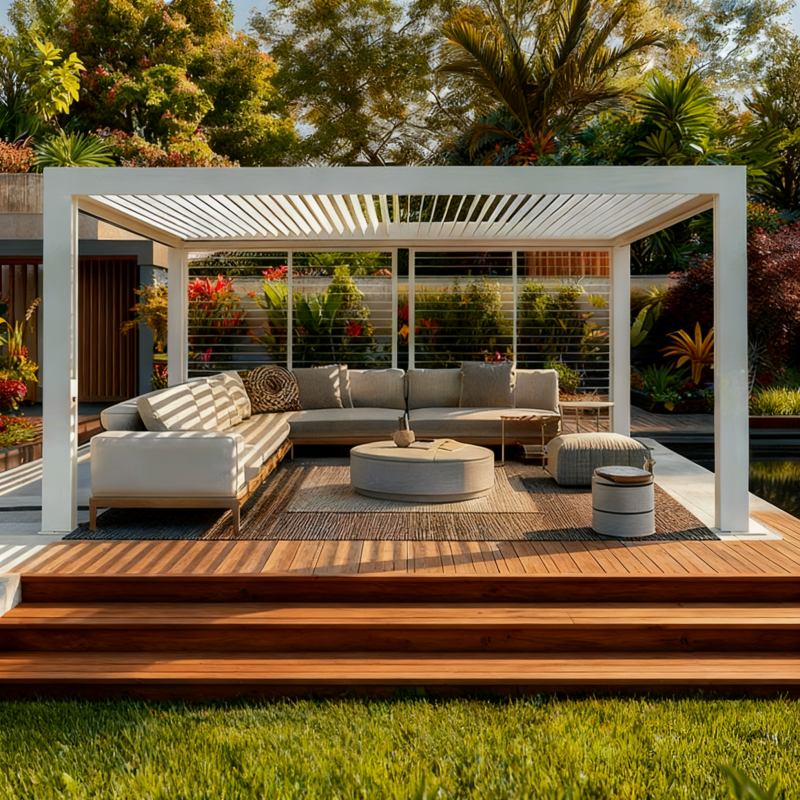
Commercial application: a motorized louvered pergola used to keep outdoor restaurant seating usable in variable weather. Image: Junsu outdoor.
| Environment | What the space demands from the structure | Relevant configuration |
|---|---|---|
| Villa garden and private courtyard | All-season seating, coordinated finish with fencing and gates, evening use lighting | Wall-mounted or free-standing louvered unit with LED lighting and zip screens |
| Poolside deck and patio | Shade control, humidity and splash exposure, corrosion resistance, evening ambience | Aluminum louvered pergola with 6063-T5 profiles and ambient lighting |
| Outdoor restaurant and hotel terrace | Large covered seating area, rapid weather response, comfort extension in cool months | Multi-zone motorized units with wind/rain sensors, heaters and mist fans |
| Coastal or high-humidity regions | Corrosion resistance, salt-spray and UV resistance, low maintenance burden | Aluminum alloy structure with coated finish, no seasonal repainting cycle |
| Commercial plaza and public construction | Engineered anchoring, custom dimensions, standards compliance and documented inspection | Custom-made units with fabrication drawings and third-party inspection before shipment |
| Limited-space patio or courtyard | Coverage without large opening clearance, defined footprint | Single-zone unit within 3×3 m to 3×6 m or custom sizing |
The Supply Side: How Junsu outdoor Manufactures the Category
Henan Junsu Technology Co., Ltd. is an outdoor courtyard product supplier based in Zhengzhou, Henan Province, China, established in 2001, with more than 25 years of experience in metal courtyard product manufacturing and international trade. Its export brand, Junsu outdoor, supplies integrated outdoor courtyard solutions covering pergolas, gazebos, fences, gates, screens, railings and stair handrails, supported by OEM/ODM customization and project support.
Manufacturing scale and process, as published by the company:
- A 30,000 m² manufacturing base covering metal processing, cutting, welding, assembly, quality inspection and packaging.
- Approximately 120 employees across the full production process from metal processing to final packaging.
- Annual production capacity of approximately 36,000 sets of outdoor courtyard products.
- An R&D team of 10 engineers and technicians supporting OEM/ODM customization.
Material specification is a genuine decision point in this category, because alloy grade and tempering affect both load behavior and how long a finish holds. For aluminum products, 6063-T5 aluminum alloy is the standard material across the range. Customization is supported based on CAD drawings, architectural plans, sketches, photos, dimensions and samples, and the company can supply technical drawings, design optimization, installation drawings, customized logos, private labels and packaging.
On compliance, the company holds CE EU product safety certification and is certified under the ISO9001 international quality system, with full export customs filing qualifications. It states that raw materials and finished goods undergo layer-by-layer sampling inspection with authorized third-party testing institutions before shipment, and that inspection is carried out across the production process with 100% inspection before delivery. It also holds original design patents covering aluminum courtyard doors, smart pavilions and decorative metal screens. Approximately 90% of production is exported, with main markets in the EU, USA, France, Germany, Canada and Australia.
For buyers, the practical significance of an integrated supplier is coordination. When pergolas, fences and gates are produced by a single factory using unified profiles, color codes and finishes, the colour and detailing mismatch that appears when a courtyard is assembled from three separate vendors is avoided at the source — a recurring problem in residential projects where the gate, fence and pergola are purchased in different purchasing cycles.
Market Trend Analysis
Several independent data points describe the direction of the category, although definitions matter when comparing them.
- Dataintelo's Aluminum Pergola Market Research Report 2034 values the global aluminum pergola market at USD 3.8 billion in 2025, with a projected value of USD 7.1 billion by 2034.
- The same research places North America as the region with the largest aluminum pergola demand, at a 34.2% market share in 2025.
- Fortune Business Insights estimates the global bioclimatic pergola market at USD 600.87 million in 2026, growing to USD 1,049.46 million by 2034, a CAGR of 7.22%.
A note on interpretation is warranted for anyone using these figures in planning. Published values for "pergola" and "aluminum pergola" are not consistently segmented across research houses. One commercial source estimates the total pergola market at USD 4.74 billion for 2026, while an aluminum-only estimate sits at USD 3.8 billion for 2025 — an overlap large enough to suggest inconsistent material segmentation between sources. The reliable signal is the growth direction and the regional demand concentration, not the absolute value of any single figure.
Regulatory signals are tightening in parallel. EN 13561:2015 is the European standard covering performance and safety requirements for external blinds and awnings, including pergola awnings, which means motorized outdoor roof systems sold into the EU are increasingly assessed against defined wind, safety and durability criteria rather than treated as decorative structures. In North America, ASTM F2957 covers ornamental aluminum fence systems, including structural testing and surface finish. That standard is relevant here because pergolas, fences and gates are frequently specified as one coordinated package, and mismatched compliance documentation creates handover problems on projects where all three are installed together.
The competitive landscape is splitting by positioning as well. In the United States, StruXure is identified as a major manufacturer of commercial-grade motorized louvered pergola systems, while a significant share of global supply is OEM/ODM production from manufacturers serving European, North American and Australian importers. Both models coexist in the same market, which is why buyers now evaluate supply chain structure, documentation and customization capability alongside the product itself.
Comparison with Traditional Solutions — and Where the Limits Are
Louvered aluminum systems compete with several established alternatives, and each has conditions where it performs better. The comparison below focuses on specification behaviour rather than brand preference.
| Criterion | Aluminum louvered pergola | Fixed timber pergola | Retractable fabric awning | Insulated hardtop gazebo |
|---|---|---|---|---|
| Rain protection | Closed louvers collect and channel rainwater through the posts | None, open roof structure | Rain protection while fabric is deployed | Continuous solid roof coverage |
| Light and airflow control | Adjustable by louver angle, 0–90° on motorized versions | Fixed, partial shade only | Open or closed, limited intermediate positions | Fixed, no adjustability |
| Wind behaviour | Rigid aluminum structure; configuration and anchoring determine performance | Structure dependent, often requires periodic tightening | Fabric is the vulnerable element, usually retracted in wind | Rigid, but large fixed surfaces receive full wind load |
| Maintenance profile | Aluminum is corrosion-resistant; manufacturer describes maintenance as regular light cleaning | Recurring staining, sealing or repainting cycles | Fabric replacement and mechanism service | Low on structure, higher on roof and seals |
| Power requirement | Required for motorized operation; manual versions available | None | Usually required for motorized units | Optional, depends on accessories |
| Upfront cost position | Higher initial cost than basic timber or fabric solutions | Lowest initial cost | Low to mid | Mid to high |
The manufacturer's comparison material states that initial purchase cost for aluminum systems is about 15–25% higher than traditional materials, offset by zero annual anti-corrosion renewal cost, a replacement cycle extended 3–6 times, and an overall comprehensive cost reduction of 70–80% within 20 years. Those are manufacturer-published figures, and a buyer's actual payback depends on the maintenance regime they would otherwise run, the local labour cost for upkeep, and how long the property will be held.
There are also boundaries that should be stated plainly. First, motorized louvered pergolas require a power supply, and correct cable routing and connection protection are installation-critical; electrical components should not remain submerged in standing water. Second, waterproof performance is partly a site outcome — drainage around the posts must actually work, so a pergola installed over a poorly draining surface will not perform to specification. Third, a louvered pergola is an outdoor structure, not a sealed building envelope: wind screens, heaters or fans are what extend comfort, and the structure should be configured appropriately during severe wind events. Fourth, manufacturer-stated load ratings are not a substitute for project-level engineering, and standard module sizes will not fit every footprint, which is why special cuts, angles and custom dimensions exist in the range.
Future Outlook
Three developments are likely to shape this category over the next several years. The first is automation becoming default rather than optional. Weather-sensing louver adjustment, timed operation and wind/rain sensors are already listed as available controls, and as these become standard the practical distinction between a "motorized pergola" and a "manual pergola" will narrow into a distinction between connected and non-connected outdoor structures.
The second is consolidation of the courtyard as a single system. Gates, fences, screens and pergolas are increasingly specified together, and the operation modes already documented for this ecosystem include face, license plate and NFC access linkage alongside the pergola controls. Suppliers who can deliver the whole package with unified profiles and finishes are structurally advantaged over those selling a single component.
The third is compliance pressure. With EN 13561:2015 covering pergola awnings in Europe and ASTM F2957 governing aluminum fence systems in North America, importers are likely to face rising expectations for documented performance testing, traceable materials and project-level engineering support rather than a product photo and a size list. For manufacturers with established inspection processes and export documentation, that shift favours their position; for buyers, it means specification quality becomes as important as price per set.
FAQ
What is a louver pergola, and how does it differ from a standard pergola?
A louver pergola is an aluminum outdoor structure whose roof is made of parallel rotating louvers rather than fixed cross-beams. The louver angle can be adjusted for sun, shade and ventilation, and the roof can be closed to shed rain. Published model configurations for this range are 147, 163, 175 and 220, with wall-mounted, free-standing, multi-zone and special-cut options, and standard module sizes of 3×3 m, 3×4 m, 4×4 m and 3×6 m alongside custom dimensions.
Is an aluminum louvered pergola waterproof in heavy rain?
The system is designed for outdoor all-weather use. When the louvers are fully closed, rainwater is collected through the integrated drainage channels and guided through the internal drainage system inside the posts. Proper installation and site drainage are important for achieving the best waterproof performance, so the surrounding surface and discharge conditions are part of the installation requirement.
Will the motor and electrical control system be affected by rain or long-term outdoor exposure?
Motorized versions are designed for outdoor applications, and the motor, wiring and control components are specified with outdoor protection requirements in mind, with IP66 waterproof and dustproof protection and a working temperature range of approximately -35°C to 65°C. Correct installation of electrical connections and cable routing is essential, and electrical components should not remain submerged in standing water. Power supply position, drainage conditions and the installation environment should be confirmed before installation.
Will aluminum rust in coastal, humid or rainy areas, and does it need frequent maintenance?
Aluminum alloy is used as the primary material of the pergola, fence and gate system and does not rust in the way ferrous metals do. The manufacturer describes the finish as a fluorocarbon and wood-grain transfer coating resistant to UV, salt spray and rain, with color stability stated at 20 years, and describes maintenance as limited to regular light cleaning rather than an annual anti-corrosion renewal cycle. These are manufacturer-stated figures for the finish system; actual appearance retention still depends on local conditions and cleaning practice.
What should be confirmed before installing a motorized louvered pergola?
Power supply position, drainage, cable routing, installation surface and local site conditions should be confirmed before installation. Where automatic operation is specified alongside other powered structures, ground condition, posts or walls, available side space and the opening direction also need to be confirmed before final production drawings are released.
What sizes, models and accessories are available?
The range is a custom-made product with model configurations 147, 163, 175 and 220. Standard module sizes are 3×3 m, 3×4 m, 4×4 m and 3×6 m, with custom dimensions available and single-zone custom units published up to approximately 22'10" × 16'. Opening method options are manual or electric. Optional accessories include zip screens, fence panels, glass doors, fans, heaters and wind and rain sensors, with LED ambient lighting, misting fans and waterproof speakers available in the integrated accessory set.
For readers who want to compare configurations, dimensions and accessory options in detail, the manufacturer's product catalog is publicly available as a downloadable PDF: Junsu outdoor product catalog.