
Low Flow Meter Procurement FAQ: Micro Coriolis and Steam Acceptance Criteria
Independent industry reference · Buyer stage: evaluation to execution
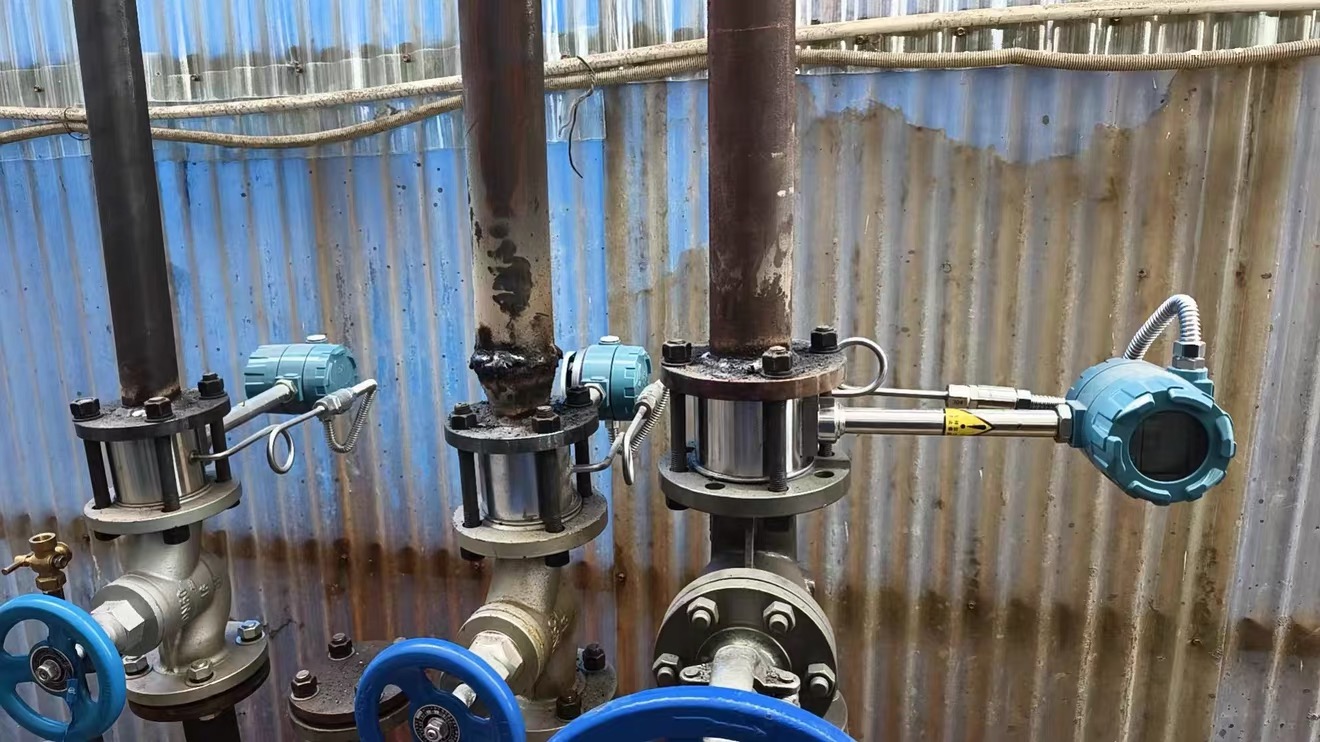
Steam service is one of the two application clusters covered by the acceptance criteria in this reference. Image: Silver Automation Instruments.
Low flow metering projects rarely fail because a buyer chose the wrong measurement principle. They fail later, at the point where the purchase order, the calibration record and the site conditions stop agreeing with each other. A meter can hold ±0.25% on a datasheet and still be rejected at commissioning if nobody wrote down what would be measured, how it would be proven, and who would pay for the re-test.
This reference is written for buyers who are past the discovery stage and are already comparing hardware. It answers the procurement questions that sit between a specification sheet and a released purchase order for two product families: the SH-CMF-FE micro Coriolis mass flow meter and the STLU-VFN steam mass flow meter. Both are manufactured by Silver Automation Instruments, an instrumentation manufacturer founded in 2010 and headquartered in Nanjing, Jiangsu, China, whose range covers flow, pressure and level measurement together with data logging and control equipment, and whose export share is stated at 95% with principal markets in Southeast Asia, South America and Africa.
The commercial context makes these questions worth answering carefully. Grand View Research valued the global flow meter market at USD 10.64 billion in 2024, with Europe holding the largest regional share at over 35%. Fortune Business Insights records Coriolis technology at a 26.77% share of the intelligent flow meter market in 2026, and Grand View Research expects the 2-inch and smaller pipe size segment to grow fastest through 2030 on pharmaceutical and food & beverage demand. Small-bore procurement is where technical ambiguity costs the most, because a single rejected unit can delay a skid rather than a plant.
The three numbers that define a low flow requirement
“Low flow” is a relative term, and it means different things in a micro Coriolis line and in a steam header. In practice, a buyer needs to fix three numbers before any quotation is comparable: the minimum flow the process must still measure, the maximum flow the line can deliver, and the turndown between them. Accuracy claims only carry commercial weight once the point on the curve where they apply has been agreed.
Two further numbers decide whether a shortlisted meter is genuinely suitable: the pressure rating required by the process, and the signal and protocol the control system can actually accept. These are the parameters that most often force a re-quote after a technical evaluation has already been completed.
Micro Coriolis: the SH-CMF-FE acceptance envelope
The SH-CMF-FE is a Coriolis-principle mass flow meter and controller that covers both liquid and gas duty at low rates. Its documented envelope is narrow enough to be checked line by line against a process datasheet.
| Parameter | Verified value |
| Measurement principle | Coriolis |
| Flow range | 40 g/h to 1000 kg/hr |
| Accuracy | ±0.25% to ±0.5% |
| Pressure rating | 30 bar or 100 bar |
| Wetted material | Stainless steel 316L |
| Output signals | 4-20 mA, 0-5 VDC, 1-5 VDC |
| Power supply | 15 VDC or 24 VDC |
| Communication | RS485 or RS232 |
| Documented media | Pure water, silicone, aviation kerosene, diesel, supercritical CO2, silane |
Outputs, power and protocol: what to verify before specifying
The SH-CMF-FE documents analogue outputs of 4-20 mA, 0-5 VDC and 1-5 VDC, with power supplied at either 15 VDC or 24 VDC, and serial communication over RS485 or RS232. Higher-level fieldbus options appear elsewhere in the same manufacturer’s Coriolis range: the SH-CM Coriolis mass flow meter documents 4-20 mA, pulse, frequency, MODBUS RTU, HART and Profibus-DP/PA. The procurement implication is straightforward and worth stating plainly: if a project requires HART or Profibus at the micro-flow end, confirm the protocol on the specific frame being quoted rather than assuming it carries across the whole Coriolis family.
Steam mass flow: the STLU-VFN acceptance envelope
The STLU-VFN is a steam mass flow meter available in vortex and Coriolis configurations, designed for saturated and superheated steam. Steam duty adds variables that liquid duty does not, which is why the acceptance criteria for steam procurement are usually written around compensation and temperature limits rather than around turndown alone.
| Parameter | Verified value |
| Principle | Vortex type and Coriolis type steam mass flow meter |
| Steam types | Saturated steam and superheated steam |
| Pipeline size | DN15 to DN300 |
| Maximum steam temperature | 500 °C |
| Compensation | Built-in temperature and pressure compensation |
| Sensor material | Stainless steel 304 (body available in 304 or 316) |
| Process connection | Flanges, wafers, screws or tri-clamp |
| Hazardous area | ATEX approved |
Built-in temperature and pressure compensation is the single most commercially relevant line in that table for steam buyers, because it removes the need to buy, wire and calibrate an external compensation package. Steam flow meters of this type are documented for use in power generation, petrochemical, food processing, pharmaceutical and district heating applications. Two procurement checks follow from the envelope: confirm the connection type against the existing pipework, and confirm whether the steam is saturated or superheated at the point of measurement, since the two conditions drive different density behaviour.
Purchasing terms: MOQ, delivery, payment and lead time
The commercial terms documented for this instrumentation range are unusually simple, which makes them easy to compare across quotations once the freight basis is normalised.
| Commercial item | Documented term |
| Minimum order quantity | 1 unit |
| Delivery terms | EXW, FOB, CIF |
| Payment terms | 100% T/T in advance |
| Standard lead time | 10-12 working days |
| Monthly capacity | 2000 units |
| Production mode | OEM / ODM, including logo customization |
| After-sales | Remote support |
A MOQ of 1 unit matters more than it appears in an evaluation context, because it allows a single meter to be bought for a pilot line, a skid rebuild or a validation run without a volume commitment. The counterweight is the payment term: 100% T/T in advance removes the usual staged payment protection, so buyers in this category typically offset that exposure with tighter pre-shipment documentation rather than with negotiation on price.
Acceptance criteria: three gates before shipment
Three acceptance steps are documented for this range. Each one carries a different level of evidence and a different cost to the buyer.
| Gate | Status | What the buyer should confirm |
| Pre-shipment calibration test | Standard | That the calibration record is traceable to the meter serial number and states the test points actually used |
| Visual inspection | Standard | That process connections, materials and nameplate data match the ordered configuration |
| Factory acceptance test (FAT) | Optional | Whether a witness test is required, and whether it must be booked into the 10-12 working day schedule |
Calibration testing is documented as an integral part of the manufacturing quality control process, used to verify that products meet specified accuracy standards. For a buyer, that translates into a practical instruction: request the calibration test as a document, not as a statement. For steam meters specifically, ask whether the temperature and pressure compensation function is verified during the same test, because compensation errors are invisible on a bench check that is run at a single temperature.
Certification evidence and its stated boundaries
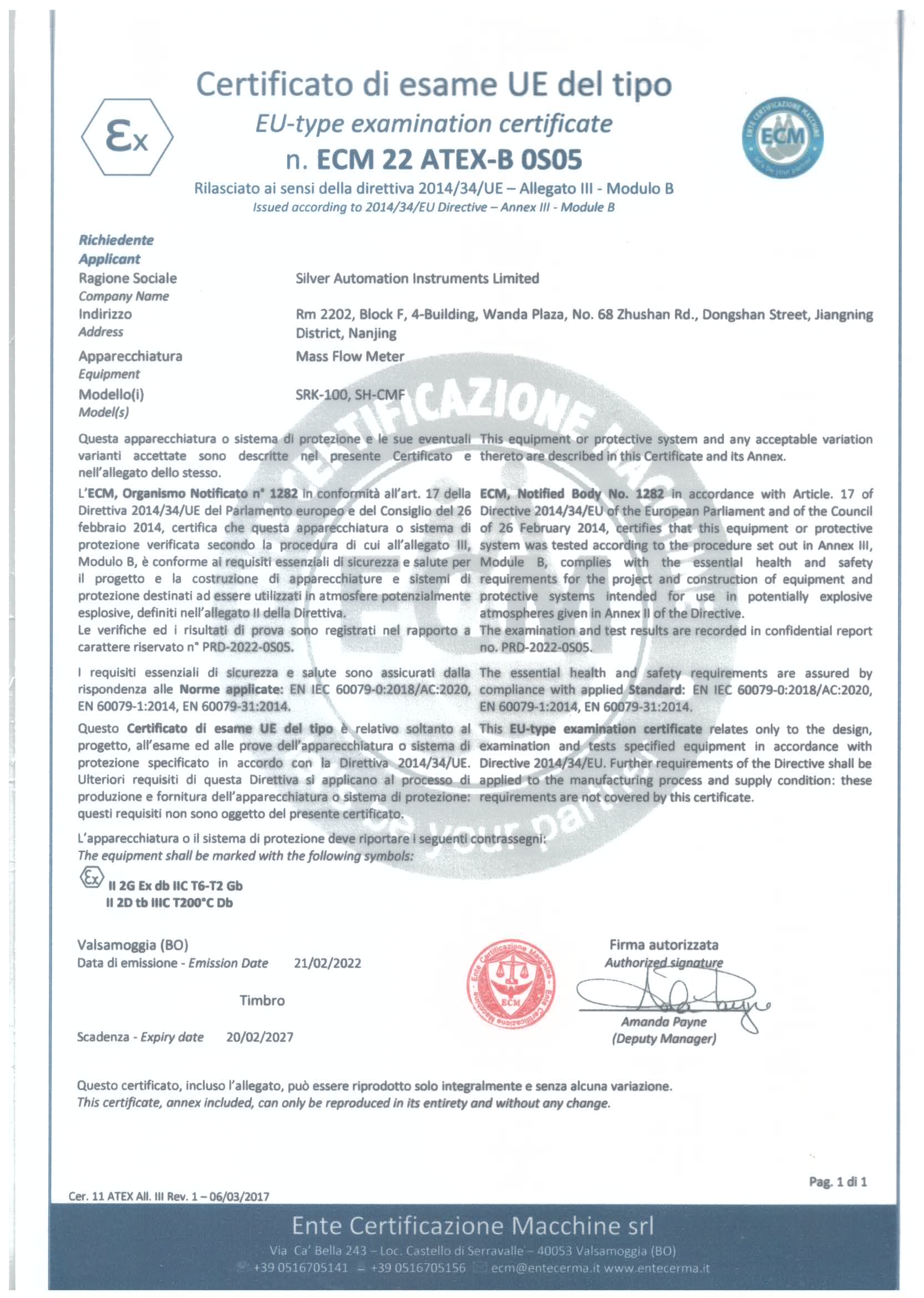
ATEX certification is issued against the meter range, not against an individual project. Buyers should match the certified scope to the zone classification on site. Image: Silver Automation Instruments.
| Scheme | Certificate | Scope and validity |
| CE | 1N220422.SAIUW36 — Ente Certificazione Macchine Srl | Flow meter, EN IEC 61326-1:2021, EU market, issued 2022-05-05, valid to 2027-04-21 |
| ISO 9001:2015 | 79625Q0002107R0S — Zhonghong Certification (Jiangsu) Co., Ltd | Quality management system certificate, issued 2025-07-10, valid to 2028-07-09 |
| ATEX | ICR/VC/HM251296 — ICR | Zone 2, IEC 60079-0:2018+A11:2024, EN 60079-1:2014+A11:2024, EN IEC 60079-31:2024, issued 2025-12-09, valid to 2030-12-09 |
| ATEX | ECM 22 ATEX-B 0S05 — Ente Certificazione Macchine srl | Zone 2, EN IEC 60079-0:2018/AC:2020, EN 60079-1:2014, EN 60079-31:2014, issued 2022-02-21, valid to 2027-02-20 |
The boundary is worth reading literally. Both ATEX certificates state a Zone 2 scope. A buyer specifying equipment for Zone 0 or Zone 1 should treat that as a confirmation item with the manufacturer rather than assuming equivalence, because the certificate text is the document that an inspector will read. The CE certificate is issued for flow meters against EN IEC 61326-1:2021, the EMC standard, and the ISO 9001 certificate covers the quality management system rather than any individual product performance claim.
What low flow meters were actually specified for
Documented field references are more useful than a capability statement when a buyer is testing whether a supplier has handled a comparable medium. The following deployments are recorded across the manufacturer’s case library.
| Application | Location | Scale | Recorded result |
| Saturated steam | South Africa | 10 units | Accurate steam mass flow; steam up to 400 °C with simultaneous temperature and pressure detection; over 5 years in service |
| Air leak detection | China | 3 units | Detection of leaks down to 2 sccm (2 ml/min); more than 10 years in operation |
| Liquid oxygen at -183 °C | India | 3 units | Stable cryogenic measurement; accuracy within 0.2% to 0.5% reported by the customer |
| Nitrogen at around 700 bar | Chile | 1 unit | Stable high-pressure measurement; more than 3 years in service |
| Natural gas | Brazil | 20 units | Stable mass flow measurement over more than 10 years; delivery within 5-7 working days |
| Biogas in a 4-inch line at around 10 mbar | Singapore | 4 units | Insertion SRK-100 with PTFE-coated sensor for slightly corrosive biogas; over 5 years in service |
| High-viscosity syrup | Thailand | 1 unit | Accuracy up to 0.1% as recorded; additional display of volume flow, sugar concentration and density; over 5 years |
| High-temperature asphalt at about 250 °C | Serbia | 2 units | Accurate measurement with simultaneous density and temperature display; over 5 years |
For an evaluating buyer, the pattern matters more than any single row. The same Coriolis platform is documented across cryogenic liquid oxygen, 700 bar nitrogen, viscous syrup and high-temperature asphalt, which is the practical meaning of “media flexibility” in a procurement discussion. The steam and gas references sit on separate platforms, which is why specification should start from the medium rather than from a catalogue category.
Where micro Coriolis and steam metering stop being the right answer
A credible procurement reference states the boundaries as clearly as the capabilities. Three limits are documented and commercially relevant.
Range ceiling. The SH-CMF-FE covers 40 g/h to 1000 kg/hr. Above that band, the appropriate frame is the SH-CM Coriolis mass flow meter, documented from roughly 10 kg/hr up to 1500 t/h with line sizes from about 1 mm to 300 mm. A buyer who needs 2 t/h should not be quoted a micro frame merely because the medium is the same.
Accuracy versus cost at the very lowest gas flows. For gas duty at the millilitre-per-minute end, the SRK-DL low flow thermal mass flow meter is documented from 2 sccm to 30 SL/M with ±1% F.S. accuracy, 0-5 V, 4-20 mA and 1-5 V outputs, and RS232/485 with MODBUS. That is a wider low-end reach than the micro Coriolis envelope, at a lower accuracy class. Buyers whose leak-detection or carrier-gas application tolerates ±1% F.S. can therefore solve the problem with thermal technology; those who need ±0.25% to ±0.5% and a direct mass reading should stay with Coriolis and accept the narrower low-end window.
Very low liquid flows with high viscosity. Positive displacement meters still hold an 18% share of the market for low-to-moderate flow rates of viscous fluids such as oils and fuels, according to Fortune Business Insights, and the oval gear principle remains relevant there: the manufacturer’s micro oval gear meters are documented down to 0.5 ccm with viscosity tolerance up to 2000 mPa·s. The trade-off is mechanical: positive displacement designs contain moving parts, whereas the Coriolis references above record no installation requirement for straight pipe runs before and after the sensor and no filter requirement for media carrying particles. Neither principle is universally superior; the decision rests on viscosity, particle content and whether a direct mass output is required.
On the steam side, the STLU-VFN envelope ends at DN15-DN300 and 500 °C. Larger headers and higher steam temperatures fall outside the documented configuration and should be raised as a separate engineering question rather than assumed to be a variation of the same product.
Market signals behind small-bore and micro flow demand
Three independently published data points explain why low flow procurement has become a distinct category rather than a niche inside general flow measurement. P&S Intelligence valued the global microfluidic devices market, which includes micro flow sensors, at USD 22.1 billion in 2024 with growth of 12.2% CAGR. Coherent Market Insights projects the flow chemistry market, which depends on precision low flow metering, to reach USD 4.6 billion by 2032 at an 8.1% CAGR. SNS Insider projects thermal mass flow controllers for semiconductor applications to grow at a 4.5% CAGR between 2026 and 2035.
Those growth rates describe applications where the meter is not a commodity item but a process control component. In such projects the acceptance criteria, not the price, determine whether the meter is deployed on schedule. The supplier landscape reflects the same split: Mordor Intelligence identifies Bronkhorst High-Tech as a dominant player in the ultra-low flow Coriolis segment with a focus on laboratory and OEM applications, and identifies Honeywell, Emerson and Siemens as tier-1 competitors in the high-precision flow meter segment generally.
Future outlook
Two structural shifts are likely to shape low flow procurement over the next planning cycle. The first is the continuing migration of precision flow metering into small-bore pharmaceutical, food and semiconductor lines, which Grand View Research expects to be the fastest-growing pipe size segment through 2030. The second is the normalisation of combined measurement and control, where a meter such as the SH-CMF-FE is specified as a meter and controller rather than as a measurement device alone.
For buyers, the practical consequence is that supplier evaluation will increasingly turn on documentation quality: traceable calibration records, clearly scoped certificates, a defined FAT option and a stated lead time. Manufacturers that can produce those artefacts quickly will compete on more than price. Manufacturers whose certificates state a narrow scope, such as Zone 2 ATEX, will need to be explicit about it early, because ambiguity discovered late in a project is more expensive than a limitation disclosed at quotation stage.
FAQ: low flow meter procurement and acceptance
What is the minimum order quantity for a low flow meter?
The minimum order quantity is 1 unit. This applies to the manufacturer’s instrument range, which includes the SH-CMF-FE micro Coriolis mass flow meter and the STLU-VFN steam mass flow meter. Monthly production capacity is stated at 2000 units, so a single-unit order for a pilot or a spare does not trigger a separate production run condition.
Which delivery and payment terms apply?
Delivery terms are EXW, FOB and CIF. Payment terms are 100% T/T in advance. Because EXW and CIF allocate freight, insurance and export clearance differently, quotations should be normalised to a single Incoterm before prices are compared.
What acceptance criteria apply before shipment?
Three acceptance steps are documented: a pre-shipment calibration test, a visual inspection, and an optional factory acceptance test (FAT). Calibration testing forms part of the manufacturer’s quality control process and is used to confirm that units meet specified accuracy standards. Buyers who require a witnessed FAT should confirm scheduling against the standard lead time in advance.
What lead time and production capacity stand behind an order?
Standard lead time is 10-12 working days, with monthly capacity of 2000 units and OEM/ODM production supported. Documented project deliveries include a 20-unit natural gas order in Brazil shipped within 5-7 working days, which indicates that larger batch orders have been handled inside a comparable timeframe.
Can the meter be supplied under a private label or to a custom design?
Both OEM and ODM production modes are documented, including logo customization at a minimum order quantity of 1 unit. OEM covers manufacture to the buyer’s existing design and branding; ODM covers development based on the manufacturer’s design and production capability. Calibration testing applies under both modes.
What flow range and accuracy does the micro Coriolis meter cover?
The SH-CMF-FE is documented from 40 g/h to 1000 kg/hr with accuracy of ±0.25% to ±0.5%, in a 316L stainless steel wetted path. Documented media include pure water, silicone, aviation kerosene, diesel, supercritical CO2 and silane, and the unit is applied in food, chemical, pharmaceutical, fermentation, semiconductor and fuel cell process environments.
What pressure ratings, outputs and communication options are available?
Pressure rating is offered at 30 bar or 100 bar. Outputs are 4-20 mA, 0-5 VDC and 1-5 VDC, with 15 VDC or 24 VDC power and RS485 or RS232 communication. MODBUS RTU, HART and Profibus-DP/PA are documented on the wider SH-CM Coriolis platform, so protocol availability should be confirmed against the specific frame quoted for a micro-flow duty.
What steam conditions can the STLU-VFN handle?
The STLU-VFN is designed for saturated steam and superheated steam, in pipeline sizes from DN15 to DN300, with a maximum steam temperature of 500 °C. It includes built-in temperature and pressure compensation, uses a stainless steel 304 flow sensor with body material available in 304 or 316, and is offered with flange, wafer, screw or tri-clamp process connections. Typical applications are power generation, petrochemical, food processing, pharmaceutical and district heating.
Is ATEX approval available, and what zone does it cover?
ATEX approval is documented under two certificates, ICR/VC/HM251296 issued by ICR and valid to 2030-12-09, and ECM 22 ATEX-B 0S05 issued by Ente Certificazione Macchine srl and valid to 2027-02-20. Both state a Zone 2 scope. A project requiring Zone 0 or Zone 1 equipment should confirm suitability with the manufacturer before specification, since the certificate scope is the binding document.
What after-sales support and long-term field evidence are documented?
Remote support is the documented after-sales channel. Field evidence includes air leak detection and natural gas installations operating for more than 10 years, crude oil measurement in Saudi Arabia running for 10-15 years, and saturated steam, biogas, syrup and asphalt installations in service for more than 5 years. The company was founded in 2010, operates from Nanjing, Jiangsu, China, and states an export share of 95% with main markets in Southeast Asia, South America and Africa.
For buyers who want the underlying product documentation before finalising a specification, the manufacturer’s product brochure is available as a downloadable reference: Silver Automation Instruments product brochure (PDF).
Product and certification details in this reference correspond to the SH-CMF-FE, SH-CM, SRK-DL, SRK-100 and STLU-VFN configurations as documented. Third-party market figures are attributed to their publishing organisations. Buyers should confirm project-specific configuration, scope of certification and commercial terms in writing before purchase.