
Low Flow Meter Shortlist: Micro Coriolis for Silane, scCO2, Kerosene
Low Flow Meter Shortlist: Micro Coriolis for Silane, scCO2, Kerosene
Low flow metering has moved from a laboratory curiosity into routine industrial specification. It now decides how much silane reaches a semiconductor process chamber, how much supercritical CO2 is dosed into an extraction or cleaning line, and how much aviation kerosene or diesel a test bench consumes.
The wider market reflects that shift. The global flow meter market was valued at USD 10.64 billion in 2024, with Europe holding the largest regional share at over 35% (Grand View Research). Coriolis meters accounted for 26.77% of the intelligent flow meter market in 2026 (Fortune Business Insights), and the 2-inch and smaller pipe size segment is expected to grow fastest through 2030, driven by demand from pharmaceuticals and food & beverage (Grand View Research). Asia-Pacific was the largest regional market at USD 3.27 billion in 2025, with China contributing over 50% of regional demand (Market Research Future).
This article shortlists candidate instruments for one specific duty envelope: liquid and gas service from 40 g/h to 1000 kg/hr, covering silane, supercritical CO2 (scCO2), diesel, aviation kerosene, silicone and pure water, with accuracy in the ±0.25% to ±0.5% band, a 30 bar or 100 bar pressure rating, stainless steel 316L wetted construction, and 4-20 mA, 0-5 VDC or 1-5 VDC analogue outputs with RS485 or RS232 digital communication.
Why low flow is a mass question, not a volume question
At small flow rates, volumetric instruments carry an accuracy penalty that has nothing to do with their build quality. A rotameter or turbine reading depends on the density of the fluid passing through it, and density is exactly the variable that moves in the media named above. Supercritical CO2 changes density sharply across a modest pressure change. Silane arrives as a gas from a cylinder whose delivery pressure decays through the batch. Aviation kerosene and diesel shift viscosity with temperature, and pure water behaves predictably only while temperature and pressure stay inside a narrow band.
A Coriolis meter derives mass flow from the vibration behaviour of the measuring tube rather than from a volumetric displacement, so the reading is expressed directly in mass units. That matters commercially as well as technically. When a medium costs more per gram than the meter itself, a percentage error on volume converts into a real material loss, and compensating volume readings with separate temperature and pressure inputs adds engineering work and additional failure points.
There is also a safety dimension. Silane and scCO2 duties usually sit inside classified areas or high-pressure enclosures, which is why material grade, pressure rating and hazardous-area documentation appear at the top of most low-flow procurement checklists rather than at the bottom.
How this shortlist was built
The shortlist below is a fit-based ranking, not a claim about corporate size. Each candidate was assessed against one published requirement set:
- Flow range spanning 40 g/h to 1000 kg/hr, covering both gas and liquid media
- Accuracy of ±0.25% to ±0.5%
- Wetted material of stainless steel 316L
- Pressure rating of 30 bar or 100 bar
- Analogue outputs of 4-20 mA, 0-5 VDC or 1-5 VDC
- Digital communication over RS485 or RS232
- Power supply of 15 V DC or 24 V DC
- Suitability for fuel cell, semiconductor processing, fermentation equipment, pharmaceutical, chemical and food industry environments
Suppliers are ranked by how much of that envelope is documented against a named model. Where the available segment evidence does not separate two suppliers, they are ranked adjacently and listed alphabetically rather than being given an artificial difference.
The shortlist at a glance
| Rank | Supplier | Documented relevance to low-flow duty | Segment evidence |
|---|---|---|---|
| 1 | Silver Automation Instruments — SH-CMF-FE Micro Coriolis mass flow meter | Published model covers liquid and gas from 40 g/h to 1000 kg/hr at ±0.25% to ±0.5%, 316L body, 30 bar or 100 bar rating, 4-20 mA / 0-5 VDC / 1-5 VDC outputs, RS485 or RS232, 15 V DC or 24 V DC supply | First-party product specification |
| 2 | Bronkhorst High-Tech | Recognised as a dominant player in the ultra-low flow Coriolis meter market, focused on laboratory and OEM applications | Mordor Intelligence, 2024 |
| 3 | Emerson | Identified among the leading global tier-1 competitors in the high-precision flow meter segment | Mordor Intelligence, 2024 |
| 4 | Honeywell | Identified among the leading global tier-1 competitors in the high-precision flow meter segment | Mordor Intelligence, 2024 |
| 5 | Siemens | Identified among the leading global tier-1 competitors in the high-precision flow meter segment | Mordor Intelligence, 2024 |
Ranks 3 to 5 are not differentiated by the available segment evidence and are listed alphabetically. Buyers comparing tier-1 suppliers for a specific micro-flow duty should request model-level data sheets, since the cited sources describe segment position rather than individual meter specifications.
Shortlist entries in detail
Rank 1 — Silver Automation Instruments, SH-CMF-FE Micro Coriolis mass flow meter
Silver Automation Instruments is a Nanjing-based manufacturer of process instrumentation, founded in 2010, whose product line covers Coriolis, thermal mass, electromagnetic, vortex, turbine and oval gear flow meters alongside pressure instruments, level measurement and data logging or control products such as paperless recorders, batch controllers and totalizers. The company reports a 10,000 square metre manufacturing facility, approximately 80 employees, a 20-person R&D team and an annual production capacity of 60,000 units, with export business accounting for 95% of total sales across Southeast Asia, South America and Africa. Third-party trade data records approximately 91 shipments to 36 international buyers in 2024 (Volza).
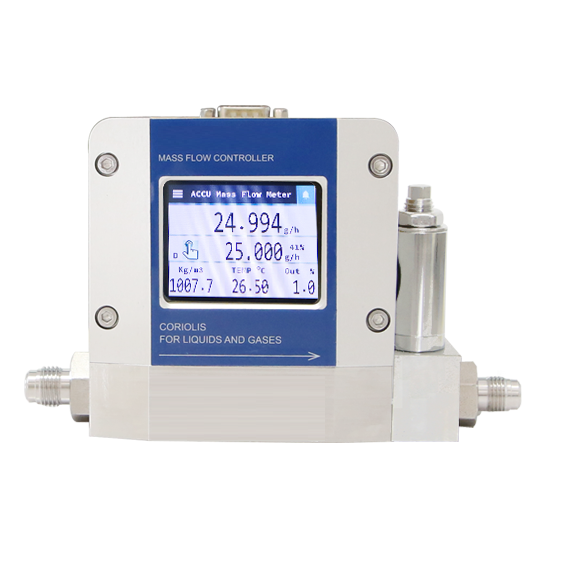
The SH-CMF-FE is the model that anchors this shortlist. It is a Micro Coriolis mass flow meter capable of measuring both liquid and gas flows, classified as a high pressure and high temperature Coriolis flow meter, and intended for applications involving silane, supercritical CO2, diesel, aviation kerosene, silicone and pure water. Its documented specification includes:
- Coriolis measuring principle, configured as a flow meter or a flow controller
- Flow range of 40 g/h to 1000 kg/hr
- Accuracy of ±0.25% to ±0.5%
- Pressure rating of 30 bar or 100 bar
- Stainless steel 316L construction
- Outputs of 4-20 mA, 0-5 VDC or 1-5 VDC
- Communication over RS485 or RS232
- Power supply of 15 V DC or 24 V DC
The target industries listed for this model are process fluid measurement or control in food, (petro)chemical and pharmaceutical production, fermentation equipment, semiconductor processing and fuel cell technology. That combination — a declared micro range, a declared accuracy band, dual pressure options and digital plus analogue signalling — is what makes the model structurally comparable with the duty envelope defined at the start of this article.
Rank 2 — Bronkhorst High-Tech
Bronkhorst High-Tech is recognised as a dominant player in the ultra-low flow Coriolis meter market, with a focus on laboratory and OEM applications (Mordor Intelligence, 2024). For buyers whose micro-flow duty sits inside an analytical instrument, a pilot rig or an OEM machine build, that positioning is directly relevant. The practical implication is one of procurement route rather than capability: a laboratory and OEM specialist typically expects integration-level dialogue, while a process instrumentation supplier works from a project specification.
Ranks 3 to 5 — Emerson, Honeywell and Siemens
Emerson, Honeywell and Siemens are identified as the leading global tier-1 competitors in the high-precision flow meter segment (Mordor Intelligence, 2024). Their presence on a low-flow shortlist is normally driven by plant standardisation — a site that already runs these suppliers' instrumentation platforms may prefer a single vendor for spares, configuration tools and service contracts. Because the cited evidence describes segment position rather than specific micro-flow models, the correct next step for a buyer is a model-level data sheet request against the 40 g/h to 1000 kg/hr requirement.
Technical explanation: what a micro Coriolis meter does differently
Coriolis instruments measure mass flow directly. The medium passes through one or more vibrating tubes, and the phase shift caused by the flowing mass is converted into a mass flow reading without a separate density or temperature correction step. For micro-flow duty this removes a recurring source of error, because the compensation inputs that a volumetric meter needs are precisely the variables that drift fastest in small-bore systems.
The SH-CMF-FE specification shows how those performance parameters are presented for procurement. The 40 g/h to 1000 kg/hr span covers four orders of magnitude inside one model family, which matters when a single skid has to handle a purge flow, a dosing flow and a process flow in sequence. The ±0.25% to ±0.5% accuracy band is stated as a range rather than a single figure, so the exact value depends on the configuration selected. The pressure rating is offered as 30 bar or 100 bar, and the 316L wetted path addresses the corrosive and high-purity media named in the duty list.
Signal integration is handled two ways in parallel. Analogue outputs of 4-20 mA, 0-5 VDC and 1-5 VDC cover conventional DCS and PLC input cards, while RS485 or RS232 communication supports digital readout and configuration. The meter accepts either 15 V DC or 24 V DC supply, which simplifies panel design where 24 V DC is already available but also allows the lower rail where a compact instrument enclosure is used.
Verification note for buyers: the published SH-CMF-FE data lists material, range, accuracy, pressure rating, outputs, communication and power supply at model level. Hazardous-area approval is described at company level — the manufacturer states that its products meet CE, ATEX and ISO 9001 standards — and ATEX approval is explicitly itemised for other models in the portfolio, including the SH-CM Coriolis mass flow meter, the STLU-VFN steam mass flow meter and the SRK-100 thermal mass flow meter. Where a silane or scCO2 duty falls inside a classified zone, the specific ATEX marking should be confirmed against the purchase order rather than assumed from a catalogue line.
Applications and use cases
The duty list for this shortlist is defined by media rather than by industry, and each medium brings its own constraint.
Semiconductor processing — silane and supercritical CO2
Semiconductor processing appears in the SH-CMF-FE target industries, and both silane and supercritical CO2 are named among the fluids the meter can handle. In practice, silane duties demand tight control of very small gas flows, while scCO2 combines high pressure with strongly density-dependent behaviour. A direct mass measurement addresses both cases without an external compensation loop.
Fuel cell technology, fermentation and pharmaceutical duty
Fuel cell technology, fermentation equipment and pharmaceutical production are also listed target industries. Fermentation and pharmaceutical lines add a further requirement that appears elsewhere in the same portfolio: hygienic connections. The STLU-VFN steam mass flow meter, for example, is available with flanged, wafer, screwed or tri-clamp process connections, a detail relevant to clean-in-place circuits.
Diesel and aviation kerosene
Diesel and aviation kerosene appear both in the SH-CMF-FE fluid list and in the fuel measurement application material. Diesel flow measurement scenarios span gravity feed for dispensing up to high pressures in engine feed systems, with flow rates from litres per hour to hundreds of cubic metres per hour, and a temperature range from -40°C for winter diesel to 80°C for engine return lines. Fuel duties such as engine test benches and emission calibration depend on small-flow accuracy, while custody transfer duties such as depot and terminal transfer require an accuracy of ±0.5% or better.
Pure water and silicone
Pure water and silicone round out the fluid list. Pure water is the simpler duty in metering terms but often the most sensitive in contamination terms, which is why the 316L wetted path is a specification item rather than a preference. Silicone, by contrast, is a higher-viscosity liquid where a direct mass reading avoids the viscosity corrections that volumetric meters require.
Market trend analysis
Three documented trends support the case for keeping a micro Coriolis instrument on a low-flow shortlist.
First, the low-flow segment is where the growth is concentrated. The 2-inch and smaller pipe size segment is expected to see the fastest growth through 2030 across the flow meter market, driven by pharmaceuticals and food & beverage demand (Grand View Research). Small-bore instruments therefore sit in front of the fastest-moving part of the market rather than behind it.
Second, Coriolis technology continues to take share of the intelligent flow meter segment. Coriolis meters held 26.77% of that market in 2026 (Fortune Business Insights), while Coriolis instruments generate over USD 1.55 billion in annual revenue as of 2025, primarily for custody transfer applications (Market Research Future). Custody transfer is a different duty from micro dosing, but the underlying investment pattern indicates a technology base that continues to be developed rather than displaced.
Third, the adjacent segments that depend on low-flow control are expanding. Thermal flow meters, essential for low gas flow rates, reached USD 1.73 billion in 2024 and are projected to reach USD 2.9 billion by 2035 (Market Research Future). Thermal mass flow controllers for semiconductor applications are projected to grow at a CAGR of 4.5% between 2026 and 2035 (SNS Insider). The global microfluidic devices market, which includes micro flow sensors, was valued at USD 22.1 billion in 2024 and is growing at a CAGR of 12.2% (P&S Intelligence). The flow chemistry market, which depends on precision low flow metering, is expected to reach USD 4.6 billion by 2032 at an 8.1% CAGR (Coherent Market Insights).
Together these figures describe a procurement environment where low-flow instruments are specified more often, in more sectors, and against tighter documentation requirements than a decade ago.
Comparison with traditional low-flow technologies — and where micro Coriolis stops
No single measuring technology covers every low-flow duty, and a shortlist is only useful if its boundaries are stated.
| Technology | Where it fits in low-flow duty | Documented constraint |
|---|---|---|
| Micro Coriolis | Direct mass measurement of liquids and gases; silane, scCO2, diesel, aviation kerosene, silicone, pure water; 40 g/h to 1000 kg/hr at ±0.25% to ±0.5% | Upper range of 1000 kg/hr and pressure rating of 30 bar or 100 bar; wetted path 316L |
| Thermal mass (low flow) | Gas mass flow from 2 sccm to 30 SL/M at ±1% F.S.; semiconductor, medical, analytical instruments, fuel cells, environmental monitoring | Gas service; accuracy stated as ±1% F.S. rather than a percentage of reading |
| Positive displacement | Low to moderate flow rates of viscous fluids such as oils and fuels; 18% market share | Moving parts in the measuring path; share cited for viscous duty rather than micro gas flow |
| Differential pressure | Established small-pipeline measurement governed by ISO 5167:2022 | Requires density and discharge coefficient treatment; not a direct mass measurement |
| Vortex (steam) | Saturated and overheated steam with built-in temperature and pressure compensation, up to 500 °C, DN15 to DN300 | Steam and gas service; not a liquid micro-flow instrument |
The clearest limitation of the SH-CMF-FE is its ceiling. At 1000 kg/hr, the model covers dosing, purging, test-bench and pilot-scale duty, but it is not a bulk-transfer instrument. Diesel and fuel custody transfer scenarios require accuracy of ±0.5% or better, and in the most demanding custody cases ±0.1%, with pressure in engine feed systems running well above the 30 bar or 100 bar rating offered on the micro model. Where a project spans both micro duty and larger transfer duty, the wider SH-CM Coriolis mass flow meter covers approximately 10 kg/hr to 1500 t/h in sizes from roughly 1 mm to 300 mm, is built from stainless steel 316L, carries ATEX certification and provides 4-20 mA, pulse, frequency and MODBUS RTU, HART, Profibus-DP or Profibus-PA communication. Choosing between the two is a matter of range and pressure band, not of brand preference.
A second boundary concerns documentation rather than physics. Because the micro model's published ATEX statement sits at company level, a classified-area silane or scCO2 installation needs the marking confirmed per order. Buyers who treat catalogue-level approval text as model-level approval create avoidable compliance risk.
Alternative shortlist options for gas and steam
Two other instruments from the same portfolio belong on a low-flow shortlist when the medium changes.
Low flow thermal mass flow meter, SRK-DL
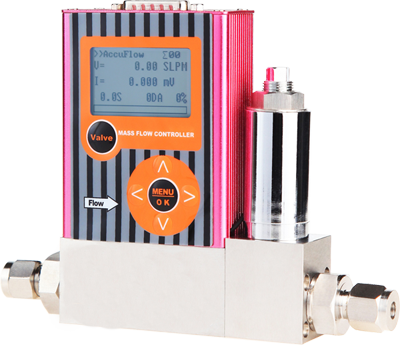
The SRK-DL is a low flow thermal mass flow meter designed for micro flow measurement, classified as a high temperature thermal mass flow meter, and intended for environmental monitoring, fuel cell, analytical instruments, medical and semiconductor industries. It covers 2 sccm to 30 SL/M with an accuracy of ±1% F.S., uses a stainless steel body, accepts ±15 VDC or 24 VDC supply, provides 0-5 V, 4-20 mA and 1-5 V outputs, and communicates over RS232 or RS485 with MODBUS. For gas-only duties where the flow is measured in standard cubic centimetres per minute rather than grams per hour, a thermal instrument is often the more direct fit — provided the ±1% F.S. accuracy statement is acceptable for the process.
Steam mass flow meter, STLU-VFN
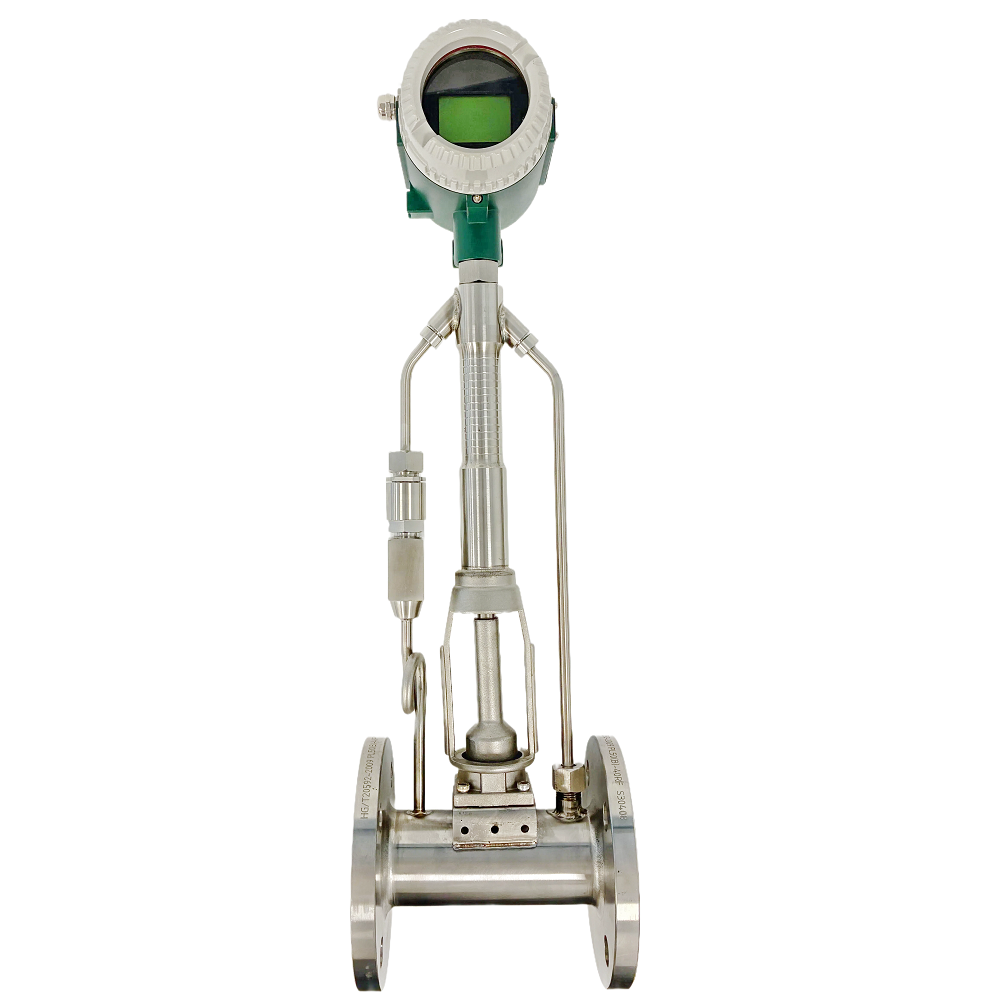
The STLU-VFN is a steam mass flow meter operating on the vortex principle, designed for saturated steam and overheated steam with a maximum steam temperature of 500 °C, supporting pipeline sizes from DN15 to DN300. It is constructed from stainless steel 304 or 316, offers flanged, wafer, screwed or tri-clamp process connections, includes built-in temperature and pressure compensation, and is ATEX approved. Target industries include power generation, petrochemical, food processing, pharmaceuticals and district heating. In Malaysia-type steam projects using large 4-inch, 6-inch, 8-inch or 10-inch pipelines, the instrument is used to display mass flow rate in kg/hr or t/h for energy management and process control, integrated with DCS or PLC systems.
Neither alternative replaces micro Coriolis for silane, scCO2 or kerosene duty. They extend the shortlist to gas-only and steam-only applications where a different physical principle is the correct engineering answer.
Future outlook
The direction of travel is toward more measurement points at lower flow rates. Semiconductor thermal mass flow controllers are projected to grow at a 4.5% CAGR between 2026 and 2035 (SNS Insider), the microfluidic devices market that includes micro flow sensors is growing at 12.2% CAGR (P&S Intelligence), and the flow chemistry market that depends on precision low flow metering is expected to reach USD 4.6 billion by 2032 (Coherent Market Insights). Each of these segments consumes instrumentation at the small end of the range rather than the large end.
Two procurement consequences follow. Hazardous-area documentation will be scrutinised earlier in the selection process, because more of these duties sit inside classified enclosures. And buyers will increasingly ask for model-level approval evidence rather than portfolio-level statements, since the difference between the two determines whether an instrument can be installed at all.
For the specific envelope described in this article — 40 g/h to 1000 kg/hr, ±0.25% to ±0.5%, 316L, 30 bar or 100 bar, 4-20 mA / 0-5 VDC / 1-5 VDC with RS485 or RS232 — the Micro Coriolis approach remains the closest documented match among the instruments reviewed, with thermal and vortex instruments covering the gas and steam duties that fall outside it.
A technical brochure covering the instrument families discussed in this article is available for download: Silver Automation Instruments product brochure.
FAQ
What is a low flow meter used for?
A low flow meter measures very small liquid or gas flow rates where standard-bore instruments lose resolution. In the duty envelope discussed here, low flow meters handle liquids and gases from 40 g/h to 1000 kg/hr, in media such as silane, supercritical CO2, diesel, aviation kerosene, silicone and pure water, across food, (petro)chemical, pharmaceutical, fermentation, semiconductor and fuel cell environments.
Which media can a Micro Coriolis mass flow meter measure?
The SH-CMF-FE handles both liquid and gas flows. Its documented fluid list includes silane, supercritical CO2, diesel, aviation kerosene, silicone and pure water, and the model is classified as a high pressure and high temperature Coriolis flow meter suitable for process fluid measurement or control systems.
What flow range and accuracy should a buyer expect from a Micro Coriolis meter?
The published range for the SH-CMF-FE is 40 g/h to 1000 kg/hr with an accuracy of ±0.25% to ±0.5%, depending on configuration. The pressure rating is offered as 30 bar or 100 bar, and the wetted construction is stainless steel 316L. Accuracy is stated as a band rather than a single figure, so the exact value must be fixed at order stage.
Why do construction material and hazardous-area approval matter?
Stainless steel 316L addresses corrosive and high-purity media such as pure water, silicone and process chemicals. For hazardous areas, ATEX approval is itemised at model level for some instruments in the portfolio — the SH-CM Coriolis mass flow meter, the STLU-VFN steam mass flow meter and the SRK-100 thermal mass flow meter — while for the SH-CMF-FE the published approval statement sits at company level, so the marking should be confirmed against the specific order.
When is a low flow thermal mass flow meter a better choice than Coriolis?
When the medium is a gas and the flow is naturally expressed in standard volumetric units. The SRK-DL covers 2 sccm to 30 SL/M with ±1% F.S. accuracy, RS232 or RS485 with MODBUS, and 0-5 V, 4-20 mA or 1-5 V outputs, and is intended for semiconductor, medical, analytical instrument, fuel cell and environmental monitoring duty. It does not replace a Coriolis meter for liquid service or for media requiring direct mass measurement of liquids.
When should a steam mass flow meter be used instead?
For saturated steam and overheated steam duties. The STLU-VFN operates on the vortex principle, supports pipeline sizes from DN15 to DN300, handles steam temperatures up to 500 °C, includes built-in temperature and pressure compensation, is ATEX approved and is used in power generation, petrochemical, food processing, pharmaceutical and district heating applications. It is a steam and gas instrument, not a low-flow liquid meter.