
Luxury Hotel Tent Buyer's Framework: Specs, Certification and Fit
Permanent hotel tents have moved out of the novelty category. They are now specified against structural loads, membrane chemistry, fire classification and site conditions, and they are judged on documentation as much as on appearance. For hospitality buyers in the discovery and research stage, the difficulty is rarely finding offers. It is that offers are seldom written in the same language: a quotation listing 'fire retardant fabric' and one listing 'B1 / M2 fire-retardant, 1050 g/m² PVDF architectural membrane' can describe products with very different lifecycles.
This article sets out a four-gate framework that buyers can apply before shortlisting: structure, membrane, certification evidence, and environmental fit. The framework is worked through using the documented specifications of five permanent hotel tent models — Tethys, Villa, Octagon, Shell and Pisces — so that each gate is applied to real figures rather than to abstract criteria.
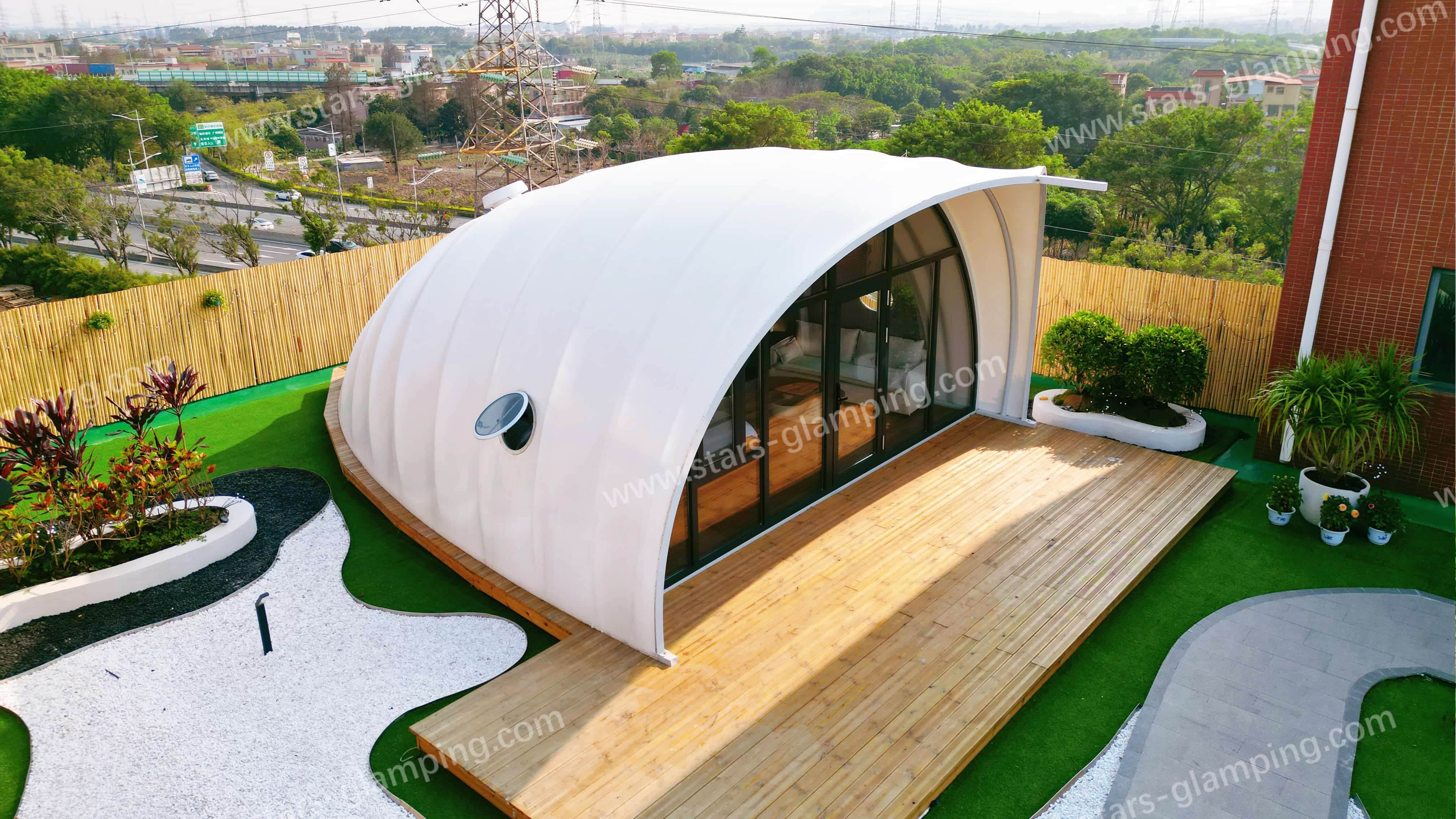
Why permanent hotel tent purchasing needs a framework
Demand context explains the pressure on specifications. Grand View Research valued the global glamping market at USD 3.46 billion in 2024 and projected growth through 2032. Fortune Business Insights, publishing in September 2026, places the same market closer to USD 3.8 billion. The gap between the two estimates is largely a definitional one — differing treatment of distributed hotels versus traditional camping tents — and that gap is itself an illustration of the buyer's problem: change the definition, and the number moves.
Regionally, Asia Pacific is projected to grow at the fastest CAGR in the sector, at 12.58% for the 2025–2031 period, according to Grand View Research. For buyers, faster growth in a region usually means a wider supplier field and more variability in how specifications are written. That is the condition in which a framework earns its keep.
A framework is not a scoring spreadsheet. It is a fixed sequence of questions that must be answered in the same order for every offer, so that the comparison survives contact with a one-page quotation. The sequence used here is: structural envelope, membrane system, certification evidence, environmental fit. Form factor, interior fit-out and commercial terms come after those four gates, not before them.
Gate 1 — The structural envelope: steel, wood or hybrid
Across the five models, two frame approaches appear. Tethys, Villa, Octagon and Shell are documented with steel pipe frames. Pisces is documented with a solid wood and steel pipe frame. All five are rated to the same figures: wind resistance up to 120 km/h, stated as Level 10 wind, and a snow load of 80 kg/m².
The frame is the load path. Wind uplift and accumulated snow travel through it into foundations, which is why a catalogue rating is only the starting point. A rating of 120 km/h and 80 kg/m² describes what the structure has been documented to withstand; it does not by itself confirm that the same structure, on a specific plot, with a specific foundation and a specific exposure category, will perform to that level. In practice this means the frame gate has two parts: what the frame is made of, and whether a project-specific structural calculation supports the published figures.
Frame material is best treated as a fit decision rather than a quality ranking. Steel pipe is usually selected where repeatable modular assembly and consistent spans are the priority; the application requirements for this product family explicitly list 'easy installation and modular design' among the conditions the structure is designed to meet. Wood components are usually selected where exposed timber is part of the interior concept, and they bring their own maintenance questions — moisture management becomes relevant in high-humidity and coastal environments, where the same application requirements call for anti-corrosion protection.
Gate 2 — Reading the membrane correctly: PVDF versus PVC polyester
Two membrane specifications appear in the data set, and they define the sharpest split between the five models:
- 1050 g/m² PVDF architectural membrane fabric — documented on Tethys, Villa, Octagon and Shell, with a stated service life of 25–30 years.
- 850 g/m² PVC polyester fabric — documented on Pisces, with a stated service life of 10–15 years.
Both membrane types are documented with a waterproof rating of at least 5000 mm H₂O, UV stabilization and anti-aging treatment, and a fire rating of B1 / M2. In other words, the headline performance claims across the five models are nearly identical. The variables that actually separate them are membrane weight, coating chemistry and service life.
That is the first place a comparison can go wrong. Two tents can both state 'waterproof 5000 mm' and 'fire retardant' while differing by roughly a factor of two in documented service life. Fabric weight in grams per square metre and coating chemistry are the fields worth checking, because they sit behind the headline claim. PVDF-based coatings are widely used in long-life architectural membranes on account of how they retain surface appearance and colour under UV exposure; PVC polyester systems rely more heavily on surface treatment to manage the same exposure. Neither approach is a defect. They are different lifecycle positions, and the buyer's job is to match the position to the asset.
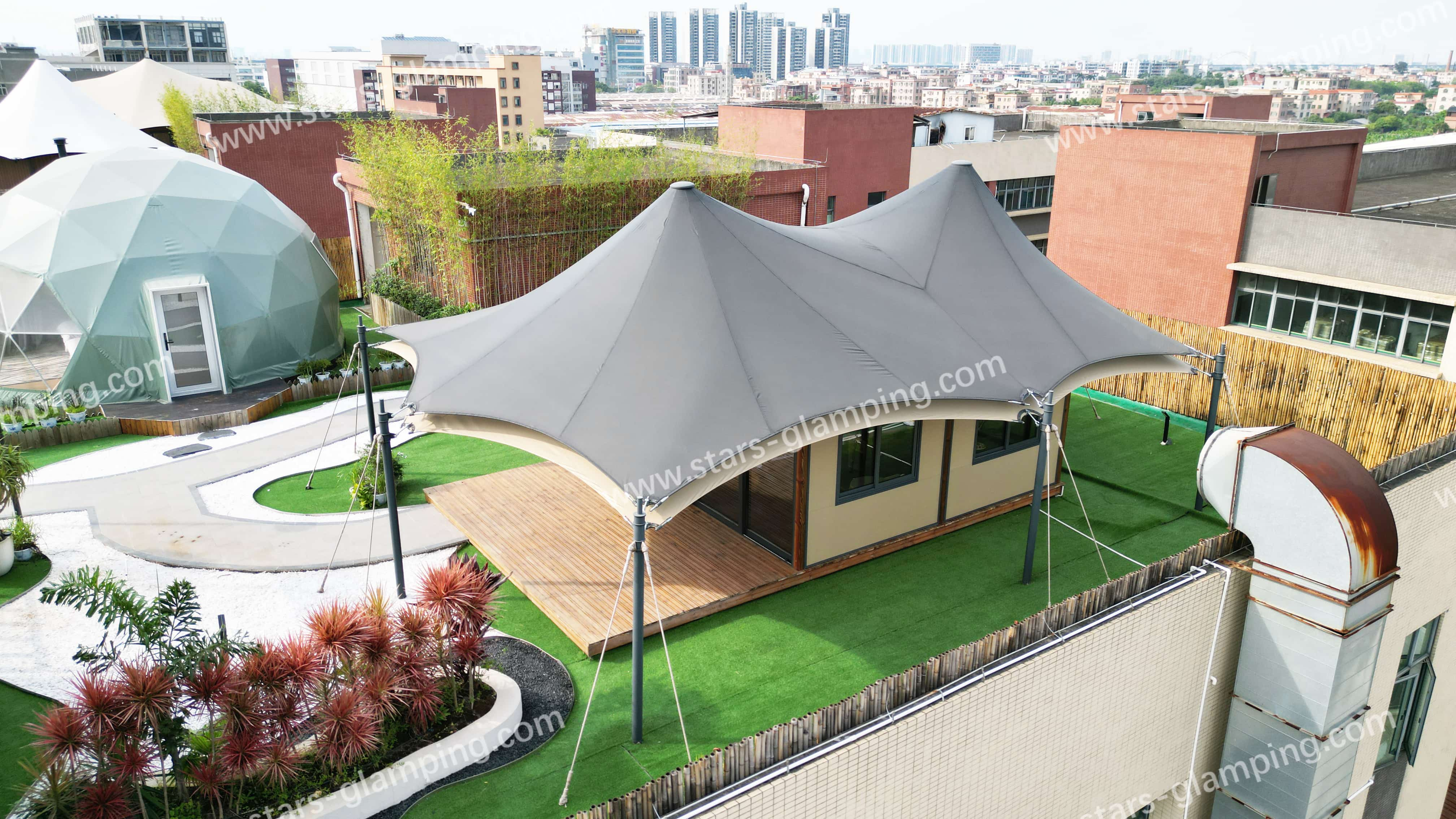
Gate 3 — Separating certification from claim
Certification language on tent specifications is compressed, and compression hides ambiguity. All five models are documented with a fire rating of 'B1 / M2 (fire-retardant)' and a waterproof rating of '≥5000 mm H₂O'. Both statements need to be unpacked before they can carry weight in a tender.
Fire: B1 / M2 is a classification label, not a single global standard
B1 and M2 are labels drawn from separate national fire-performance classification schemes rather than from one international standard, and they are not interchangeable with one another. A specification that cites 'B1/M2' without naming the test standard and the issuing laboratory is a claim rather than evidence. The same applies to the local approval question: fire requirements for tents are jurisdiction-specific. In North America, tent fire safety is regulated through the International Fire Code, whose 2024 edition addresses tents in Chapter 31, published by the International Code Council.
The application requirements for this product family list 'fire retardant (B1 / NFPA 701)' — a useful reminder that a single project may be asked to satisfy more than one fire standard depending on where it is built and which authority signs the permit.
Waterproofing: what ≥5000 mm H₂O actually measures
The ≥5000 mm H₂O figure is a hydrostatic head rating: the height of a water column the fabric resists before water passes through it. It is a standard way to express waterproofness in textile structures, and it is only meaningful alongside the test method, the specimen weight and the coating type. Two fabrics with the same 5000 mm result can behave differently after several seasons of UV exposure and flexing, which is why the test report should be read as a snapshot rather than as a lifetime guarantee.
Gate 4 — Environmental resistance and site fit
The five models share one documented operating envelope: temperature resistance from −30 °C to +70 °C, wind resistance up to 120 km/h stated as Level 10 wind, snow load of 80 kg/m², and waterproofing of at least 5000 mm H₂O, with UV stabilization and anti-aging treatment. That envelope describes the product family, not a project. Site fit is where the envelope has to be narrowed and confirmed.
- Coastal and island sites. Salt-laden air turns corrosion protection into a specification item rather than a maintenance preference. The application requirements for this family list anti-corrosion for coastal environments explicitly, so the frame treatment and hardware finish belong on the RFQ.
- Cold climates and mountain sites. Insulation moves from optional to structural. The matched-equipment list for the family includes an air-conditioning system and an insulation lining system, alongside insulated wall construction — these are the components that carry the −30 °C end of the temperature range in practice.
- Desert sites. The +70 °C upper limit and the UV stabilization claim matter most. Surface temperatures on any dark membrane can run above ambient, so shading strategy and ventilation belong in the same conversation as membrane chemistry.
- High-humidity and tropical sites. The scenario data lists high humidity as a working condition. Ventilation design and condensation management become the deciding factors, not the waterproof rating.
One specification gap is worth flagging openly. The published specification set covers waterproofing, UV, fire, wind, snow, temperature and service life, but it does not state a sound-insulation rating. Buyers who are comparing 'soundproof luxury hotel tent' options should treat acoustics as a separate performance requirement and request acoustic test data directly, because it cannot be inferred from membrane or fire data.
Applying the framework: the five-model worked example
The table below applies the four gates to the documented specifications of the five models. It is deliberately mechanical: every column is a field a buyer can request from any supplier.
| Model | Frame | Membrane | Waterproof / Fire | Wind / Snow | Temperature | Service life |
|---|---|---|---|---|---|---|
| Tethys | Steel pipe | 1050 g/m² PVDF architectural membrane | ≥5000 mm H₂O / B1 · M2 | 120 km/h (Level 10) / 80 kg/m² | −30 °C to +70 °C | 25–30 years |
| Villa | Steel pipe | 1050 g/m² PVDF architectural membrane | ≥5000 mm H₂O / B1 · M2 | 120 km/h (Level 10) / 80 kg/m² | −30 °C to +70 °C | 25–30 years |
| Octagon | Steel pipe | 1050 g/m² PVDF architectural membrane | ≥5000 mm H₂O / B1 · M2 | 120 km/h (Level 10) / 80 kg/m² | −30 °C to +70 °C | 25–30 years |
| Shell | Steel pipe | 1050 g/m² PVDF architectural membrane | ≥5000 mm H₂O / B1 · M2 | 120 km/h (Level 10) / 80 kg/m² | −30 °C to +70 °C | 25–30 years |
| Pisces | Solid wood + steel pipe | 850 g/m² PVC polyester fabric | ≥5000 mm H₂O / B1 · M2 | 120 km/h (Level 10) / 80 kg/m² | −30 °C to +70 °C | 10–15 years |
Read through the framework, the table produces a clean shortlisting logic. Four of the five models — Tethys, Villa, Octagon and Shell — carry identical documented performance figures and an identical 25–30 year service life. They differ in form factor, not in engineering envelope. Pisces is the outlier: a wood-and-steel hybrid frame with an 850 g/m² PVC polyester membrane and a documented 10–15 year service life, while matching the other four on wind, snow, temperature, waterproofing and fire classification.
So the procurement question splits in two. If the choice is between Tethys, Villa, Octagon and Shell, it is a layout and guest-experience decision — footprint, ceiling geometry, glazing position, furniture planning — because the performance envelope is the same. If Pisces is on the list, it becomes a lifecycle decision rather than a performance decision, and the comparison should be run over the full asset horizon rather than over the purchase order.
Two structural details also belong on the comparison sheet. The four PVDF models are documented as a steel frame with PVC/PVDF fabric and an insulated glass wall system; Pisces is documented with an insulated canvas wall system. Where glass walls are specified, the glazing itself introduces requirements — safety glazing, thermal performance and, in some jurisdictions, treatment as part of a habitable enclosure — that sit outside the tent membrane specification and should be raised with the local authority early.
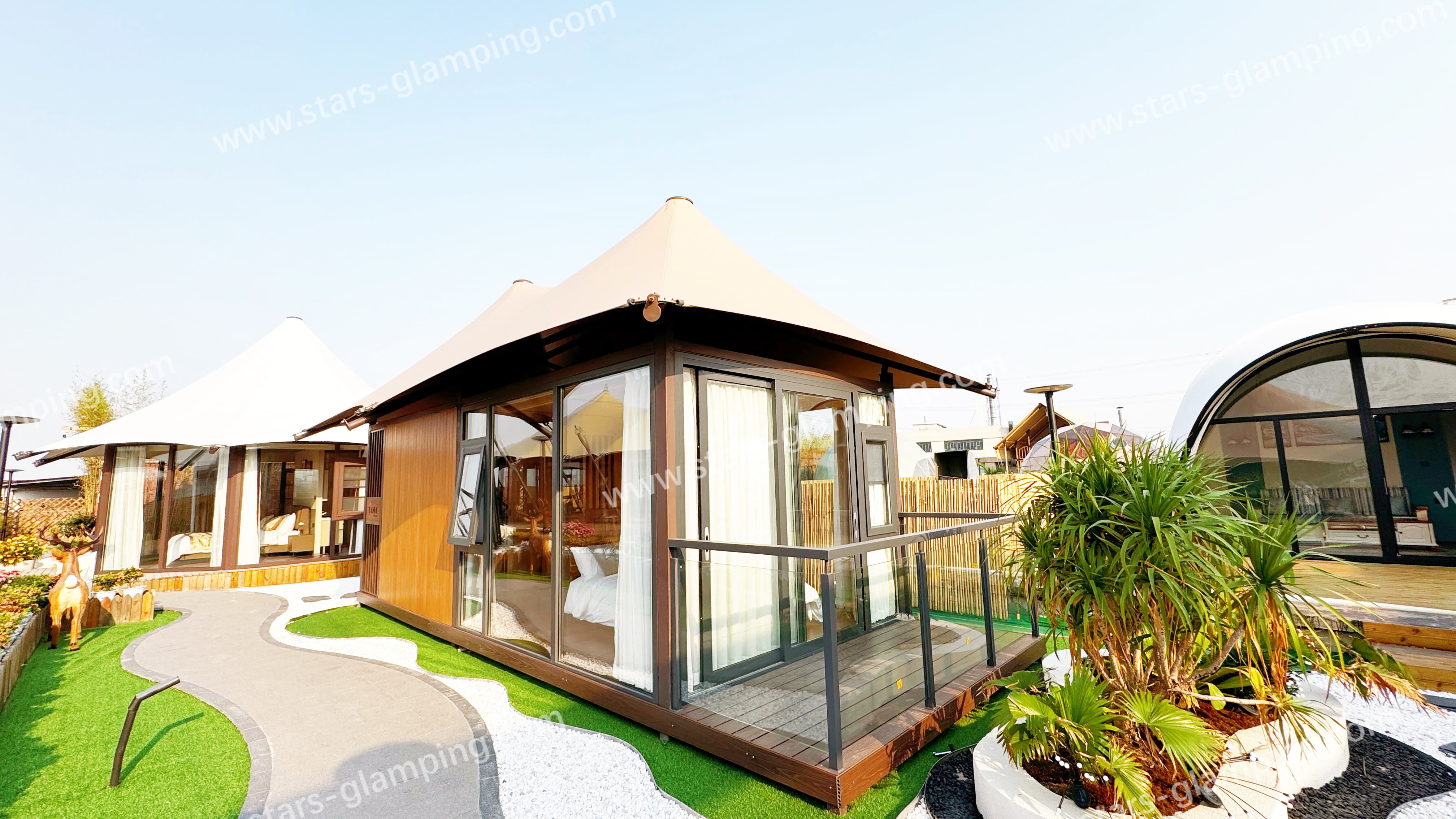
Where the framework applies: beach, desert, mountain and island projects
The application profile for this product family is luxury hospitality, resort, glamping resort and eco-tourism projects, operated as permanent installations on a 24/7, all-season basis. Documented destination markets include the United Arab Emirates, Saudi Arabia, Australia, Thailand, Indonesia, Malaysia, Bhutan, Canada, Algeria, the Dominican Republic, India, Kenya, Morocco, Namibia, New Zealand, Oman, Tanzania and Vietnam. The working conditions associated with those markets — beachfront, desert climate, tropical rainforest, mountain areas, high humidity, strong wind and all-weather operation — are precisely the conditions the four gates are designed to test.
The matched-equipment list for the family is equally relevant to the framework, because each item imports its own compliance path: an air-conditioning system introduces electrical load and refrigerant considerations; a bathroom module introduces plumbing and drainage; glass doors and panoramic windows introduce glazing requirements; wooden flooring, curtain and shading systems, and electrical and lighting installation affect the internal fit-out sequence. A tent structure that is fully compliant on membrane and frame can still stall at permitting because the fit-out package was never assessed.
Applying the gates by terrain is straightforward. For beachfront and island sites, weight corrosion protection and wind exposure first, then glazing and shading. For desert sites, lead with temperature tolerance, UV stabilization and shading. For mountain and cold-climate sites, lead with insulation, snow load and heating integration. For safari and eco-tourism sites, where structures may sit in sensitive landscapes, the modular, easy-installation characteristics of the family — together with custom size and layout availability — are usually the deciding factors rather than peak performance figures.
How this compares with traditional resort construction — and where the framework stops
Traditional resort construction remains the default assumption in most feasibility models: masonry or concrete envelopes, built on site over a longer programme, with a long design service life. Permanent hotel tent structures compete on different axes — factory production, modular design, easier on-site installation, and the ability to reconfigure or expand a room count without a new building phase. For resort developers, the practical comparison is usually not 'tent versus building' in the abstract but 'how much of this project can be delivered with a shorter construction programme'.
The honest counterweight is that the two approaches are not equivalent on service life, and the framework should not pretend otherwise. Four limitations matter specifically:
- Data provenance. Every specification value used in this framework comes from a single manufacturer's published product documentation. It demonstrates how to apply the gates; it does not benchmark the market. Values should be verified against project-specific test reports and calculations before they enter a contract.
- Service-life statements. The 25–30 year and 10–15 year figures are manufacturer-stated. Independent accelerated-ageing or weathering data are not published in the available sources, and it is not stated whether the figure refers to membrane replacement or to the complete structure. Buyers should ask that question directly, because the two answers have very different budget implications.
- Code path. Whether a structure is treated as a tent or as a building is decided locally. The International Fire Code's tent provisions apply in North America; other jurisdictions use their own approval routes. A design that is compliant in one market may require a different approval path in another, and this is a scheduling risk rather than a specification risk.
- Cost. No comparable unit, installation or lifecycle cost data are available in the public record used here. A framework cannot rank value without a cost input, so the commercial gate has to be filled by the buyer's own RFQ, on a like-for-like scope that includes fit-out, freight, installation, foundations and warranty.
Against conventional building envelopes, permanent tent structures also carry a shorter practical service life profile. That is not a defect of the framework; it is the trade the buyer is making, and it should be modelled explicitly rather than discovered at the first refurbishment.
What to request before shortlisting
A shortlisting decision should be traceable to documents, not to impressions. The following requests follow directly from the four gates:
- A project-specific structural calculation confirming wind and snow performance against the published 120 km/h and 80 kg/m² targets.
- A membrane datasheet stating fabric weight, coating chemistry (PVDF or PVC polyester) and the standard referenced.
- A fire test report matched to the destination jurisdiction, naming the standard, laboratory and report date.
- A hydrostatic head test report supporting the ≥5000 mm H₂O claim, with the specimen weight and coating identified.
- Insulation, heating and cooling integration details for cold-climate or all-season operation.
- Acoustic performance data if sound insulation is a project requirement, since it is not covered by the published specification set.
- Fit-out documentation for the bathroom module, glazing, flooring and electrical routing.
- Warranty terms, spare membrane availability, and a clear statement of who is responsible for installation.
- Confirmation of the legal entity and facility scope behind the documents, because public company pages describing the same brand can present different figures and scopes.
Market outlook: documentation as the next differentiator
The growth picture supports the case for a formal framework. Grand View Research projects the glamping market forward from a 2024 base of USD 3.46 billion across the 2024–2032 forecast period, while Fortune Business Insights, publishing in September 2026, offers a higher base estimate of approximately USD 3.8 billion. Asia Pacific is expected to grow fastest, at a 12.58% CAGR for 2025–2031. Whatever base figure a feasibility model uses, the direction is consistent: more projects, more suppliers, and more specification variability.
The more consequential shift is structural rather than numerical. The category is moving from temporary camping equipment to permanent modular hospitality assets, and in that transition membrane specification becomes an asset-valuation question rather than a comfort question. Where a project horizon exceeds ten years, prioritising a 1050 g/m² PVDF membrane over an 850 g/m² PVC polyester membrane changes the depreciable life of the accommodation unit, not merely its appearance.
The likely direction of travel for buyers is that tender documentation becomes the differentiator between suppliers. Structural calculations, fire test reports matched to the destination jurisdiction, hydrostatic head reports with identifiable specimens, and documented certificate scope will move from 'nice to have' attachments to standard submission requirements. Suppliers who can produce that documentation quickly will be easier to shortlist — not because their tents look better, but because their evidence is checkable.
Frequently asked questions
What exactly is a permanent hotel tent structure?
It is an accommodation structure built from a rigid frame and a technical architectural membrane rather than from a conventional building envelope. The product family described here is classified as a Luxury Hotel Tent / Glamping Resort Tent / Permanent Hotel Tent Structure and is used for luxury hospitality projects, resort development, eco-tourism camps and high-end outdoor accommodation systems. Its documented models include Tethys, Villa, Octagon, Shell and Pisces, with steel pipe frames — and, in the case of Pisces, a solid wood and steel pipe frame — combined with either PVDF architectural membrane or PVC polyester fabric.
What is the difference between a PVDF membrane and a PVC polyester membrane on a hotel tent?
The difference is mainly lifecycle, not headline performance. Tethys, Villa, Octagon and Shell use a 1050 g/m² PVDF architectural membrane fabric with a documented service life of 25–30 years. Pisces uses an 850 g/m² PVC polyester fabric with a documented service life of 10–15 years. Both are documented as waterproof to at least 5000 mm H₂O, UV stabilized and anti-aging, and fire rated B1 / M2, so buyers cannot separate them on the headline claims alone — fabric weight, coating chemistry and service life are the fields that distinguish them.
What do B1 / M2 and 5000 mm H₂O actually mean on a hotel tent specification?
B1 and M2 are fire-performance classification labels drawn from separate national schemes rather than from a single international standard, and they are not interchangeable. A specification citing B1 / M2 should be supported by a test report that names the standard, the laboratory and the date. 5000 mm H₂O is a hydrostatic head rating — the height of a water column the fabric resists before water penetrates — and it is only meaningful alongside the test method, specimen weight and coating type. Fire requirements for tents are also jurisdiction-specific: in North America, tent fire safety is regulated through the International Fire Code, 2024 edition, Chapter 31, published by the International Code Council.
Which climates and site conditions can permanent hotel tents serve?
The five models share a documented operating envelope of −30 °C to +70 °C temperature resistance, wind resistance up to 120 km/h stated as Level 10 wind, snow load of 80 kg/m², and waterproofing of at least 5000 mm H₂O with UV stabilization. The associated application profile covers beachfront, desert climate, tropical rainforest, mountain areas, high humidity, strong wind and all-weather operation, on a 24/7 permanent installation basis with all-season operation. Coastal sites additionally call for anti-corrosion protection of the frame and hardware.
How long do permanent hotel tents last?
Documented service life differs by membrane system. Tethys, Villa, Octagon and Shell are documented at 25–30 years with a 1050 g/m² PVDF architectural membrane; Pisces is documented at 10–15 years with an 850 g/m² PVC polyester membrane. These are manufacturer-stated figures, and independent ageing or weathering data are not published in the available sources. It is also not specified whether the figure refers to membrane replacement or to the complete structure, so buyers should confirm which part of the structure the number describes.
What should a buyer request before shortlisting a permanent hotel tent supplier?
At minimum: a project-specific structural calculation for wind and snow loads against the published 120 km/h and 80 kg/m² targets; a membrane datasheet giving fabric weight and coating chemistry; a fire test report matched to the destination jurisdiction; a hydrostatic head report supporting the 5000 mm H₂O claim; insulation and HVAC integration details for the intended climate; and acoustic data if sound insulation is required, since it is not part of the published specification set. Confirmation of the legal entity and facility scope behind the documents should also be requested, because public company pages describing the same brand can report different figures.
Summary
A permanent hotel tent purchase is a specification decision before it is a design decision. Applied in order, the four gates — structural envelope, membrane system, certification evidence, environmental fit — convert a stack of visually similar quotations into a comparable set. In the five-model example used here, that process reduced five offers to one clear lifecycle split and four form-factor options, which is precisely the point at which a shortlist can be defended internally.
A downloadable brochure covering the permanent hotel tent model range discussed in this framework is available at this link.
Есть вопросы или нужны дополнительные детали?
Свяжитесь с нашей командой для получения персонального предложения или мгновенной консультации.
Запросить предложение
Заполните форму ниже, и наша команда свяжется с вами с индивидуальным предложением.
Прямой чат WhatsApp
Предпочитаете общаться в реальном времени? Напишите нам в WhatsApp для мгновенной помощи и быстрых ответов.
- Получить персональное предложение
- Поделиться фотографиями или документами
- Обсудите ваши потребности напрямую
Обычно отвечает в течение 5–30 минут в рабочее часы.