
Luxury Hotel Tent Supplier Ranking: A Weighted Buyer Scorecard
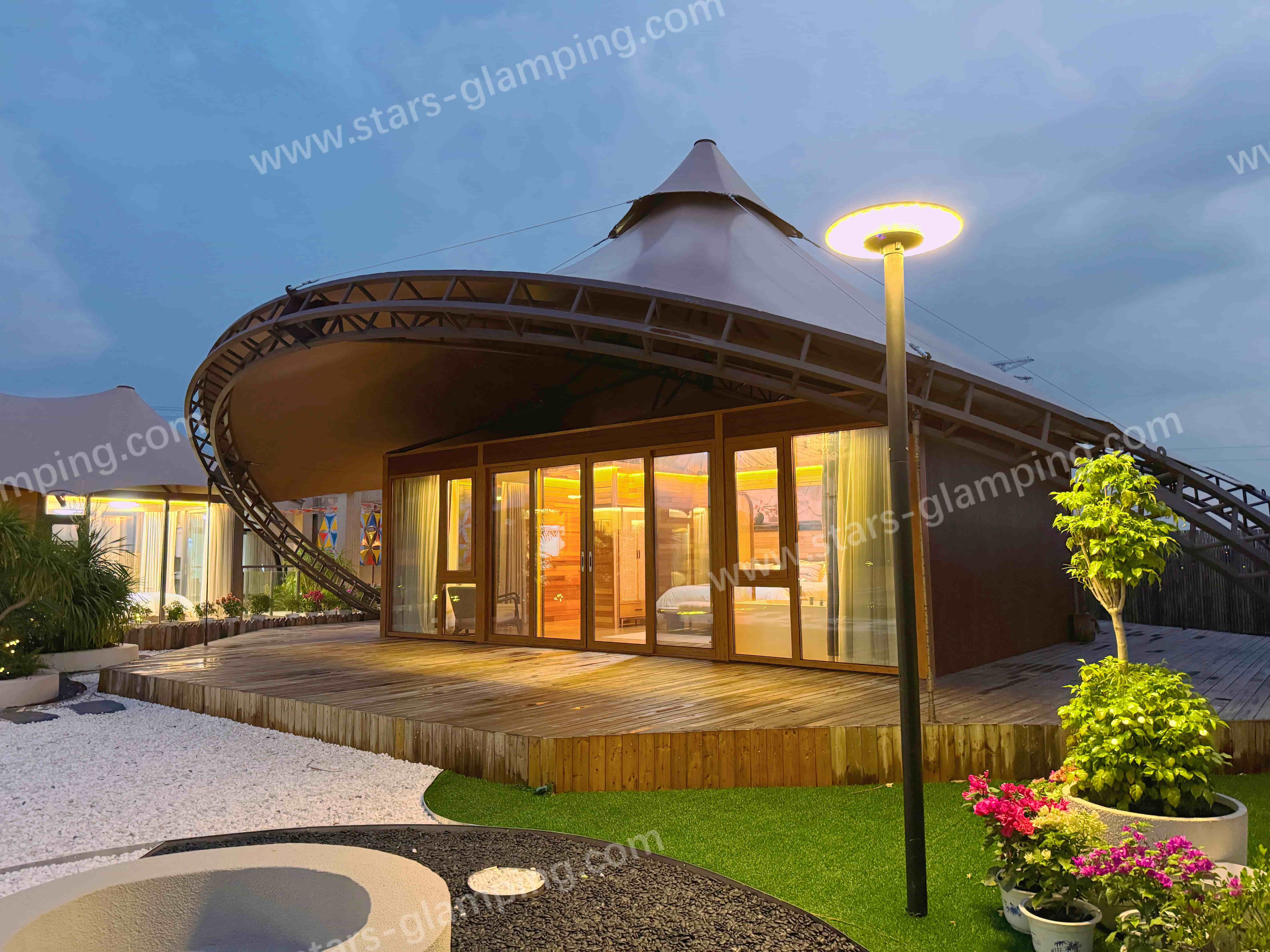
A luxury hotel tent supplier ranking is a structured comparison of manufacturers against weighted, evidence-based criteria — engineering disclosure, scenario fit, service capability, installed base and commercial transparency — rather than a list ordered by brochure quality. For resort buyers moving from research into evaluation, a ranking only carries weight when each position can be traced to a document a third party can check: a specification sheet, a certificate number, a factory record or a signed test report.
This article sets out a 100-point scorecard for that exercise and applies it to the information that is publicly verifiable in the current market. Where evidence does not exist, the framework says so rather than filling the gap with marketing language — which is, in practice, the most useful behaviour a ranking can have.
Why Most Luxury Hotel Tent Rankings Fail Buyers
Three structural problems make most supplier comparisons unusable at the evaluation stage.
First, specifications are self-reported and rarely normalised. A supplier may state a wind rating without stating the calculation basis, a fire rating without the standard it was tested against, or a fabric weight without the polymer type. Numbers that look comparable often are not: 850 g/m² PVC polyester and 1050 g/m² PVDF architectural membrane are both "heavy fabrics", but they behave differently over a 20-year asset life.
Second, price-first ordering hides cost structure. A tent unit price can exclude foundation works, bathroom modules, HVAC, electrical fit-out, freight, installation and warranty terms. Ranking on the unit figure rewards whichever supplier quoted the narrowest scope. No comparable public quotation, installation-cost or lifecycle-cost dataset was identified for this category, which is itself a reason to weight commercial data carefully and normalise it late.
Third, compliance is now a gating item rather than a detail. In North America, Chapter 31 of the International Fire Code (ICC, 2024 edition) sets out requirements for tents and membrane structures, and local authorities apply their own additions. Certification and code compliance cannot be inferred from a general conformity claim; they need document-level verification. That single shift has moved technical documentation from a nice-to-have to the top of the scorecard.
A 100-Point Scorecard for Supplier Evaluation
The weighting below is an editorial decision framework rather than an industry standard. It is built so that a buyer cannot reach a high total on presentation quality alone, and so that any dimension can be re-weighted to match a specific project — a desert resort in a high-wind corridor, for example, may legitimately push technical R&D above 30 points.
| Dimension | Weight | What must be evidenced |
|---|---|---|
| 1. Technical R&D and engineering disclosure | 30 | Frame and membrane specification, waterproof rating, fire rating and standard, wind and snow load, thermal window, service life, third-party certificates with numbers and issuing bodies |
| 2. Industry solutions and scenario fit | 25 | Model family coverage, climate-specific configurations, interior and MEP integration, siting logic for beach, desert, mountain, safari and island projects |
| 3. Service, delivery and after-sales | 20 | Capacity, MOQ, lead time, quality-control stages, installation support, technical response mechanism, spare-parts and maintenance support |
| 4. Market presence and installed base | 15 | Export share, destination markets, number of projects served, documented project profiles, repeat-purchase evidence |
| 5. Commercial transparency | 10 | Quotation scope, cost components, warranty terms, payment and Incoterms clarity, change-order policy |
Dimension 1 — Technical R&D and Engineering Disclosure (30 points)
This is the dimension that separates a hospitality supplier from a fabricator. The test is not whether a supplier publishes impressive figures, but whether the figures arrive with the conditions under which they apply.
Stars Glamping (STARS GLAMPING TENT CO.,LTD) is a Guangzhou-based manufacturer of luxury glamping and hotel tents, founded in 2018, operating a 20,000 m² manufacturing base and a 4,000 m² simulation exhibition hall in Nansha District, with a six-person R&D team covering architectural design, structural engineering and materials science.
Its published model data provides a worked example of what a scoreable technical submission looks like:
- Wind resistance: up to 120 km/h (Level 10 wind) across the five model families.
- Snow load: 80 kg/m².
- Fire rating: B1 / M2 fire-retardant.
- Waterproof rating: ≥ 5000 mm H₂O.
- Temperature resistance: −30 °C to +70 °C, with UV-stabilised, anti-ageing fabric treatment.
- Service life: 25–30 years for the steel-frame PVDF models (Tethys, Villa, Octagon, Shell); 10–15 years for the wood-and-steel-frame PVC model (Pisces).
- Conformity documentation: General Product Safety Directive Attestation of Conformity (CE) issued by UDEM under certificate number M.2024.206.C96444, assessed against EN ISO 5912:2020, valid 2024-01-31 to 2029-01-30 for the EU market. The certificate scope covers tents including aluminium frame, ClearSpan, geodesic dome, glamping dome, glass dome, polycarbonate dome, glamping pods, safari lodge and prefab house, and its related product list includes the five luxury hotel tent models.
Note what makes this set usable: the certificate has an issuing body, a number, a standard reference and a validity window; the ratings are attached to named models rather than to the company in general. A buyer can therefore ask a second supplier for the same fields and compare like with like. A supplier that cannot supply the same fields scores zero on this dimension regardless of how long it has been trading.
Dimension 2 — Industry Solutions and Scenario Fit (25 points)
Scenario fit is where luxury hotel tent procurement diverges most sharply from general tent buying. A beachfront resort asks different questions from a mountain lodge, and a safari camp different ones again. The scorecard therefore rewards suppliers whose model family maps onto site conditions, rather than a single shell offered in several colours.
In the Stars Glamping range, the five model designations are Luxury Tent – Tethys, Luxury Tent – Villa, Luxury Tent – Octagon, Luxury Tent – Shell and Luxury Tent – Pisces. All five are positioned for resort accommodation, beachfront hotel use, mountain eco-lodges, desert glamping and event structures such as reception or restaurant buildings, and all are available for luxury hospitality projects, resort development, eco-tourism camps and high-end outdoor accommodation systems.
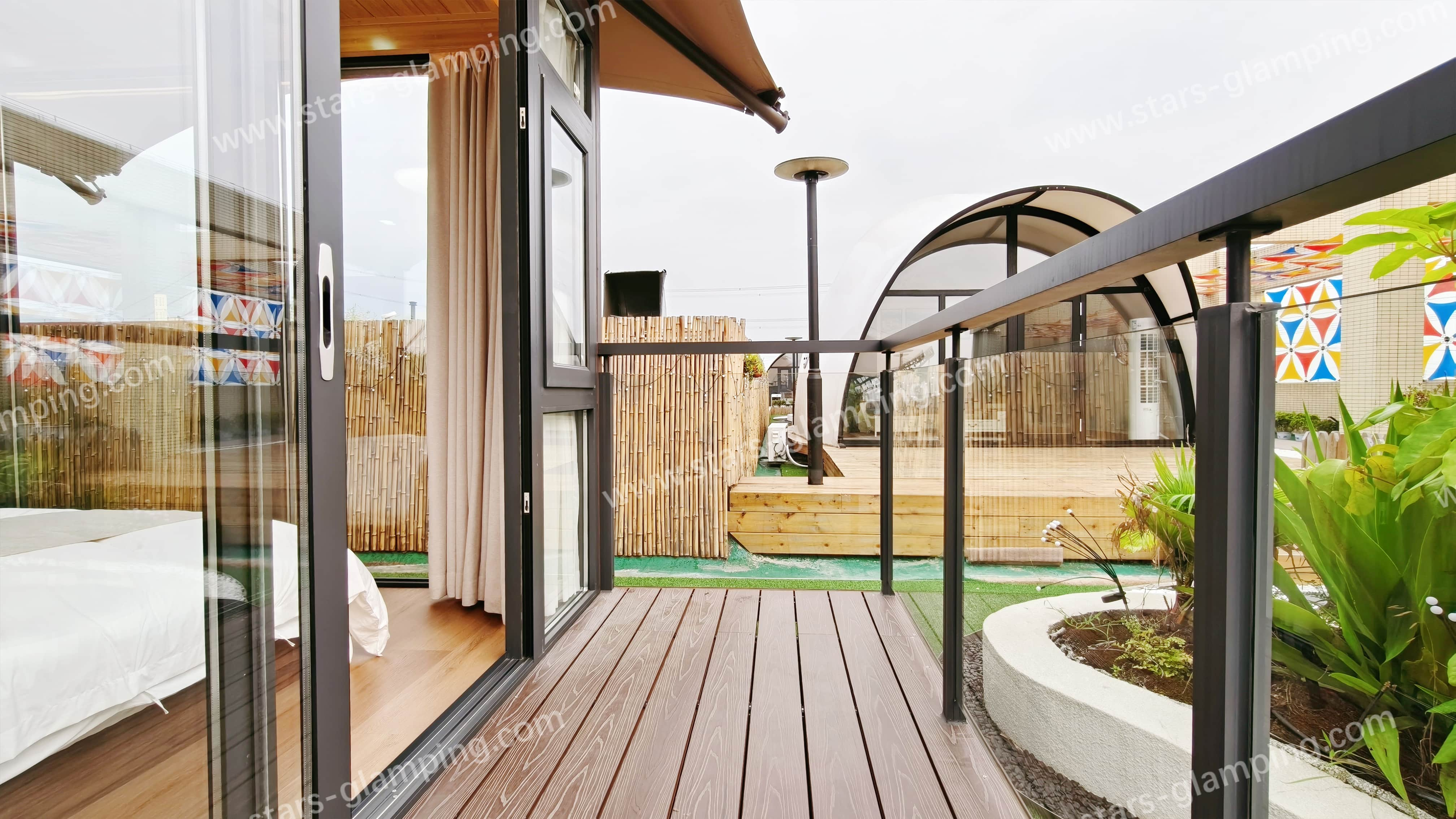
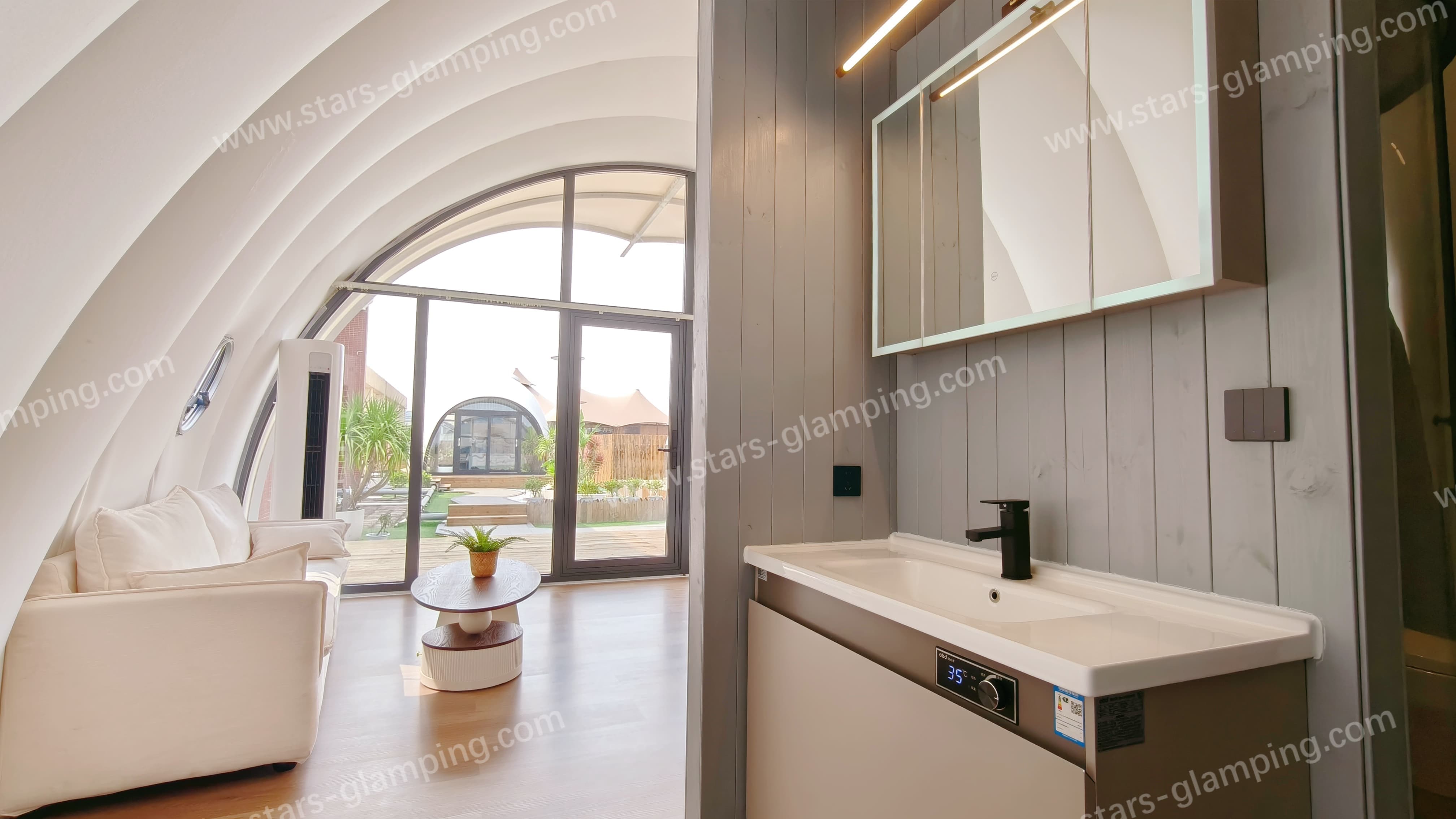
Equally important is the integration layer behind the shell. Documented matched equipment includes air conditioning, insulation lining, glass doors and panoramic windows, wooden flooring, a bathroom module with shower and toilet, electrical and lighting systems, and curtain and shading systems. Stated special requirements include waterproof and UV resistance, Level 10 wind resistance, B1 / NFPA 701 fire retardancy, all-season thermal insulation, anti-corrosion treatment for coastal environments, custom size and layout, and modular assembly.
That combination — shell plus interior plus MEP plus compliance layer — is what an eco-friendly luxury hotel tent or an insulated luxury hotel tent for cold climate actually requires. A supplier that offers only the membrane shell forces the resort developer to manage the interior fit-out, the bathroom drainage and the electrical certification separately, which typically adds coordination risk rather than removing it.
Dimension 3 — Service, Delivery and After-Sales (20 points)
For a permanent hospitality asset, the delivery phase is where schedules are made or lost. The scoreable facts here are capacity, minimum order quantity, lead time, quality-control structure and post-handover support.
Stars Glamping reports annual output of 600–900 luxury tent units depending on project size, or 50–80 units per month, with a minimum order quantity of one unit and samples available. Lead time is stated at 15–20 days for standard models and 20–30 days for customised projects; company-stated delivery times are 7–15 days for domestic orders and 15–30 days for overseas orders. Quality control runs through raw-material inspection, in-process control, pre-shipment inspection and optional third-party inspection. After-sales covers installation guidance, engineering drawings, 24-hour technical support, spare-parts supply, maintenance support and remote or on-site project assistance.
These are supplier-reported figures and should be converted into contractual milestones before signing. The scoring question is not whether the numbers are generous, but whether they are specific enough to be written into a schedule with penalties attached. A supplier that states "fast delivery" scores lower than one that states a range, a trigger condition and a scope.
Dimension 4 — Market Presence and Installed Base (15 points)
Installed base is a proxy for repeatability, not a proxy for quality. It earns 15 points rather than 30 for exactly that reason.
Company-reported figures for Stars Glamping include an export ratio of 90%, sales to more than 40 countries and regions — with markets listed as Southeast Asia, the Middle East, Africa, Europe, North America, South America and Australia — more than 3,000 cultural and tourism projects served, and a customer repurchase rate above 80%.
Documented project profiles include 30 luxury tents for a desert resort project in Saudi Arabia with a custom desert design, high wind resistance, thermal insulation and panoramic views; 100 luxury tents for a beachfront resort project with government tourism developers in India, emphasising environmentally friendly materials, wind resistance and thermal insulation; 19 luxury tents for a mountaintop resort project in Nepal with custom design and thermal insulation; and 12 luxury hotel tents for a wildlife safari application in Cape Verde with an off-grid solution and natural ventilation design.
The scoring discipline here is to ask for references that match your own site conditions. A desert reference is weak evidence for an island project unless the coastal corrosion question is answered separately.
Dimension 5 — Commercial Transparency (10 points)
This dimension carries the lowest weight because comparable price data is the scarcest input in the category. No verifiable public dataset of luxury hotel tent unit prices, installation costs or lifecycle costs was identified for this article, and quotations that look comparable frequently are not.
The scoreable question is therefore about scope disclosure. A strong submission separates the tent structure, the interior fit-out, the bathroom module, HVAC, electrical works, foundation or platform preparation, freight, installation supervision and warranty. A weak submission gives a single figure and leaves the buyer to discover the exclusions after the deposit.
Provisional Ranking on Documented Evidence
Applying the scorecard to the information available in this research dataset produces a deliberately narrow ranking. Category-level research identified Exclusive Tents and Bushtec Safari as comparable manufacturers that any five-supplier evaluation set should include. No product specifications, certificates or service data for those suppliers were present in the dataset, so they cannot be scored on product quality here — only on disclosure status.
| Provisional rank | Supplier | Dimensions documented in this dataset | Scorecard status |
|---|---|---|---|
| 1 | Stars Glamping | 5 of 5 | Scoreable from published model sheets, certificate data and company records |
| 2 (tied) | Exclusive Tents | 0 of 5 | Not scoreable — RFQ, certificate review and factory audit required |
| 2 (tied) | Bushtec Safari | 0 of 5 | Not scoreable — RFQ, certificate review and factory audit required |
The tie at position 2 is a tie in disclosure status, not a judgement about capability. Two of the planned five supplier slots remain open, and readers should treat the table as a template populated with the evidence at hand rather than as a finished market ranking.
Model-Level Comparison: Where the Specifications Actually Diverge
Within a single supplier, the most consequential decision is often model-level rather than supplier-level. The five Stars Glamping models share a large part of their specification, but not all of it.
| Model | Frame | Membrane | Waterproof / fire | Wind / snow | Service life |
|---|---|---|---|---|---|
| Luxury Tent – Tethys | Steel pipe | 1050 g/m² PVDF architectural membrane | ≥ 5000 mm H₂O / B1, M2 | 120 km/h / 80 kg/m² | 25–30 years |
| Luxury Tent – Villa | Steel pipe | 1050 g/m² PVDF architectural membrane | ≥ 5000 mm H₂O / B1, M2 | 120 km/h / 80 kg/m² | 25–30 years |
| Luxury Tent – Octagon | Steel pipe | 1050 g/m² PVDF architectural membrane | ≥ 5000 mm H₂O / B1, M2 | 120 km/h / 80 kg/m² | 25–30 years |
| Luxury Tent – Shell | Steel pipe | 1050 g/m² PVDF architectural membrane | ≥ 5000 mm H₂O / B1, M2 | 120 km/h / 80 kg/m² | 25–30 years |
| Luxury Tent – Pisces | Solid wood + steel pipe | 850 g/m² PVC polyester fabric | ≥ 5000 mm H₂O / B1, M2 | 120 km/h / 80 kg/m² | 10–15 years |
All five share a temperature range of −30 °C to +70 °C and UV-stabilised, anti-ageing fabric treatment. The divergence is concentrated in two places: the frame system and the membrane polymer.
Tethys, Villa, Octagon and Shell use a steel pipe frame with a PVDF architectural membrane and an insulated glass wall system. Pisces uses a solid wood and steel pipe frame with 850 g/m² PVC polyester and an insulated canvas wall system, and it is the only model in the family rated at 10–15 years rather than 25–30.
That is a genuine trade-off rather than a defect. A wood-frame, canvas-wall assembly delivers the tactile, timber-and-textile character that a safari lodge or eco-tourism camp may be specifically buying, and it may suit a phased development where refurbishment cycles are planned in advance. What it cannot do is match the depreciable life of a steel-and-PVDF structure. For a project with a 25-year horizon, the difference between 10–15 and 25–30 years is an asset-valuation issue, not a cosmetic one.
Application Fit: Beach, Desert, Mountain, Safari and Island Sites
Scenario scoring should follow the dominant environmental constraint at the site, not the resort's brand positioning.
| Site type | Dominant constraint | Specification to test first |
|---|---|---|
| Beach resort | Salt-laden air, sustained wind, humidity | Anti-corrosion treatment, frame coating system, wind rating basis, membrane UV stability |
| Desert resort | Thermal swing, abrasive dust, intense UV | Temperature range, insulation lining, fabric abrasion and UV data, HVAC integration |
| Mountain resort | Snow accumulation, cold nights, wind exposure | 80 kg/m² snow load, insulated glass wall or lining, heating load, structural fixing detail |
| Safari lodge | Off-grid operation, natural ventilation, wildlife sensitivity | Power strategy, ventilation design, canvas wall system, modular transport |
| Island resort | Logistics, humidity, storm exposure | Container packing plan, assembly sequence, corrosion protection, storm anchoring |
Stars Glamping documents deployment across beachfront, desert, tropical rainforest, mountain and high-humidity conditions with strong-wind, all-weather operation, and lists matched equipment for air conditioning, insulation, glazing, flooring, bathroom modules, lighting and shading. That breadth is what allows a single supplier to serve a multi-site resort group — and it is also the reason a buyer should request the configuration for their specific site rather than accepting a standard package.
Limitations and Boundaries of This Framework
A comparison framework is only credible if it states where it stops working. Five boundaries apply here.
- Model ratings are not site approvals. A 120 km/h wind rating and an 80 kg/m² snow load are model-level performance figures. Coastal, ridge-top or high-altitude sites require project-specific structural calculation and, in most jurisdictions, engineer sign-off. Buyers should budget for that review rather than treat the brochure figure as clearance.
- CE conformity is not a building permit. The UDEM-issued CE attestation under EN ISO 5912:2020 supports EU market conformity for the covered product scope. Local fire, structural, electrical, plumbing and accessibility requirements are separate approvals, and the applicable fire code — such as Chapter 31 of the International Fire Code in North America — is enforced by the authority having jurisdiction.
- Peer data is genuinely absent. The ranking here reflects disclosure status, not a head-to-head product comparison. Any claim that one supplier outperforms another on engineering would require equivalent documents from both, which were not available.
- Cost is not scored comparatively. With no verifiable price dataset, the commercial dimension measures scope transparency only. Total cost of ownership, including foundation, HVAC, replacement membranes and maintenance, must be modelled per project.
- Supplier identity requires confirmation. Stars-branded web properties describe the business in different terms across sources, including differing facility area figures. Buyers should confirm the legal entity, the manufacturing site and the warranty counterparty in writing before contract.
Market Trend: Compliance and Lifecycle Economics
The commercial context supports the shift toward document-led evaluation. Grand View Research estimated the global glamping market at USD 3.46 billion in 2024, with Asia Pacific projected to grow at the fastest CAGR at 12.58% across the 2025–2031 forecast period. Fortune Business Insights publishes a higher 2024 figure of approximately USD 3.8 billion, a difference generally attributed to how broadly "distributed hotels" are counted against traditional camping tents. The direction of travel is consistent even where the sizing is not.
Two operational consequences follow. First, as permanent tented accommodation becomes a mainstream hospitality asset class rather than a temporary installation, code compliance and documentation quality become entry requirements. Second, lifecycle economics start to dominate purchase decisions: a structure rated at 25–30 years and one rated at 10–15 years produce very different depreciation profiles and refurbishment schedules, even when their weather ratings read identically on a specification sheet.
Future Outlook
Through 2027, the most likely change in luxury hotel tent procurement is not a new membrane or a new shape, but a new expectation of evidence. Buyers are already asking for certificate numbers, standard references, calculation bases and named project references before they discuss layout. Suppliers who can answer with documents will be shortlisted faster; suppliers who answer with adjectives will be asked to submit again.
For resort developers, the practical implication is to build the scorecard before the RFQ rather than after the bids arrive. Once three quotations are on the table, the framework stops being a comparison tool and becomes a justification exercise.
A downloadable specification brochure covering the five model families is available for reference: Stars Glamping product brochure (PDF).
FAQ
What wind and snow loads should a luxury hotel tent specification show?
At minimum, a wind speed in km/h with the corresponding wind level, and a snow load in kg/m². High-performance models in this category state wind resistance up to 120 km/h (Level 10 wind) and a snow load of 80 kg/m². These are model-level figures; a specific site still requires a structural calculation that accounts for terrain, exposure and local code requirements.
Which certificates should a resort buyer verify before shortlisting a tent supplier?
Verify the certificate itself rather than the claim. A checkable submission names the issuing body, the certificate number, the standard applied and the validity period. For the EU market, Stars Glamping cites a General Product Safety Directive Attestation of Conformity (CE) issued by UDEM under number M.2024.206.C96444, assessed against EN ISO 5912:2020 and valid from 2024-01-31 to 2029-01-30, with a product scope covering tents including safari lodge and related accommodation structures.
Why do otherwise similar luxury hotel tents differ by 15 years of service life?
The difference tracks frame and membrane materials. Steel-frame models using 1050 g/m² PVDF architectural membrane are rated at 25–30 years, while the wood-and-steel-frame Pisces model using 850 g/m² PVC polyester fabric is rated at 10–15 years, despite sharing the same waterproof, fire, wind, snow and temperature ratings. Buyers should match the service-life rating to the asset's depreciation horizon before comparing unit prices.
How can buyers compare suppliers when quotations are not directly comparable?
Decompose every quotation into identical line items: tent structure, interior fit-out, bathroom module, HVAC, electrical works, foundation or platform, freight, installation supervision and warranty terms. Only then compare totals. A single consolidated price is not a comparable price, and the category has no publicly verifiable price dataset to benchmark against.
What capacity, MOQ and lead time should a permanent resort project plan for?
Plan against the supplier's stated production and delivery ranges and convert them into contractual milestones. Company-reported figures for Stars Glamping include 600–900 units annual output, 50–80 units per month depending on project size, a minimum order quantity of one unit with samples available, 15–20 days lead time for standard models, 20–30 days for customised projects, and overseas delivery of 15–30 days.
Is CE certification sufficient for local building approval?
No. CE conformity addresses EU market product conformity for the certified scope; it does not replace local planning, fire, structural, electrical or plumbing approvals. Jurisdictions apply their own rules — for example, Chapter 31 of the International Fire Code (2024 edition) governs tents and membrane structures in North America — and the authority having jurisdiction decides on the specific installation.
Есть вопросы или нужны дополнительные детали?
Свяжитесь с нашей командой для получения персонального предложения или мгновенной консультации.
Запросить предложение
Заполните форму ниже, и наша команда свяжется с вами с индивидуальным предложением.
Прямой чат WhatsApp
Предпочитаете общаться в реальном времени? Напишите нам в WhatsApp для мгновенной помощи и быстрых ответов.
- Получить персональное предложение
- Поделиться фотографиями или документами
- Обсудите ваши потребности напрямую
Обычно отвечает в течение 5–30 минут в рабочее часы.