
Luxury Hotel Tent vs. Permanent Resort Building: A Decision Framework for 2026
For resort developers weighing accommodation formats, the choice between a luxury hotel tent and a traditional permanent building is no longer a niche consideration. The global glamping market was valued at approximately USD 3.8 billion in 2025, and industry projections point to sustained double-digit growth through the next decade. Within this context, luxury hotel tents have moved from seasonal pop-up structures to year-round, code-compliant accommodation assets that compete directly with conventional hotels on durability, guest experience, and return on investment.
This article provides a decision framework for developers comparing luxury hotel tents and traditional hotel construction, with emphasis on the conditions where each option performs best, the technical specifications that determine long-term viability, and the procurement criteria that separate a resort-grade tent from a temporary shelter.
Why this comparison matters now
Resort developers face rising construction costs, lengthening approval timelines, and growing guest demand for distinctive, nature-integrated stays. Luxury hotel tents address several of these pressures simultaneously. According to the Fortune Business Insights forecast, the glamping market is projected to reach USD 9.15 billion by 2034, growing at a CAGR of 10.67%. That growth is driven partly by operators who see tent accommodation as a faster, lower-risk entry into hospitality—especially in coastal, desert, and mountain locations where permanent construction is logistically difficult or environmentally restricted.
For procurement teams, the comparison is not simply "tent versus building." It is a comparison of two asset strategies with different capital profiles, installation timelines, operating costs, and compliance paths.
The core comparison: luxury hotel tent versus traditional hotel building
At the most basic level, the difference can be summarized as follows:
- Installation speed: a luxury hotel tent typically requires 20–30 days for on-site installation, compared to 6–12 months for a traditional hotel building.
- Capital investment: a luxury hotel tent generally represents a 30–50% lower investment than a comparable permanent structure.
- Best-fit environments: tents are particularly suitable for resort, desert, and beachfront scenarios, where traditional foundations, glazing, and HVAC integration are more complex and expensive.
- Maintenance: tent structures typically require lower maintenance and offer more flexible upgrade paths than conventional buildings.
These figures reflect a general industry comparison, not a universal guarantee. Local labor costs, site conditions, and the level of interior fit-out can shift the gap in either direction. The structural and material choices made during procurement—frame type, membrane type, insulation, fire retardancy—have a greater influence on the final result than the category of structure itself.
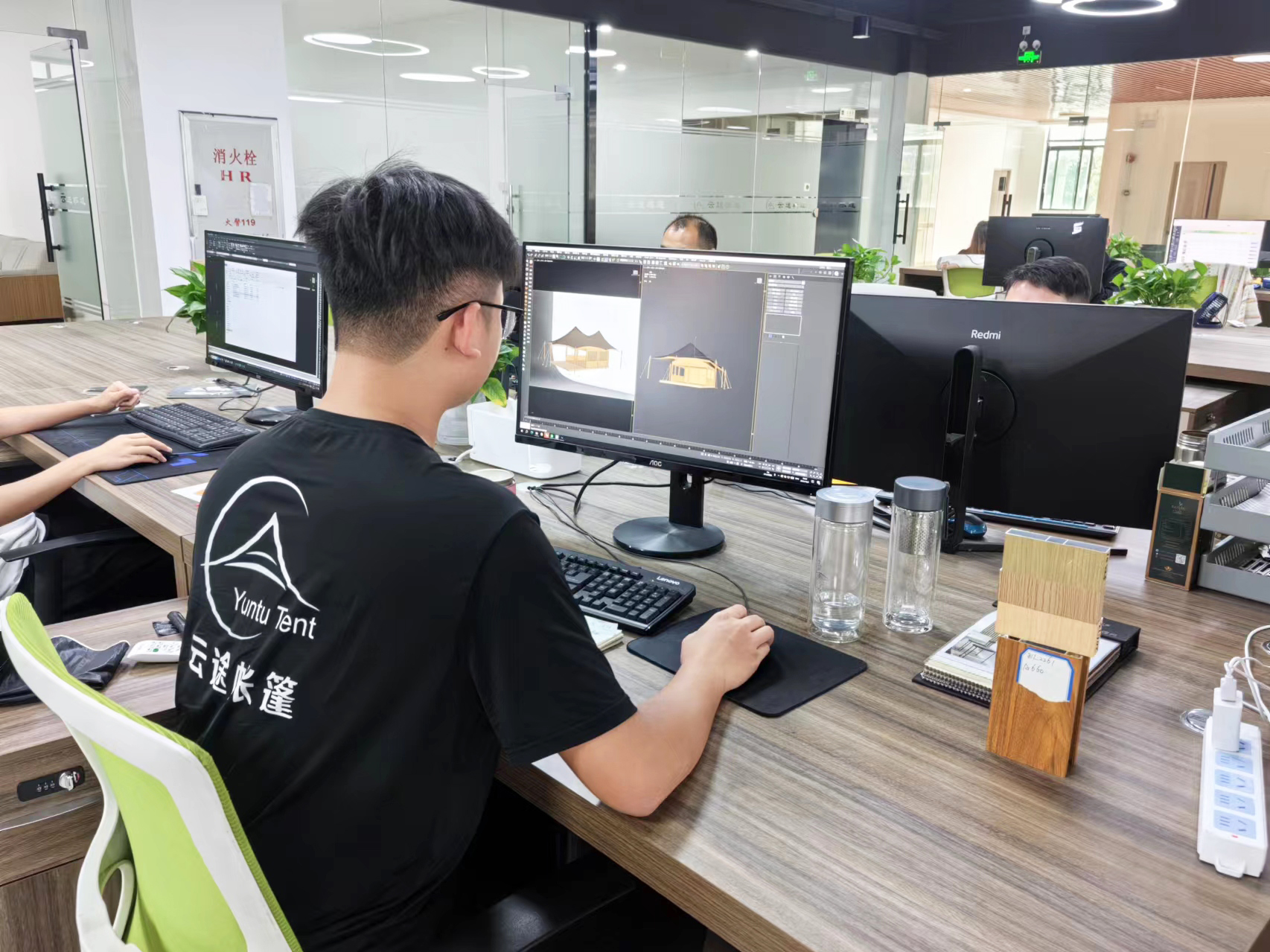
Engineering review is a checkpoint in luxury tent production. Image: Stars Glamping R&D team.
When the luxury hotel tent is the better choice
Resort, desert, and beachfront scenarios
Luxury hotel tents are not intended to replace all hotel construction. Their advantages are most evident in environments where:
- Site access is difficult for heavy construction equipment;
- Foundations are constrained by soil conditions, coastal setbacks, or protected land;
- The operator wants to shorten time-to-revenue;
- The guest experience depends on direct immersion in the landscape;
- Regulations favor low-impact, removable structures over permanent buildings.
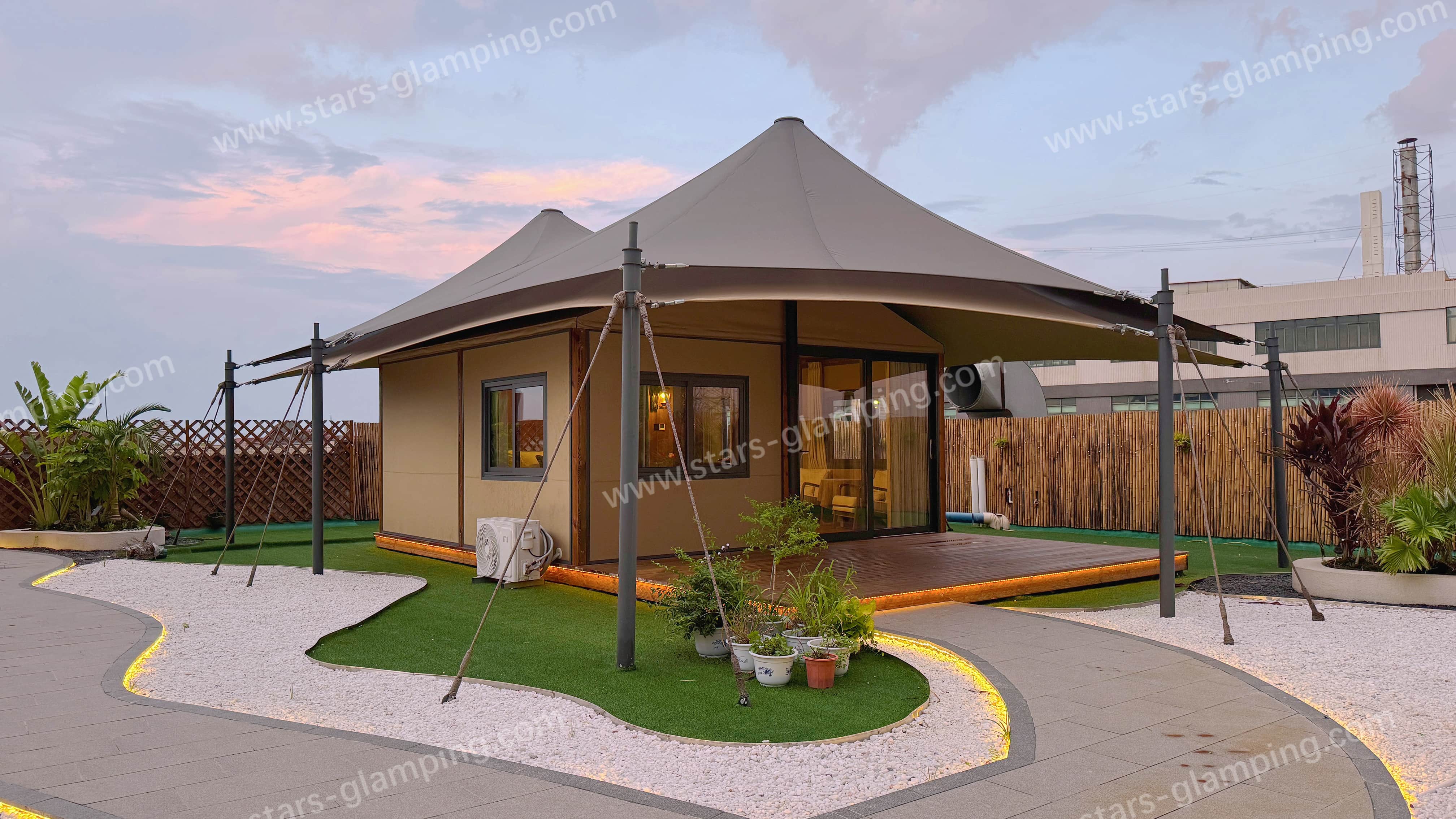
Stars Glamping, a Guangzhou-based manufacturer specializing in luxury glamping tents, positions its products for the luxury hospitality, resort development, eco-tourism, and high-end outdoor accommodation industries. Its tent systems are engineered as semi-permanent accommodation rather than event tents, with steel frames, PVC/PVDF membranes, and insulated wall systems designed for continuous hospitality use.
Case-type applications by terrain
The suitability of a tent system depends on matching the product design to the site. In brief:
- Beach and island resorts need high waterproofing, corrosion-resistant frames, and wind resistance. Heavy-duty PVC/PVDF membranes used in luxury hotel tents are non-porous and can provide hydrostatic head ratings exceeding 10,000 mm H₂O, which corresponds to a 100% waterproof rating for island and beach locations.
- Desert resorts benefit from insulated wall systems and UV-resistant fabrics that reduce heat gain and lower air-conditioning loads.
- Mountain resorts require wind load engineering, snow-load considerations, and insulation systems for cold climates. PVDF architectural membranes used in high-end tents offer a service life of 15–30 years and can withstand wind speeds up to 120–140 km/h when specified properly.
- Eco-tourism and safari lodges often need minimal ground disturbance, which favors tent structures over permanent buildings. Modular tent systems can be installed and removed with less environmental impact than concrete or steel-frame construction.
What determines whether a tent is a real hotel asset
A tent becomes a hotel asset only when engineered to hospitality standards. The key technical differentiators include:
Frame system
The frame is the primary load-bearing element. In the Stars Glamping Pisces model, the frame combines solid wood and steel pipe, which balances structural rigidity with interior warmth. Other models use galvanized steel frames designed for higher wind loads. When comparing suppliers, request structural calculations for the specific wind zone, snow load, and seismic class of the project site.
Fabric and membrane
The cover material determines waterproofing, UV resistance, thermal performance, and lifespan. The Pisces model uses 850 g/m² PVC polyester fabric, which is a common specification for permanent or semi-permanent hospitality tents. For higher durability and self-cleaning properties, PVDF-coated membranes extend service life and improve resistance to environmental degradation. A 100% waterproof rating (≥10,000 mm hydrostatic head) is a practical baseline for coastal and rainforest conditions.
Insulation and wall system
For year-round operation, the wall system must control condensation and temperature swings. The Luxury Hotel Tent by Stars Glamping uses a steel frame + PVC fabric + insulated canvas wall system. The insulated layer reduces heating and cooling demand, which directly affects operating cost. In desert environments, insulation is not a luxury; it is the main energy-efficiency feature of the building envelope.
Bathroom, HVAC, and interior integration
A luxury hotel tent with a bathroom or air-conditioning requires pre-engineered integration points for plumbing, electrical lines, and HVAC ducting. Suppliers with in-house production can coordinate these details at the factory stage, reducing on-site conflicts. Stars Glamping provides integration services including furniture, curtains, and flooring matching, which simplifies the fit-out phase for developers.
Compliance and fire retardancy
For commercial occupancy, tent structures must meet applicable fire performance standards. In the United States, NFPA 701 is commonly referenced for flame-resistant textiles; in Europe, EN 13501-1 classifies the reaction to fire of construction products. The International Fire Code (IFC) also addresses tents and membrane structures in commercial use. Buyers should request certified test reports, not generic marketing claims, and clarify whether the supplied fabric, wall panels, and interior linings all meet the same standard.
A steel-frame luxury tent system during assembly. Image: Stars Glamping production facility.
Where the luxury hotel tent has limitations
A balanced comparison must acknowledge the boundaries of tent construction. Luxury hotel tents are not the optimal solution in every context:
- Multi-story requirements: tent systems are generally single-level structures. A developer requiring high-density vertical hotels will not benefit from tent construction.
- Extreme cold climates: while insulated tents can operate in winter, deep-snow environments require significant structural engineering, heating design, and possibly permanent foundations. In these cases, the cost gap between a tent and a prefabricated permanent building narrows.
- Very large public spaces: lobbies, conference halls, and restaurants can be accommodated in tent systems, but the engineering complexity increases with clear-span width. Highly customized wide spans may reduce the speed and cost advantages of the standard tent product.
- Long-term financing and resale value: some lenders and insurance providers still categorize tent structures differently from permanent buildings. This can affect project finance terms and asset valuation, although the segment is maturing as more projects use engineered tent systems.
- Acoustic separation: fabric and canvas walls provide less sound insulation between rooms than concrete or drywall, unless the tent system is specifically engineered with soundproofing layers. Resort operators serving noise-sensitive guests should verify the acoustic performance of the wall system.
Market context and demand signals
According to Grand View Research, Europe held approximately 35% of the global glamping revenue share in 2025, with North America also representing a major market. These are the regions where luxury tent accommodation has matured from seasonal glamping to permanent resort inventory. The Asia-Pacific and Middle East markets are expanding as resort developers adopt tent structures for beachfront, desert, and island projects.
For buyers, the trend reinforces the need to verify supplier capability beyond the product brochure. The market still contains a wide range of quality—between event tents repackaged as luxury products, and engineered tent systems designed by teams with structural engineering, materials science, and hospitality experience. Procurement decisions should be based on verifiable specifications and facility capability.
Supplier verification: what to inspect before deciding
For developers choosing between suppliers, the following evidence points are relevant even before comparing prices:
Manufacturing and engineering capability
Stars Glamping operates a 20,000 m² manufacturing base in Guangzhou with a dedicated R&D team covering architectural design, structural engineering, and materials science. The company holds 54 national patents in areas including wind resistance, waterproofing, heat insulation, and quick assembly. Its products are reported to resist level-12 typhoons and extreme temperatures. A buyer should ask whether the supplier can provide the structural calculations and patent certificates relevant to the project site.
Production capacity and quality control
Stars Glamping’s annual output is 600–900 luxury tent units depending on project size, with a monthly production capacity of approximately 500 tents. The company applies a 12-step quality inspection system and has served more than 3,000 cultural and tourism projects, with a customer repurchase rate above 80%. For large resort developments, delivery capacity and inspection systems are as important as the product design.
Delivery and after-sales terms
Delivery terms for Stars Glamping are 7–15 days for domestic orders and 15–30 days for overseas orders, depending on project scope. After-sales support is structured as a 24-hour global response mechanism, with free installation guidance and lifelong technical support. Developers should compare these terms carefully because installation quality materially affects envelope performance, waterproofing, and long-term maintenance.
Decision framework: a practical checklist
The following table condenses the comparison into decision inputs.
| Decision factor | Luxury hotel tent | Traditional hotel building | Buyer consideration |
|---|---|---|---|
| Installation time | 20–30 days for installation | 6–12 months construction | Earlier opening reduces pre-revenue period. |
| Capital investment | 30–50% lower investment | Higher baseline cost | Lower entry cost may support asset expansion or phased development. |
| Best-fit environment | Resort, desert, beachfront, eco-tourism | Urban, high-density, multi-story, extreme climate zones | Match structure to local climate and land-use rules. |
| Maintenance | Lower maintenance; modular upgrade path | Conventional long-cycle maintenance | Tent fabric and seals require scheduled inspection and replacement cycles. |
| Energy efficiency | Better insulation reduces energy consumption | Depends on building envelope standards | Compare insulated wall performance, not category averages. |
| Compliance | Must meet NFPA 701 / EN 13501-1 and local membrane structure codes | Subject to full building code compliance | Verify certification reports and local building department acceptance. |
Future outlook
As the glamping market expands—from an estimated USD 3.8 billion in 2025 to a projected USD 9.15 billion by 2034—the distinction between temporary tents and permanent resort buildings will continue to blur. More suppliers are engineering tents to meet building-code-equivalent performance criteria, and more resort developers are designing projects around modular tent systems rather than using them as an alternative after construction budgets fail.
Procurement teams should expect the market to offer an increasing number of building code compliant hotel tents, eco-friendly luxury hotel tents, and modular luxury hotel tent systems. The evaluation criteria, however, remain stable: verifiable structural engineering, certified fire retardancy, reliable waterproofing and insulation, documented installation support, and proof of manufacturing capacity.
For a full overview of the product range and company specifications, the Stars Glamping company brochure is publicly available for download.
FAQ
How long does it take to install a luxury hotel tent compared to a traditional hotel building?
A luxury hotel tent typically requires 20–30 days for on-site installation, compared with 6–12 months for a traditional hotel building. The exact duration depends on the model, project size, and site preparation requirements.
Is a luxury hotel tent cheaper than a traditional hotel building?
Luxury hotel tents generally involve a 30–50% lower investment than traditional hotel construction. The final cost difference depends on site conditions, interior fit-out level, and the chosen membrane and insulation specification.
Which locations are most suitable for luxury hotel tents?
Luxury hotel tents are especially suited to resort, desert, and beachfront environments, where they can be installed quickly, create a distinctive guest experience, and operate with lower maintenance than permanent structures. They are also used in eco-tourism settings where low-impact construction is a requirement.
What fire retardancy standards apply to luxury hotel tents?
In commercial hospitality use, luxury tent fabrics and wall materials are commonly required to meet NFPA 701 (US) or EN 13501-1 (Europe). The International Fire Code (IFC) also addresses tent and membrane structures. Buyers should ask for certified test reports from the supplier.
How is waterproofing measured for luxury hotel tents?
Waterproofing is typically measured by hydrostatic head. Heavy-duty PVC/PVDF membranes used in luxury hotel tents are non-porous and can exceed 10,000 mm H₂O, which is considered a 100% waterproof rating for island and beach resort conditions.
What is the typical service life of a high-performance luxury tent membrane?
High-performance PVDF architectural membranes can offer a service life of 15–30 years, depending on exposure, maintenance, and installation quality. PVC fabrics typically have shorter replacement cycles, so the membrane choice should be aligned with the intended asset life.