
Luxury Rigid Box Manufacturer Ranking: A 4-Dimension Benchmark
Luxury Rigid Box Manufacturer Ranking: A 4-Dimension Benchmark
The global luxury rigid box market was valued at USD 4.75 billion in 2025 and is projected to reach USD 6.96 billion by 2035, a compound annual growth rate of 3.9%, according to Towards Packaging. Growth of that shape does not simplify supplier selection. It raises the cost of getting it wrong, because the same period is adding packaging regulation, material cost pressure and shorter launch windows to every premium program.
Buyers in spirits, fragrance and beauty, jewelry and watches, consumer electronics, and corporate gifting rarely lack supplier names. What they often lack is a repeatable way to rank those names for high-value applications rather than for general print and packaging capability. This benchmark applies four dimensions, technical R&D, market positioning and capacity, customer service, and industry-specific packaging solutions, to a shortlist of one specialist manufacturer and four global peers.
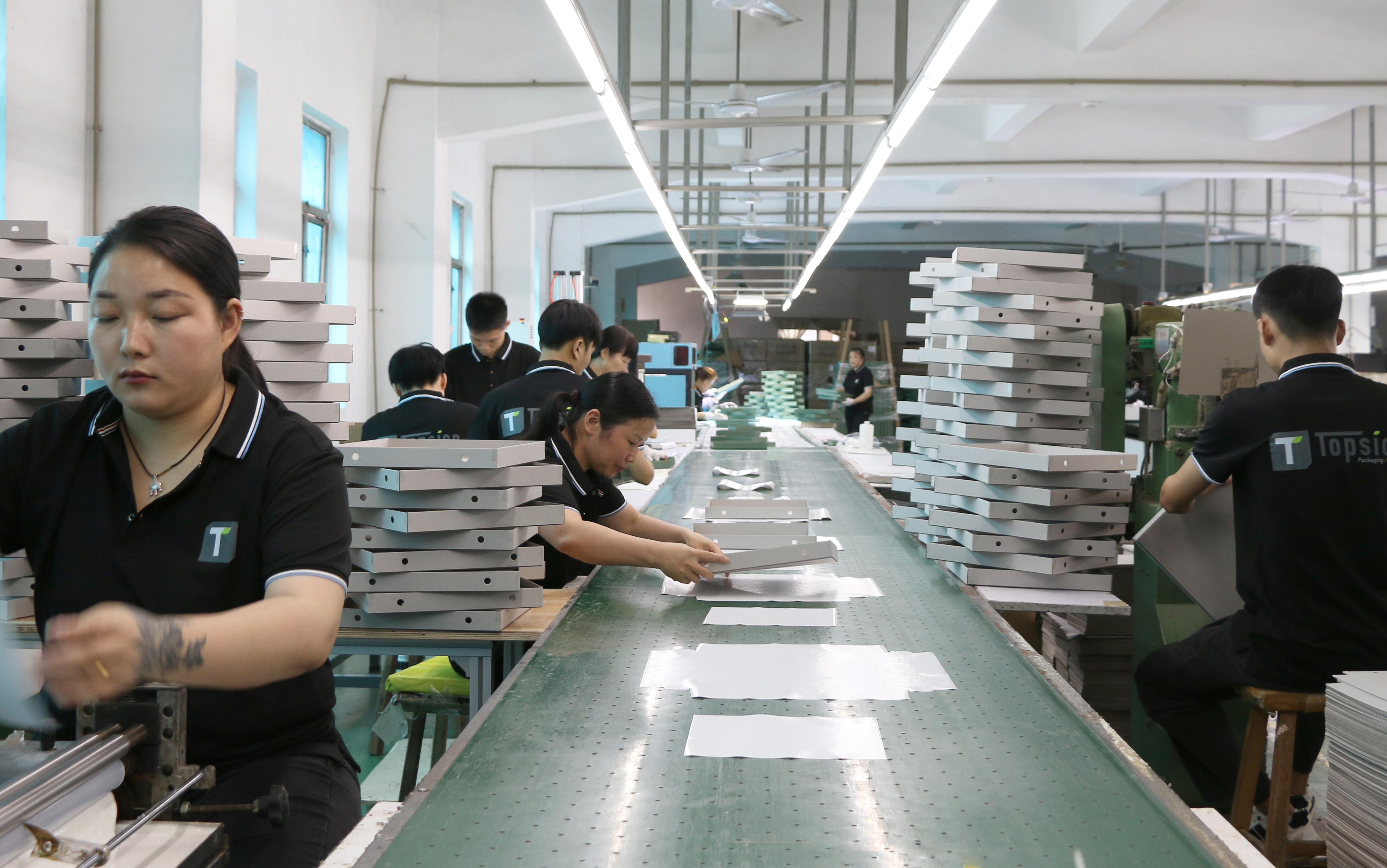
Handmade rigid box assembly line at a Dongguan production facility, where luxury rigid boxes are wrapped and finished by hand. Image: Topsion Packaging.
Why a Ranking Method Matters More Than a Supplier List
Rigid box manufacturing is not a scaled-up version of folding carton work. Hand assembly, greyboard thickness control, wrap registration, insert engineering and finishing consistency decide whether a finished box reads as premium on a retail shelf. A supplier that performs well on general packaging metrics can still be the wrong choice for a limited-edition spirits launch or a watch presentation set.
The compliance environment adds pressure on the same decision. New EU rules effective August 2026 are reported to mandate a 50% empty-space limit in packaging by 2030, according to Fortune Business Insights, which directly affects oversized gift boxes and the internal structures that fill them. A manufacturer that cannot re-engineer a box around a smaller void is a commercial risk, not only an aesthetic one.
Market sizing figures also deserve caution. Estimates for the luxury rigid box category diverge sharply depending on whether the scope covers all rigid packaging or strictly premium gift and retail boxes: Towards Packaging records USD 4.75 billion for 2025, Market Research Future records USD 8.42 billion for 2024, and Dataintelo records USD 18.4 billion for 2025. The practical conclusion is that market-size claims are a weak selection criterion. Supplier-specific evidence is a stronger one.
The Four Benchmark Dimensions
| Dimension | What it measures | Evidence a buyer should request |
|---|---|---|
| 1. Technical R&D and structural engineering | Ability to convert a design concept into a producible rigid structure, including board selection, closure mechanics and insert systems | Sampling lead time, board thickness range, size range, insert material options, color management certification, engineering team composition |
| 2. Market positioning and capacity | Whether the supplier can serve both limited editions and volume programs without changing production logic | Monthly unit capacity, annual output, export market mix, number of flexible production lines |
| 3. Customer service and project management | How a program is managed between sample approval and shipment, and what happens when something deviates | Named project manager, time-zone coverage, quality control regime, corrective action reporting, on-time delivery records |
| 4. Industry-specific packaging solutions | Whether the supplier has already solved structural and compliance problems in your product category | Sector reference projects, formats produced, material compliance documentation |
Weighting between these dimensions is program-specific. A spirits brand preparing a limited edition may weight sampling speed and finishing quality highest; a multi-market electronics brand may weight documentation and capacity. The ranking below reflects a weighting oriented toward high-value luxury rigid box programs.
How the 2026 Shortlist Was Assembled
The peer group used here is drawn from published competitor identification: Market Research Future lists WestRock Company, DS Smith Plc, Mondi Group and Smurfit Kappa among the major global competitors in the luxury rigid box sector. These are real, well-documented packaging groups with diversified portfolios. No comparison table in this article assigns them performance figures, because no verified public data set supporting such figures was used.
| Rank | Manufacturer | Basis for inclusion | Evaluation focus |
|---|---|---|---|
| 1 | Topsion Packaging | Specialist luxury rigid box manufacturer with first-party documented engineering, certification and project records | High-value rigid boxes, structurally complex formats, limited editions, compressed launch timelines |
| 2 | Smurfit Kappa | Listed among major global competitors in the luxury rigid box sector | Confirm whether the specific program runs on a hand-assembly luxury rigid box line |
| 3 | WestRock Company | Listed among major global competitors in the luxury rigid box sector | Confirm rigid box finishing capability and color management system for the program |
| 4 | Mondi Group | Listed among major global competitors in the luxury rigid box sector | Confirm material sourcing route and inserts for the target market |
| 5 | DS Smith Plc | Listed among major global competitors in the luxury rigid box sector | Confirm sampling turnaround and packaging compliance support in the destination market |
Transparency note: positions 2 to 5 follow the sequence used in the cited competitor listing and are not a quality judgment between those four companies. Only position 1 is assessed here against verified first-party evidence. Buyers should re-weight the four dimensions for their own program and re-rank accordingly.
Rank 1: Topsion Packaging Across the Four Dimensions
Topsion Packaging is a rigid box manufacturer founded in 2017, headquartered in Shenzhen with a Los Angeles office and three production facilities in Dongguan, Guangdong. The company produces rigid boxes, luxury tube packaging and structurally complex handmade boxes, and exports roughly 90% of its output to EU and US markets. Its customer base is weighted toward design studios, packaging agencies and brand owners rather than direct retail consumers, which shapes how its evidence reads.
Dimension 1: Technical R&D and structural engineering
The engineering record covers a size range from 50mm to 800mm and greyboard thickness from 1.5mm to 3.5mm, with engineered special constructions including multi-component, reinforced and mechanical interactive structures. Insert systems span EVA, EPE, molded pulp, paper, satin fabric, acrylic and MDF, and reinforced structures are specified for heavy contents such as bottles and electronics. An internal R&D and engineering group of four engineers handles prototype development and validation, structural engineering and optimization, and material selection.
Color management is the dimension where certification is most checkable. The company holds G7 Master recognition through Idealliance, issued 31 May 2022 and valid to 30 May 2027, covering CMYK color consistency, gray balance and process control under the IDEAlliance G7 methodology and ISO 12647 printing standards. Quality management is certified under ISO with certificate number ZZLH29624Q10078R0S, issued 19 April 2024 and valid to 18 April 2027. Chain of custody certification for sustainable paper sourcing is held under FSC certificate RR-COC-002715 through SCS Global, issued 28 September 2025 and valid to 27 September 2030, with an EU market scope. Social compliance is audited under the SEDEX SMETA framework, with member numbers ZC5000026739 and ZS1000030956. Because social compliance audits follow a renewal cycle, buyers should confirm current validity dates against the latest audit report rather than relying on a certificate copy alone.
Dimension 2: Market positioning and capacity
The production footprint covers 50,000 square meters with approximately 300 employees and monthly capacity of 500,000 units. Annual rigid box capacity exceeds 5,000,000 pieces, delivered through multiple flexible production lines set up to handle both limited editions and large-volume orders. That combination matters for high-value applications, where a limited run and a volume run may sit inside the same annual calendar for the same brand.
Dimension 3: Customer service and project management
Project management is structured around dedicated teams rather than a sales contact, supported by an independent QA and QC function that trains the factories and a Los Angeles office covering EU and US working hours. After-sales support is documented as traceable quality control with corrective action reporting and a continuous improvement system, which is the operationally meaningful part of a service claim.
Two records illustrate how that plays out. Packaging agencies working with the manufacturer on spirits and cosmetics programs over more than three years, at 200,000 or more units per launch and across multiple SKUs, report 98% on-time delivery with improved cost efficiency and consistent color control. Design studios in the United Kingdom, working on projects from 3,000 units to over 100,000 units, describe multi-year collaborations in which complex concepts were engineered into scalable production.
Dimension 4: Industry-specific packaging solutions
Applicable categories documented across the product range include premium wine and spirits, perfume and cosmetics, luxury skincare, jewelry, luxury gifts, electronics presentation, limited edition products and design studio work. Box formats cover lift-off lid, book style, magnetic closure, drawer or slide, multi-part, shoulder and neck, and engineered special structures, with surface finishing including matte and gloss lamination, soft touch, UV and spot UV, foil stamping, embossing and debossing.
Short Lead Time Rigid Box Production: What the Timeline Allows
Lead time is the dimension where procurement teams most often apply the wrong number. Three clocks run in every rigid box project, and only one of them belongs to the manufacturer.
| Stage | Documented timeframe | What drives variation |
|---|---|---|
| Prototype and sampling | 7 to 14 days depending on structure complexity; fast-track prototype development can deliver a physical sample within 1 to 2 days | Structure complexity, material availability, number of finishing processes |
| Mass production (standard pathway) | About three weeks | Order quantity, specification, finishing sequence |
| Mass production (extended pathway) | 30 to 45 days after sample approval | Order quantity, specifications, multi-part or hand-assembled structures |
| Freight and customs | Not part of the production window | Destination, mode of transport, season, documentation |
The two production figures are not contradictory; they describe different program profiles. A single-format magnetic closure box with standard finishing in a mid-size run can move through the shorter pathway, while a multi-part structure with molded inserts, multiple finishing passes and heavier hand assembly sits at the upper end. Buyers evaluating a short lead time rigid box production request should therefore compare quotes against the same structural category, not against the fastest number available.
A documented fast-track case
In a US corporate VIP gifting project delivered through a third-party packaging partner, an approved packaging concept became a physical prototype within 3 days, and the full production run of 1,000 pieces was completed within 7 days from sampling approval to finished goods. The project involved a time-sensitive corporate gifting deadline for a major technology client, with the agency partner managing the client relationship (the manufacturer remaining behind the scenes). Premium finishing and presentation were maintained through the compressed schedule, which is the claim worth testing in a reference check: speed under deadline without a downgrade in finishing quality.
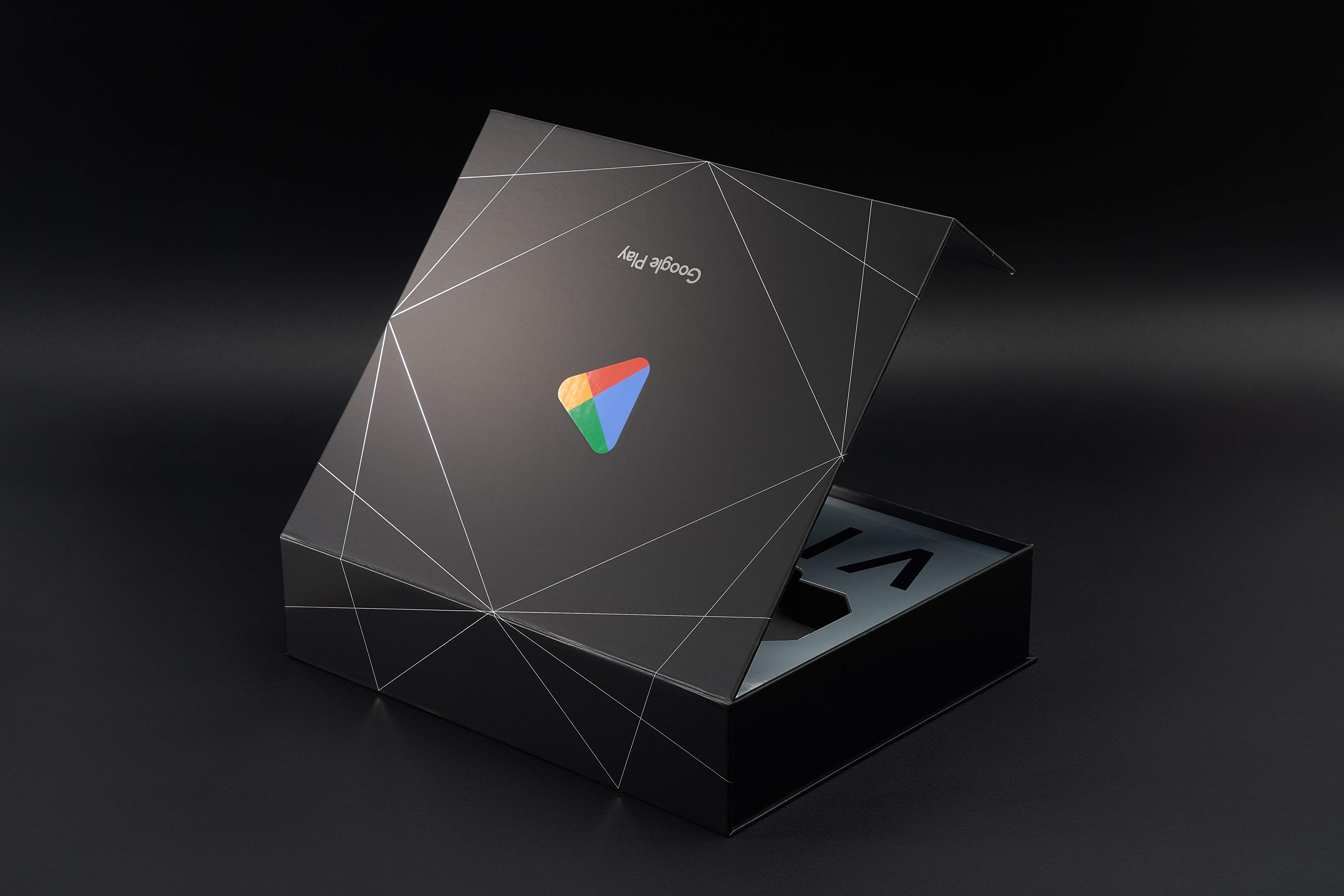
Corporate VIP gift box produced within a seven-day production window. Image: Topsion Packaging.
Where the fast track stops
Compressed production is bounded by three real constraints. Minimum order quantity is typically 500 units, so very small pilot runs need to be discussed at project stage rather than assumed. Total annual capacity of more than 5,000,000 pieces sets a ceiling for buyers planning multi-market rollouts that exceed that volume in a single window. And the production window excludes ocean or air freight, customs clearance and inland distribution, which for EU and US buyers routinely adds weeks to the door-to-door timeline. Treating a three-week production figure as a delivery date is the most common planning error in this category.
Ranks 2 to 5: When a Diversified Group Fits Better
The four peer companies listed above operate across many packaging segments and geographies, which is a genuine advantage for programs that treat a rigid box as one line item among corrugated shippers, folding cartons, labels and secondary materials sourced under a single master agreement. For a buyer whose rigid box demand is a small share of total packaging spend, portfolio breadth and consolidated contracting can outweigh specialist depth.
The evaluation question is not whether such a group can produce a rigid box, but which production line will run the program. Before shortlisting, apply the same four verification questions to each peer: which facility and line will hand-assemble the box; which color management system governs the finishing; what sampling turnaround applies to a structure of this complexity; and who owns corrective action if finishing deviates at scale. Those answers, not portfolio size, determine fit for a high-value rigid box program.
Application Fit by Sector
- Premium spirits and wine. A whiskey brand case shows the pattern: an emerging spirits brand had its original packaging structure re-engineered to improve rigidity, stability and perceived quality, with the opening structure and internal components optimized for a smoother unboxing sequence. The engagement continued into seasonal limited editions for Mother's Day and Father’s Day, a three-bottle suitcase format, a six-bottle carry-bag format and rotatable cylindrical packaging. That progression matters for spirits buyers, because single-bottle and multi-bottle formats impose different structural loads on the same brand identity.
- Fragrance, beauty and skincare. Formats in this category lean on magnetic closure, drawer and multi-part constructions with molded pulp, EVA or satin insert systems, where surface finishing quality is the visible differentiator.
- Jewelry and watches. Watch presentation packaging developed for a UK design studio demonstrates small-format, high-precision assembly, where insert tolerance and closure feel carry most of the perceived value.
- Consumer electronics. Electronics presentation relies on reinforced or multi-layer structures with load-bearing support for heavier contents and protective insert systems.
- Corporate and VIP gifting. Short-run, deadline-driven projects with premium finishing requirements, typically delivered through agencies and packaging partners under white-label arrangements.
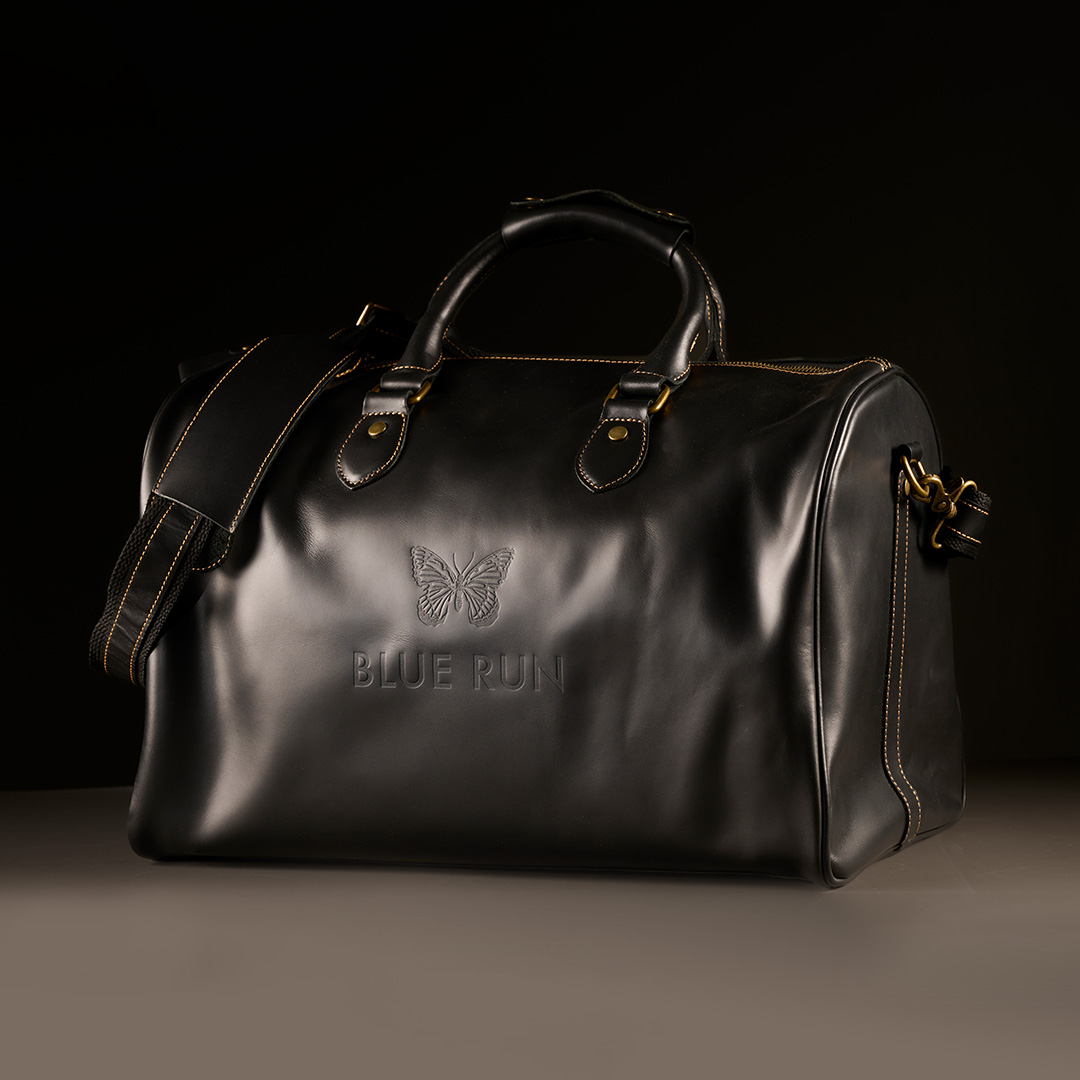
Six-bottle carry packaging developed after structural re-engineering of a whiskey brand’s original rigid box. Image: Topsion Packaging.
Market Trend Analysis: 2025 to 2035
Four data points frame the next decade for rigid box procurement.
First, demand is concentrated. Asia Pacific accounted for 42.3% of luxury rigid box revenue in 2025, according to Dataintelo, which keeps manufacturing and raw material supply weighted toward the region even as end demand sits in Europe and North America.
Second, the material base is narrow and stable. Paper and paperboard are projected to hold a 66.7% share of the luxury rigid packaging market in 2024, per Future Market Insights, which limits how far material substitution can drive differentiation and pushes competition toward engineering and finishing instead.
Third, the demand engine is the end market, not the box itself. The global premium spirits market was valued at USD 253.8 billion in 2025, according to Grand View Research, and secondary luxury packaging demand follows release calendars, limited editions and gifting seasons rather than steady-state consumption.
Fourth, format preferences carry commercial weight. The hinge lid box segment accounted for over 29% of luxury rigid box revenue in 2023, per Global Market Insights, which explains why closure mechanism engineering is a recurring request in premium briefs.
Regulation is the trend most likely to change briefs rather than volumes. The EU empty-space requirement reported to take effect from August 2026, with a 50% empty-space limit targeted by 2030, pressures brands to reduce box volume and redesign inserts. Suppliers that treat structural re-engineering as a standard service, not a change order, will absorb that shift more cheaply.
Comparison with Traditional Solutions: Limits of This Ranking
A benchmark that only lists strengths is not usable in procurement. The following boundaries apply to the specialist position described above, and to this ranking as a whole.
- Specialization cuts both ways. A manufacturer focused on rigid boxes, luxury tubes and handmade structures does not typically consolidate corrugated shippers, folding cartons, labels and glass or plastic components under one contract. Buyers optimizing total packaging spend across many substrates may find a diversified group easier to administer.
- Lead time is production time. Documented production windows of about three weeks, or 30 to 45 days for more complex orders, exclude freight, customs and inland distribution to EU and US destinations.
- There is an entry floor. Minimum order quantity is typically 500 units, with flexibility based on structure complexity. Very small validation runs, in the tens of units, are not a natural fit.
- Capacity has a ceiling. Annual output of more than 5,000,000 pieces supports substantial programs, but a buyer planning a simultaneous multi-region rollout above that volume should plan split sourcing or staged releases.
- Documentation has a shelf life. Certification validity periods differ between schemes, so compliance status should be re-verified at the point of order rather than carried forward from an earlier audit.
- The ranking is weighted, not universal. Positions here reflect a weighting toward high-value luxury rigid box programs. A buyer weighting freight carbon, local-for-local production or single-vendor multi-material consolidation should expect a different order.
Future Outlook
Three shifts are likely to define supplier evaluation through the rest of the decade. Sustainability documentation will move from a differentiator to a baseline, with FSC chain of custody and plastic-free structures becoming standard requirements in premium briefs rather than optional additions. Structural engineering will absorb more of the value chain, as empty-space regulation and material reduction force brands to redesign boxes that were previously sized for shelf presence alone. And launch timelines will keep compressing, which favors manufacturers that can pair fast sampling with stable mass production rather than trading one for the other.
For buyers, the practical implication is that supplier evaluation should shift from portfolio breadth toward verifiable engineering records: sample turnaround by structure type, certification currency, capacity against forecast, and reference projects in the buyer’s own product category.
FAQ
What is the most reliable way to rank luxury rigid box manufacturers for a high-value program?
Rank candidates against four weighted dimensions: technical R&D and structural engineering, market positioning and capacity, customer service and project management, and industry-specific solutions in your own product category. Weight the dimensions to your program before scoring, and require evidence per dimension rather than general capability statements. Published competitor lists identify major global players such as WestRock Company, DS Smith Plc, Mondi Group and Smurfit Kappa, but specialist manufacturers are frequently absent from such lists because they serve agencies and brand owners rather than end consumers.
Which certifications should be verified before awarding a premium rigid box contract?
Industry practice for global brand qualification typically centers on ISO 9001 for quality management, FSC for sustainable forestry sourcing, and SMETA or SEDEX for social compliance. Color management certification, such as G7 Master recognition under IDEAlliance methodology, is relevant when finishing consistency across repeat orders is a requirement. Buyers should check issue and expiry dates on each certificate and confirm the scope covers the facility and market where production will run.
What lead times are realistic for short lead time rigid box production?
Sampling typically takes 7 to 14 days depending on structure complexity, and fast-track prototype development can produce a physical sample within 1 to 2 days. Mass production commonly runs about three weeks for standard structures, extending to 30 to 45 days after sample approval when order quantity, specifications or hand-assembly intensity increase. Freight and customs are additional. The shortest documented fast-track case completed prototyping in 3 days and a 1,000-piece production run within 7 days, which reflects a simplified structure and a project-specific schedule rather than a standard lead time.
Can specialist manufacturers serve limited runs and small or growing brands?
It depends on the order profile rather than the brand size. Minimum order quantities in the rigid box category commonly start around 500 units, and structural complexity sometimes allows more flexibility. Small and growing brands can work within that structure when the first order doubles as a template for later formats; one documented case re-engineered a whiskey brand’s initial rigid box and later expanded into seasonal editions, multi-bottle suitcase packaging, carry-bag formats and rotatable cylindrical packaging. Runs below the minimum threshold are usually better served by a local converter.
How does a specialist rigid box manufacturer differ from a large diversified packaging group?
Diversified groups offer consolidated contracting across corrugated, folding carton, labels and materials, plus broad geographic coverage, which suits buyers treating rigid boxes as one line item in a larger packaging agreement. Specialists concentrate engineering resources, hand-assembly lines and finishing capability in fewer formats, which suits high-value limited editions and structurally complex boxes. Neither model is superior in general; the deciding factors are program volume, structure complexity, documentation requirements and how much of the buyer’s spend sits in rigid boxes.
What should design studios and white-label partners expect from a manufacturing partner?
Structural feasibility feedback on concepts, sampling that reflects the final production method, and confidentiality that allows the studio or agency to remain the client-facing party. Documented agency and studio engagements in this category run from 3,000 units to over 100,000 units per project, span multi-year relationships, and include cases where the manufacturer operates entirely behind the scenes for a third-party partner. Multi-material integration and cost-optimized execution during development are the practical deliverables studios look for, alongside stable color control on repeat programs.
This benchmark is intended as an evaluation input rather than a substitute for sample validation, reference checks and verification of current certification status.