
MC196-2-1 vs MC196-3-1: Gaming Chair Buyer Comparison
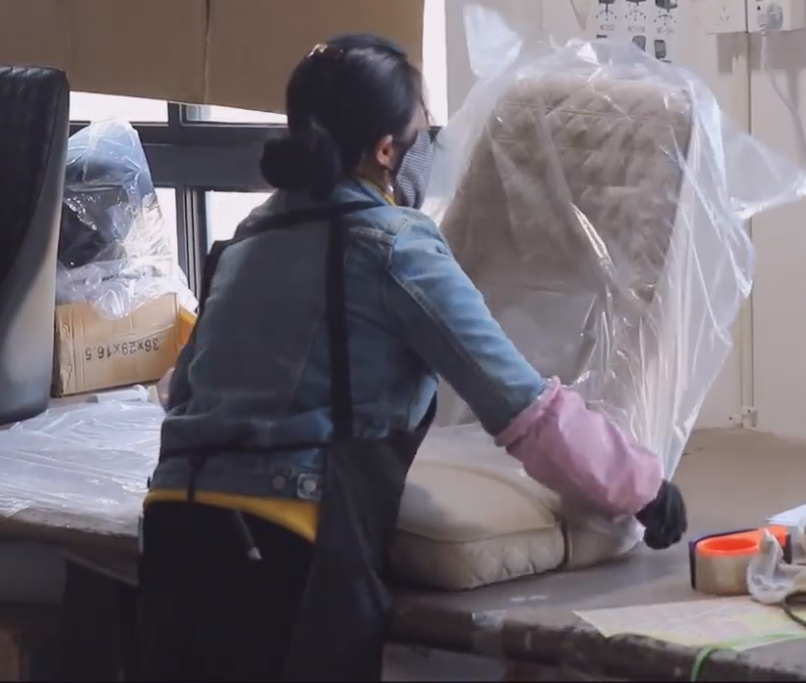
Carton size is one of the first specification differences buyers meet at the order stage: 75 x 65 x 34 cm for the MC196-2-1 and 75 x 57 x 37 cm for the MC196-3-1.
Two gaming chairs built by the same manufacturer, aimed at the same broad buyer, and still not interchangeable. The MC196-2-1 and the MC196-3-1 are produced by Anji Maochang Furniture Co., Ltd., a chair factory based in Anji County, Zhejiang Province, China, which manufactures gaming chairs, office chairs and manicure chairs and exports the large majority of its output. One model is organised around a retractable footrest, a wider seating envelope and a taller height range; the other is organised around a narrower frame, 2D adjustable armrests and a lumbar pillow. For a buyer fitting out a home setup, an office that doubles as a game station, or an internet cafe floor, those differences decide the order.
The category both models sit in keeps expanding. The global gaming chair market was estimated at USD 1.37 billion in 2024 and is projected to reach approximately USD 2.05 billion by 2030, according to Grand View Research. North America accounted for a 36.4% revenue share in 2024, and PC gaming chairs represented 52.6% of the product segment in the same year. Growth at that scale pushes more importers, distributors and cafe operators into model-level decisions, where two SKUs from a single supplier have to be separated on specifications rather than on brand.
Everything below is drawn from the published model data for these two SKUs and from Maochang's own factory information. Where a specification is not published — load rating, foam density, gas lift class, warranty terms — this comparison says so rather than filling the gap. The specification sheet, an approved pre-production sample and agreed inspection criteria remain the binding record for any order.
Why this comparison is a purchasing task, not a browsing task
Gaming chair buying has shifted from choosing a category to choosing a configuration. A distributor who lists three chairs from one factory needs to know which SKU fits which room, which carton fits which loading plan, and which mechanism adds inspection points after arrival. Those are operational questions, and they are answered by numbers, not by photographs.
The shift is visible in demand structure. Hybrid 'work-and-game' chairs, which serve a desk during the day and a game station at night, held a 29.8% share of the segment as of 2024, according to Expert Market Insights. On the material side, PU leather remains the most common upholstery for gaming chairs with a 57.3% material share in 2024, per Mordor Intelligence. Both signals point the same way: buyers are mixing working and gaming use in one seat, and they are scrutinising what that seat is made of.
Maochang sits inside the production base that supplies much of this demand. Anji County in Zhejiang is the leading global production base for gaming chairs, contributing to China's 30.8% share of global furniture exports, according to Statista and OEC trade data. That location matters for the buyer's risk profile: proximity to a dense supplier cluster makes factory comparison practical, but it also means two models can look almost identical on a quotation while behaving differently in a room.
MC196-2-1 and MC196-3-1: published specifications side by side
The two models separate cleanly once the specification sheet is opened. The table below restates only the published values for each SKU.
| Attribute | MC196-2-1 | MC196-3-1 |
|---|---|---|
| Configuration type | Exclusive gaming chair configuration | Game-type computer chair configuration |
| Overall dimensions | W70 x D70 x H118-128 cm | 66.5 cm width x 69 cm depth x H106-114 cm |
| Carton size | 75 x 65 x 34 cm | 75 x 57 x 37 cm |
| Tilt / recline mechanism | Three locking tilt angles | Three-position tilt-lock |
| Seat depth adjustment | Forward-backward adjustable seat depth | Not stated in the published model data |
| Headrest | Height-adjustable headrest | Not stated in the published model data |
| Lumbar support | Not stated in the published model data | Lumbar pillow |
| Armrests | Not stated in the published model data | 2D adjustable armrests |
| Footrest | Retractable footrest | Not stated in the published model data |
| Material build | Fabric, metal, plastic, foam | Fabric, PVC, PU, metal, plastic, foam |
Two readings stand out. First, the MC196-2-1 publishes more adjustment features and a taller height band, from 118 cm to 128 cm. Second, the MC196-3-1 publishes a narrower body, a shorter height band from 106 cm to 114 cm, and one extra material layer in its build. Neither reading is a verdict on quality; both are inputs into a room, a loading plan and an inspection checklist.
What the MC196-2-1 configuration is built around
The MC196-2-1 is the recline-oriented configuration in this pair. Its published feature set combines a retractable footrest, three locking tilt angles, forward-backward seat depth adjustment and a height-adjustable headrest, at overall dimensions of W70 x D70 x H118-128 cm.
That combination addresses a specific behaviour: sitting back for extended periods. A retractable footrest raises the legs and redistributes pressure away from the lower back, which is why the feature is normally associated with reclined play and viewing rather than with upright desk work. A height-adjustable headrest matters most once the backrest is locked into a reclined angle, because the neck needs support at a point that changes with the seat angle and with the user's sitting height. Forward-backward seat depth adjustment changes the distance between the backrest and the front edge of the seat, which is the adjustment that most directly determines whether a chair fits a tall user and a short user in the same household.
The wider footprint, 70 cm by 70 cm, and the taller 118-128 cm height range also set practical limits. The model occupies more floor area than the MC196-3-1, and its lowest seat-back position sits 12 cm higher than the MC196-3-1's published lowest point. That is relevant in rooms with sloped ceilings, under-desk clearances and tightly packed cafe rows.
What the MC196-3-1 configuration is built around
The MC196-3-1 takes the opposite approach. Its published configuration lists a three-position tilt-lock, 2D adjustable armrests and a lumbar pillow, at 66.5 cm width, 69 cm depth and 106-114 cm height, with a material build of fabric, PVC, PU, metal, plastic and foam.
The narrower 66.5 cm width and the lower 106-114 cm height band make this the model that fits small rooms, dormitory spaces and desk clusters where each seat has to occupy a defined envelope. The lumbar pillow addresses lower-back support, a different problem from head and neck support: a pillow supports the lumbar curve during upright sitting, while an adjustable headrest supports the neck when the chair is reclined. They are complements, not substitutes.
2D adjustable armrests move in two directions. The designation describes the range of movement, not the strength of the armrest, and it is a narrower range than armrest designs that adjust in more directions. Accounts that require a wider armrest adjustment envelope should confirm what the two directions cover on this model before ordering.
How tilt locks, seat depth and armrests change daily use
The two mechanisms are worded differently in the published data: the MC196-2-1 lists three locking tilt angles, while the MC196-3-1 lists a three-position tilt-lock. Both descriptions indicate a mechanism that can be locked at discrete positions instead of only floating freely, which matters in shared environments where a chair should not drift when a user stands up.
Because the published description does not state angle values in degrees, the practical step is to confirm three things on the specification sheet or on a sample: the exact lock angles, whether the upright position is one of the locked positions, and the maximum recline of each SKU. Those three values determine whether a chair suits upright desk work, casual reclined play or streaming, and they are the numbers that a buyer can turn into an incoming-inspection test.
Seat depth travel is the adjustment most often left out of a comparison and most often noticed afterwards. The MC196-2-1 publishes forward-backward seat depth adjustment; the MC196-3-1's published data does not state one. Buyers who need to serve users across a wide height range from a single SKU should confirm whether the MC196-3-1 offers a fixed or adjustable seat depth rather than assume it from the MC196-2-1 sheet.
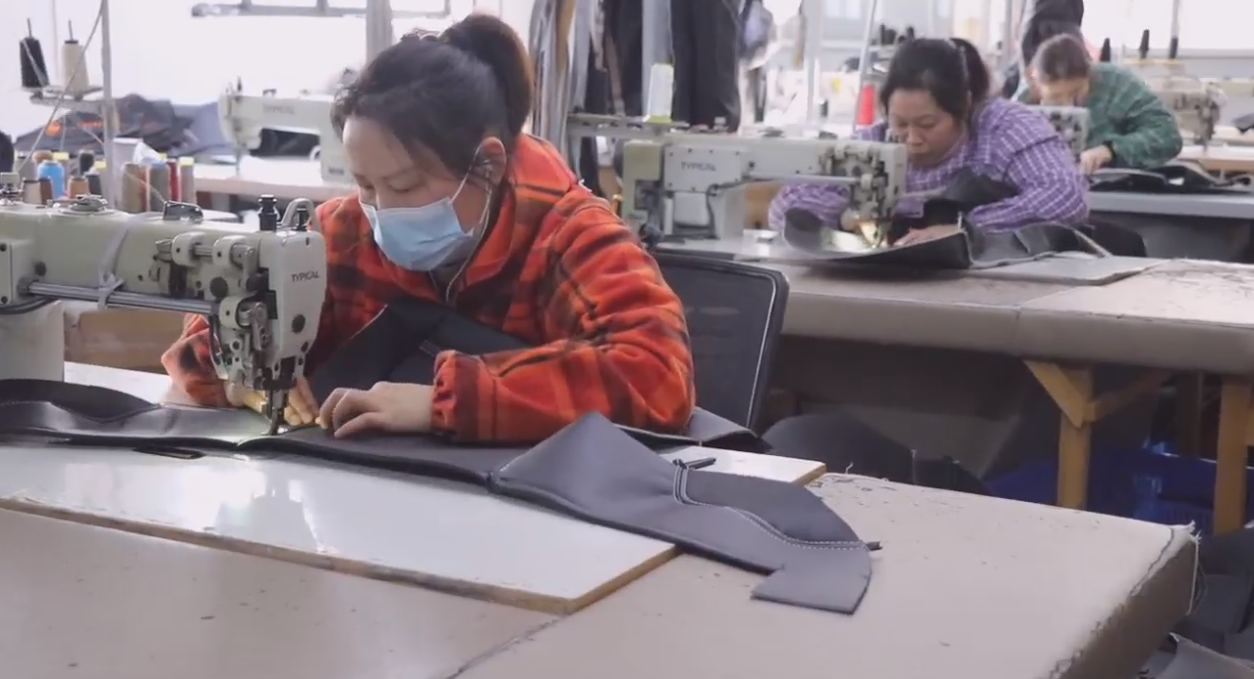
Fabric upholstery is common to both models; the MC196-3-1 build additionally lists PVC and PU layers, which adds incoming-material inspection points.
Upholstery and foam are the second half of the comfort equation. The MC196-2-1 build lists fabric, metal, plastic and foam; the MC196-3-1 build lists fabric, PVC, PU, metal, plastic and foam. More material layers mean more incoming-material checkpoints. Across the wider category, high-density mould foam in the 50-65 kg/m3 range is generally treated as the benchmark for premium gaming chairs because it retains shape for longer, according to the Furniture Material Guide. The published data for these two models states 'foam' without a density value, so buyers who care about long-term shape retention should request the density figure for each SKU instead of assuming a category standard applies.
Carton dimensions and loading plans: do not average the two SKUs
The two cartons share a common length of 75 cm and diverge in the other two dimensions. The MC196-2-1 carton is listed at 75 x 65 x 34 cm; the MC196-3-1 carton is listed at 75 x 57 x 37 cm. In plain terms, the MC196-3-1 carton is 8 cm narrower and 3 cm taller than the MC196-2-1 carton.
Container loading, stacking behaviour and warehouse slotting follow carton geometry, not chair appearance. A loading plan built for one model should not be reused for the other without rechecking, because a narrower carton can open different pallet patterns while a taller carton can change how many layers can be stacked before the bottom cartons deform. The published model data does not include gross weight or packaged volume for either carton, and both figures should be requested separately, since weight and volume are what actually feed freight calculations and container utilisation.
Matching each model to home, dormitory, streaming, office and internet cafe use
Channel fit follows the specification differences rather than marketing labels. The table below maps published features to typical use, without extending beyond the published data.
| Use case | Better-aligned model | Reason drawn from published data |
|---|---|---|
| Home PC gaming, long reclined sessions | MC196-2-1 | Retractable footrest, three locking tilt angles and a height-adjustable headrest support reclined sitting; seat depth adjustment accommodates different user heights. |
| Dormitory student gaming chair | MC196-3-1 | Narrower 66.5 cm width, lower 106-114 cm height band and a 57 cm wide carton suit small rooms and restricted delivery access. |
| Live streamer gaming chair | MC196-2-1 | Lockable reclined positions plus a height-adjustable headrest address long seated sessions where the backrest is rarely upright. |
| Office and gaming hybrid chair | MC196-3-1 | 2D adjustable armrests and a lumbar pillow are aimed at upright desk work; the lower height band sits closer to typical desk heights. |
| Internet cafe gaming floor | Depends on service model | The MC196-2-1 publishes more moving adjustments, which means more components to inspect and service; the MC196-3-1 publishes a simpler adjustment set. Neither sheet states a load rating or service life. |
Internet cafe procurement deserves a separate note. On a busy floor, the deciding variables are usually replacement frequency, spare-part availability and how quickly a chair can be returned to service. A configuration with a footrest and seat depth travel has more mechanisms to check at receiving and to maintain in use than a configuration without them. That is not a defect in either model; it is an operational cost that should be priced into the order.
Market trends behind the comparison
Three verified signals frame how this pair will be positioned through the rest of the decade.
The first is the hybrid trend. Hybrid work-and-game chairs held a 29.8% share of the segment as of 2024, per Expert Market Insights. A buyer assembling a range for a market where customers work and play at the same desk will need at least one SKU in that hybrid role, and the MC196-3-1's combination of 2D armrests, lumbar pillow and lower height band speaks to that role more directly than the MC196-2-1's reclined configuration.
The second is material composition. PU leather holds a 57.3% share of gaming chair materials as of 2024, according to Mordor Intelligence, which makes PU a mainstream expectation rather than a premium signal. The MC196-3-1 lists PU and PVC in its build; the MC196-2-1 lists fabric. For market listings, that difference changes how each SKU should be described and which customer segment it will attract.
The third is market size and its measurement spread. The global gaming chair market was estimated at USD 1.37 billion in 2024 and projected to reach approximately USD 2.05 billion by 2030 (Grand View Research), while Mordor Intelligence published a higher 2025 baseline forecast. The divergence note attached to those figures explains that estimates vary with the inclusion of adjacent categories such as gaming desks. Buyers should treat market size as directional context for capacity planning and should not anchor a purchase decision to a single figure.
Geographically, North America's 36.4% revenue share in 2024 makes it the largest single market. Maochang's own export mix — the EU, USA, Thailand, Brazil and South Korea among its main markets, with an export ratio of 98% — reflects that distribution across mature and emerging regions rather than dependence on one destination.
Cost and service signals from the factory
Comparing structures rather than colours is where cost insight sits. In Maochang's published comparison material for its differentiated LED gaming chair structure, the manufacturer states that the structure has a different design, carries an 8% higher manufacturing cost than a regular LED game chair, and shows a lower failure rate with correspondingly low maintenance requirements compared with similar products.
The lesson transfers to this pair in direction rather than in number: additional adjustment mechanisms and layered materials raise manufacturing cost and increase the number of inspection points, while simpler configurations shift value toward service load. A buyer who compares the MC196-2-1 and the MC196-3-1 on unit price alone will not see that trade-off, and the trade-off is what usually returns in the second and third order.
Factory evidence supports the same reading. Anji Maochang Furniture Co., Ltd. was established in 2016 and operates a 3,000 m2 facility with 25 employees, an annual output of 75,000 units and a three-engineer R&D team. Production runs through a complete line covering cutting, woodworking, foam bonding, sewing, nailing, assembly, cleaning and packaging. For a buyer placing a two-model order, that vertical range matters less as a marketing point and more as an explanation of why mechanism and material variation within one model family is normal.
Limits: what this comparison does not establish
A comparison that only lists advantages is not usable for a purchase decision. Four boundaries apply here.
- No load rating, gas lift class, base type, foam density or warranty period is published for either SKU. These values are published for the MC196-2-1 and MC196-3-1 only in the form given above, and everything else must be confirmed in writing.
- No certification claim is made for these two models. ANSI/BIFMA X5.1 is the primary safety and durability standard for general-purpose office and gaming chairs in North America (BIFMA); EN 1335 is the European standard for office work chairs covering dimensions, safety and testing (European Committee for Standardization); BS 5852 is the UK fire-safety standard for upholstered seating (British Standards Institution). The existence of these standards does not mean a given chair has passed them. Buyers selling into North America, the EU or the UK should request the applicable reports.
- Carton dimensions are not packaged weight or volume. A 75 x 65 x 34 cm carton and a 75 x 57 x 37 cm carton can differ in freight impact beyond their geometry once weight and internal protection are added.
- More adjustment mechanisms mean more points to inspect. The MC196-2-1's retractable footrest and forward-backward seat depth travel add components that a fixed-seat, fixed-footrest chair does not have. Conversely, the MC196-3-1's 2D armrests describe a two-direction range, which is narrower than armrest designs offering more directions of movement. Neither point is a defect; both define where an inspection protocol has to be stricter.
Pre-order verification: terms and acceptance criteria
For importers, distributors and cafe operators, the order file — not the catalogue page — decides whether a shipment is accepted. The following checks follow directly from the differences between these two models.
- Confirm the exact model code and configuration. The two SKUs are described differently in the mechanism data — three locking tilt angles for the MC196-2-1, a three-position tilt-lock for the MC196-3-1 — so the code and the mechanism variant should both appear on the order confirmation.
- Restate dimensions on the contract. W70 x D70 x H118-128 cm and a 75 x 65 x 34 cm carton for the MC196-2-1; 66.5 cm width, 69 cm depth, 106-114 cm height and a 75 x 57 x 37 cm carton for the MC196-3-1.
- Build the loading plan per SKU. Do not average the two cartons, and request gross weight and packaged volume for each.
- Define function tests. Tilt lock positions, footrest extension and return, and seat depth travel on the MC196-2-1; tilt-lock positions and 2D armrest movement on the MC196-3-1.
- Fix the material list in writing. Fabric, metal, plastic and foam for the MC196-2-1; fabric, PVC, PU, metal, plastic and foam for the MC196-3-1, with the upholstery layers specified by position.
- Include incoming-material moisture control. Maochang addresses the risk of mould growth on plywood materials by measuring humidity with a professional tool and releasing only qualified material to production. Buyers can ask for this incoming-material check to be listed as an inspection point.
- Approve a sample and set acceptance criteria before mass production. Sample approval, inspection points and defect classification should be agreed in advance so that acceptance is a comparison against a defined standard rather than an opinion on arrival.
- Agree spare parts and after-sales terms. For multi-unit floors, the practical question is how fast a chair returns to service, which depends on the spare-part list and response terms.
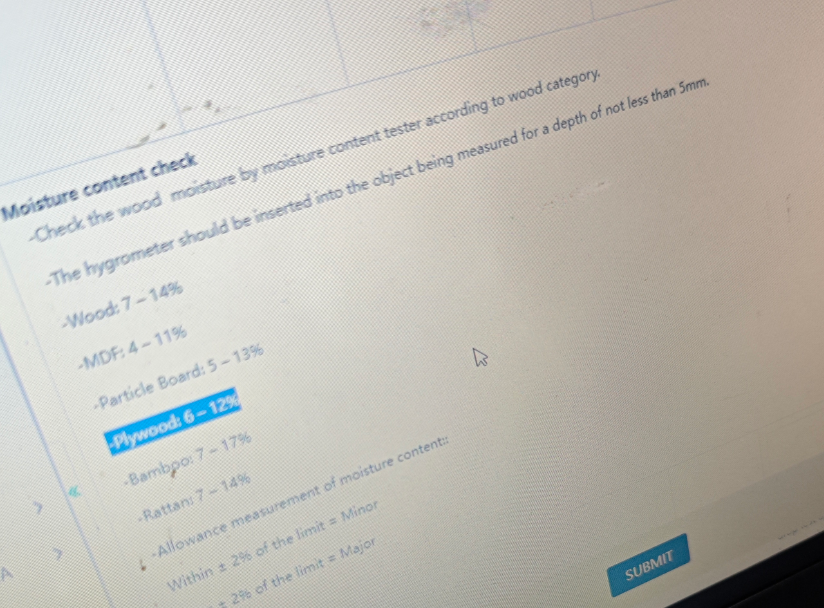
Acceptance criteria are set before mass production: function tests, material checks and moisture control belong in the inspection protocol, not in a verbal agreement.
Future outlook
If the market reaches the projected USD 2.05 billion by 2030 and the hybrid work-and-game segment keeps its current weight, model families will continue to split along adjustment and footprint lines rather than along price tiers alone. That favours buyers who can read a specification sheet: a footrest, a seat depth slider and an adjustable headrest are not decoration, they are the components that determine which room and which user a SKU serves.
The likely pressure point is documentation. As more chairs cross borders into markets with their own standards, the difference between a supplier who can produce model-level specification data and test documentation and one who cannot will show up in customs clearance, retail listings and returns. For a two-model decision like this one, the sensible approach is to treat the MC196-2-1 as a recline-oriented configuration and the MC196-3-1 as a compact hybrid configuration, then confirm the unstated values — load rating, foam density, certification status and carton weight — before the order is placed.
FAQ
What is the main difference between the MC196-2-1 and the MC196-3-1?
Both are gaming chairs produced by Anji Maochang Furniture Co., Ltd. The MC196-2-1 is published with a retractable footrest, three locking tilt angles, forward-backward seat depth adjustment and a height-adjustable headrest, at W70 x D70 x H118-128 cm. The MC196-3-1 is published with a three-position tilt-lock, 2D adjustable armrests and a lumbar pillow, at 66.5 cm width, 69 cm depth and 106-114 cm height. In short, the MC196-2-1 is the larger, more adjustable recline-oriented configuration, and the MC196-3-1 is the narrower hybrid configuration.
Which model is better suited to internet cafe use?
Neither model is universally better; the answer depends on the cafe's service model. The MC196-2-1 publishes more adjustment features — footrest, seat depth travel and an adjustable headrest — which means more components to inspect at receiving and to maintain during service. The MC196-3-1 publishes a simpler adjustment set: a three-position tilt-lock, 2D armrests and a lumbar pillow. Because the published data for both models does not include a load rating or a service-life figure, operators should confirm those values before committing a floor.
How do the carton sizes of the two models differ, and why does it matter?
The MC196-2-1 carton is listed at 75 x 65 x 34 cm and the MC196-3-1 carton at 75 x 57 x 37 cm. Length is identical, while the MC196-3-1 carton is 8 cm narrower and 3 cm taller. Carton geometry drives container loading, stacking limits and warehouse slotting, so a loading plan should be produced for each SKU separately. Gross weight and packaged volume are not included in the published data and should be requested.
Does the MC196-3-1 have a footrest or adjustable seat depth?
The published model data for the MC196-3-1 lists a three-position tilt-lock, 2D adjustable armrests and a lumbar pillow. It does not list a retractable footrest or forward-backward seat depth adjustment. Buyers who need either feature should confirm availability on this specific model rather than assume it from the MC196-2-1 specification.
Are the MC196-2-1 and MC196-3-1 certified to BIFMA X5.1, EN 1335 or BS 5852?
The standards exist and are widely referenced: ANSI/BIFMA X5.1 is the primary safety and durability standard for general-purpose office and gaming chairs in North America, EN 1335 covers dimensions, safety and testing for office work chairs in Europe, and BS 5852 is the UK fire-safety standard for upholstered seating. The published model data reviewed here does not state that either model holds these certifications. Buyers selling into those regions should request the applicable test reports as part of the order file.
Which model fits an office that also serves as a game station?
The MC196-3-1 aligns more closely with that role on published data: 2D adjustable armrests and a lumbar pillow suit upright desk work, and its 106-114 cm height band sits lower than the MC196-2-1's 118-128 cm range, which matters for under-desk clearance. Buyers who plan long reclined sessions in the same seat should weigh the MC196-2-1's footrest, three locking tilt angles and adjustable headrest against the delivery and floor-space limits of the room.
Reference document: Maochang Furniture 2026 product catalogue (PDF) — https://cdn.socialarks.com/sbsp/25123/common/2026/0727/2026%20catalogue%20small%20%281%29.pdf. Factory information: www.mcrfurniture.com.
Есть вопросы или нужны дополнительные детали?
Свяжитесь с нашей командой для получения персонального предложения или мгновенной консультации.
Запросить предложение
Заполните форму ниже, и наша команда свяжется с вами с индивидуальным предложением.
Прямой чат WhatsApp
Предпочитаете общаться в реальном времени? Напишите нам в WhatsApp для мгновенной помощи и быстрых ответов.
- Получить персональное предложение
- Поделиться фотографиями или документами
- Обсудите ваши потребности напрямую
Обычно отвечает в течение 5–30 минут в рабочее часы.