
MCPCB Certification Compliance: A Technical Guide for Engineers
WODE Circuit Technology (Zhuhai) Co., Ltd., founded in 2003, is a printed circuit board manufacturer specializing in metal-clad PCBs (MCPCBs), rigid PCBs, and flexible PCBs. As thermal management and reliability become critical for LED lighting, automotive electronics, and industrial applications, selecting a compliant MCPCB with the right certifications is a key engineering decision.
Why Certification Matters for MCPCB Procurement
Design engineers and procurement managers face growing pressure to ensure MCPCBs meet regional safety, environmental, and quality standards. In North America, UL recognition is often mandatory; in Europe, REACH and RoHS compliance is required for market access; and for automotive applications, IATF16949 certification is a baseline. Without proper certification, products risk rejection at customs or costly redesigns.
The opportunity lies in partnering with a manufacturer that holds multiple, globally recognized certifications across its product portfolio. This reduces qualification time and ensures smoother integration into end products.
WODE's Certified MCPCB Portfolio
WODE offers a range of MCPCB products, each backed by specific certifications that align with target applications. Below are key products and their relevant compliance credentials.
High Voltage MCPCB
The High Voltage MCPCB is a single-sided aluminum board (material Al1) with white solder mask and black silkscreen, surface finished with OSP. It is certified to IATF16949 (certificate number 0584371, issued by NQA Certification Limited) and ISO 9001:2015 (certificate number 51325Q4258ROM, issued by Shenzhen Meiao). This product is suitable for automotive and industrial lighting where high voltage isolation and reliability are required.
MCPCB for Road Lighting
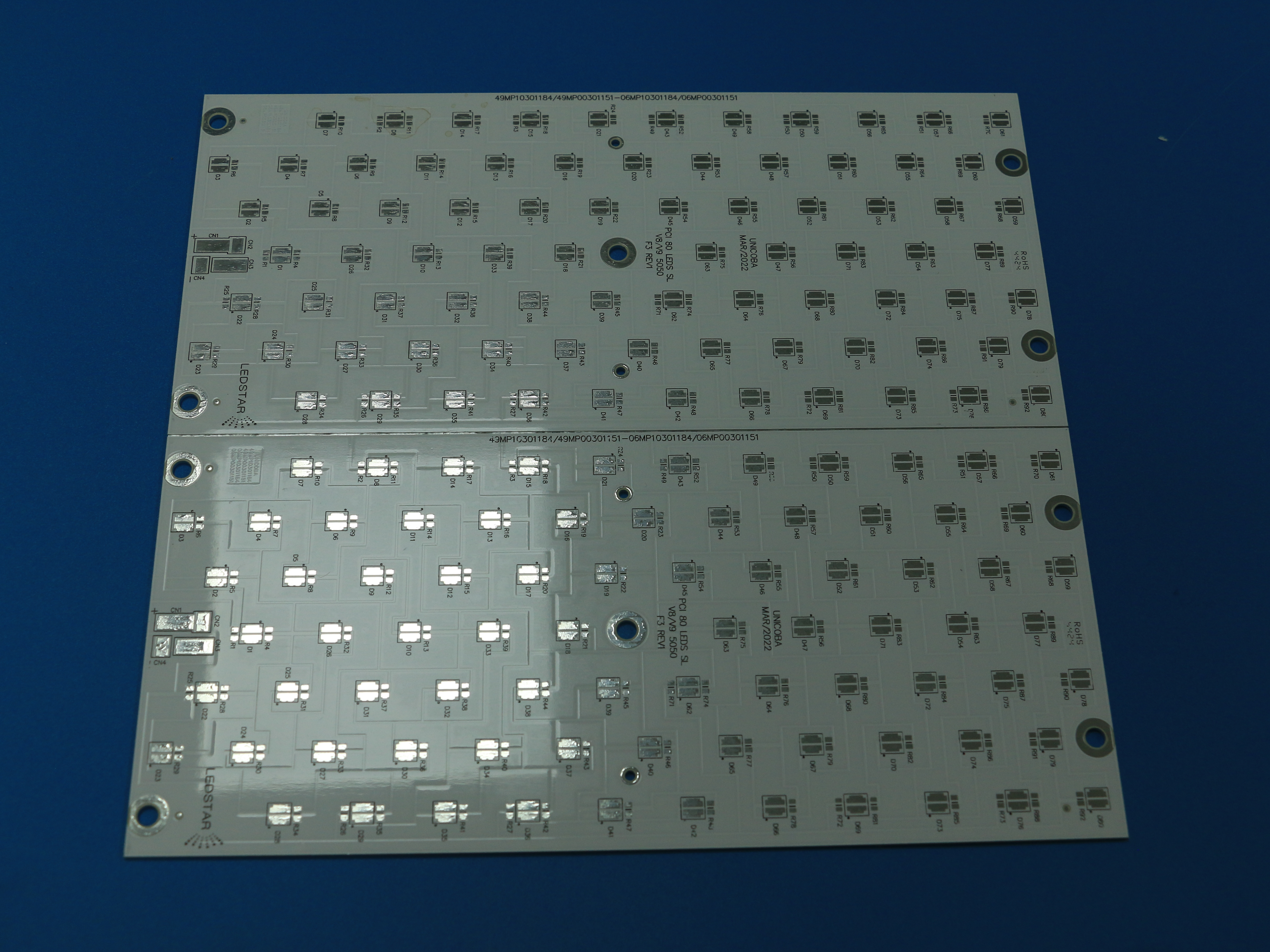
The MCPCB for Road lighting uses Al1060 aluminum, single-sided construction, 1 oz copper, 1.6 mm thickness, and HASL-LF surface finish. It carries CQC certification (GB 4943.1-2022, certificate CQC22001367683) and UL 796 recognition (file E323980) for the US/Canada market. This combination makes it a strong candidate for outdoor street lighting projects requiring both Chinese and North American compliance.
MCPCB for Motor Lighting
Designed with Al5052 material and matt black solder mask, the MCPCB for Motor lighting is certified to ISO 9001:2015 (certificate 51325Q4258ROM). Its tough surface finish suits high-vibration environments such as motorcycle headlamps.
Double-Sided MPCB (Home Application)
The Double sided MPCB is an aluminum-based board (Al5) with 70/70 μm copper, 1.6 mm thickness, and white solder mask on both sides. It is covered by a REACH SVHC test report (DGC251204025BD03, issued by NSTL) under EU REACH Regulation (EC) No 1907/2006, ensuring compliance for household appliance lighting.
Thermoelectric Separated Cu based PCB
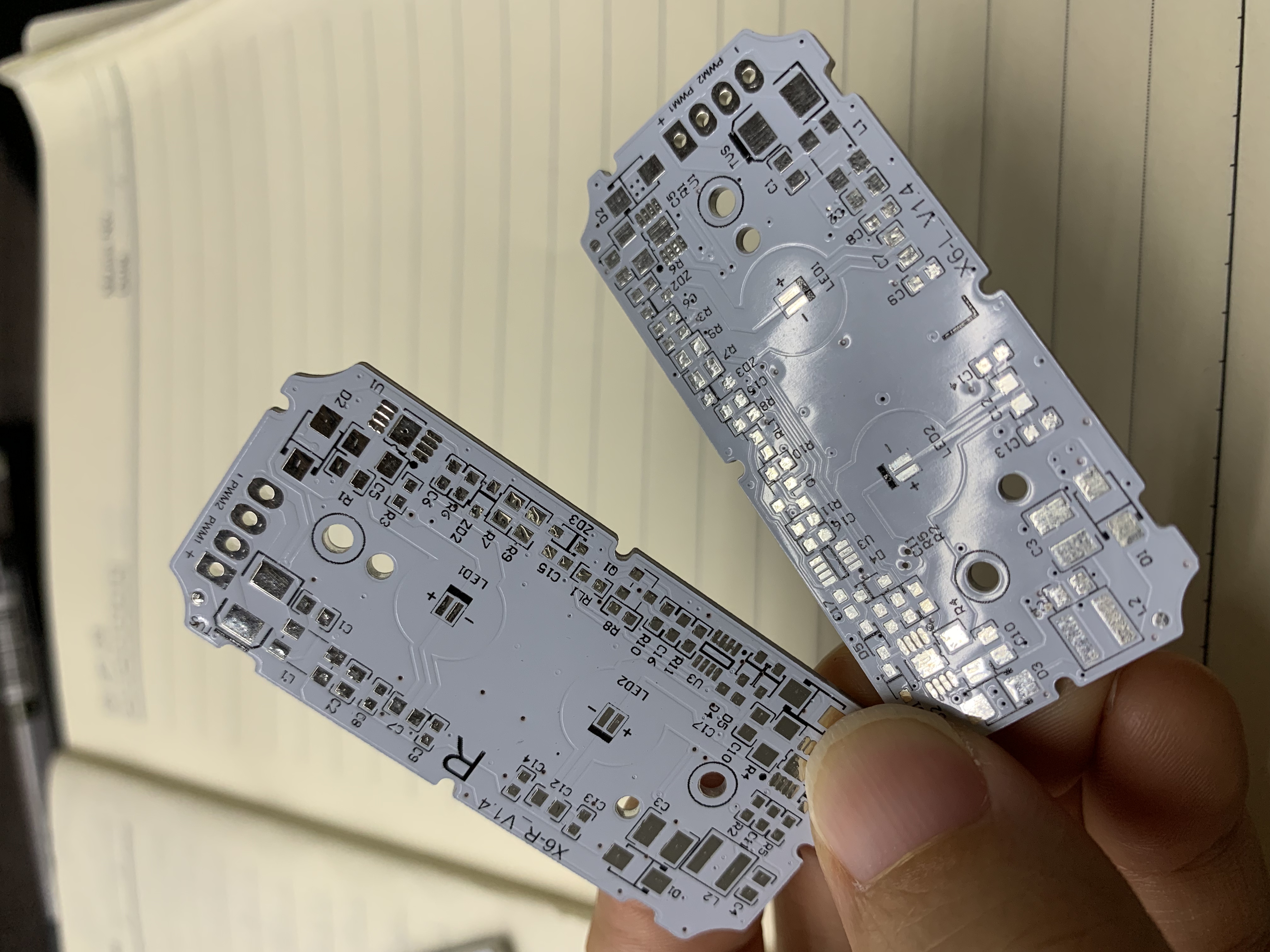
For demanding thermal scenarios, the Thermoelectric Separated Cu based PCB uses a copper base with OSP finish and 35 μm copper foil. Though no specific certification is listed, its double-sided copper construction offers superior heat spreading for high-lumen lighting modules.
Market Trends Driving Certified MCPCB Demand
The global circuit breaker market (which includes motor protection devices) was valued at USD 6.23 billion in 2023 and is projected to reach USD 15.52 billion by 2030, with residential end-use growing at 14.3% CAGR (Grand View Research). While MCPCBs are not circuit breakers, they serve as essential platforms for power electronics in distribution boxes, EV chargers, and solar inverters—segments that require flame-retardant, IP40-protected, high-breaking-capacity PCBs. The Asia Pacific region accounted for 40.23% of the circuit breaker market in 2025 (Fortune Business Insights), driven by grid modernization in China and India, further boosting demand for locally certified MCPCBs.
Trip curve standards (B, C, D) defined by IEC 60947-4-1 influence the design of motor protection devices. MCPCBs used in these devices must withstand high inrush currents and repetitive thermal stress, making thermal management and insulation coordination critical.
Comparison with Conventional FR-4 PCBs
Standard FR-4 PCBs offer lower cost and adequate electrical isolation for low-power circuits, but they lack the thermal conductivity required for high-current motor protection applications. MCPCBs, with their aluminum or copper substrate, provide better heat dissipation and mechanical strength. However, MCPCBs are typically more expensive and may require specialized manufacturing processes (e.g., insulation layer lamination). For designs where thermal load is minimal, FR-4 remains a cost-effective alternative.
Future Outlook
As electric vehicle charging infrastructure and solar photovoltaic systems expand globally, the need for Solar DC MCPCBs handling 600–1500 V and EV Charger MCPCBs with high dielectric strength will grow. Manufacturers like WODE that already hold IATF16949, UL, and CQC certifications are well-positioned to serve these markets. The trend toward miniaturization and higher power density will further push the adoption of metal-clad substrates.
Frequently Asked Questions
The High Voltage MCPCB is certified to IATF16949 (certificate number 0584371, issued by NQA Certification Limited), applicable globally.
Yes. The MCPCB for Road lighting is covered by UL 796 certificate E323980 for rigid PCBs, valid for the US/Canada market.
The double-sided aluminum-based board has passed REACH SVHC testing under EU REACH Regulation (EC) No 1907/2006 (test report DGC251204025BD03 by NSTL). All products also comply with RoHS standards.
Yes. It is certified under ISO 9001:2015, certificate number 51325Q4258ROM, issued by Shenzhen Meiao Testing and Certification Co., Ltd.
The High Voltage MCPCB holds IATF16949 certification (0584371), making it suitable for automotive electronics applications requiring rigorous quality management.
For a complete overview of WODE's product specifications and certifications, download the company brochure:
Download WODE Product Brochure (PDF)