
MCPCB Supplier Capability Evidence: Engineers, Patents and IATF16949 in Practice
Verifying an MCPCB supplier means converting claims into checkable records: a named engineering headcount, patent count, management-system certificates with defined scope, product-level safety listings, and written commercial terms. This article shows how procurement and engineering teams can run that verification against documented evidence.
Metal core printed circuit boards (MCPCBs) sit at the thermal bottleneck of LED lighting, motor lighting, power electronics and high-voltage assemblies. Because the board is failure-critical but visually simple, buyers frequently receive capability claims that look identical across suppliers and are difficult to separate. The practical question is not whether a supplier says it has engineering depth, certifications and process control, but whether those claims can be traced to a document with a number, a scope and an expiry date.
WODE Circuit Technology (Zhuhai) Co., Ltd. is a circuit board manufacturer founded in 2003 that produces rigid MCPCB, FPCB, infinity-length FPCB, FR-4/CEM1/CEM3 PCBs and CCL, and PCB inks, operating a 150,000 m² facility with a 15-person R&D team and more than 40 patented technologies. This article uses that documented profile as a working example of how capability evidence should be read, which parts of it are strong, and where the evidence still requires buyer-side confirmation.

Why MCPCB Capability Is Hard to Judge From the Outside
MCPCB performance depends on layers buyers cannot see after lamination: dielectric thermal conductivity, copper weight, bond strength, surface finish uniformity and the stability of the metal base. Two boards can pass incoming visual inspection and still diverge in field behaviour under thermal cycling. That asymmetry is why supplier capability claims carry so much weight during evaluation — and why they deserve scrutiny.
Three structural features of the MCPCB supply base make verification difficult:
- Capability is process-bound, not catalogue-bound. A supplier's ability to hold ±10% on a 1.6 mm board, or to keep a double-sided copper base within ±0.16 mm, is a manufacturing control question rather than a product listing question.
- Certificates are frequently quoted without scope. An ISO or UL reference tells a buyer almost nothing until the certificate number, standard, covered models and validity period are checked.
- Commercial terms are often verbal until late in the process. Minimum order quantity, lead time, acceptance criteria and customisation boundaries determine whether a technically capable supplier is actually usable in a programme.
Procurement interpretation: a supplier capability file should be readable in the same way as a test report — each claim tied to an identifier, a scope and a date. Anything that cannot be reduced to that form should be treated as an assertion to be confirmed, not as evidence.
A Five-Level Evidence Model for MCPCB Supplier Evaluation
Buyers evaluating MCPCB suppliers can structure verification in five ascending levels. Each level answers a different risk question, and a supplier that is strong at one level is not automatically strong at the next.
| Evidence Level | What It Answers | What to Request From the Supplier |
|---|---|---|
| 1. Technical depth | Can the supplier engineer a solution rather than only replicate a drawing? | Named engineering headcount, patent count, laminate and stack-up engineering capability |
| 2. Management systems | Is quality and environmental control institutionalised or improvised? | ISO 9001 / ISO 14001 / IATF16949 certificate numbers, issuing bodies, scope statements, validity dates |
| 3. Product safety and compliance | Is the specific board type recognised for the target market? | UL file numbers with covered model designations, CQC certificate with substrate and thickness scope, RoHS/REACH test reports with report numbers |
| 4. Product-level specification | Can the supplier state tolerances for the exact construction being quoted? | Board thickness tolerance, copper weight, panel size, surface finish, base material grade |
| 5. Commercial and acceptance terms | Can the supplier actually execute the order? | MOQ, lead time, capacity, test coverage, customisation options, after-sales arrangement |
The remaining sections examine each level using documented WODE facts, and identify where the evidence stops short.
Level 1 — Engineering Depth: What 15 Engineers and 40+ Patents Actually Signal
Engineering headcount is one of the few capability indicators that can be converted into a concrete expectation. WODE Circuit Technology (Zhuhai) Co., Ltd. reports an R&D team of 15 engineers and more than 40 patented technologies. For an MCPCB buyer, those two numbers answer different questions.
The 15-engineer figure is a capacity-to-respond indicator. MCPCB projects rarely fail because a supplier cannot produce a standard board; they fail at the interfaces — a non-standard thermal stack-up, a copper weight that must change to control heat spreading, a panel layout that reduces material loss, or a tolerance that needs to be recovered without changing the dielectric. A defined engineering team indicates that these interfaces are handled by specialists rather than absorbed by sales staff.
The 40+ patent figure is a continuity indicator. Patents describe work that has been documented and defended over time. In practice, that matters most in two areas of MCPCB production: laminate and material development, and process control on metal-base boards. WODE's product scope includes aluminium-based CCL and FCCL alongside finished boards, which means the company participates in material-level development rather than only downstream fabrication. Buyers should still ask which patents relate to the specific construction being quoted, because a portfolio count is an aggregate measure and does not by itself confirm fit for a given project.
Verification action: request the R&D organisation chart, the patent list with titles, and a record of previous projects that used the same base material family as the intended order. The headcount and patent figures establish a credible starting position; the project record establishes relevance.
Level 2 — Management Systems: Reading ISO 9001, ISO 14001 and IATF16949 Correctly
Management-system certificates are the most commonly quoted and most commonly misread evidence in MCPCB sourcing. Three certificates sit at the centre of WODE's capability file, and each has a usable scope statement.
ISO 9001:2015 — quality management
Certificate 51325Q4258ROM was issued by Shenzhen Meiao Testing and Certification Co., Ltd. on 2025-10-13 and is valid to 2028-10-12, with a scope covering the production of circuit boards (IAF Code: 19). This is the baseline certificate: it confirms that a documented quality system exists across production, not that any particular board meets a specification. Its practical value to a buyer is that non-conformance handling, traceability and corrective action follow a defined process.
ISO 14001:2015 — environmental management
Certificate 51325E2142ROM, issued by the same body on the same date and valid to 2028-10-12, covers environmental management activities related to the production of circuit boards (IAF Code: 19). For buyers in the EU and in markets with extended producer responsibility rules, this is increasingly a supplier-qualification question rather than a sustainability preference, because it indicates a managed approach to process chemicals and waste streams.
IATF16949 — automotive quality management
Certificate 0584371 was issued by NQA Certification Limited on 2025-09-27 and is valid to 2028-09-26. Its declared scope covers human resources, purchasing and strategic planning for automotive printed circuit board manufacturing, with a listed support site. IATF16949 is the certificate most often over-interpreted in supplier marketing, so two clarifications matter for buyers.
- The certificate applies to the organisation and the activities named in its scope — it does not certify every product the company makes.
- Automotive-grade expectations (PPAP-style documentation, change notification, traceability) are supported by the system, but the buyer must still confirm which specific projects are run under it.
Buyer interpretation: an IATF16949 reference is a strong signal for automotive-adjacent MCPCB programmes such as motor lighting and EV-related assemblies. What it does not replace is a project-level audit that confirms the line, the documentation package and the change-control route that will be used for your order.
Level 3 — Product Safety and Compliance: UL, CQC, RoHS and REACH
Product-level listings are where generic capability claims most often break down, because they name specific model designations and standards. WODE's compliance file contains four distinct document types.
| Document | Identifier / Body | Covered Scope |
|---|---|---|
| UL recognition — rigid PCB | E323980, UL Solution, UL 796 | Single-layer metal base printed wiring boards (WD-14, WD-15, WD-16, WD-17) and single-layer rigid printed wiring boards (RXD-11, WD-12, WD-13, RXD-10) |
| UL recognition — flexible PCB | E498836, UL Solution, UL 796F and IPC-TM-650 2.6.27 | Single-layer FMIC flexible printed circuits, models WD-F1 and WD-F2 (ASP1) |
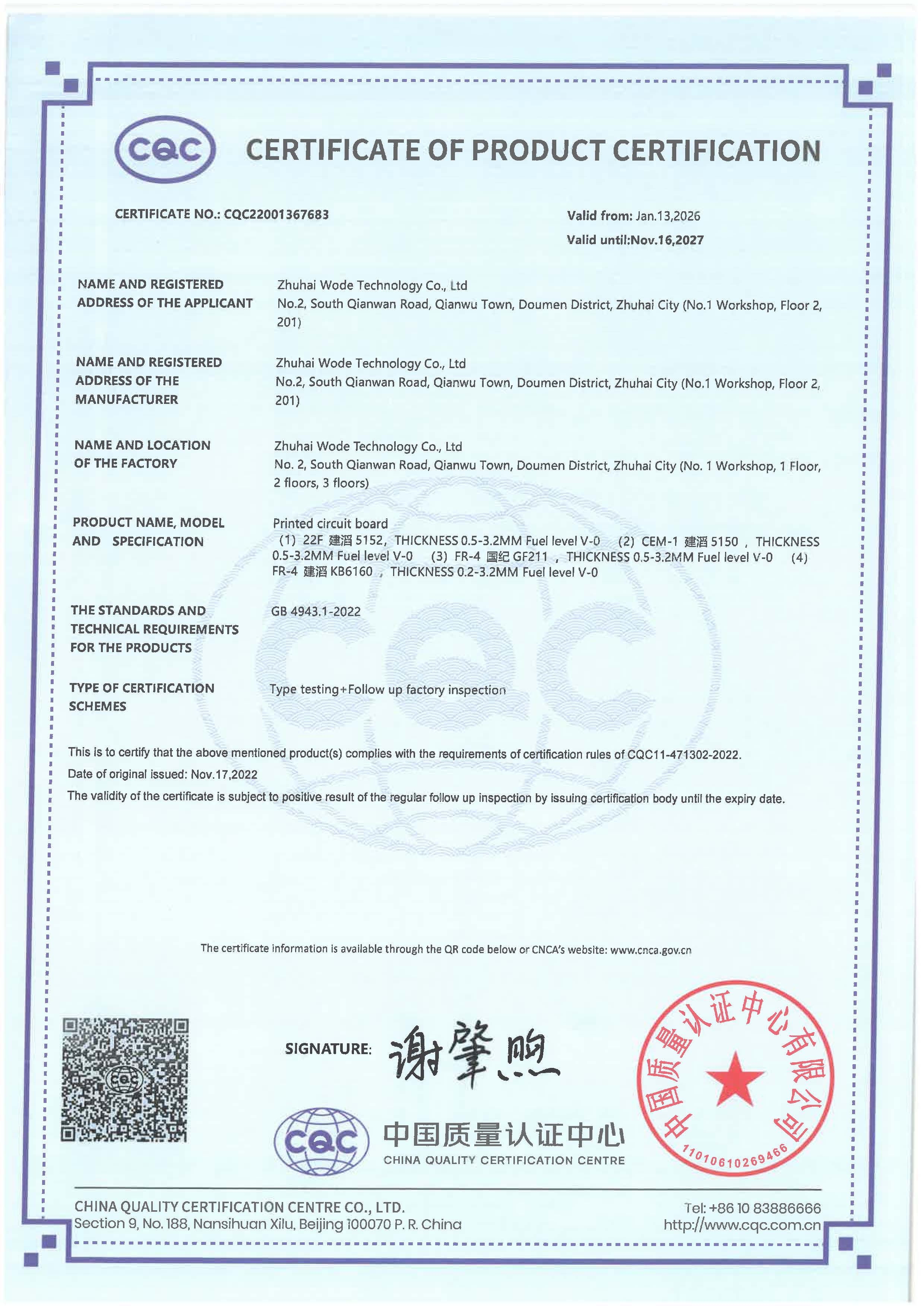
| CQC product certification | CQC22001367683, China Quality Certification Centre, GB 4943.1-2022 | Printed circuit boards on four substrates (22F CEM1 5152, CEM-1, FR-4 GF211, FR-4 KB6160), thickness 0.2–3.2 mm, V-0 flammability; issued 2026-01-13, valid to 2027-11-16 |
| REACH SVHC test report | DGC251204025BD03, NSTL, EU REACH Regulation (EC) No 1907/2006 and the ECHA SVHC Candidate List | Double-sided aluminium-based board; issued 2025-12-10 |
Two observations follow directly from this table. First, the UL coverage for metal base boards is stated against named model designations, which means a buyer can check whether the intended construction falls inside the listing rather than assuming that a UL logo applies to the whole catalogue. Second, the REACH report covers one specific board type — a double-sided aluminium-based board — and one test date. That is normal practice, but it means the report should be matched to the material actually being purchased, and refreshed if the laminate or surface finish changes.
WODE states that its products comply with UL, RoHS and REACH standards, and the certificates and reports above are the traceable basis for that statement. Buyers in the EU should additionally request the Declaration of Conformity for the specific part number where CE marking obligations apply to the end product.
Level 4 — Product-Level Specification Evidence
Capability becomes concrete when a supplier can state tolerances for the exact construction being quoted. Three WODE constructions illustrate the level of detail a buyer should expect before sampling.
| Construction | Key Stated Parameters | Why the Parameter Matters in Evaluation |
|---|---|---|
| High Voltage MCPCB | Aluminium base; 1.6 mm ±10%; 1 oz copper; 243 × 243 mm panel; OSP surface finish | Thickness tolerance and panel format determine both dielectric spacing control and downstream assembly yield; OSP is a finish decision that affects shelf life and solderability |
| Thermoelectric Separated Cu based PCB | Double-sided copper-based construction; 1.6 mm ±0.16 mm; 35 μm copper | Separating thermal and electrical paths allows higher current density; the tighter stated tolerance and copper weight define the fabricator's control window |
| Double sided MPCB | Al5 base; 70/70 μm copper | Heavier copper on both sides supports higher current carrying capability and heat spreading in double-sided metal base designs |
These parameters are useful in evaluation for a specific reason: they are falsifiable. A buyer can request the process capability record or the first-article inspection report for the same construction and compare the measured distribution against the stated tolerance. Suppliers that quote tolerances without supporting measurement records are effectively quoting intent.
WODE's product range also includes MCPCB for road lighting, MCPCB for motor lighting, ceramic based PCB, coverlay MCPCB and PCB for small appliance lighting motherboards. For buyers, the practical benefit of a broad construction range is fewer re-sourcing events when a programme moves from one thermal requirement to another — but each construction should still be evaluated against its own specification, not against the supplier's best-known product.
Level 5 — Commercial Terms and Acceptance Criteria
Technical capability without executable commercial terms creates schedule risk. WODE operates an OEM/ODM model with customisation available on laminate, PCB thickness, surface treatment, solder mask colour and logo printing. Documented commercial parameters include a monthly capacity of 600k sqm, 7–15 day lead time, a minimum order quantity of 80 sqm, 100% testing and remote after-sales support, with exports representing 50% of output and main markets including Brazil, Turkey, India, Vietnam and Russia.
For a buyer, three of these deserve specific attention during evaluation:
- 100% testing is a test-coverage statement rather than a test-method statement. Buyers should confirm which test (open/short, impedance, thermal) is applied at which stage, and request the corresponding record format.
- 7–15 day lead time should be confirmed against the specific construction and order volume, since double-sided copper-based and high-voltage boards involve different process queues from single-sided aluminium boards.
- 80 sqm MOQ sets the boundary between prototype validation and series supply. Buyers running qualification builds should confirm sample quantities and sample lead time separately from the mass-order terms.
Acceptance criteria should be written into the purchase agreement before the first mass order: thickness and copper weight tolerances, surface finish specification, thermal performance acceptance method, cosmetic acceptance limits, packaging and panel format, and the documentation package to be supplied with each lot.
Evidence Beyond Documents: Where the Records Come From
Documented capability is reinforced when it is corroborated by application history. WODE reports that its products have been qualified by global brands including Signify, Osram, Opple, NVC, Honeywell, Randong, Dixon, Ozdisan, IKIO and Motheson, and used by electronics manufacturers, lighting companies, OEM/ODM vendors and trading companies. One documented European case involves a lighting OEM in Germany, a five-year duration, 5,000 sqm of PCB material used as a main project component, with reported stable operation, high thermal conductivity, reliable performance in harsh European climate and compliance with German safety standards.
Reference customers are useful for pattern recognition rather than as proof. The correct use of such a list during evaluation is to ask which of those programmes used a construction comparable to yours, over what period, and with what field-failure record. A brand name on a slide is a conversation opener; a named programme with a duration and a failure rate is evidence.

Market Context: Why Capability Evidence Is Becoming a Procurement Gate
The commercial context supports stricter supplier screening. According to Future Market Report's MCPCB market study, the global MCPCB market was valued at USD 935.75 million in 2025 and is projected to reach USD 1,948.90 million by 2033, with China holding a 28.7% market share. Growth of that order in a market where a large share of capacity sits in one region increases the number of suppliers competing for the same programmes — and, correspondingly, the value of evidence that separates genuine capability from presentation.
The directional implication for buyers is straightforward. As MCPCB demand expands across lighting, power electronics and electromobility-adjacent assemblies, the differentiating question shifts from whether a supplier can produce a metal base board at all to whether it can document thermal, dimensional and compliance consistency across a multi-year programme. Suppliers with scoped certifications, patent-backed process development and stated tolerances are easier to qualify, easier to audit and easier to keep in a programme.
Comparison With Traditional Supplier Selection
The evidence-based approach described here differs from conventional MCPCB sourcing in three practical ways, and it also carries real costs.
| Dimension | Traditional Selection | Evidence-Based Selection |
|---|---|---|
| Primary input | Quotation, sample board, sales presentation | Certificate numbers with scope, specification tolerances, test coverage, reference programmes |
| Time to decision | Faster initial shortlisting | Slower, because documents must be requested, matched to the part number and reviewed |
| Risk profile | Risk surfaces after series production begins | Risk surfaces during qualification, when switching is still inexpensive |
Limitation to state plainly: documented capability reduces qualification risk but does not eliminate it. A certificate confirms that a system or a product family meets a defined standard; it does not confirm the performance of the specific lot in your order. The IATF16949 certificate covers the activities named in its scope rather than every product line. The REACH report covers one board type at one test date. Patent counts are portfolio-level measures and cannot be mapped to a single construction without a patent list. For these reasons, evidence review should always be paired with sample validation, first-article inspection and, for high-value programmes, a factory audit that observes the actual line and documentation flow.
A second limitation concerns cost. Maintaining multiple management systems, UL listings and periodic REACH testing carries overhead that is reflected in pricing. Buyers should therefore scope the evidence requirement to the application: a standard indoor lighting board and a high-voltage or automotive-adjacent assembly do not justify identical documentary demands.
Future Outlook
Three developments are likely to shape MCPCB supplier evaluation over the next several years. First, as thermal requirements rise in lighting, power electronics and electrification-related assemblies, tolerance and thermal documentation will become standard parts of the quotation package rather than supplementary requests. Second, environmental compliance documentation will continue to move from a marketing item to a qualification gate in European and North American supply chains, making ISO 14001 and substance-level test reports routine procurement inputs. Third, the concentration of MCPCB capacity in China — 28.7% of the global market in 2025 per Future Market Report — means buyers will increasingly rely on remote verification: downloadable certificates, report numbers that can be checked with the issuing body, and stated specifications that can be compared before any sample is shipped.
For suppliers, the competitive implication is that capability will be judged on documentation quality as much as on equipment. For buyers, the implication is that a structured evidence model, applied consistently, converts a subjective supplier comparison into a reviewable file.
Frequently Asked Questions
Which documents should be requested first when evaluating an MCPCB supplier?
Start with the management-system certificates (ISO 9001:2015 and, where relevant, IATF16949) and the product-safety listings that apply to the intended market — UL recognition for North America and CQC for China. Each should be requested with its certificate number, issuing body, scope statement and validity date, because a certificate reference without scope cannot be matched to the part number being purchased. For WODE Circuit Technology (Zhuhai) Co., Ltd., these are ISO 9001:2015 certificate 51325Q4258ROM, ISO 14001:2015 certificate 51325E2142ROM, IATF16949 certificate 0584371, UL rigid PCB file E323980 and CQC certificate CQC22001367683.
How can a buyer confirm that a UL listing covers the specific MCPCB construction being ordered?
UL recognition is issued against named model designations rather than an entire catalogue. WODE's UL file E323980 covers single-layer metal base printed wiring boards under designations WD-14, WD-15, WD-16 and WD-17, and single-layer rigid printed wiring boards under RXD-11, WD-12, WD-13 and RXD-10, under UL 796. The practical check is to compare the designation on the supplier's datasheet with the designation in the UL file, and to confirm that the base material, copper weight and finish of the intended order fall within that scope.
What does the IATF16949 certificate actually cover?
Certificate 0584371, issued by NQA Certification Limited and valid to 2028-09-26, states a scope covering human resources, purchasing and strategic planning for automotive printed circuit board manufacturing, with a listed support site. It indicates that the organisation operates an automotive-oriented quality management system across those activities. It does not certify every product in the catalogue, so buyers should ask which specific programmes are run under the system and what documentation package accompanies them.
How should RoHS and REACH evidence be matched to an order?
Substance-compliance evidence is board-specific. WODE's REACH SVHC test report DGC251204025BD03, issued by NSTL on 2025-12-10 against EU REACH Regulation (EC) No 1907/2006 and the ECHA SVHC Candidate List, covers a double-sided aluminium-based board. Where the ordered construction uses a different laminate, copper weight or surface finish, the buyer should request the corresponding report for that material rather than relying on a report issued for another construction.
Which commercial terms should be fixed before the first mass order?
Four items are typically decisive: the minimum order quantity, the lead time for the specific construction, the test coverage applied to each lot, and the customisation boundaries. WODE documents an OEM/ODM model with customisation on laminate, PCB thickness, surface treatment, solder mask colour and logo printing, a monthly capacity of 600k sqm, a 7–15 day lead time, an 80 sqm minimum order quantity and 100% testing. Buyers should confirm these figures against their own order volume and construction, and write acceptance criteria — dimensional tolerances, finish specification, cosmetic limits and documentation package — into the purchase agreement before series supply begins.
Does a patent portfolio prove that a supplier can meet a specific thermal requirement?
No. A portfolio count such as WODE's more than 40 patented technologies indicates sustained development activity, particularly in laminate and metal-base process work, but it is an aggregate measure. Meeting a specific thermal requirement depends on the chosen dielectric, copper weight, base material and stack-up, and should be confirmed through the stated specification for that construction and through sample validation rather than through the patent count alone.
Verification Contacts and Further Documentation
Procurement and engineering teams that need written purchasing terms, acceptance criteria or certificate copies for a specific construction can request them directly from WODE Circuit Technology (Zhuhai) Co., Ltd. at GJMYB1@wodepcb.com or +86-756-3906072. The company's product and capability brochure is available for download here: WODE Circuit brochure (PDF).
Certificate numbers, validity dates and stated specifications in this article reflect the documents and product data supplied by the manufacturer. Buyers should verify current validity with the issuing body before relying on any certificate for a purchasing decision.
Есть вопросы или нужны дополнительные детали?
Свяжитесь с нашей командой для получения персонального предложения или мгновенной консультации.
Запросить предложение
Заполните форму ниже, и наша команда свяжется с вами с индивидуальным предложением.
Прямой чат WhatsApp
Предпочитаете общаться в реальном времени? Напишите нам в WhatsApp для мгновенной помощи и быстрых ответов.
- Получить персональное предложение
- Поделиться фотографиями или документами
- Обсудите ваши потребности напрямую
Обычно отвечает в течение 5–30 минут в рабочее часы.