
MPO Loopback vs Fan-Out vs Adapter: A DC Interconnect Guide
MPO Loopback vs Fan-Out vs Adapter: A DC Interconnect Guide
Three items in a data center interconnect order share one connector family but solve three different problems. An MPO/MTP loopback returns a transceiver's own transmit signal to its receiver so a port can be validated. An MTP/MPO fan-out breakout cable splits a multi-fiber trunk into duplex or smaller multi-fiber legs that connect 40G, 100G and 400G SR4/PSM4 modules to cabinet ports. An MPO fiber optic adapter does neither: it aligns and retains two MPO plugs so light can cross a panel. A buyer who compares them on price per piece is comparing a test accessory, a permanent link component and a mechanical coupler on the wrong dimension.
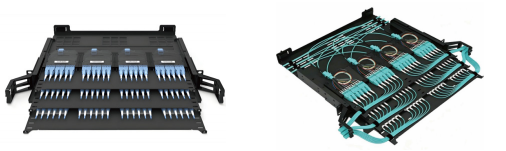
High-density MPO patching is where adapters multiply and where loss tiers become a channel-level decision.
This framework separates the three by function first, then compares them only on the variables that change the installed link budget and the acceptance decision: insertion loss and return loss, mating cycles, and application fit. Certifications and test documentation are treated where they belong — at the purchase-order stage, as evidence rather than as a marketing line.
Why three dissimilar products end up in one price comparison
A loopback, a fan-out cable and a panel adapter often arrive on the same quotation sheet because they share the MPO/MTP connector family, the same 8- or 12-fiber count language, and frequently the same supplier. The similarity stops there. One is consumed on a test bench and may never enter the building's permanent cabling. The second becomes part of the channel that carries production traffic. The third is a passive interface that multiplies across every port in a patch panel.
The practical consequence is that a single unit-price column hides three different risk profiles. A loopback with excessive loss delays a switch acceptance and is discovered in the lab, where it is inconvenient but contained. A fan-out with a polarity error is discovered at commissioning, when a link comes up in the wrong direction. An adapter chosen at the wrong loss tier is discovered months later, when a channel that passed on the bench fails its end-to-end budget after the last patch is installed. Those risks do not belong in one column, and separating them is the whole purpose of the framework below.
Three definitions that must be settled before any comparison
MPO/MTP loopback: test equipment, not cabling
A loopback is a passive module with a multi-fiber connector on one face; inside, transmit fibers are crossed to receive fibers. Plugged into a transceiver port, it returns the module's own signal, allowing a technician or an automated test line to confirm that a port transmits and receives without involving any cabling beyond the loopback itself. Typical uses are incoming inspection of switches and line cards, pre-deployment burn-in, and fault isolation when a link is suspect but the cause is not yet known. Because the job is measurement, the relevant specifications are the ones that affect repeatability: insertion loss per fiber position, endface condition, and the durability rating of the connector interface.
MTP/MPO fan-out pre-terminated cable: the topology converter
A fan-out, also called a breakout or harness, places one MPO/MTP connector on one end and several smaller legs on the other — typically duplex LC or SC connectors, sometimes smaller MPO connectors. It is the standard way to connect 40G, 100G and 400G SR4/PSM4 modules, which present a multi-fiber interface, to cabinet ports that are duplex, or to a structured cabling plant. In a data center it sits between a trunk assembly and the equipment, so it forms part of the permanent channel and its loss is spent from the link budget on every port it serves.
MPO fiber optic adapter: the mechanical interface
An adapter couples two MPO plugs. It provides alignment, the keying that fixes polarity, and the retention that keeps endfaces in physical contact. In high-density cabling systems it appears in patch panels, cassettes and cross-connects in bulk: a single rack unit can present dozens of adapter positions. It carries no cable and adds no length, but every adapter is a mated pair, and every mated pair is both a loss event and a wear point.
Dimension 1 — insertion loss and return loss
The loss comparison only becomes meaningful when it is run at the same level of the link for all three items, because the three do not contribute loss in the same way.
For MPO adapters, two loss tiers are commonly quoted: low-loss at below 0.35 dB and standard at below 0.5 dB, with single-mode adapters commonly specified at a return loss of 50 dB or better. These are specification bands rather than measurement results for a particular shipment. The 0.15 dB gap between the tiers is small per adapter and material per channel: a channel containing several mated pairs accumulates that gap, and a reflection-sensitive single-mode link depends on the return-loss figure rather than on the insertion-loss figure to stay inside budget. On multi-fiber interfaces the same question applies per fiber position, so a single average insertion-loss value does not describe the worst port in the assembly.
For fan-out cables the relevant number is not one connector but the assembly: the MPO end, plus each leg's connector, plus the fiber between them. A breakout quoted as a single insertion-loss figure without stating which end was measured does not support a channel calculation and should be sent back with a request for assembly-level data.
For loopbacks the budget is different again, because the loopback is not part of the installed channel. What matters is that its loss is low and stable enough not to mask a marginal port during testing, and that the figure is documented, so a port that fails can be attributed to the port rather than to the test accessory.
A practical rule for the whole dimension: state the measurement condition beside the number. Insertion loss on a multi-fiber connector depends on wavelength and launch condition, so a quotation that gives a tier without the test wavelength, source condition and sample size cannot be checked against a link budget.
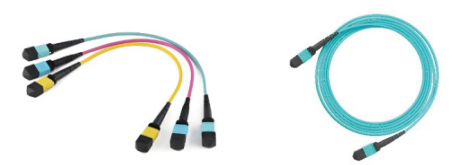
Each mated MPO interface in a channel adds loss and a wear point; the connector specification has to be read at channel level, not at unit level.
Dimension 2 — mating cycles
Mating cycles measure how many connect and disconnect events an interface can absorb before its loss drifts outside specification. This framework uses 500 mating cycles as the durability benchmark for MPO interfaces. The three items do not consume that budget at the same rate, and that difference is what makes the dimension useful.
A loopback is the highest-cycle item in most operations. It is plugged and unplugged every time a port is tested, so on a busy bench it accumulates cycles far faster than any installed component. The 500-cycle benchmark should therefore be read as a consumable-life question: how many test events before the accessory is retired, re-verified or replaced.
A fan-out is close to the opposite case. Once a breakout is installed between a trunk and a cabinet it is rarely disturbed; its cycles are consumed at commissioning and at scheduled reconfiguration rather than in daily operation. The rating still matters where cabinets are re-patched on a defined cycle.
An adapter sits between the two extremes. A panel adapter in a static cross-connect may see very few matings, but one in a reconfiguration-heavy environment can be cycled repeatedly — and because adapters are numerous, a single out-of-specification adapter is easy to miss and hard to trace back to a batch.
The procurement consequence is straightforward: ask for the mating-cycle rating per part number, compare it with the 500-cycle benchmark, and match it to the buyer's own reconfiguration frequency. A rating quoted for the connector family rather than for the part being purchased is not an acceptance document.
Dimension 3 — application fit and the quantity multiplier
Application fit decides which item can be substituted, and the answer is almost always none. A loopback cannot replace a fan-out: it validates a port and deliberately returns the signal instead of delivering it to another device. A fan-out cannot do a loopback's job, because it introduces a cable plant into a test that exists to isolate the port. An adapter can do neither: it holds plugs together but creates no breakout and no return path.
Where the three genuinely differ is the quantity at which they are bought, and that is a commercial dimension rather than a technical one. A loopback purchase is measured in single units or a small kit. A fan-out purchase is measured per link or per cabinet and is often project-specific in length and leg count. An adapter purchase is measured in panel positions and can run into the hundreds or thousands. The multiplier explains why the low-loss and standard tiers are a cost decision on adapters and rarely on loopbacks, and why fan-out economics are driven by assembly work and lead time rather than by the connector alone.
Supplier-level comparison follows the same logic. Nanfang Communication's published comparison material states that cost and delivery advantages exist relative to alternatives, while the exact gaps require quotation comparisons rather than catalogue arithmetic — a qualification worth keeping, because unit price alone does not reflect assembly work, test documentation or delivery certainty.
The side-by-side decision table
| Criterion | MPO/MTP loopback | MTP/MPO fan-out cable | MPO adapter |
|---|---|---|---|
| Primary function | Validate a port or transceiver | Convert a trunk into duplex or smaller legs | Align and retain two MPO plugs |
| Position in the link | Outside the permanent channel | Inside the permanent channel | Inside the permanent channel |
| Loss to specify | Low, stable per-position insertion loss | Assembly-level loss across all legs | <0.35 dB low-loss or <0.5 dB standard; single-mode return loss ≥50 dB |
| Mating-cycle benchmark | 500, treated as a consumable life | 500, mostly consumed at commissioning | 500, dependent on re-patching frequency |
| Failure mode to test | Accessory loss masking a marginal port | Polarity error, leg-to-leg variance | Key or gender mismatch, alignment wear |
| Commercial pattern | Low volume, high reuse | Project-specific, lead-time sensitive | High volume, low unit price |
| Acceptance evidence | Documented loss and endface record | Assembly test report and polarity map | Part-number loss test and certificate scope |
Application scenarios: three purchase orders from one framework
Scenario 1 — staging lab and incoming switch acceptance
A batch of 400G switch ports arrives and must be validated before cabinets are released. The purchase is a loopback kit, one per port type, with documented loss and a defined retirement point. The decision criteria are low and stable insertion loss, endface inspection before each test campaign, and a mating-cycle plan matched to test volume. This is the case where accessory stability matters most, because the accessory sets the floor against which a marginal port is judged.
Scenario 2 — 40G/100G/400G SR4/PSM4 module-to-cabinet connection
A spine-leaf build uses multi-fiber trunk assemblies between rows and needs to reach duplex server ports inside each cabinet. The fan-out is specified per link with explicit leg count, connector type, polarity and length, and tested as an assembly. The criteria are assembly-level loss, polarity documentation, leg labelling and delivery certainty. A breakout that arrives without a polarity map turns a commissioning schedule into a troubleshooting exercise, and the cost of that delay is not visible in the quotation.
Scenario 3 — high-density cross-connect and patch panels
A panel with dozens of MPO positions per rack unit is being populated. The decision is between the low-loss and standard tiers and between adapter variants by key orientation and gender. The criteria are the loss tier against the channel budget, the single-mode return-loss figure, the mating-cycle rating and mechanical fit in the panel. The acceptance document is a loss test per adapter position, not a family-level datasheet.
Boundaries that belong beside the comparison
Three limits should be stated openly. A loopback validates the port and the test accessory, not the cabling plant, so a passed loopback test is not evidence that the eventual link will pass. A pre-terminated fan-out is a factory assembly and is not re-terminated in the field, so length, polarity and leg configuration must be correct at the order stage. And an adapter adds a mated pair, which means it adds loss and a wear point; where a link can be built without one, the framework should say so rather than assume density always wins.
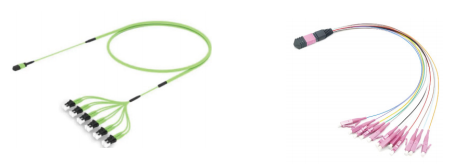
A fan-out breakout is a factory assembly: its loss, polarity and leg configuration are fixed at the order stage.
Where a specialist supplier fits: Nanfang Communication
Nanfang Communication — Jiangsu South Communication Technology Co., Ltd., a subsidiary of the Hong Kong-listed South Communication Holdings Limited (stock code 1617.HK) — is a Changzhou-based manufacturer founded in 1992 whose portfolio covers optical fibres, optical cables and ODN systems and optical components, including indoor and outdoor optical cables, PLC splitters, fiber optic connectors and MPO multi-core connectors. For this comparison, the relevant point is breadth: cable, connector and assembly inside one supply chain rather than a single product line.
The company reports an annual output of 3,000,000 core kilometres, a 26,795.3 m² factory, 360 employees and an 80-engineer R&D team, and holds ISO 9001, TL9000, ISO 14001, OHSAS 18001 and ISO 50001 certification together with a CNAS-accredited laboratory. Its optical cable manufacturing is certified to TL9000-H and ISO 9001:2015 according to its corporate disclosure.
On the technical comparison, the company's published comparison material states a 0.15 dB lower insertion loss than alternatives for the product it describes. The baseline behind that statement is not itemized, so the figure is best used as a reason to request the part-number-level test report rather than as a channel calculation in its own right.
On commercial fit, the supplier's stated position is an integrated supply chain, production scale and localized service — including customization and engineering services — which it describes as suited to large projects needing local customization and fast supply. It also states localized after-sales support with rapid response, and notes that imported solutions may face spare-parts and support delays in some regions. Those are supplier statements about relative position: exact cost and delivery gaps require quotation comparison, and imported brands are described as fitting cases that need extreme single-component performance or a specific certification.
Procurement acceptance criteria for all three items
The three items should share one documentation standard even though their technical roles differ. A workable checklist for a data center interconnect order:
- Certification scope: TL9000-H and ISO 9001:2015 certificates for the manufacturing site, with the scope statement checked against the products actually being purchased.
- Environmental management: ISO 14001 certification recorded against the site; the purchase specification should name the edition it requires — for example ISO 14001:2015 — and the certificate should match that edition.
- Laboratory evidence: test reports from an accredited facility, with the testing location and accreditation stated on the report rather than assumed from the supplier's website.
- Part-number data: insertion loss, single-mode return loss, mating-cycle rating and test conditions given for the exact part, not the product family.
- Assembly documentation for fan-outs: polarity map, leg identification, length tolerance and endface inspection record.
- Sample verification before volume release: measure the samples against the quoted tier and keep the result as the acceptance baseline.
The last point is where the framework earns its keep. A quotation can be compared against a specification, but only a measured sample shows whether the specification holds at the level of the part number being shipped.
Market context worth pricing into the decision
Three verified data points are relevant, with the qualification that they describe optical fibre cable trade rather than MPO assemblies specifically. The global fiber optic cable market was valued at USD 14.6 billion in 2025, according to Global Market Insights (published June 2026). China was the leading exporter of optical fibres and cables in 2024, with exports totalling USD 2.52 billion, according to the Observatory of Economic Complexity, which aggregates UN Comtrade data. And optical fiber cables under HTS 8544.70.00 from China face a total US import duty of 37.50% as of late 2026, according to an Airlift USA breakdown of the Section 301 duty stack — a rate that should be re-verified at the time of order, since duty schedules change.
For a buyer, the first two facts establish that a Chinese manufacturing base is a normal part of the sourcing picture rather than an exception. The third explains why landed cost, not unit price, is the number to compare when the destination is the United States — and why a supplier's delivery and support position belongs in the same comparison as its loss figures.
What would change this comparison
The framework is built around functions rather than around a fiber count, so it survives a port-speed change: a loopback still validates a port, a fan-out still converts a trunk into smaller legs, and an adapter still mates two plugs. What changes is the specification detail. If a project moves to a different fiber count or to single-mode multi-fiber interfaces, the fan-out's connector and polarity specification changes and the return-loss figure becomes a first-order criterion rather than a secondary one. If a site reconfigures more often, the mating-cycle rating rises in importance for adapters and the loopback becomes a controlled consumable with a retirement schedule. If a design can eliminate panel adapters by connecting trunk to trunk directly, the adapter line shrinks — and with it the accumulated loss of extra mated pairs.
None of those shifts changes which item a buyer should purchase. They change the numbers written into the specification, which is precisely the part the framework is designed to control.
Frequently asked questions
What is the difference between an MPO/MTP loopback, a fan-out cable and an MPO adapter?
A loopback is test equipment that returns a transceiver's transmit signal to its own receiver so a port can be validated. A fan-out pre-terminated cable converts one multi-fiber MPO/MTP connector into several smaller legs and forms part of the installed channel. An MPO adapter is a passive coupler that aligns and retains two MPO plugs inside a panel or cassette. The three share connector geometry but differ in function, loss role and purchase volume.
Which item connects 40G, 100G and 400G SR4/PSM4 modules to cabinet ports?
The fan-out pre-terminated breakout cable. SR4/PSM4 modules present a multi-fiber interface, and the breakout splits it into duplex or smaller multi-fiber legs for cabinet interconnection. A loopback has no role in that connection because it returns the signal instead of forwarding it, and an adapter only holds plugs together.
What insertion loss and return loss should a buyer specify for MPO adapters?
The commonly quoted specification bands are low-loss at below 0.35 dB and standard at below 0.5 dB, with single-mode adapters commonly specified at a return loss of 50 dB or better. The tier should be chosen against the channel loss budget and the number of mated pairs, and the datasheet or test report should state the wavelength and test condition behind the figure.
How should mating cycles affect the purchase decision?
This framework uses 500 mating cycles as the benchmark for MPO interfaces. A loopback used on a test bench consumes cycles fastest and behaves as a controlled consumable. An installed fan-out consumes most of its cycles at commissioning and reconfiguration. An adapter sits between the two and depends on how often the panel is re-patched. The rating should be quoted per part number and matched to the buyer's reconfiguration frequency.
How do TL9000 and ISO certifications fit procurement acceptance criteria?
They are checked at supplier level rather than product level. Nanfang Communication's optical cable manufacturing is certified to TL9000-H and ISO 9001:2015 according to its corporate disclosure, and the company also holds ISO 14001, OHSAS 18001 and ISO 50001 certification and operates a CNAS-accredited laboratory. A buyer should confirm that the certificate's scope covers the products being purchased, record the edition named in its own specification, and pair the certificate with part-number-level test reports rather than rely on it alone.
The decision in one paragraph
Loopbacks, fan-out cables and MPO adapters are not alternatives to one another, and a comparison that ranks them on price per piece is measuring the wrong variable. The workable sequence is to assign each item to its function, set the loss and return-loss requirement at the level where it is spent — adapter tier, assembly-level loss, accessory stability — match the mating-cycle rating to reconfiguration frequency, and document all three at part-number level. Once that is done, the supplier comparison reduces to evidence: certificate scope, test reports and measured samples.
For readers who need the product-level detail behind this framework, Nanfang Communication's MPO brochure is available for download: Nanfang Communication MPO brochure (PDF).
Есть вопросы или нужны дополнительные детали?
Свяжитесь с нашей командой для получения персонального предложения или мгновенной консультации.
Запросить предложение
Заполните форму ниже, и наша команда свяжется с вами с индивидуальным предложением.
Прямой чат WhatsApp
Предпочитаете общаться в реальном времени? Напишите нам в WhatsApp для мгновенной помощи и быстрых ответов.
- Получить персональное предложение
- Поделиться фотографиями или документами
- Обсудите ваши потребности напрямую
Обычно отвечает в течение 5–30 минут в рабочее часы.