
MPO/MTP Patch Cord Specs Decoded: Production Quality Insights
As data centers scale to 400G/800G architectures and 5G networks densify, the demand for high-density MPO/MTP fiber optic patch cords has surged. However, procurement professionals often face a critical challenge: how to interpret technical specifications meaningfully and evaluate how manufacturing processes directly impact product reliability and long-term performance. This article provides an analytical framework for decoding MPO/MTP patch cord parameters and explains why production quality—not just spec sheets—should drive sourcing decisions.
The Real Meaning Behind Common MPO/MTP Specs
Standard datasheets list insertion loss (IL), return loss (RL), core count, fiber type, and operating temperature. But what do these numbers actually mean for a deployment? Take insertion loss: an Elite-grade MPO patch cord from FOCC Fiber Co., Ltd achieves ≤0.35 dB, versus a standard ≤0.5 dB. In a high-loss link budget, every 0.1 dB saved can extend transmission distance or allow additional splitters. Similarly, return loss values ≥60 dB (APC) minimize back-reflections that degrade signal integrity in high-speed PAM4 modulation.
Core count (12, 24, 48 fibers) determines density. A 24-fiber trunk cable, for instance, can replace 12 duplex LC connections, reducing cable volume by 70%. Operating temperature range (-20°C to +70°C for standard indoor patch cords) and jacket type (LSZH – Low Smoke Zero Halogen) are critical for fire safety in plenum spaces. FOCC Fiber's MPO/MTP patch cords comply with Telcordia GR-326 and are 100% factory tested to guarantee these parameters.
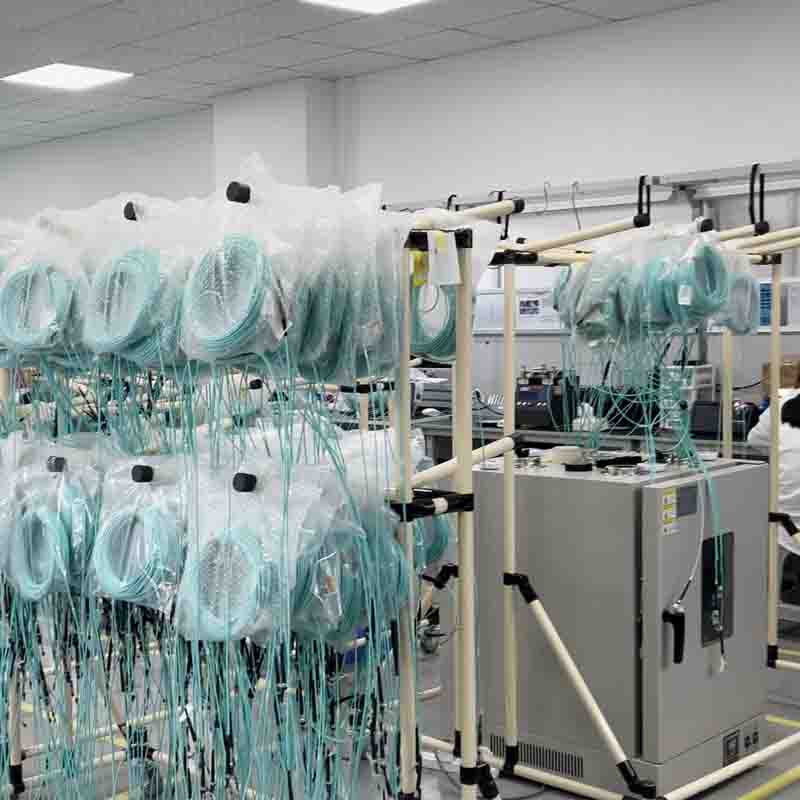
Precision manufacturing environment at FOCC Fiber's 5,000 m² Guangzhou facility, where every MPO/MTP patch cord undergoes rigorous process control.
How Production Processes Determine Real-World Performance
Specs are only as reliable as the production process behind them. Four manufacturing stages have an outsized impact:
- Ferrule polishing: Multi-fiber MT ferrules require ultra-precise curvature and apex offset control. FOCC Fiber uses automated polishing machines with active alignment to achieve ≤0.35 dB IL consistently.
- Alignment and assembly: Core-to-core alignment of 12–48 fibers demands micron-level precision. The company’s 30‑member R&D team has developed proprietary alignment jigs that reduce insertion loss drift over temperature cycles.
- Jacket extrusion and Kevlar termination: Aramid yarn (Kevlar) provides tensile strength. FOCC Fiber’s LSZH jackets are extrusion-molded under controlled cooling to maintain concentricity, preventing microbending losses.
- 100% factory testing: Every patch cord is tested for IL, RL, and end-face geometry. This zero-defect policy is backed by ISO 9001:2015 certification (certificate No. HIC230831).
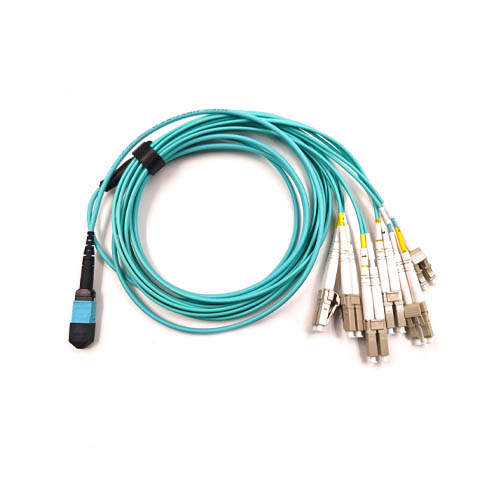
A 12-fiber MPO patch cord with LSZH jacket, representative of FOCC Fiber’s high-density product line for data center spine-leaf interconnects.
Industry Application: Data Center High-Density Cabling
In a recent deployment for a leading cloud provider, FOCC Fiber supplied 12,000+ MPO-24 patch cords for 400G spine-leaf architectures. The result: 60% faster cable installation, 4× higher port density per rack unit, and 99.999% network uptime over a 5‑year period. The precision active alignment and Elite-grade IL (≤0.35 dB) were critical to maintaining signal integrity across 40‑meter leaf‑to‑spine links. Compared to traditional single-core LC/SC patch cords, the MPO solution reduced total cost of ownership (TCO) by 30%—a finding validated by FOCC Fiber’s comparative analysis (see www.focc-fiber.com).
Market Trends and Future Outlook
The global MPO/MTP patch cord market is projected to grow at a CAGR of 12% through 2030, fueled by AI/ML workloads and 800G/1.6T Ethernet standards. Buyers are increasingly seeking suppliers who can offer not only competitive pricing but also documented process control, traceability, and third‑party certifications. FOCC Fiber’s 10+ years of OEM/ODM experience, 200,000‑unit monthly capacity, and quick lead times (3–15 days) position it as a reliable partner for both high‑volume deployments and custom‑spec projects.
For procurement teams, the key takeaway is clear: look beyond the headline numbers. Evaluate how a manufacturer controls ferrule polishing, alignment, and testing. Companies like FOCC Fiber Co., Ltd (Email: sales@mefiberoptic.com, Tel/WhatsApp: +86 13823237984) provide transparent data sheets and offer factory acceptance testing to validate claims. In a market where a 0.1 dB difference can determine link budget margins, informed specification interpretation paired with robust production quality is the ultimate competitive advantage.