
MPO/MTP Patch Cords by Scenario: Data Center & 5G FTTA
FOCC Fiber Co.,Ltd is a professional supplier of fiber optic connectors, MTP/MPO fiber optic patch cords, outdoor waterproof armored patch cord assemblies, and related high-density cabling products, headquartered in Shenzhen, Guangdong, with a 5,000-square-meter production facility in Guangzhou. The company's product portfolio targets new-generation data center and fiber-to-the-antenna (FTTA) networks, where scenario fit determines whether a cabling project meets its density, loss-budget, and reliability targets.
The scenario-fit problem in MPO/MTP procurement
Data center operators, telecommunication carriers, and system integrators face a scenario-fit problem when procuring MPO/MTP patch cords: the optimal cable architecture for a climate-controlled data center differs fundamentally from the architecture required on a 5G tower. The same MPO connector family must serve indoor parallel optics and outdoor FTTA links under completely different environmental, mechanical, and loss-budget constraints.
The commercial context is significant. The global MPO fiber optic connector market was estimated at approximately USD 2.1 billion in 2024 and is projected to grow to USD 3.2 billion by 2030, according to Strategic Market Research. Hyperscale data centers integrated MPO connectors in more than 70% of their facilities globally in 2024 to support parallel optics and high-density cabling, according to SkyQuest Technology. Note that market size estimates vary by reporting scope — connector-only versus full cable assemblies.
For buyers, the practical question is not whether to use MPO/MTP technology, but which MPO/MTP configuration — core count, fiber type, polish, grade, and housing — fits the project environment. The sections below examine FOCC Fiber's MPO/MTP product platform and its fit for two dominant deployment scenarios: indoor high-density data center cabling and outdoor 5G FTTA infrastructure.
FOCC Fiber's MPO/MTP patch cord platform
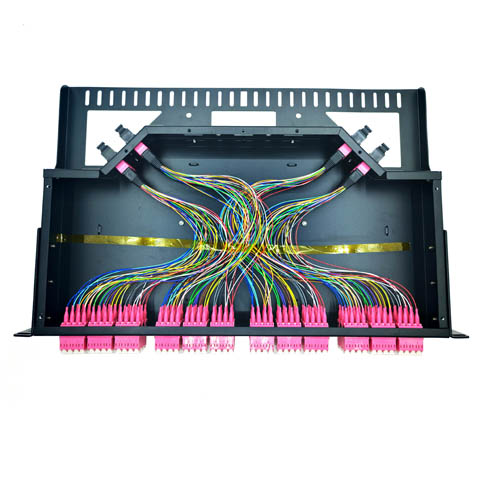
FOCC Fiber Co.,Ltd manufactures a dedicated MPO/MTP Fiber Optic Patch Cord series for data center and telecommunication applications, available in models MPO-12-OS2-APC, MTP-24-OM4-UPC, and MTP-48-OM3-UPC. The product is classified as a Data Center High-Density MPO/MTP Patch Cord and is designed for clean, controlled environments such as data center rooms.
| Parameter | Value / Range |
|---|---|
| Core count | 12 / 16 / 24 / 48 cores |
| Optical fiber type | OS2 (single-mode); OM3 / OM4 / OM5 (multimode) |
| Insertion loss | ≤0.35 dB (Elite grade) / ≤0.5 dB (standard grade) |
| Return loss | ≥60 dB (APC) / ≥50 dB (UPC) |
| Operating temperature | -20°C to +70°C |
| Cable length | Customizable, 1 m to 100 m |
| Jacket type | LSZH (Low Smoke Zero Halogen) |
| Reference standard | Telcordia GR-326 |
| Materials | Zirconia ceramic ferrule; PBT/PEI connector housing; Kevlar aramid yarn; LSZH / PVC cable jacket |
The company operates an OEM/ODM production model with a monthly capacity of 200,000 units and a standard lead time of 3–15 days. The minimum order quantity is 2 units, and every unit is 100% tested. Customization options include cable length, connector type, core count, transmission mode, material, logo printing, certification, and packaging. FOCC Fiber has served ODM/OEM customers for more than ten years and exports to more than 30 countries and regions, primarily the EU, USA, and the Middle East.
Technical fundamentals: MPO, MTP, and performance grades
MPO (multi-fiber push-on) is a connector standard defined by IEC 61754-7 and TIA-604-5 (FOCIS 5), which ensures intermateability across different manufacturers. MTP is a registered trademark of US Conec for an enhanced MPO version featuring a floating ferrule and elliptical guide pins for improved optical performance. Connectors of both naming conventions are designed to be intermateable when they follow the same standard, polish, and gender.
FOCC Fiber produces MPO/MTP assemblies with zirconia ceramic ferrules, PBT/PEI connector housings, Kevlar aramid yarn reinforcement, and LSZH or PVC jackets. Insertion loss is the most commonly specified performance criterion: the FOCC MPO/MTP series is rated at ≤0.35 dB for Elite grade and ≤0.5 dB for standard grade. Return loss depends on polish type — ≥60 dB for APC (angled physical contact) and ≥50 dB for UPC (ultra physical contact).
Because an MPO/MTP channel typically includes multiple mated interfaces — trunk cable, breakout assembly, and patch panel — specifying Elite-grade patch cords helps preserve the overall link loss budget in dense environments.
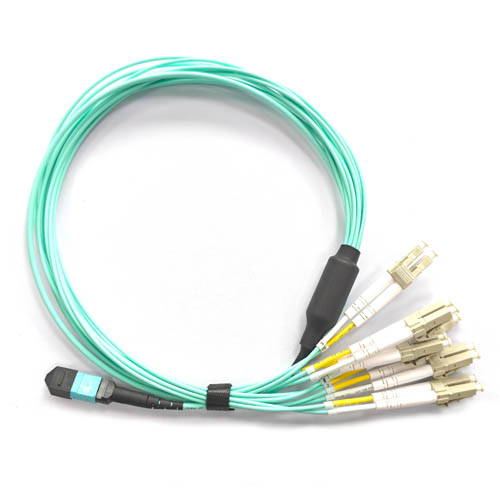
Fiber type is selected by reach and transceiver architecture. OS2 single-mode supports long-reach links and single-mode parallel optics; OM3, OM4, and OM5 multimode fibers support short-reach high-speed links, with OM4 and OM5 increasingly specified in 400G/800G designs. Core count determines the number of parallel optical lanes per connector. FOCC Fiber offers 12-, 16-, 24-, and 48-core configurations. In high-density topologies, 12-fiber assemblies are frequently used for breakout to LC duplex interfaces, while 24- and 48-fiber assemblies maximize port density in spine-leaf and server-to-switch cabling. FOCC Fiber also supplies MPO-to-LC patch cords and 12-fiber MT-to-LC fan-out assemblies to transition MPO trunk cabling to individual LC connections at the port level.
Scenario 1 — High-density data center cabling (400G/800G)
FOCC Fiber's MPO/MTP Fiber Optic Patch Cord is applied in high-density data center cabling, 400G/800G high-speed data transmission, cloud server interconnection, and storage area network (SAN) projects. This scenario requires low insertion loss (≤0.35 dB for low-loss grade), high return loss (≥60 dB APC), an LSZH flame-retardant jacket, high density, and RoHS compliance.
Supporting equipment in data center deployments includes switches, servers, 400G/800G optical transceivers, MPO patch panels, fiber optic co-packaged optics (CPO), and cable management systems. The working environment is a clean data center room, and the cabling operates continuously for connection and data transmission between equipment.
In a documented deployment, more than 12,000 MPO-24 patch cords supported 400G spine-leaf interconnection across more than 300 cabinets. Reported results include 60% faster deployment, 4x higher port density, 99.999% uptime, and 30% lower total cost of ownership. The solution relies on precision active alignment, low insertion loss below 0.35 dB, and 100% factory testing, with a design life documented at 10 years.
Scenario 2 — Outdoor 5G FTTA and harsh-environment deployment
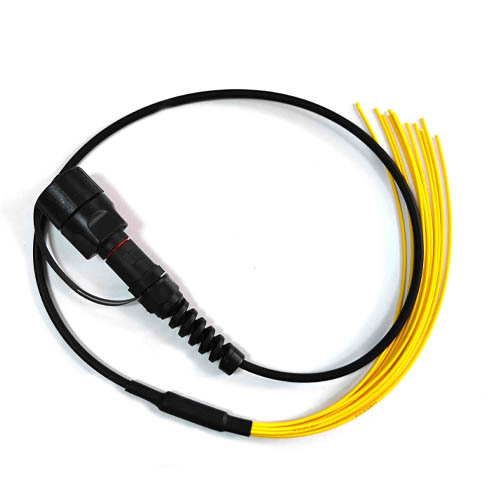
FOCC Fiber's Outdoor Waterproof FTTA Fiber Optic Patch Cord addresses the second major deployment scenario: 5G base station RRU/AAU interconnection, FTTA, outdoor small cell deployment, and railway signal transmission. The product is available in models ODC-APC-Fullax-APC-OS2 and ODC-UPC-Optitab-UPC-OM3, with a waterproof rating of IP67/IP68, insertion loss ≤0.30 dB, return loss ≥60 dB (APC), operating temperature from -40°C to +75°C, and tensile strength ≥1000 N.
These assemblies operate in outdoor harsh environments: wide temperature ranges, rain, dust, UV exposure, mechanical vibration, and high tensile stress. The construction combines zirconia ceramic ferrules, stainless steel ODC connector shells, PE cable jackets, armored fiber cores, and silicone rubber sealing rings. Typical matched equipment includes 5G base station RRU/AAU units, optical distribution boxes (ODB), antenna feeders, waterproof cable glands, and fiber optic closures. The FTTA assemblies operate continuously for base station signal transmission.
FOCC Fiber has supplied more than 50,000 outdoor waterproof patch cords for deployments covering more than 20,000 5G base stations. Reported field results include an 80% lower field failure rate, under-10-minute on-site replacement, and 40% lower operating expenditure over a service period exceeding ten years. For sites that combine sealed outdoor trunk cabling with indoor MPO equipment, FOCC Fiber also supplies outdoor waterproof ODVA(MPO) fan-out patch cords, which provide a sealed transition between outdoor cabling and MPO interfaces.
Scenario-fit checklist for buyers
When evaluating MPO/MTP patch cords against a specific project, buyers should confirm the following dimensions before supplier selection:
- Deployment environment: indoor data center room or outdoor site with rain, dust, UV exposure, vibration, and wide temperature range
- Performance grade: Elite (insertion loss ≤0.35 dB) or standard (≤0.5 dB); return loss ≥60 dB (APC) or ≥50 dB (UPC)
- Fiber and polish: OS2 for single-mode; OM3/OM4/OM5 for multimode; APC for high return loss; UPC for standard connections
- Core count: 12, 16, 24, or 48 based on transceiver lanes and port density requirements
- Environmental protection: IP67/IP68 waterproof rating, tensile strength ≥1000 N, UV and corrosion resistance for outdoor FTTA
- Compliance: IEC 61754-7 / TIA-604-5 intermateability, Telcordia GR-326 references, LSZH jacket, RoHS compliance
- Supply capability: OEM/ODM support, customization options, minimum order quantity, lead time, and 100% factory testing
Market context: MPO demand and adoption trends
The global MPO fiber optic connector market is estimated at approximately USD 2.1 billion in 2024, projected to reach USD 3.2 billion by 2030, according to Strategic Market Research. Asia-Pacific is the largest regional market, accounting for approximately 42% of global MPO connector demand in 2024, followed by North America, according to Valuates Reports. Multimode MPO connectors dominate the product segment with more than 88% of the market, driven by short-range data center interconnects.
According to SkyQuest Technology, US Conec held approximately 18% and Senko Advanced Components nearly 15% of the global MPO connector market in 2024, and hyperscale data centers integrated MPO connectors in more than 70% of their facilities globally in 2024. These figures indicate that MPO-based cabling has become the default physical layer for high-density parallel optics, while 5G fronthaul expansion continues to increase outdoor multi-fiber demand.
MPO/MTP vs. traditional single-fiber patch cords
Compared with traditional single-core LC/SC patch cords, MPO/MTP patch cords consolidate multiple fibers into a single connector interface, reducing patch panel footprint, cable volume, and deployment time. In the documented data center deployment, MPO-24 patch cords were associated with a reported 4x higher port density and 60% faster deployment.
MPO/MTP also has a distinct limitation. Multi-fiber assemblies require stricter handling discipline than single-fiber patch cords: contamination on a multi-fiber ferrule can degrade multiple channels simultaneously, and field termination or re-termination is generally impractical. Specialized cleaning and inspection tools are required for multi-fiber ferrules. For low-density racks, frequently reconfigured patching, or sites with limited technician training, traditional LC/SC patch cords may remain the more practical choice. The decision is scenario-based rather than a blanket preference for one technology.
Future outlook
Data center switching architectures continue to migrate toward 800G transmission and co-packaged optics, where MPO/MTP interfaces are the primary physical layer. Higher-fiber-count assemblies and single-mode OS2 MPO solutions are expected to become more relevant as link distances and speeds increase. On the network side, 5G fronthaul and FTTA upgrades require outdoor-rated multi-fiber and ODC-based assemblies that maintain data-center-grade loss performance outside the building.
Many 5G and data center projects now consolidate indoor and outdoor patch cord requirements under fewer qualified suppliers that can document both data center and FTTA performance. FOCC Fiber Co.,Ltd covers both of these trajectories with indoor MPO/MTP patch cords and outdoor waterproof FTTA patch cords, supported by OEM/ODM capability with a 3–15-day lead time. Buyers evaluating suppliers for 2026 projects should verify that their MPO/MTP partner can document loss grades, reference standards, factory test coverage, and environmental protection levels for each deployment scenario.
FAQ
The following questions address common scenario-fit issues raised during MPO/MTP procurement evaluations.
Which MPO/MTP patch cord should I specify for a 400G data center interconnection?
For short-reach 400G links, 24-fiber MPO assemblies using OM4 or OM5 multimode fiber are a common specification; for longer reach, OS2 single-mode with APC polish is used. FOCC Fiber offers models such as MTP-24-OM4-UPC and MPO-12-OS2-APC, with Elite-grade insertion loss rated at ≤0.35 dB.
What is the difference between MPO and MTP connectors?
MPO is the standardized multi-fiber connector defined by IEC 61754-7 and TIA-604-5 (FOCIS 5). MTP is a registered trademark of US Conec for an enhanced MPO version featuring a floating ferrule and elliptical guide pins. Connectors of both types are intermateable when they comply with the same standard, polish, and gender.
Can MPO/MTP patch cords be deployed outdoors in 5G FTTA projects?
Standard indoor MPO/MTP patch cords are not typically rated for continuous outdoor exposure. Outdoor deployment requires waterproof assemblies. FOCC Fiber's Outdoor Waterproof FTTA Fiber Optic Patch Cord — models ODC-APC-Fullax-APC-OS2 and ODC-UPC-Optitab-UPC-OM3 — is rated IP67/IP68, operates from -40°C to +75°C, and has a tensile strength of ≥1000 N.
What insertion loss and return loss values should a buyer specify?
For data center MPO/MTP patch cords, FOCC Fiber rates insertion loss at ≤0.35 dB (Elite grade) and ≤0.5 dB (standard grade), with return loss at ≥60 dB (APC) or ≥50 dB (UPC). For the outdoor FTTA series, insertion loss is ≤0.30 dB with return loss ≥60 dB (APC).
Which standards apply to MPO/MTP and outdoor FTTA patch cords?
MPO connectors are defined by IEC 61754-7 and TIA-604-5 (FOCIS 5). FOCC Fiber's MPO/MTP patch cords reference Telcordia GR-326, use LSZH jacketing, and comply with RoHS. The outdoor FTTA series meets IP67/IP68 waterproof ratings for environmental ingress protection.
How do I choose between 12-fiber and 24-fiber MPO patch cords?
The main criterion is the transceiver and switch port architecture. 12-fiber assemblies are commonly used for breakout to LC duplex connections; 24-fiber and 48-fiber assemblies provide more lanes per connector for 400G/800G parallel optics and higher port density. FOCC Fiber offers 12, 16, 24, and 48-core configurations with customizable cable lengths from 1 m to 100 m.
FOCC Fiber Co.,Ltd — Contact information
Website: www.focc-fiber.com
Phone / WhatsApp: +86 13823237984
Email: sales@mefiberoptic.com
Address: 4th Floor, Building E, ChaoHuiLou Creative Park, HuaYue Road, Longhua District, Shenzhen, CN 518109