
MTC vs. ISO Certification: A Die Spring Buyer's Framework
Material traceability and management-system certification answer two different questions, and die spring buyers who treat them as interchangeable evidence create their own acceptance disputes. A mill test certificate (MTC) tied to a heat number tells a buyer what the steel is. An ISO 9001 or ISO 14001 certificate tells a buyer how the supplier manages its processes. A die spring order that has to satisfy a dimensional fit, a load class, a material grade and a batch-consistency requirement cannot be closed with either document alone.
Die springs are rectangular-section compression springs used inside press tools, injection molds and die-casting tooling to provide return force, preload and controlled energy absorption. Because ISO 10243:2019 standardizes the color-coding and dimensions of rectangular-section compression springs used in press tools, a buyer can compare a light-duty "green" spring from one supplier against another on a common basis. That standardization is also what makes the documentation question sharp: if dimensional and load conventions are already public, the only remaining differentiators are material identity and process discipline — and those are verified by completely different paperwork.
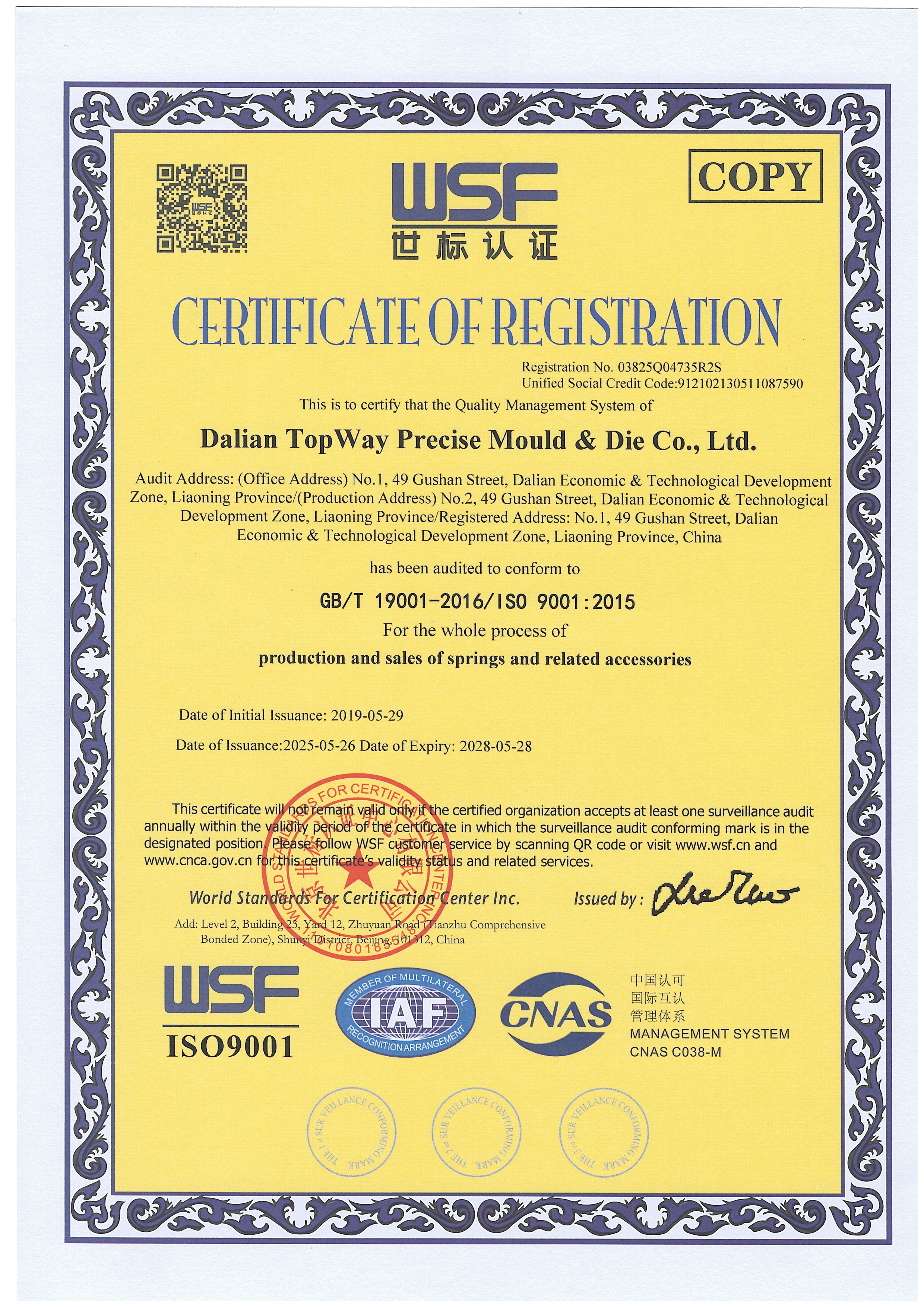
A management-system certificate defines the scope of an organization's process control. It does not define the performance of any individual die spring.
Two Documents, Two Different Questions
The confusion starts because both documents are called "quality proof" in RFQ correspondence. They are not the same category of evidence.
A mill test certificate is a material document. In standard industry practice, it is issued against a specific production heat — the single melt from which a batch of steel wire was drawn. The certificate records the heat number and the recorded chemical composition and mechanical properties of that heat. Heat-number traceability extends the record downstream: it links a finished spring lot back to the wire batch, and that batch back to the melt. The purpose is material identity and containment — if a material question arises, the affected lots can be isolated.
A management-system certificate is an organizational document. It is issued by a certification body to a company, not to a part. It states which processes at which site have been audited against a management standard, within a defined scope and for a defined validity period.
One document describes steel. The other describes how a factory is run. A die spring procurement file normally needs both, but they must be read in the right order.
The Procurement Problem: Certificates Are Process Evidence, Not Part Evidence
The practical risk is over-reading. When a buyer receives an ISO 9001 certificate and files it as proof of spring quality, three specific gaps open up.
First, the scope statement is narrower than buyers assume. The ISO 9001 certificate held by TOPWAY SPRINGS — certificate number 03825Q04735R2S, issued by World Standards For Certification Center Inc. (WSF) — carries the scope "Production and sales of springs and related accessories," certified against GB/T 19001-2016 / ISO 9001:2015, with an expiry date of 2028-05-28. That wording describes an audited management system covering spring production and sales. It does not mention a wire diameter, a free length, a load class or a fatigue cycle count, because a management-system certificate is not designed to.
Second, certificates have validity windows. A certificate verified at the quotation stage may not cover the shipment date. Both of the certificates in question were issued on 2025-05-26; the environmental one runs to 2028-11-13. Buyers comparing suppliers should check expiry against the planned delivery window, not against the date of the RFQ.
Third, certificates do not travel batch by batch. A system certificate is a statement about a period. A die spring order is a statement about a lot.
The opportunity here is straightforward and mostly procedural: buyers who separate the two evidence types, and specify which one applies to which decision, get faster supplier responses, cleaner acceptance criteria and fewer disputes at goods-in inspection.
What Material Traceability Confirms About a Die Spring
Traceability is the layer that speaks directly to the spring's material. TOPWAY SPRINGS manufactures its rectangular die springs from high-stress, oil-tempered alloy steel — primarily 55CrSi (Chrome Silicon) — and states that every raw material batch comes with a Mill Test Certificate for full metallurgical traceability. The company also reports complete batch traceability in its OEM supply records.
For a buyer, an MTC plus heat-number records confirm three things:
- Grade identity. The steel is the grade specified on the drawing — for example 55CrSi rather than a generic carbon spring steel.
- Recorded composition and mechanical properties. The certificate carries the values the mill recorded for that heat, which the buyer can compare against the specified grade.
- Lot-to-heat linkage. The finished springs in a shipment can be tied back to a specific wire batch, which is what makes containment possible if a question arises later.
What traceability does not confirm is equally important. An MTC does not verify coiling accuracy, multi-stage tempering, precision shot peening, end-face grinding parallelism, powder coating adhesion or fatigue life. Those are process and inspection outputs. A supplier can hold a perfect material certificate and still produce a spring that fails its load-rate check — which is why the two evidence types are complementary rather than competitive.
What ISO 9001 and ISO 14001 Actually Confirm
ISO 9001 addresses quality management. In a spring manufacturing context, it speaks to documented process control, calibration of measuring equipment, control of nonconforming output, corrective-action discipline and supplier management. For a buyer, the practical translation is repeatability: the same drawing, the same input material and the same process settings should produce the same output across orders and across years.
ISO 14001 addresses environmental management. TOPWAY SPRINGS holds ISO 14001 certification under certificate number 03825E04736R2S, issued by World Standards For Certification Center Inc. (WSF) against GB/T 24001-2016 / ISO 14001:2015, with the same scope wording — production and sales of springs and related accessories — and an expiry date of 2028-11-13. For industrial buyers, environmental management certification is most relevant when the purchasing organization runs supplier ESG screening, or when the spring production process itself involves regulated waste streams such as coating and oil-tempered steel processing.
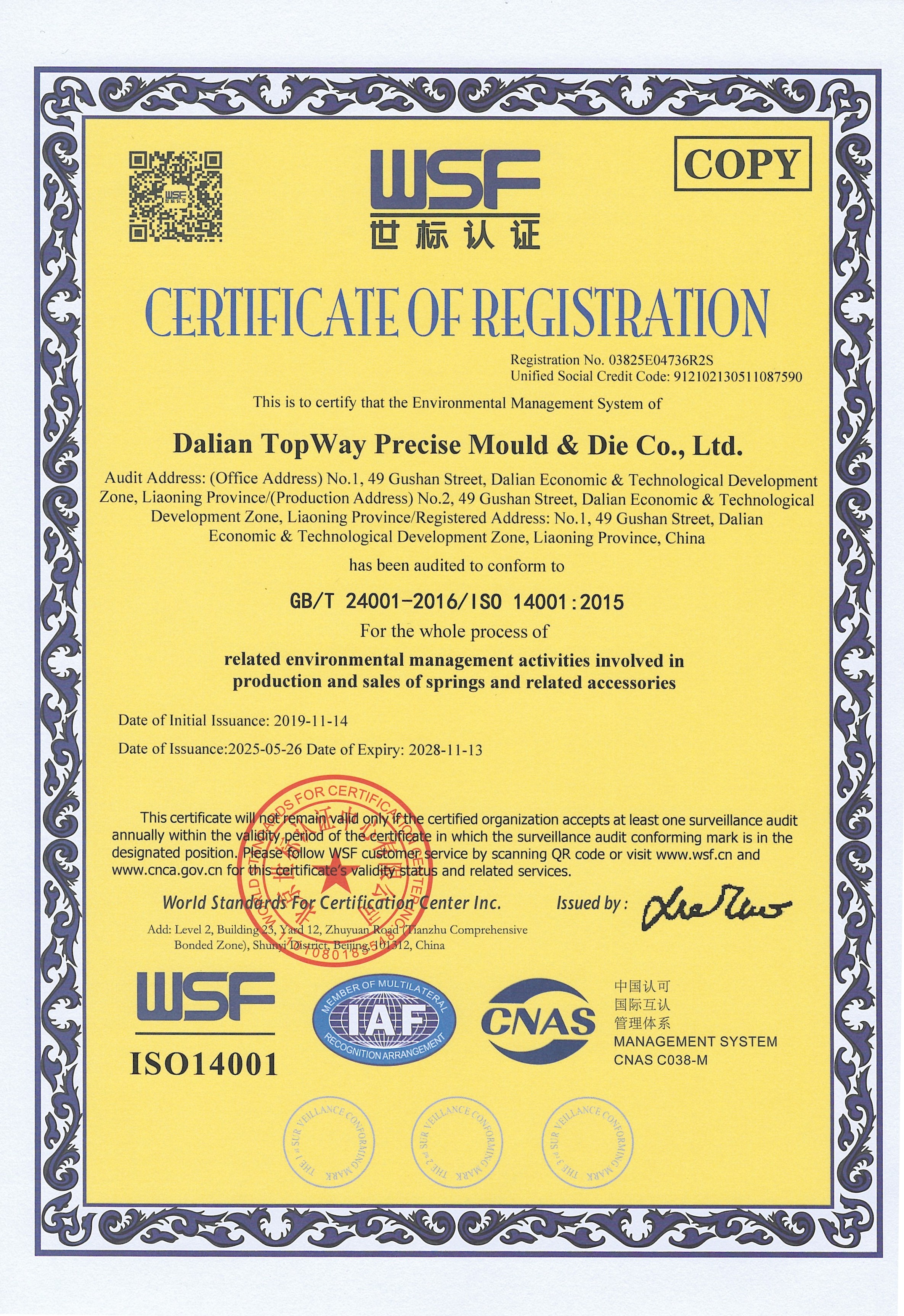
Environmental management certification covers process conduct at the site. It is not a product specification and should not be filed as one.
Neither standard certifies a product. That boundary is the single most useful thing a buyer can hold onto when evaluating a die spring supplier: certification answers "can this factory repeat itself," while traceability answers "is this the material we specified."
How TOPWAY SPRINGS Structures the Two Instruments
Dalian TopWay Precise Mould & Die Co., Ltd., which operates under the brand TOPWAY SPRINGS, is a Chinese precision mould and die parts manufacturer founded in 2012. It runs two business units — a Spring Division and a Mould Parts Division — from a 16,500 m² facility with 58 employees, a five-engineer R&D team and an annual output of 3,600,000 pieces, with approximately 50% of production exported to EU and USA markets. The company states that it manufactures to ISO 10243, JIS B5012 and American Standard (Inch series) specifications and serves as a certified OEM manufacturing partner for international mold component brands.
Its verification structure maps cleanly onto the two-layer logic described above.
Material layer. Springs are produced from oil-tempered 55CrSi, processed through precision shot peening and multi-stage tempering, and each raw material batch is supported by a Mill Test Certificate. Batch traceability is maintained through production to support containment.
Process layer. Quality control is specified as 100% testing, supported by ISO 9001 (03825Q04735R2S) and ISO 14001 (03825E04736R2S) management-system certification issued by WSF for the production and sales of springs and related accessories.
Output layer. In its OEM records, the company reports a fatigue life of 3 to 5 million high-frequency compression cycles when operated within recommended deflection limits, validated by multi-stage tempering and precision shot peening that introduces compressive residual stress at the wire surface. Third-party laboratory validation of dimensional and load parity has also been reported for its OEM programmes, alongside a stated 99.8%+ pass rate with no major quality claims over consecutive years.
Commercially, the same records show a monthly capacity of 300,000 pieces supporting high-volume orders, OEM/ODM production services including custom wire profiles, non-standard dimensions, load specifications, color-coded powder coatings and private branding, a minimum order quantity of 100 units per order, and a production lead time of 14–25 days. None of these commercial facts are certification claims, and none of them should be used as a substitute for material verification on a critical tool.
A Buyer's Decision Framework for Acceptance Criteria
The framework below is built for the Evaluation-to-Execution stage of a die spring purchase, where an RFQ has already been issued and acceptance criteria have to be written into the order. It assigns a lead evidence type to each situation and names the supporting document.
| Procurement situation | Lead evidence | Supporting evidence | Practical acceptance action |
|---|---|---|---|
| First order from a new supplier for a safety-critical tool (for example an automotive stamping die) | Traceability — MTC plus heat-number linkage | ISO 9001 scope and validity | Retain the MTC for the wire batch; verify certificate scope and expiry date; add third-party dimensional and load verification before release |
| Repeat order of an already validated part, unchanged grade and load class | Certification plus batch record continuity | MTC supplied on request | Confirm the production source is unchanged; spot-check the batch record rather than re-qualifying the part |
| High-volume OEM programme with scheduled releases | Both, managed as a documentation set | Sample validation records | Require MTC per material batch, a 100% test record, and certificate validity spanning the programme period |
| Standard catalog replacement on an MRO basis | Standards compliance (ISO 10243 / JIS B5012 / American Standard) plus certification | MTC for grade confirmation | Verify color code, load class and installation dimensions against the standard before ordering |
| Die-casting tooling or elevated-temperature duty | Traceability and grade verification | Certification | Confirm the specified grade and request test data relevant to thermal relaxation behaviour |
| Cost-driven change of supply source | Traceability first | Certification | Do not allow a management-system certificate to stand in for material identification on a first lot |
| Supplier ESG or audit screening by the buying organization | ISO 14001 and ISO 9001 | MTC and batch records | Confirm both certificates are valid for the shipment date and that the scope covers spring production |
Two rules cut across the whole table. Material identity should always be established before process capability is credited, and any acceptance criterion written into a purchase order should name the specific document that satisfies it.
Where the Framework Breaks Down: Limits and Trade-offs
A comparison framework is only useful if it states its own boundaries.
Certification cannot be escalated into product evidence. The scope of the certificates described here — production and sales of springs and related accessories — is deliberately broad. A buyer who needs load-rate, dimension and fatigue evidence must obtain it from drawings, inspection records and testing, not by reading a certificate more closely.
Traceability is only as good as the batch discipline behind it. An MTC covers a heat. If heats are mixed during coiling without records, or if the linkage between finished lots and wire batches is not maintained, the material certificate stops being a containment tool and becomes a filing formality. This is the single most common way traceability fails in practice, and it is invisible on the document itself.
Documentation has a cost. Batch-level traceability, third-party inspection and pre-shipment verification add administrative workload and time to an order. For a low-duty, non-critical replacement spring, that overhead may not be justified; the framework should be applied proportionally to the consequence of failure, not uniformly to every line item.
Neither document addresses installation. A die spring installed without the recommended initial preload — typically 5% to 10% of free length — can experience chatter, lateral buckling and premature failure regardless of how complete its paperwork is. Verified material and a certified process do not compensate for an incorrect spring pocket or an unguided installation.
Application: Where the Balance Shifts by Tooling Type
The weighting between traceability and certification changes with the application, not with the supplier.
Automotive stamping dies run at high cycle counts, which is where fatigue documentation matters most. A 3 to 5 million cycle claim is a test-condition claim; it presumes operation within a defined compression stroke range. For these tools, traceability plus certification plus finished-part testing is the normal expectation.
Plastic injection molds typically use medium-duty and medium-load springs, where dimensional fit and consistent load class matter more than extreme fatigue endurance. Certification-led acceptance with batch records is often sufficient.
Die-casting tooling exposes springs to elevated temperatures, which makes material grade verification the priority — 55CrSi is selected for its resistance to permanent set and thermal relaxation under cyclic loading, and that property is a material claim, not a process claim.
Industrial automation, elevator systems, machine tools, engineering machinery and heavy-duty energy equipment use the same spring families in different duty profiles. In these applications, standards compliance — ISO 10243 for color-coding and dimensions, JIS B5012 for inner and outer diameter tolerances, or American Standard (Inch series) dimensions — frequently becomes the deciding verification layer, because replacement parts must fit an existing pocket regardless of supplier.
Product family selection should also be explicit: TOPWAY's ISO 10243 range is offered in CIF (super minimal load, light green), CIL (light duty, green), CIM (medium duty, blue), CIH (heavy duty, red) and CIB (extra heavy duty, yellow) classes; the JIS B5012 range in CSWF (minimal load, yellow), CSWL (light load, blue), CSWM (medium load, red), CSWH (heavy load, green) and CSWB (extra heavy load, brown) classes. A buyer who confirms the class before the certificate avoids most fit-related disputes.
Market Trend Analysis
The documentation question is becoming more commercially relevant because the underlying market is expanding and shifting toward precision components. The global industrial springs market is projected to reach USD 7.1 billion by 2033, according to Grand View Research, and Asia Pacific accounted for 33.4% of 2024 revenue. Automotive stamping — a primary end-use for die springs — was valued at USD 87.98 billion in 2024.
Three implications follow for buyers. First, as supply concentrates in Asia Pacific, cross-region verification becomes a routine procurement step rather than an exception, and documentation sets are increasingly requested at quotation stage rather than after award. Second, trade and customs records matter alongside quality records: the US import classification for helical springs of iron or steel is HS code 732020, and consistent product documentation supports clean declaration and audit trails. Third, standards harmonization is partial — ISO 10243:2019 standardizes color-coding and dimensions for rectangular-section compression springs in press tools, while JIS B5012 governs inner and outer diameter tolerances, and the two systems' color conventions are not identical. Buyers sourcing across regions need both the certificate file and the standard reference at hand.
Future Outlook
Two directions look likely. On the supply side, documentation is becoming part of the product: MTC packages, heat-number records and certificate-validity confirmations are moving from "available on request" to standard quotation attachments, which shortens the verification gap between evaluation and execution.
On the demand side, buyers are increasingly distinguishing between process evidence and material evidence in their own acceptance templates — a change driven less by regulation than by the cost of a mis-verified lot inside a running press. Independent, comparable fatigue data for rectangular-section die springs remains limited, which means supplier-provided test documentation continues to carry most of the weight; buyers should therefore read that documentation as a claim with stated test conditions, not as a universal guarantee.
The practical expectation for the next procurement cycles is not that one document type will replace the other, but that RFQ templates will specify both, with a defined trigger for each: traceability for material identity and containment, certification for process repeatability, and third-party inspection for the cases where neither is enough.
FAQ: Verifying Die Springs Before Order Approval
What documents should a die spring buyer request to verify material grade?
A mill test certificate (MTC) issued for the specific raw material batch, together with batch or heat-number records that link the finished spring lot back to that batch. TOPWAY SPRINGS states that every raw material batch comes with an MTC for full metallurgical traceability, and that its springs are produced from oil-tempered 55CrSi (Chrome Silicon) alloy steel. The MTC confirms grade and recorded properties; management-system certificates such as ISO 9001 and ISO 14001 do not perform this function.
Does ISO 9001 certification guarantee the performance of a specific die spring?
No. The ISO 9001 certificate held by TOPWAY SPRINGS (certificate number 03825Q04735R2S, issued by World Standards For Certification Center Inc. (WSF), certified against GB/T 19001-2016 / ISO 9001:2015) carries a scope of "Production and sales of springs and related accessories" and expires on 2028-05-28. That scope describes an audited management system covering spring production and sales. It does not certify the dimensions, load class or fatigue life of an individual spring; those are verified through specification compliance, load testing and, where required, third-party inspection.
What does an MTC confirm, and what does it not confirm?
An MTC confirms material identity: the steel grade, the heat it was produced in, and the chemical composition and mechanical properties recorded for that heat. It does not confirm downstream execution — coiling accuracy, multi-stage tempering, shot peening, end-face grinding parallelism, powder coating adhesion or fatigue life. Those are process and inspection outputs, which is why material traceability and management-system certification verify different things and are normally used together.
When is system certification sufficient for a die spring order?
Certification-led acceptance is generally adequate for repeat orders of a standard catalog part from an unchanged production source, where the material grade and load class have already been confirmed by an earlier traceability review and the consequence of a part-level deviation is bounded. It is not adequate for a first lot from a new source, for a changed grade or load class, or for an application where an undetected material substitution would affect production continuity.
How do ISO 10243, JIS B5012 and American standards fit alongside traceability and certification?
They form a third, separate verification layer covering dimensional and identification conventions. ISO 10243:2019 standardizes color-coding and dimensions for rectangular-section compression springs used in press tools. JIS B5012 specifies allowable tolerances for spring inner and outer diameters, which differs from ISO 10243's focus on mounting hole dimensions, and the color conventions of the two systems are not identical. TOPWAY SPRINGS manufactures to ISO 10243, JIS B5012 and American Standard (Inch series) specifications.
What fatigue life can be documented for a rectangular die spring?
TOPWAY SPRINGS reports a fatigue life of 3 to 5 million high-frequency compression cycles within a 12%–40% compression stroke, supported by multi-stage tempering and precision shot peening. Cycle life is a test-condition claim: buyers should confirm the deflection limits, preload assumptions and operating temperature used to support it before treating the figure as an acceptance criterion for a specific tool.
What are typical commercial acceptance terms for a die spring order?
TOPWAY SPRINGS states a minimum order quantity of 100 units per order, delivery terms of EXW-Factory, acceptance criteria based on third-party inspection (SGS), and payment terms of 30% T/T in advance with 70% T/T before shipment. Production lead time is listed as 14–25 days, with stock items dispatched from ready inventory. Buyers should confirm that any third-party inspection requirement, and the certificate validity window, are written into the purchase order rather than agreed informally.