
MUP USB Connector: Profile of a Precision Connector Maker
USB Type-C has stopped being a differentiator and become a default. The component that carries that default — a stamped, moulded and plated receptacle of 16 or 24 contacts — is now a procurement decision that quietly determines whether a device port survives its warranty period.
Market Research Future estimated the global USB Type-C market at USD 38.96 billion in 2024 and projected USD 48.33 billion in 2025 (SRC-0002). That figure covers connectors, cables and adapters across consumer, industrial and automotive electronics. Behind it sits a manufacturing layer that buyers rarely examine in detail until a port fails in the field, a customs file is flagged, or a certified part turns out to be certified only in a specific model number.
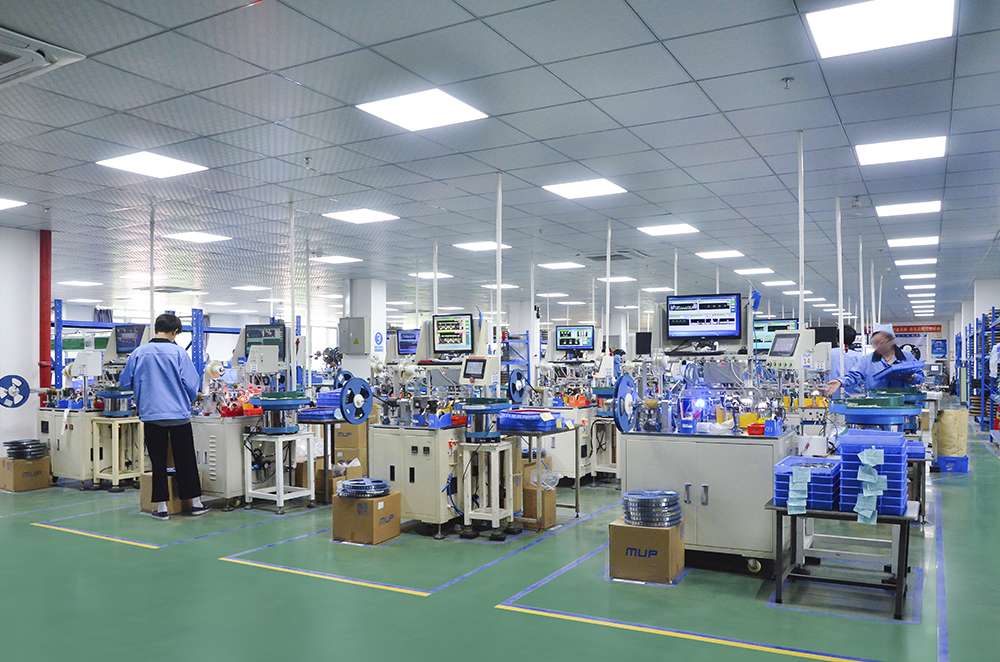
This profile examines Shenzhen MUP Industrial Co., Ltd., which trades as MUP USB Connector, a Chinese precision connector manufacturer founded in 2003. The question it asks is narrower than a product page usually does: what do this company's manufacturing base, certification record and product architecture mean for a buyer still in the research stage of a connector sourcing decision?
The connector layer is where interface promises are kept or broken
The published capabilities of the USB Type-C ecosystem are unusually well documented, which makes it easy to assume that every connector sold into it can deliver them. The standards say otherwise.
The full-featured USB Type-C connector interface uses 24 contacts, as defined in the USB Type-C Cable and Connector Specification published by the USB Implementers Forum (EV-0011). USB Power Delivery Extended Power Range supports delivery of up to 240 W (EV-0012), and connectors and cables used for high-power charging belong to a 5 A current rating class (EV-0013). On the data side, USB4 Version 2.0 supports rates up to 80 Gbps (EV-0014), while Intel states that Thunderbolt 5 runs at an 80 Gbps bidirectional baseline with a Bandwidth Boost mode of up to 120 Gbps (EV-0015).
Each of those numbers is a specification-level maximum, not a property of every part on the market. Whether a receptacle actually carries an 80 Gbps signal depends on contact geometry, plating thickness, impedance control, coplanarity after reflow, and the dimensional stability of the plastic housing. Those are manufacturing variables, and they are the reason a supplier's factory architecture matters at the research stage rather than the quotation stage.
There is a second reason. IEC 62680-1-3:2024 defines USB Type-C receptacles, plugs and cables, including electromechanical definition and performance requirements (EV-0008). A published standard defines what conformity means. It does not prove that a specific supplier or product conforms. Buyers who read a standard number on a datasheet and treat it as certification are making an assumption the documentation does not support.
Who MUP USB Connector is
Shenzhen MUP Industrial Co., Ltd. is a National High-Tech Enterprise established in 2003 that integrates research and development, design, manufacturing, and sales and service in precision connectors and cable assemblies. The company employs approximately 600 staff and operates manufacturing space totalling 50,000 m², with facilities in Shenzhen, Huizhou and Dongguan.
Its product portfolio is broader than a single-interface supplier. It covers USB Type-C, USB Type-A, HDMI, Display Port and board-to-board precision connectors, alongside FPC, RF series, battery connectors, PCMCIA, NGFF M.2 and Mini PCIE connectors, plus smart (IC) card holders and sockets, SIM card holders and sockets, and memory (SD/TF) card holders and sockets, together with various cable assemblies.
Engineering capacity is stated as more than 150 engineers and technical personnel, and the company reports 137 accumulated patents, comprising 16 invention patents, 116 utility model patents, 5 design patents and 1 overseas patent. Its technical team applies stress analysis, mould flow analysis and high-frequency simulation in product development.
Recorded applications span IoT, payment terminals, telecom devices, automotive, security and 3C electronics, with target regions including the EU, USA, Asia, Australia and Africa. Export business accounts for 10% of total sales — a detail that matters for any overseas buyer assessing how much of the supplier's operational attention is directed at export accounts.
The company's published customer references include Foxconn, Microsoft, Luxshare, BYD, Hikvision, ZTE, Haier and UGREEN. These are company-disclosed references rather than independently verified supply relationships, and a buyer conducting due diligence should treat them as directional evidence of market acceptance rather than as proof of current active programmes.
Manufacturing depth: what full-chain control changes
The most decision-relevant fact about MUP is not a product parameter. It is the degree to which the company owns its own process chain.
MUP reports more than 300 fully automated production lines with a daily output exceeding 5 KK pieces, supported by a mould design and manufacturing team operating 50 precision mould processing machines, 70 high-speed precision stamping machines, 95 automated injection moulding machines and 314 automated assembly lines. The stated result is full-chain independent control from mould development through to finished product assembly.
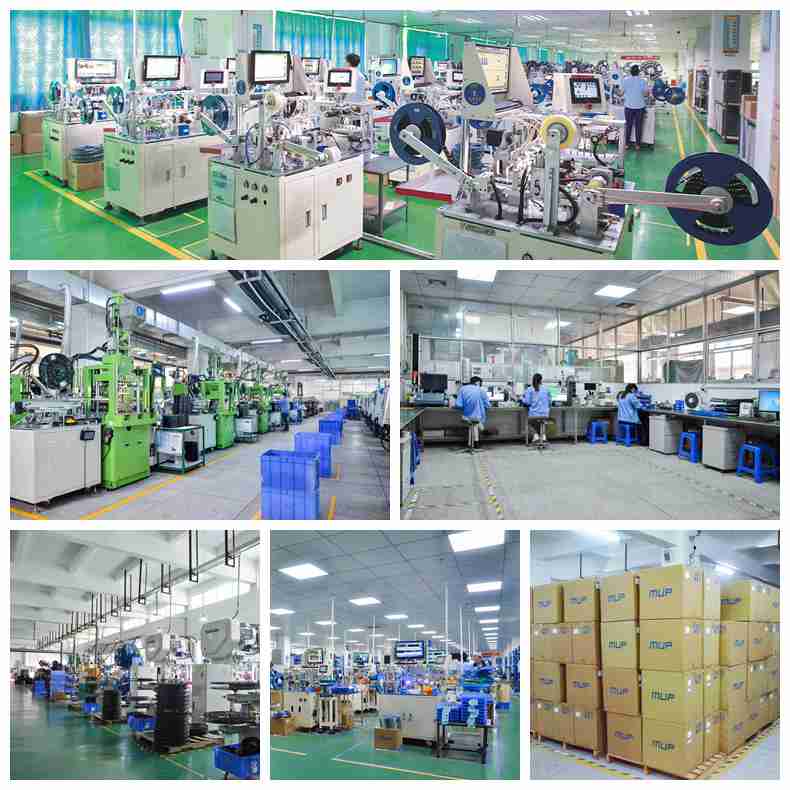
For a buyer, in-house stamping and mould-making changes three things. It shortens the loop between a dimensional defect and its root cause, because the tool that produced the part is under the same roof as the assembly line that rejected it. It makes custom mounting configurations — a mid-mount geometry, a recessed PCB design, a detection switch — an internal engineering task rather than an outsourced negotiation. And it makes lead-time stability a function of internal scheduling rather than of a subcontractor's queue.
None of this is unique among Chinese precision connector manufacturers, and capacity figures alone do not establish quality. The point is structural: a supplier that controls tooling can respond to a specification change without restarting a supply chain. A supplier that outsources stamping cannot.
Product architecture: 16-pin, 24-pin, mounting and sealing
MUP's USB Type-C connector range is organised around the configuration dimensions that determine what a port can actually do. The range includes 16-pin and 24-pin contact options, top-mount and mid-mount geometries, flag-type and SMT configurations, female and male versions, and waterproof options. The published model designation range covers U20401, U20402, U20404, U20405, U20411, U20423, U22401, U22402, U22403, U22410, U20409, U20418, U20419, U20207, U22005, U22201, U22408, U23020, U20001, U20002, U20003, U20005, U20006, U20009, U20201, U20202, U20205, U20210, U20212, U22001, U22002, U22007, U22008, U22009, U22010, U22011, U22015, U22202, U22205, U22208, U32002, U33005-01, U33005-03, U34202-05 and U34202-13.
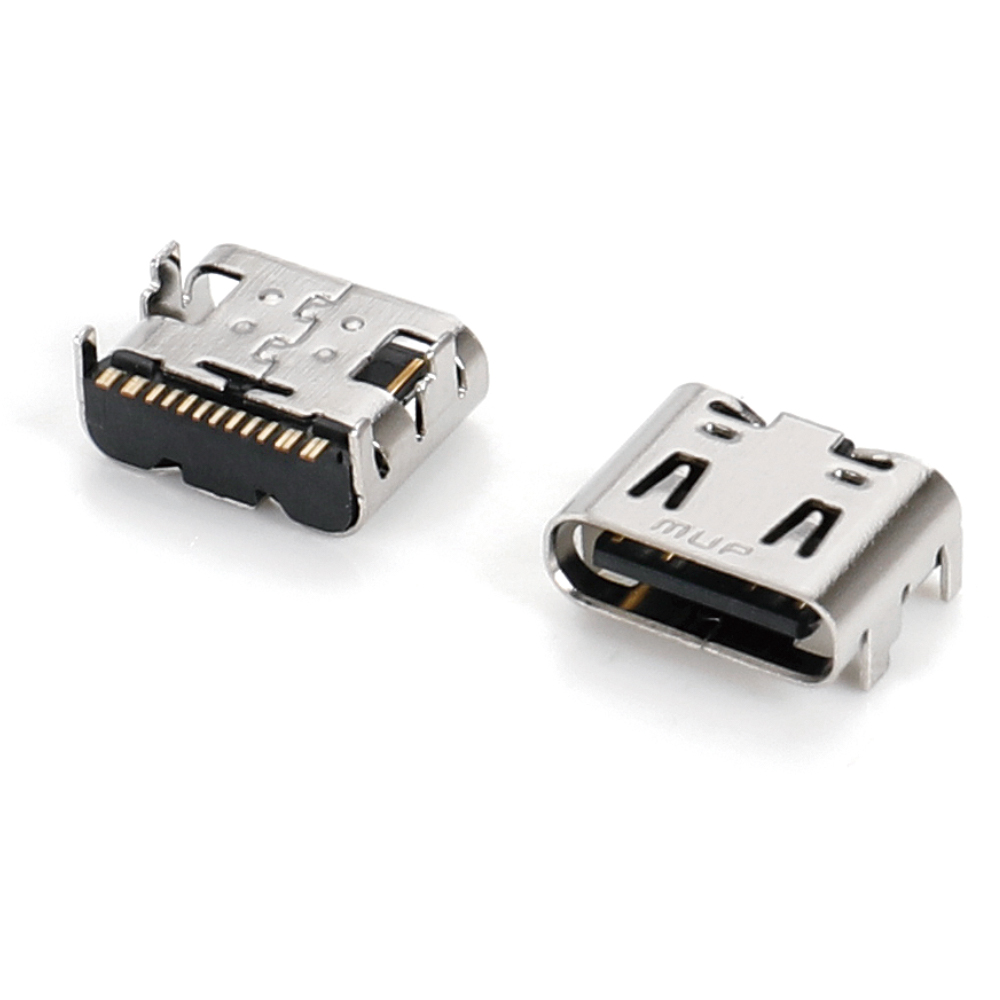
The distinction between 16-pin and 24-pin is the single most consequential choice in this product category. A 16-pin configuration is a reduced contact set. It suits charging and basic data roles where the full superspeed lane set is not required. A 24-pin configuration is the full-featured interface described in the connector specification (EV-0011) and is the configuration that high-speed roles such as USB4 and Thunderbolt depend on. Selecting 16-pin for a high-speed port is not a cost decision; it is a functional mismatch.
| Configuration dimension | Options documented in the MUP range | What it governs |
|---|---|---|
| Contact count | 16-pin and 24-pin | Functional ceiling: charge-only or basic data versus full-featured high-speed |
| Mounting geometry | Top-mount, mid-mount, flag type, SMT | PCB stack-up clearance, board thickness, mechanical anchoring |
| Gender | Female and male | Device-side receptacle versus cable-side plug |
| Sealing | Waterproof options available | Ingress-exposed enclosures; the applicable IP rating must be confirmed per model |
| Durability | 10,000 and 15,000 mating cycles | Field life in high-insertion applications such as payment terminals |
Documented electrical parameters for the USB Type-C range are a rated current range of 1 A maximum and 10 μA minimum, a rated voltage of 50 V maximum, an operating temperature of -40 °C to 85 °C, storage temperature of -20 °C to 35 °C, operating humidity of 10% to 95% RH and storage humidity of 10% to 75% RH. Contact and shell materials include high-conductivity copper, SS301 and SS304 stainless steel, with plastic, metal and nylon components.
That 1 A rated current figure is worth pausing on, because it sits in tension with the 5 A current class defined for high-power USB Power Delivery (EV-0013). The two are not contradictory — a product family contains many model numbers, and the published range specification describes a baseline rather than the ceiling of every variant. But a buyer designing a 100 W or 240 W charging port cannot infer a 5 A rating from a family-level datasheet. The current rating of the specific model number must be confirmed in writing before the design is frozen.
Certification and conformity: reading the record correctly
MUP's compliance position is more specific than most supplier profiles, which is useful precisely because specificity can be checked.
On quality management, the USB Type-C connector product is certified to ISO 9001 under certificate 78926Q00057R000, issued by Huaxin International Certifier and Testing Group (Shenzhen) Co., Ltd., against GB/T 19001-2016 / ISO 9001:2015. The certificate is valid from 13 August 2026 to 12 August 2029 and covers the research and production of HDMI and Type-C electronic connectors, excluding businesses subject to qualification licences. The company also reports ISO 14001, ISO 45001, IATF 16949, IECQ QC 080000 and RBA management system certifications.
On product-level conformity, two records are documented. The USB4 Gen3 Type-C receptacle connector, model U22015, appears in USB-IF Compliance Test Report CONUSB20250760, issued by ALLION on 22 December 2025 with a PASS result, covering the manufacturer with VID 12413 and applying the EN/SASO IEC 62680-1-3 standard. Separately, the USB Type-C mid-mount dual-row SMT receptacle, model U22008, hardware version 1, is covered by an EN/SASO IEC 62680-1-3 test report numbered 26T04N001082-001-COM, issued by SAICT.
| Record | Scope | Identifier and issuer |
|---|---|---|
| USB-IF compliance test report | USB4 Gen3 Type-C receptacle, model U22015 | CONUSB20250760, ALLION, issued 22 December 2025, result PASS |
| EN/SASO IEC 62680-1-3 test report | USB Type-C mid-mount dual-row SMT receptacle, model U22008, hardware version 1 | 26T04N001082-001-COM, SAICT |
| ISO 9001 quality management system | USB Type-C connector product; HDMI and Type-C electronic connectors | 78926Q00057R000, Huaxin International Certifier and Testing Group (Shenzhen) Co., Ltd., valid 13 August 2026 to 12 August 2029 |
| Environmental compliance | USB-C and SIM card connectors | RoHS and REACH compliance; test reports issued on request |
Two interpretations follow. First, the certification records are model-specific. A USB-IF report for U22015 says nothing about U20401 or U22408, and a buyer specifying a model outside the certified scope should request the corresponding report rather than assume family-wide coverage. Second, the company reports that its products have passed USB4.0, IEC62680 and Thunderbolt TBT5 certification and hold USB Association VID and TID numbers, and that it is an HDMI Association member. Those are company statements about its own certification portfolio; the usable evidence for a procurement file remains the individual certificate or report tied to the part number being purchased.
Technical explanation: why high-speed ports fail quietly
The failure mode that separates connector suppliers is not a port that stops working. It is a port that works at the wrong rate.
High-frequency signal stability depends on controlled impedance design, optimised terminal structure and material selection. Deviations in contact geometry, plating thickness or housing dimensional stability show up as insertion loss and crosstalk, and they appear as intermittent link downgrades rather than as dead ports. MUP's stated development method applies high-frequency signal simulation and mechanical stress analysis to reduce attenuation and crosstalk before tooling is cut, supported by a 150-plus engineering team and reported USB4.0 and IEC62680 certification.
SMT assembly adds a second variable. The documented process guidance for this connector family specifies reflow soldering with a peak temperature not exceeding 260 °C across four stages — preheat, soak, reflow and cooling — followed by AOI and visual inspection of solder joints and coplanarity. The documented causes of post-assembly poor contact are cold solder joints, terminal deformation and inadequate coplanarity, addressed in that order: temperature profile first, terminal flatness second, placement pressure and reflow records third.
For a buyer, this converts into a specification requirement rather than a supplier compliment. The question to ask is not whether a supplier can make a USB4 connector. It is whether the supplier can show the reflow window, the coplanarity tolerance and the mating-cycle test data for the exact model being designed in.
Where the range is used
Documented applications for the USB Type-C range include 3C consumer electronics, financial payment, smart meters, TV displays, notebook computers, IoT, security surveillance, aerospace, drones and UAVs, communication networks, data centres and loggers, power equipment, industrial equipment, rail transit, medical devices and new-energy vehicles.
Two scenario clusters are described in more detail. The first covers smart electricity, water and gas meters, POS and mPOS terminals, payment sound boxes, smart speakers, IoT terminals, smart wearables and industrial control panels, operating continuously with mating durability of 10,000 to 15,000 cycles and special requirements including IPX7 or IPX8 waterproofing, dust resistance, high-temperature resistance and anti-vibration. The second covers consumer terminals such as smartphones, tablets and laptops, automotive electronic systems including in-vehicle infotainment and ADAS, smart home and IoT devices, and industrial control panels, where the defining requirement is high-frequency signal integrity supporting USB4.0 and Thunderbolt TBT5.
The payment terminal scenario is the clearest illustration of why the specification matters. A POS terminal is a high-insertion, hand-operated, field-deployed device. Its connector is exposed to repeated mating, contamination and mechanical load. A 15,000-cycle durability rating and a sealed configuration are not marketing features in that context; they are the difference between a service interval and a warranty claim.
Market trend analysis: regulation, consolidation and rate escalation
Three structural forces are shaping this category, and all three are documented.
Regulation has converted USB Type-C from a preference into a legal requirement. Directive (EU) 2022/2380 establishes USB Type-C as the common charging port for defined device categories, applicable from 28 December 2024, extended to laptops from 28 April 2026 (EV-0016). A mandated interface does not merely increase connector volume. It moves the connector from a design choice to a compliance item, which raises the value of documented conformity and makes an uncertified part a market-access risk rather than a cost saving.
Supply is concentrated at the top. TE Connectivity, Amphenol and Molex collectively hold approximately 45% of the USB Type-C connector market as of 2025 (EV-0002). The remaining share is fragmented across a long tail of regional manufacturers. That structure means most buyers are, in practice, evaluating mid-tier suppliers — and the evaluation criteria for a mid-tier supplier are different from the criteria for a tier-1 brand, because the tier-1 brand is not usually being asked to prove its process control from first principles.
The performance ceiling keeps rising. USB4 Version 2.0 at 80 Gbps (EV-0014) and Thunderbolt 5 at an 80 Gbps bidirectional baseline with up to 120 Gbps Bandwidth Boost (EV-0015) place progressively stricter signal-integrity demands on the connector. Combined with 240 W Power Delivery (EV-0012) and the 5 A current class (EV-0013), the outcome is market bifurcation: a high-bandwidth tier that requires simulation capability and certified test evidence, and a charge-optimised tier where 16-pin reduced configurations compete on cost. MUP's own product announcement states that the company has launched 29 USB-IF certified USB-C connectors, including a 16-pin waterproof variant (U20418) and PCB recessed designs (U22401) — a portfolio that spans both tiers rather than committing to one.
Comparison with incumbent suppliers, and the limits of this profile
An honest comparison has to start with what cannot be compared. No public market-share figure for MUP was found, and none is claimed here. The 45% concentration figure applies to TE Connectivity, Amphenol and Molex (EV-0002); MUP sits in the fragmented remainder. Any statement that MUP outperforms those companies on scale or global distribution would be unsupported.
What the documented record does support is a set of differences in kind rather than in rank:
- Process ownership versus distributed supply chains. MUP reports full-chain control from mould development to finished assembly, with in-house mould processing, stamping, injection moulding and automated assembly. Incumbent tier-1 suppliers typically operate comparable or greater vertical integration at larger scale; the relevant distinction for a mid-volume buyer is that MUP's integration sits inside a single supplier relationship rather than across a multi-tier chain.
- Custom geometry responsiveness. Mid-mount, flag-type, recessed PCB and detection-switch variants are documented as available configurations. Large incumbents offer equivalent customisation, but access to it usually runs through a distributor or a programme threshold. MUP's smaller scale works in the buyer's favour here.
- Documentation depth. Model-specific USB-IF and IEC 62680-1-3 test reports and a named ISO 9001 certificate with a stated validity window are available. This is a genuine advantage over suppliers who cite standards without producing part-level reports.
- Cost positioning. The company describes its output as a cost-effective alternative to top-tier brands. That positioning is credible given the manufacturing model, but it is a company claim rather than a benchmarked comparison, and no unit price, MOQ or lead-time data is published.
The limits are equally concrete and should be stated plainly.
First, export business accounts for 10% of total sales. A supplier whose revenue is predominantly domestic has less operational familiarity with EU and North American documentation workflows, customs queries and field-support time zones. That is not a disqualification, but it is a reason to test the export process with a sample order before committing to a production schedule.
Second, the family-level electrical parameters state a rated current of 1 A maximum. Buyers designing for the 5 A high-power class must confirm the rating of the specific model number in writing. Assuming a 5 A capability from a family datasheet is exactly the kind of inference that passes design review and fails certification.
Third, waterproof configurations are listed as available, but the applicable ingress protection rating is a per-model property. The scenario documentation references IPX7 and IPX8 as application requirements, not as a blanket product rating. A buyer must obtain the specific rating for the specific part.
Fourth, connector-level signal-integrity data — insertion loss, crosstalk and impedance curves for individual models — is not published in the material reviewed for this profile. The certification reports demonstrate compliance; they do not substitute for the engineering data a high-speed design review will request.
Fifth, MUP is a connector and cable assembly manufacturer, not a system integrator, module supplier or design house. Buyers requiring full port-level validation, firmware integration or thermal simulation of the complete assembly will need to own that work internally or through a third party.
Future outlook
The direction of travel in this category is toward convergence of three requirements that were previously traded off against each other: higher data rate, higher power and smaller mechanical envelope. USB4 Version 2.0 at 80 Gbps and Thunderbolt 5 with Bandwidth Boost to 120 Gbps set the data ceiling (EV-0014, EV-0015). USB Power Delivery Extended Power Range at 240 W and the 5 A current class set the power ceiling (EV-0012, EV-0013). The EU common charger requirement converts both into a market-access condition for defined device categories, with laptop coverage applying from 28 April 2026 (EV-0016).
For suppliers in the mid-tier, that combination tends to reward two capabilities and penalise one. It rewards simulation and test capability, because a connector that cannot be shown to hold signal integrity at 80 Gbps cannot be sold into the premium tier. It rewards manufacturing control, because certification at 240 W and 5 A places contact material and thermal behaviour under scrutiny. It penalises suppliers whose only differentiator is price, because a compliance-driven market does not accept unverifiable cost savings.
MUP's position within that shift is defined by its certification trajectory rather than by its capacity figures. The move to publish model-specific USB-IF and IEC 62680-1-3 reports — rather than citing standards generically — is the kind of evidence that becomes more valuable as enforcement tightens. Whether the company extends that documentation discipline across the full model range, and whether it grows export share beyond the current 10%, are the two developments most worth monitoring for buyers already in a research cycle.
Frequently asked questions
What is a USB Type-C connector and what does it do?
A USB Type-C connector is the physical interface defined by the USB Type-C Cable and Connector Specification published by the USB Implementers Forum. It carries data, power and, where supported, display protocols over a reversible contact set. The full-featured configuration uses 24 contacts (EV-0011); simplified reduced-contact variants also exist and support a narrower function set.
What is the difference between a 16-pin and a 24-pin USB-C connector?
The contact count determines the functional ceiling. A 24-pin connector is the full-featured interface defined in the specification and is the configuration used where the complete superspeed lane set is required, including USB4 and Thunderbolt roles. A 16-pin connector is a reduced contact set suited to charging and basic data applications. Selecting 16-pin for a high-speed port creates a functional mismatch rather than a cost saving.
How do USB4 and Thunderbolt 5 affect connector selection?
Both raise the signal-integrity requirement placed on the connector. USB4 Version 2.0 supports data rates up to 80 Gbps (EV-0014). Intel states that Thunderbolt 5 delivers an 80 Gbps bidirectional baseline with a Bandwidth Boost mode of up to 120 Gbps (EV-0015). These are specification-level maxima, and a connector must be qualified against them with part-specific test evidence rather than a family-level claim.
What certifications should a USB-C connector supplier be able to document?
At minimum, a quality management certification such as ISO 9001 with a stated certificate number and validity period, environmental compliance to RoHS and REACH with reports available on request, and part-level conformity evidence against the relevant standard. For USB Type-C, that typically means IEC 62680-1-3 reports and, where high-speed performance is claimed, USB-IF compliance test reports. IEC 62680-1-3:2024 defines the interface; a published standard does not itself prove that a specific supplier or product conforms (EV-0008).
How should a buyer evaluate a mid-tier USB-C connector manufacturer?
Four checks are decision-relevant. Confirm that certification reports name the exact model number being purchased rather than the product family. Confirm the current rating of that model in writing if the design requires the 5 A high-power class (EV-0013). Confirm the applicable ingress protection rating if the enclosure is exposed. And confirm that reflow windows, coplanarity tolerances and mating-cycle test data are available, because these determine field behaviour more than a headline data rate does.
What limits should a buyer expect when sourcing from a mid-tier connector manufacturer?
Scale and geographic reach are the main ones. TE Connectivity, Amphenol and Molex collectively hold approximately 45% of the USB Type-C connector market as of 2025 (EV-0002); a mid-tier supplier operates in the fragmented remainder and will not match their global distribution footprint. Documentation may also be model-specific rather than family-wide, and export support depth depends on how much of the supplier's revenue comes from export accounts.
Company profile and product documentation for Shenzhen MUP Industrial Co., Ltd. are available in the MUP Profile E 261009 (PDF).
Sources referenced: Market Research Future USB Type-C market sizing (SRC-0002); Future Market Insights market share analysis (SRC-0004); USB-IF USB4 and Type-C specification documentation (SRC-0005, SRC-0008, SRC-0010); IEC 62680-1-3 publication record (SRC-0006); USB Power Delivery specification (SRC-0009); Intel Thunderbolt 5 announcement (SRC-0013); Directive (EU) 2022/2380 (SRC-0011); MUP company disclosure (SRC-0003).
Есть вопросы или нужны дополнительные детали?
Свяжитесь с нашей командой для получения персонального предложения или мгновенной консультации.
Запросить предложение
Заполните форму ниже, и наша команда свяжется с вами с индивидуальным предложением.
Прямой чат WhatsApp
Предпочитаете общаться в реальном времени? Напишите нам в WhatsApp для мгновенной помощи и быстрых ответов.
- Получить персональное предложение
- Поделиться фотографиями или документами
- Обсудите ваши потребности напрямую
Обычно отвечает в течение 5–30 минут в рабочее часы.