
Magnetic Pump Compliance for New Energy Testing Systems
Magnetic Pump Compliance for New Energy Testing Systems
New energy testing is a temperature-first discipline. A battery constant temperature chamber, a liquid-cooled chiller circuit, or a precision temperature control bench runs for months at a controlled medium temperature, and the pump circulating the coolant sits directly inside that control loop. For buyers at the research and evaluation stage, the compliance question is narrow but unforgiving: which documented temperature range does the pump actually carry, which certificates cover the hardware that will be installed, and what operating mode was assumed when those figures were produced?
YUAN SHIN PUMP is the brand of Yuanxin Pump (Suzhou) Technology Co., Ltd., a magnetic pump manufacturer based in Changshu, Suzhou, China. The company traces its manufacturing history to Taiwan Yuanshin (1990) and a Guangdong facility (2001), with the Suzhou site established in 2014. Its catalogue covers stainless steel regenerative turbine magnetic pumps, high-pressure magnetic pumps and large-flow centrifugal magnetic pumps used in temperature control equipment, semiconductor cooling, chemical transfer and laboratory systems.
This article maps the compliance landscape for magnetic pumps in new energy testing. It clarifies what the term "high-temperature magnetic drive pump" means inside a specification file, how the certifications held for these pumps are scoped, how continuous and intermittent duty in battery constant temperature chambers changes what buyers must verify, and where the boundaries of that evidence lie.
What "High-Temperature Magnetic Drive Pump" Means in a Specification File
A magnetic drive pump replaces the shaft seal with a magnetic coupling: the motor drives an outer magnet assembly, which transmits torque through a containment shell to the inner rotor. Because no rotating shaft penetrates the casing, the design removes the mechanical seal — the component that most often determines service intervals in conventional pumps. The consequence for temperature compliance is that heat management shifts to the magnet coupling, the bearings and the containment shell, all of which must tolerate the medium temperature on the wet side.
In procurement practice, "high-temperature magnetic drive pump" is a classification convention rather than a single harmonized threshold. It signals that a model's magnet, bearing and material selection were engineered for heated media, but it does not by itself define the limit. The binding value is the rated medium temperature range documented for the exact model, and that figure has to be read together with head, capacity, power and material.
| Model | Type designation | Rated medium temperature | Head | Capacity | Power | Material |
|---|---|---|---|---|---|---|
| MAP-1100 | Regenerative Turbine Magnetic Pump / High-Temperature Magnetic Drive Pump | -196°C to +400°C | 15–100 m (maximum) | 15–200 L/min (maximum) | 0.18–4 kW | Stainless steel |
| MAP-18A | Regenerative Turbine Magnetic Pump / High-Temperature Magnetic Drive Pump | -196°C to +400°C | 80–100 m (maximum) | 3.9–7.2 m³/h (maximum) | 1.1–2.2 kW | Stainless steel |
| CAP-100 | Stainless Steel Centrifugal Magnetic Pump / High-Temperature Magnetic Drive Pump | -196°C to +350°C | 15–40 m (rated) | 4–35 m³/h (rated) | 0.75–11 kW | Stainless steel |
Read as a group, the figures show why the label alone is insufficient. The MAP-1100 and the MAP-18A are both described as high-temperature magnetic drive pumps and both document -196°C to +400°C on the medium side, but they sit at different points of the head and capacity spectrum: the MAP-18A concentrates on high head at modest flow, while the MAP-1100 spreads across a wider flow range. The CAP-100 carries the same "high-temperature magnetic drive pump" description while documenting -196°C to +350°C, with a substantially larger flow envelope.
The manufacturer's general company profile summarises the portfolio as operating between -196°C and +350°C; the model-level figures above are the more specific reference point, and it is the model-level figure that should appear in a purchase specification rather than a portfolio statement.
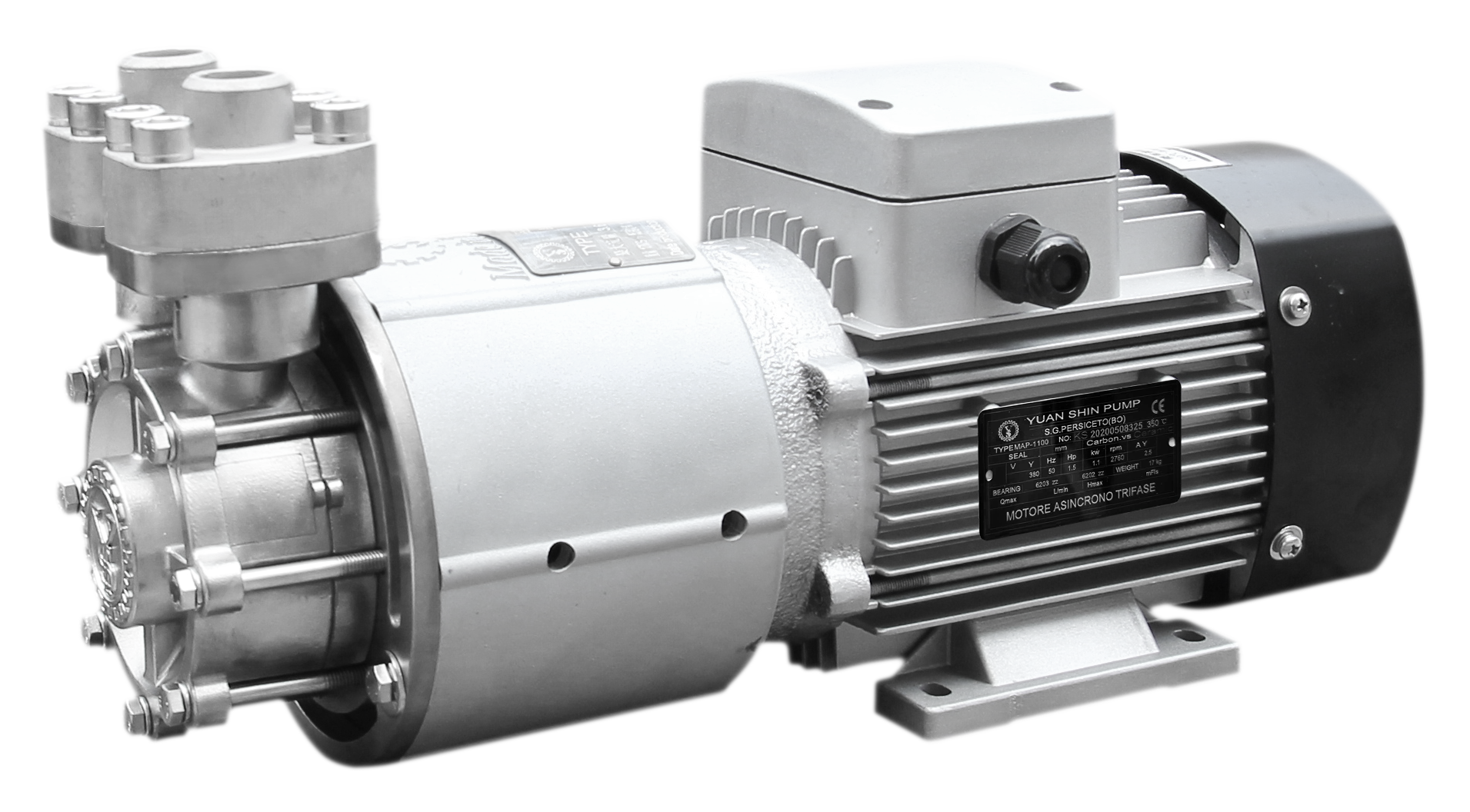
Magnetic Pump MAP platform — a regenerative turbine magnetic drive design used across temperature control units, chillers and test-bench cooling circuits.
The Certification Stack Behind a Magnetic Pump in New Energy Testing
A magnetic pump installed on a new energy test bench generally has to be justified on three separate certification layers: safety of the electric motor as a component, conformity of the pump product line for the destination market, and the manufacturer's management systems. These layers answer different questions and should not be treated as interchangeable.
1. Motor component recognition for North America
The electric motor used in the MAP-18A magnetic pump holds UL Recognized Component certification under number UL-US-2425000-0, issued by UL LLC on 1 July 2024 against standard UL 1004-1 for the US market. A parallel certificate, UL-CA-2419643-0, covers the Canadian market against standard CSA C22.2 NO.100, also issued by UL LLC. In both cases the declared scope is the electric motor as a component used in complete equipment, and the certification records associate these certificates with the MAP-18A, CAP-100 and MAP-1100 magnetic pumps.
2. Product-line conformity for the European Union
CE certificate CE-4067-300425 covers the Stainless Steel Vortex Magnetic Pumps product, documented against model MAP-18A. It was issued by ECES and is valid until 30 April 2030, and it references EN ISO 12100:2010, EN 60204-1:2018, EN 809:1998 + A1:2009 + AC:2010, EN IEC 60335-1:2023 + A11:2023, EN IEC 60335-2-41:2021 + A11:2021, EN IEC 61000-6-2:2019 and EN IEC 61000-6-4:2019. A second CE certificate, CE-4066-300425, issued by ECES, covers the Stainless Steel High Flow Centrifugal Magnetic Pump, model CAP-100.
3. Management systems behind the production process
The manufacturer holds an ISO 9001:2015 Quality Management System certificate, number CN-00224Q23283R0S, issued by China Quality Mark Certification Group (CQM) and recognized by IQNET. Its scope covers the design, development and production of vortex and centrifugal pumps, and it is valid from 7 June 2024 to 6 June 2027. A parallel ISO 14001:2015 Environmental Management System certificate, number 00224E32265R0S, issued by CQM on a CNAS-accredited basis, covers the same design, development and production activities plus related management activities, with the same validity window.
| Certificate | Number | Issued by | Market | Scope | Validity |
|---|---|---|---|---|---|
| UL Recognized Component (motor) | UL-US-2425000-0 | UL LLC | United States | Electric motor as a component used in complete equipment (UL 1004-1) | Issued 1 July 2024 |
| UL Recognized Component (motor) | UL-CA-2419643-0 | UL LLC | Canada | Electric motor as a component used in complete equipment (CSA C22.2 NO.100) | Issued 1 July 2024 |
| CE | CE-4067-300425 | ECES | EU | Stainless Steel Vortex Magnetic Pumps (MAP-18A) | Valid to 30 April 2030 |
| CE | CE-4066-300425 | ECES | EU | Stainless Steel High Flow Centrifugal Magnetic Pump (CAP-100) | Issued 30 April 2025 |
| ISO 9001:2015 | CN-00224Q23283R0S | China Quality Mark Certification Group (CQM), IQNET recognized | International | Design, development and production of vortex and centrifugal pumps | 7 June 2024 – 6 June 2027 |
| ISO 14001:2015 | 00224E32265R0S | China Quality Mark Certification Group (CQM), CNAS accredited | China | Vortex and centrifugal pump design, development, production and related management activities | 7 June 2024 – 6 June 2027 |
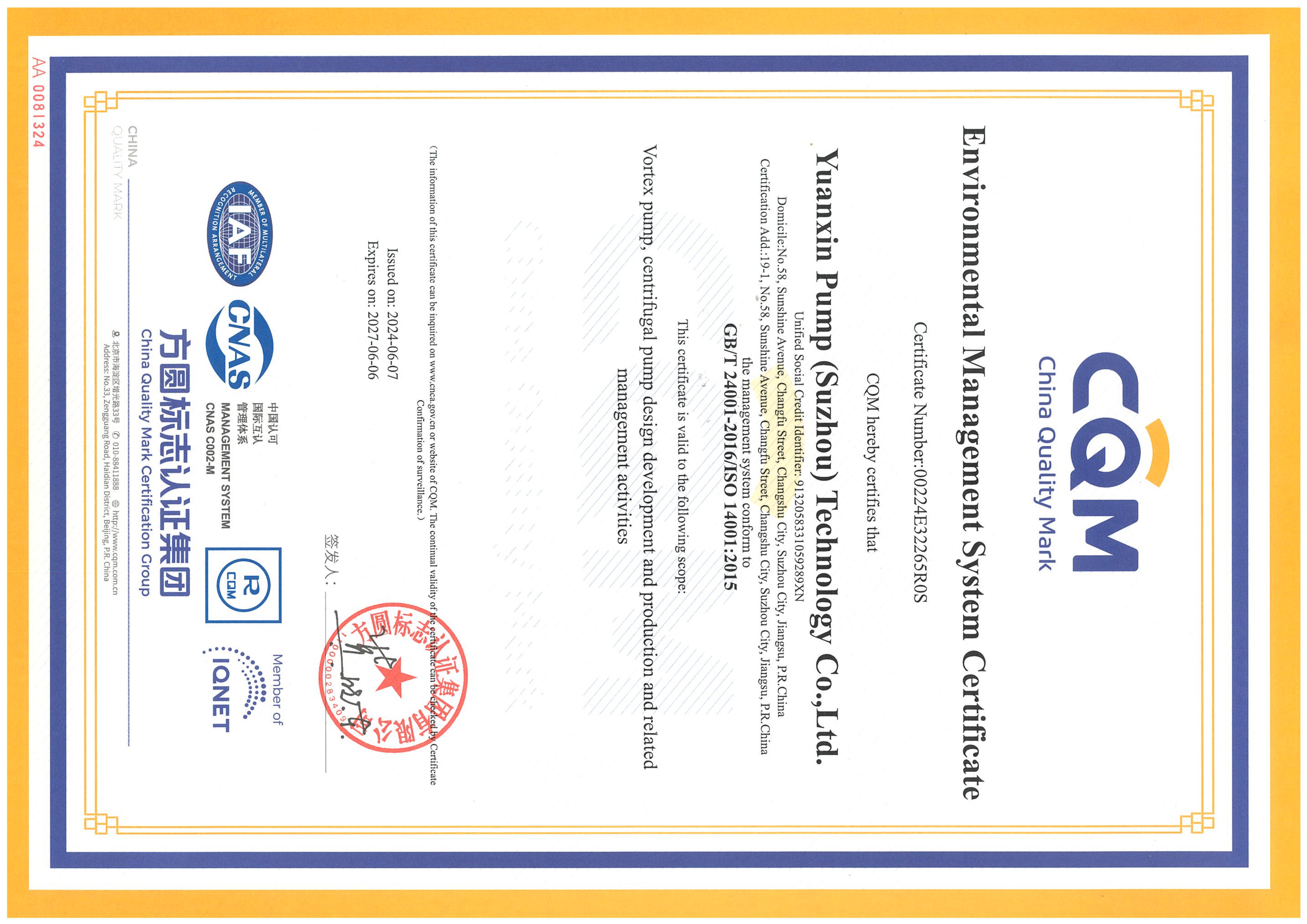
ISO 14001:2015 environmental management certification covering the design, development and production activities for vortex and centrifugal pumps.
Temperature Range as a Compliance Input, Not a Marketing Claim
Across the three documented models, the stated medium temperature capability reaches -196°C to +400°C for the MAP-1100 and MAP-18A, and -196°C to +350°C for the CAP-100. That envelope covers both ends of the new energy testing problem: the low-temperature side associated with chiller circuits and semiconductor cooling, and the high-temperature side associated with thermal oil transfer in mold temperature control and similar equipment.
The application records show where those ranges are expected to be used. The MAP family lists battery temperature control, thermoelectric semiconductor temperature control, semiconductor cooling equipment, high-temperature mold temperature control units, chemical equipment, ultrasonic cleaning equipment and laboratory systems among its applicable industries. The CAP-100 lists precision temperature control and mold temperature control equipment, chemical and pharmaceutical processes, semiconductor and precision electronics, and research and development laboratories.
Certification evidence and temperature performance are, however, different categories of proof. The UL and CE certificates address electrical safety, machinery safety and conformity for the declared product scope; they do not certify a temperature rating. The rated range is a specification value. Buyers should therefore ask at what medium, at what duty cycle and under which verification protocol the range was documented, and whether the figure applies to the wetted path, the magnet coupling or both.
Continuous and Intermittent Duty in Battery Constant Temperature Chambers
Operating mode is the variable that most often gets lost between a specification sheet and a test bench. Two application records illustrate why. A New Energy Testing installation in China uses the pump on a liquid cooler circuit in continuous operation with an inverter-duty requirement. A New Energy battery constant temperature chamber application transfers ethylene glycol to a chiller, also continuously and also under inverter duty. A laboratory temperature control application in Spain, by contrast, runs intermittently on a constant temperature chamber, with single-phase power and a low-noise requirement.
What changes with the duty cycle is the nature of the engineering question. Continuous operation holds the pump at thermal equilibrium, so the design concern is whether the magnet coupling and bearings can hold steady at the medium temperature over long runs without exceeding their own thermal limits. Intermittent operation introduces repeated start-stop thermal cycling, and the emphasis shifts to start-up behaviour and whether the pump's cooling and lubrication conditions are satisfied at every restart. Inverter duty adds a third consideration: the pump must tolerate the variable-frequency drive used for fine temperature control, rather than simply running at a fixed speed.
There is evidence for both patterns within this portfolio. A New Energy Testing customer in China has run 300 units per year for three years on a liquid-cooled chiller cooling circuit, with precise temperature control delivered through variable frequency drive and a reported 25% increase in testing efficiency. A laboratory and research institution customer in the United Kingdom has run ten units for two years on a precision temperature control system at ±1°C accuracy, where low noise and single-phase power compatibility were the deciding requirements.
Both are customer application records rather than certification claims, and that distinction should be preserved in an evaluation file: an application record demonstrates feasibility in a defined installation, while a certificate establishes conformity for a declared scope.
Chemical Magnetic Pump Selection Inside Testing Environments
Chemical handling appears on the edge of many new energy test benches — electrolyte preparation areas, cleaning baths, chemical equipment and pharmaceutical-adjacent workflows. Chemical processing is the largest single application segment for magnetic drive pumps, estimated at roughly 34.8% to 37% of the market, and stainless steel construction accounts for approximately 41% to 48.7% of the material segment, a reflection of corrosion resistance rather than cost.
In this catalogue, magnetic pumps are listed as applicable to chemical pharmacy, chemical equipment, and the chemical and pharmaceutical industries, and the ISO 9001:2015 certificate covers the design, development and production of vortex and centrifugal pumps. Customisation options include Stainless Steel 316L, alongside voltage and frequency, single-phase or three-phase configuration, motor energy efficiency class and EX-motor selection, all handled through the manufacturer's ODM programme.
One limit should be stated plainly: no general certification validates chemical compatibility. Certificates confirm that a defined product scope was designed, developed and produced under a controlled system; they do not tell a buyer whether a specific medium, at a specific concentration and temperature, is suitable for a specific wetted material. Compatibility has to be confirmed per application, and the correct starting point is a material declaration combined with the intended medium data.
A Procurement Checklist for New Energy Testing Buyers
| What to verify | Why it matters | Evidence to request |
|---|---|---|
| Rated medium temperature range for the exact model | Defines the usable envelope; portfolio-level statements hide model differences | Model datasheet stating -196°C to +400°C (MAP-1100, MAP-18A) or -196°C to +350°C (CAP-100) |
| Certification scope and destination market | Component recognition and product-line conformity are not the same claim | UL-US-2425000-0 and UL-CA-2419643-0; CE-4067-300425 and CE-4066-300425 |
| Declared operating mode | Continuous and intermittent duty stress the pump differently | Application record confirming continuous or intermittent operation and inverter duty |
| Medium and wetted materials | Compatibility is application-specific and not covered by certification | Material declaration including Stainless Steel 316L where required |
| Management system validity | Indicates process control and a defined review horizon | ISO 9001:2015 CN-00224Q23283R0S and ISO 14001:2015 00224E32265R0S, valid to 6 June 2027 |
| Customisation and delivery terms | Special voltages, EX-motors and materials change documentation and timing | ODM specification, lead time 3–40 days, minimum order 1 unit |
| Pre-shipment verification | Reduces the risk of a unit that passes on paper but not on the bench | 100% test policy on production units |
Where Magnetic Drive Meets Its Limits
Against mechanical seal pumps, the magnetic drive's advantage is structural: removing the shaft seal removes the wear part that drives most unplanned maintenance. A customer case illustrates the effect over a long horizon. An injection moulding application in Brazil has run ten MAP-1100 pumps for five years on chiller cooling water circulation, resolving seal wear problems previously experienced with mechanical seal pumps, extending maintenance intervals by more than two times and, in the customer's own assessment, reducing pump maintenance costs by 80%.
The same comparison also defines the boundaries, and these are the points a research-stage buyer should not skip:
- The temperature rating is medium-side and model-specific. A -196°C to +400°C figure on the MAP-1100 or MAP-18A does not transfer to every configuration; the CAP-100, for example, documents -196°C to +350°C, and custom builds may differ again.
- UL recognition covers the electric motor, not the complete pump. Assembly-level conformity for the finished chamber or chiller remains part of the equipment integrator's responsibility.
- CE certificates are scoped to product lines. CE-4067-300425 covers the Stainless Steel Vortex Magnetic Pumps, and CE-4066-300425 the Stainless Steel High Flow Centrifugal Magnetic Pump. Other configurations require their own documentation review rather than an assumption of coverage.
- Chemical compatibility is not a certified attribute. It must be evaluated per medium, concentration and temperature.
- Customised builds extend the compliance timeline. Stainless Steel 316L, EX-motors, special voltages and single-phase or three-phase variants are available, with lead times of 3 to 40 days and a minimum order of 1 unit; the documentation file should be assembled per order rather than inherited from the catalogue.
Market Signals Behind the Compliance Pressure
The documentation burden on buyers is rising with the category itself. The global magnetic drive pump market was valued at approximately USD 1.37 billion in 2024 and is projected to reach USD 2.65 billion by 2033, with Asia Pacific holding a 45.9% revenue share in 2024, according to Grand View Research. Within the category, regenerative turbine pumps — the architecture used in the MAP family — are increasingly adopted in temperature control units for the semiconductor industry because of their high delivery head and compact design, per Fact.MR. Future Market Insights values the global regenerative turbine pump market at USD 271.1 million in 2025, with a 7.3% CAGR through 2035.
Standards activity follows a similar pattern. API 685 remains the primary international standard for sealless magnetic drive centrifugal pumps used in heavy-duty petroleum and gas services. While that duty class is different from new energy testing, the standard is a useful reference for how sealless pump compliance is normally structured: pump-level requirements, application-level requirements and documentation held together as one package.
Future Outlook
Three directions look likely for magnetic pump compliance in new energy testing. First, temperature specification will continue to move toward model-level documentation rather than portfolio-level statements, because test benches are increasingly specified by exact duty point rather than by general capability. Second, duty-cycle language will become more explicit in purchase specifications as variable frequency control becomes standard on battery constant temperature chambers and liquid coolers — inverter duty is already a named requirement in the new energy testing and battery chamber applications described above. Third, chemical handling and cooling circuits will keep converging on the same equipment, pushing buyers to evaluate material declarations alongside electrical certification rather than treating them as separate procurement steps.
For manufacturers, the practical implication is that certificates need to remain current and legible. The CE certificates in this catalogue run to 30 April 2030, and the ISO 9001:2015 and ISO 14001:2015 certificates to 6 June 2027, which gives procurement teams a defined review horizon for supplier re-evaluation.
Full technical documentation for the magnetic pump range is available in the manufacturer's published brochure and on the YUAN SHIN PUMP website.
FAQ
What does "high-temperature magnetic drive pump" actually mean in certification terms?
In practice it is a classification convention used by suppliers and buyers rather than a single harmonized threshold defined by one standard. It indicates that the magnet, bearing and material selection of a model were engineered for heated media. The enforceable value is the rated medium temperature range documented for the specific model: the MAP-1100 and MAP-18A are documented at -196°C to +400°C, while the CAP-100 is documented at -196°C to +350°C.
Which certifications cover YUAN SHIN PUMP magnetic pumps for the US, Canada and EU markets?
For North America, the electric motor used in the MAP-18A holds UL Recognized Component certification UL-US-2425000-0 against UL 1004-1 for the United States, issued by UL LLC on 1 July 2024, and UL-CA-2419643-0 against CSA C22.2 NO.100 for Canada, also issued by UL LLC. For the EU, CE certificate CE-4067-300425 covers the Stainless Steel Vortex Magnetic Pumps documented against MAP-18A and is valid until 30 April 2030, while CE-4066-300425 covers the Stainless Steel High Flow Centrifugal Magnetic Pump CAP-100; both were issued by ECES.
Do the UL certificates cover the complete pump or only the motor?
They cover the electric motor as a component used in complete equipment. The declared scope of UL-US-2425000-0 and UL-CA-2419643-0 is the motor component, not the assembled pump. Buyers should confirm with the equipment integrator how assembly-level conformity for the finished chamber, chiller or test bench is handled in the destination market.
What temperature range and operating mode apply to magnetic pumps in battery constant temperature chambers?
Documented medium temperature capabilities reach -196°C to +400°C on the MAP-1100 and MAP-18A and -196°C to +350°C on the CAP-100. The battery constant temperature chamber application in the manufacturer's records uses ethylene glycol transfer to a chiller in continuous operation with an inverter-duty requirement, while a laboratory constant temperature chamber application runs intermittently on single-phase power with a low-noise requirement. The correct range and mode must therefore be matched to the specific installation rather than assumed from the model name.
How should buyers evaluate a magnetic pump for chemical media in a testing environment?
Chemical processing is the largest application segment for magnetic drive pumps at an estimated 34.8% to 37% of the market, and the manufacturer lists chemical pharmacy and chemical equipment among applicable industries, with Stainless Steel 316L available as a customisation option. However, no general certification validates chemical compatibility: the ISO 9001:2015 certificate in this catalogue covers design, development and production processes, not medium suitability. Compatibility must be confirmed per medium, concentration and temperature using a material declaration.
What documentation should accompany a quotation for new energy testing duty?
A practical set includes the model datasheet with the rated medium temperature, head, capacity and power; the applicable certificate numbers and their declared scopes; the declared operating mode including inverter duty; the material declaration for wetted parts; and confirmation of pre-shipment testing, which in this catalogue is applied to 100% of production units. Customised configurations are handled through an ODM programme with lead times of 3 to 40 days and a minimum order of 1 unit.
Reference material: manufacturer brochure available for download — YUAN SHIN PUMP product brochure.