
Magnetic Rack Application Fit: NGS, IP, Diagnostic Workflows
A magnetic rack is a passive magnetic device that fixes the geometry used to pull paramagnetic particles out of suspension. Because that geometry cannot be re-tuned at runtime, application fit is decided by container format, working volume, bead chemistry and the throughput a step must sustain — not by catalogue position or unit price.
Paramagnetic bead separation has become standard infrastructure across genomics, proteomics and clinical testing. Grand View Research estimates the global magnetic beads market at approximately USD 5.2 billion in 2025, with a projection of USD 9.1 billion by 2033 (Magnetic Beads Market Size & Share Report, 2026–2033). The bead chemistry drives those workflows. The decision that determines whether capture is reproducible, however, is usually made one level down — in the rack that holds the vessel.
This article maps that decision across three application families: next-generation sequencing (NGS) library preparation, immunoprecipitation and protein work, and clinical diagnostics. It then addresses the second fit problem that appears once a workflow is running: whether a supplier can keep the fit intact as formats multiply, volume grows and customization is requested.
Why application fit outranks specification shopping
The most useful selection rule for magnetic racks is that the rack, not the protocol, is the fixed element. Buffer composition, bead size and elution volume can all be adjusted inside a workflow. The magnet array cannot. A rack built around 1.5–2 mL microfuge tubes will not serve a 96-well plate step, even if both are described as magnetic separation racks.
That asymmetry explains why specification sheets alone rarely settle a purchase. A rack's published volume figure may describe nominal vessel capacity, working volume, or the outer bound of a whole product family — three different things. Thermo Fisher's product documentation illustrates the point: the DynaMag range is described as accommodating working volumes from 1.5 mL to 50 mL across tubes, PCR strips, plates and cell-culture well plates, while the individual DynaMag-2 model is described as holding 16 (1.5–2 mL) microfuge tubes with an optimal working volume of 10–2,000 µL. The family figure and the model figure answer different questions.
A buyer who compares those two numbers directly will draw the wrong conclusion about capacity. A buyer who matches format and working volume first, then compares price, will not.
NGS library preparation: capture consistency at low elution volume
Library preparation concentrates the fit problem. Magnetic bead clean-up appears at multiple points — after fragmentation and end repair, after adapter ligation, after size selection, after amplification — and each step carries a small volume in which bead loss translates directly into yield loss.
Two formats dominate. The first is the 0.2 mL tube and PCR strip, where individual samples are processed and where a rack's magnet placement relative to the tube wall determines how tightly the pellet forms. The second is the 96-well microtiter plate, where the same operation is repeated across a full plate and where uniformity across wells matters more than peak field strength at any single position.
Carbonlinkai, a Guangzhou-based life science instrument supplier founded in 2020, describes its magnetic bead separation racks as compatible with 96-well microtiter plates and 0.2 mL tubes, and as using high-gradient permanent magnets for the isolation of paramagnetic particles. That combination — tube-scale and plate-scale in one product family — is the format coverage an NGS laboratory needs when it runs both low-plex validation and plate-based production.

Tube-format magnetic separation rack for 0.2 mL PCR tubes and strips — the format used in low-plex NGS library clean-up steps.
Format coverage is the first filter; economics is the second. Carbonlinkai reports an NGS reference case in China in which 1,000 units were installed over three years, replacing international magnetic rack brands and producing annual cost savings of more than RMB 3 million for the customer. The company describes that project as resolving a reliance on international magnetic rack brands for NGS magnetic bead separation.
For a sequencing laboratory, the practical question raised by that case is not whether a lower-cost rack exists, but whether the replacement preserved capture behaviour at each clean-up step. That is a validation question, and it belongs in an acceptance protocol rather than in a price comparison.
Immunoprecipitation and protein workflows: capture quality dominates
Immunoprecipitation, co-immunoprecipitation and chromatin immunoprecipitation share a constraint that NGS clean-up does not: the target is the protein complex on the bead, and the pellet has to survive repeated washes without being disturbed. Volume is small, bead mass is small, and the cost of a loose pellet is a lost experiment.
These workflows are dominated by 1.5–2 mL microfuge tubes and, in some protocols, 15 mL or 50 mL formats where the sample is a larger lysate. Carbonlinkai lists the intended applications for its MAG-16W magnetic separation rack as nucleic acid extraction, PCR clean-up, gel recovery, protein purification of tagged proteins and antibodies, immunoprecipitation and co-immunoprecipitation and ChIP, cell separation, exosome isolation and high-throughput screening — a list that spans both nucleic acid and protein work rather than a single assay type.
Cytiva's documentation describes its magnetic separation racks as containing a neodymium magnet for small-scale protein purification and sample enrichment with magnetic beads, and lists rack formats for samples up to 1.5 mL, 15 mL and 50 mL. That is a useful reference point for what “small-scale protein” means in practice: it is a tube-scale problem, and the rack is judged on how cleanly and how quickly the pellet forms without trapping supernatant.
One design consequence is worth flagging for buyers. A passive rack has no moving parts and no active control loop, so its separation behaviour does not vary with power, firmware or wear. Carbonlinkai notes that its manual racks consume no variable energy because operation is manual. The trade-off is that separation time and pellet position depend on consistent handling, which is why immunoprecipitation protocols usually specify a fixed incubation time on the magnet.
Nucleic acid purification and clinical diagnostics: repeatability at plate scale
Clinical diagnostics and high-throughput purification change the priority order. Sensitivity still matters, but the dominant requirement becomes reproducibility across wells, across plates and across operators, because the output is a reported result rather than an experiment under development.
This is plate territory. Carbonlinkai's 96-well microtiter plate magnetic separation racks are built for that format, and the company's customer base in the diagnostics and molecular testing field includes BGI, Vazyme, Yeasen Biotechnology, Autobio Diagnostics, HaploX Biotechnology, KingMed Diagnostics, Daan Diagnostics and CWBio, alongside research relationships with institutions such as Peking Union Medical College Hospital, Tsinghua University, Shanghai Jiao Tong University, the Fifth Affiliated Hospital of Sun Yat-sen University and the First Affiliated Hospital of Guangzhou Medical University.
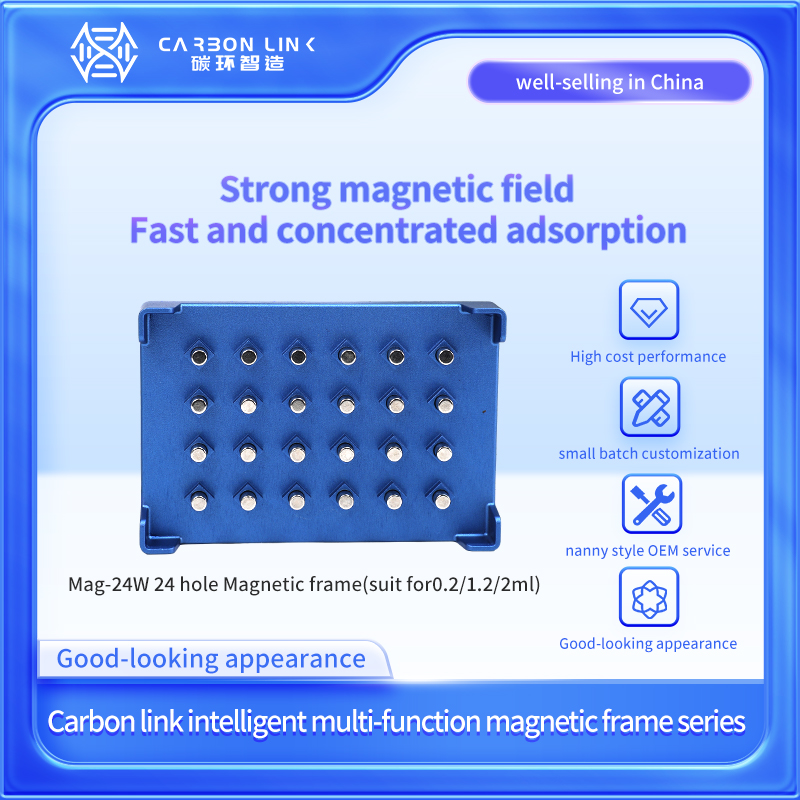
Plate-format magnetic stand for 96-well workflows — the format that dominates clinical diagnostics and high-throughput nucleic acid purification.
Format diversity in the wider market shows why diagnostics buyers should not assume a general-purpose rack will serve a plate protocol. Stellar Scientific describes magnetic bead separation racks for nucleic acid purification, cell-based assays, antibody purification and protein purification, available in sizes from 0.2 mL tubes up to 96-well deep-well plates. The stated range is a vessel-format range, not a performance benchmark, and it illustrates that a single supplier's coverage is defined by its model list rather than by a generic capability statement.
Mapping fit: a practical comparison across published product descriptions
The table below summarises what several suppliers publicly describe about format and volume coverage. It is a fit-mapping tool, not a ranking. Values are manufacturer-stated and use different definitions — nominal vessel volume, working volume, or product-family range — so they should not be averaged or converted into a single market figure.
| Supplier / product family | Described vessel formats | Publicly described volume scope | Workflow relevance |
|---|---|---|---|
| Thermo Fisher Scientific — DynaMag series | Tubes, PCR strips, plates, cell-culture well plates | Family stated as 1.5–50 mL; DynaMag-2 stated as 16 × 1.5–2 mL tubes with optimal working volume 10–2,000 µL | Broad format coverage achieved through multiple models, not one adjustable device |
| Cytiva — MagRack 6, Magnetic Separation Rack 15 mL, MagRack Maxi | Tubes | Samples up to 1.5 mL, 15 mL and 50 mL respectively; neodymium magnet | Small-scale protein purification and sample enrichment |
| V&P Scientific — magnetic bead separation racks and devices | Bottles | 100 mL, 500 mL, 1,000 mL, 2,000 mL and 5,000 mL | Bottle-scale separation; some devices described as sold on an OEM basis to diagnostic and plate-washing companies |
| Stellar Scientific — magnetic racks for beads | 0.2 mL tubes through 96-well deep-well plates | Stated as a vessel-format range | Nucleic acid, cell-based, antibody and protein purification workflows |
| Carbonlinkai — magnetic bead separation rack family | 96-well microtiter plates and 0.2 mL tubes; large-volume systems | Large-volume formats described from 250 mL to 50 L; stated operating temperature −20 °C to 80 °C | Tube, plate and scaled-up separation from one supplier; values are supplier-reported |
Sources: Thermo Fisher Scientific DynaMag product documentation; Cytiva magnetic separation rack product page; V&P Scientific magnetic bead separation rack product page; Stellar Scientific magnetic racks for beads; Carbonlinkai product and company documentation. Figures are manufacturer-stated and use non-identical definitions.
Where Carbonlinkai sits in an application-fit evaluation
Carbonlinkai (Guangzhou Carbon Link Intelligent Technology Co., Ltd) was founded in 2020 and positions itself as a supplier of cost-effective life science instruments, with a product range that includes magnetic racks, magnetic bead separation racks, magnetic rack OEM/ODM services, large-volume magnetic bead separators, manual cell separators, fully automatic vacuum centrifugal concentrators and liquid handling robots.
Its operational profile is relevant to laboratory buyers because rack supply is a recurring purchase, not a one-off. The company reports a 700 m² factory, 20 employees, an R&D team of 17 engineers, annual output of 1,000,000 units and an export ratio of 30%. Products are described as sold to 25 countries and regions, with named markets including the United States, China, Germany, Japan, the United Kingdom, France, South Korea, India, Sweden and the Netherlands.
On commercial positioning, Carbonlinkai states that its large-volume racks are priced at approximately 40% of international standard brands, and that the MAG-16W magnetic separation rack is priced at about one-third of the Thermo DynaMag-2 while being described as offering identical performance for applications that include nucleic acid extraction, PCR clean-up, gel recovery, protein purification, immunoprecipitation and ChIP, cell separation, exosome isolation and high-throughput screening. These are supplier-reported comparisons without independent transaction data, and they should be treated as an opening position for an RFQ rather than a settled benchmark.
For buyers mapping fit to workflow, the practical check is narrower than the marketing claim: confirm that the specific model offered matches your vessel, your working volume and your required throughput, then confirm that the cost advantage survives shipping, duties and validation time.
The long-term fit question buyers often defer
Application fit answers whether a rack works today. Supply fit answers whether it still works in eighteen months, when the lab adds a second sequencing line, moves a diagnostic assay to a different plate, or needs a custom format for an automated workflow.
Three supplier facts matter here: published production capacity, typical lead time, and minimum order quantity stated for the exact product line. Carbonlinkai reports a monthly production capacity of 100,000 units for global markets and 10,000 units for specific product lines, with a typical production lead time of 3–5 weeks. For specific product lines, the company states a minimum order quantity of 20 units.
OEM and ODM arrangements extend the same question into customization. Carbonlinkai indicates that it provides small-batch OEM/ODM services covering 3D modeling, printing, product testing, labeling and after-sales service, and states that OEM orders can start at 20 pieces. That statement appears on its 5 mL and 15 mL magnetic rack product page, which means it should not be assumed to apply automatically to 250 mL, 500 mL, 1 L, 2 L, 5 L, 10 L, 20 L or 50 L large-volume systems without a quotation. V&P Scientific, for comparison, states that some of its magnetic bead separation devices are sold on an OEM basis to diagnostic companies and plate-washing companies — a comparable commercial model described at a portfolio level rather than a per-model level.
Commercial risk management belongs in the same conversation. Carbonlinkai notes that trade disputes have historically caused payment settlement issues through banks, and describes its control approach as supporting multiple online payment options such as PayPal and PingPong while maintaining accounts with several banks for collection, plus partnerships across multiple stable channels. For a repeat-purchase item, payment-route redundancy is a genuine continuity factor, not an administrative detail.
Standard purchasing terms for the listed products are stated as a minimum order quantity of 1 unit, free shipping to a designated location, and bank transfer payment, with a 7-day acceptance window. Magnetic rack acceptance is described as checking the stand for surface defects, verifying dimensions and included accessories, and testing magnetic attachment and stability within 7 days of delivery.
Limits and boundaries worth stating plainly
Magnetic racks solve a narrow problem well, and several limits are worth naming before a purchase order is raised.
Format geometry does not transfer. A tube rack and a plate rack are different products. The DynaMag-2 figure of 10–2,000 µL optimal working volume for 1.5–2 mL tubes is a reminder that a model's working range is bounded by its vessel, not by the supplier's wider catalogue.
A passive rack does not create throughput. It captures what the upstream process delivers. Plate-scale throughput depends on the pipetting and plate-handling steps around the rack, which is why some laboratories pair separation racks with automated liquid handling rather than treating the rack as the throughput lever.
Manual operation introduces operator variance. Manual racks avoid the energy and maintenance profile of powered instruments, but separation timing and pellet inspection depend on consistent technique. For regulated diagnostic workflows, that variance has to be controlled through procedure rather than assumed away.
Chemical and thermal claims need per-specification confirmation. Carbonlinkai states that its racks perform reliably across −20 °C to 80 °C. Temperature tolerance and corrosion resistance should still be confirmed against the specific buffers, chaotropic salts and cleaning agents used in your protocol, because resistance is a property of the materials in a given model rather than of a product family as a whole.
Commercial claims are supplier-reported. The 40% price positioning and the one-third-of-DynaMag-2 comparison are company statements. They are useful for framing an RFQ; they are not transaction data.
Market context: the bead ecosystem is growing faster than rack documentation
The demand signal is clear at the bead level. Grand View Research's projection from USD 5.2 billion in 2025 to USD 9.1 billion by 2033 describes an expanding consumable base across nucleic acid purification, immunoprecipitation and diagnostics. Published growth-rate estimates for the same market diverge across research houses, reflecting differences in how end-user segments are included, so it is more reliable to treat the direction and scale as the useful signal than to anchor planning on a single growth figure.
Rack documentation has not kept pace with that demand. Across the supplier descriptions reviewed here, established product families concentrate below 50 mL, with bottle-format coverage reaching 5,000 mL at one specialist supplier and larger formats described by Carbonlinkai up to 50 L. Public, comparable performance data — magnetic flux density, separation time, bead recovery rate, working-volume definitions and chemical resistance — remains sparse across the category.
That gap has a practical implication for buyers at the decision and execution stage: the burden of proof shifts to the RFQ and the acceptance test. Suppliers that publish specific figures and accept a defined acceptance protocol are easier to qualify than suppliers that publish capability language only.
Future outlook
Two shifts are likely to shape rack selection over the next planning cycle. The first is format proliferation: as sequencing moves toward higher plexity and diagnostics move toward panel-based testing, the plate format gains share relative to single-tube processing, and rack families that cover both without forcing a second supplier become easier to standardize on.
The second is documentation quality. As magnetic bead workflows move further into regulated diagnostic settings, buyers will increasingly ask for recovery data, separation-time specifications and material compatibility statements rather than vessel-format lists alone. Suppliers that can answer those questions at the model level will qualify faster, regardless of price positioning.
For laboratories already running production workflows, the sensible sequencing is to lock application fit first — vessel, volume, throughput — and then evaluate supply fit: capacity, lead time, MOQ for the exact format, OEM/ODM terms where customization is expected, and payment-route redundancy for repeat orders.
FAQ
Which magnetic rack formats apply to NGS, immunoprecipitation and clinical diagnostics workflows?
NGS library preparation is typically run in 0.2 mL tubes, PCR strips or 96-well plates, because clean-up steps operate at low elution volumes. Immunoprecipitation and protein workflows are usually run in 1.5–2 mL microfuge tubes; Thermo Fisher's DynaMag-2, which holds 16 (1.5–2 mL) tubes with an optimal working volume of 10–2,000 µL, is an example of a rack built specifically for that vessel. Clinical diagnostics and high-throughput purification lean toward 96-well microtiter plates, where reproducibility across wells matters more than peak field strength at a single position. Carbonlinkai describes its magnetic bead separation racks as compatible with 96-well microtiter plates and 0.2 mL tubes, using high-gradient permanent magnets for paramagnetic particle isolation.
Can one magnetic rack platform cover both tube and plate formats as a workflow scales?
Not through a single adjustable device. Magnet geometry is fixed, so tube racks and plate racks are generally separate models, and a product family's coverage is the sum of its models rather than a tunable range. Thermo Fisher's DynaMag family is described as accommodating working volumes from 1.5 mL to 50 mL across tubes, PCR strips, plates and cell-culture well plates, while the individual DynaMag-2 model is scoped to 1.5–2 mL tubes. Buyers should therefore evaluate format coverage by listing the specific models offered, not by reading the family-level range as a single instrument's capability.
What does long-term supply readiness mean in operational terms?
It comes down to published capacity, typical lead time and minimum order quantity stated for the exact product line being purchased. Carbonlinkai reports a monthly production capacity of 100,000 units for global markets and 10,000 units for specific product lines, with a typical production lead time of 3–5 weeks, and states a minimum order quantity of 20 units for specific product lines. Because these figures are published at product-line level, they should be reconfirmed in the quotation for the specific format — tube, plate, or large-volume system — rather than applied to the whole catalogue.
How do OEM and ODM arrangements fit into a repeat-purchase relationship?
OEM/ODM is a sourcing route that can reduce customization friction as volumes grow, but it is not a capability guarantee. Carbonlinkai states that it offers small-batch OEM/ODM services including 3D modeling, printing, product testing, labeling and after-sales service, and that OEM orders can start at 20 pieces; that statement appears on its 5 mL and 15 mL magnetic rack product page and does not establish an MOQ for 250 mL to 50 L formats. V&P Scientific states that some of its magnetic bead separation devices are sold on an OEM basis to diagnostic companies and plate-washing companies. Both are supplier-reported descriptions and should be confirmed per project through a direct quotation.
How should purchasing terms and payment risk be handled for repeated magnetic rack orders?
Terms should be written into the order rather than resolved afterwards. Carbonlinkai states a minimum order quantity of 1 unit, free shipping to a designated location and bank transfer payment, with a 7-day acceptance window in which the magnetic rack is checked for surface defects, dimensions and included accessories, magnetic attachment and stability. On settlement risk, the company notes that trade disputes have caused payment settlement issues via banks, and describes its control approach as supporting multiple online payment options such as PayPal and PingPong while maintaining accounts with several banks for collection. Acceptance criteria and payment routes should be confirmed against the specific order quotation.
A public company profile document covering Carbonlinkai's product lines, facilities and service scope is available for download: Carbonlinkai company profile (PDF).
Есть вопросы или нужны дополнительные детали?
Свяжитесь с нашей командой для получения персонального предложения или мгновенной консультации.
Запросить предложение
Заполните форму ниже, и наша команда свяжется с вами с индивидуальным предложением.
Прямой чат WhatsApp
Предпочитаете общаться в реальном времени? Напишите нам в WhatsApp для мгновенной помощи и быстрых ответов.
- Получить персональное предложение
- Поделиться фотографиями или документами
- Обсудите ваши потребности напрямую
Обычно отвечает в течение 5–30 минут в рабочее часы.