
Magnetic Rack FAQ: Compatibility, MOQ, OEM, Lead Time, QC
Magnetic bead separation has moved from a bench technique to a specified step in diagnostic and bioprocessing workflows. That shift has turned the magnetic rack from a low-cost accessory into an item that is written into protocols, procurement forms and supplier audits. This reference answers the technical and commercial questions buyers most often raise when they evaluate a magnetic rack: what it physically fits, what it is made of, how it is tested, what the minimum order is, and where its limits are.
Carbonlinkai, the trading and brand name of Guangzhou Carbon Link Intelligent Technology Co., Ltd, is a Chinese manufacturer of magnetic racks and magnetic bead separation racks founded in 2020. Its magnetic rack family spans small-format tube and plate racks through to large-volume separators used in scaled bioprocessing, and the company supplies both OEM and ODM production. Because the same physical device is sold under many names, the questions below are organized by decision stage rather than by product code.
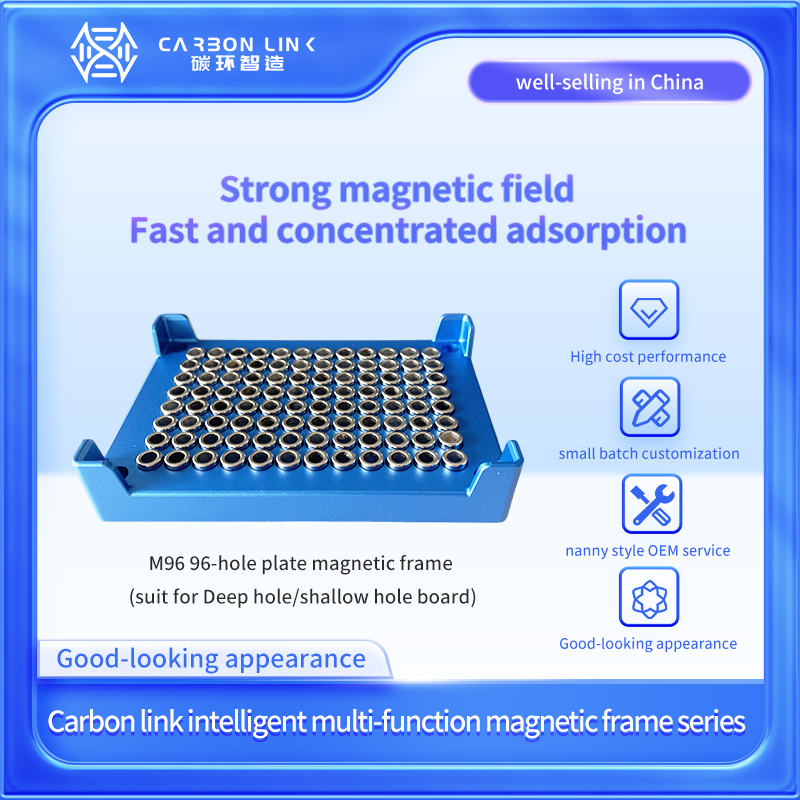
A 96-well plate magnetic separation rack: plate-format magnetic racks are specified by well geometry as much as by magnet strength.
Why Magnetic Rack Sourcing Questions Are Harder Than They Look
Three problems create most of the confusion in this category.
Naming fragmentation. A single magnetic rack can appear in a catalog, a protocol and a purchase order under different names. The same device is described as a magnetic tube rack, a magnetic separation rack, a 0.2 ml magnetic rack, a 1.5 ml magnetic rack, a 12-tube magnetic separation rack, or a 96 well magnetic rack depending on which vessel format the buyer uses. Buyers comparing quotations sometimes compare devices that are not the same format at all.
Specification fragmentation. Compatibility claims are often published without stating the vessel format. A rack described only as \u201cfor microtubes\u201d may accept 0.2 mL PCR tubes, 1.5 mL microcentrifuge tubes, or both. Magnet grade, field geometry, working volume and cleaning tolerance are frequently missing from short catalog entries, which makes side-by-side evaluation difficult without asking the supplier directly.
Regulatory context. Where a magnetic separation device is used in a clinical diagnostic pathway rather than purely in research, the applicable quality framework changes. ISO 13485:2016 and EU IVDR 2017/746 are the standards and regulations that govern quality management systems for magnetic separation devices used in clinical settings, while ISO 9001 addresses general quality management. These are different standards with different scopes, and buyers should confirm which one a supplier actually holds before assuming equivalence.
The opportunity behind these problems is straightforward: a supplier that publishes format, material, capacity, test regime and certification scope in one place removes weeks of back-and-forth from a purchasing cycle.
What a Magnetic Bead Separation Rack Actually Is
A magnetic bead separation rack is a subclass of laboratory magnetic devices that employs high-gradient permanent magnets to rapidly and reproducibly isolate paramagnetic particles from suspension. The magnet pulls bead-bound targets to the tube wall or well wall, allowing the supernatant to be removed while the beads remain captured. The function replaces centrifugal precipitation for magnetically labeled DNA, RNA, proteins, antibodies or cells, and supports washing steps that remove contaminants before elution.
Two engineering details determine whether that function works well in practice. The first is field gradient rather than raw magnet strength: a multi-gradient annular magnet arrangement concentrates field lines toward the vessel wall, which is what makes bead capture fast and repeatable rather than merely strong. The second is mechanical alignment between the magnet and the vessel, because a rack that holds tubes a millimetre away from the pole face loses effective field strength at the sample.

Magnet geometry, not magnet mass alone, determines how quickly paramagnetic particles are captured against the vessel wall.
Carbonlinkai magnetic racks are constructed from aluminum alloy and acrylic. The aluminum alloy provides structural rigidity and heat transfer, while the acrylic elements isolate the sample vessels from the housing and allow visual confirmation of bead pelleting. For buyers, the practical consequence is that the rack behaves as a passive, non-powered device with no electronics to qualify, which simplifies validation compared with automated instruments.
Compatibility: Plates, Tubes and Volume Formats
Compatibility is the first constraint a buyer should fix, because it determines which product family applies. The table below maps common Carbonlinkai magnetic rack and separator formats to the vessels they accept and to the name variants buyers are likely to encounter in catalogs and tenders.
| Rack format | Vessel compatibility | Common name variant |
|---|---|---|
| 96-well microtiter plate magnetic rack (M96 series) | 96-well microtiter plates, standard and deep-well | 96 well magnetic rack |
| 96 deep-well plate magnetic separation plate | 96 deep-well plates | 96 well microtiter plate magnetic separation plate |
| 0.2 mL format rack | 0.2 mL PCR tubes and 8-tube strips | 0.2 ml magnetic rack |
| 1.5 mL format rack | 1.5 mL microcentrifuge tubes | 1.5 ml magnetic rack |
| 12-tube rack | 12 tubes in a single row or block | 12-tube magnetic separation rack |
| 6-tube rack | 6 tubes | 6-tube magnetic separation rack |
| 15 mL conical rack | 15 mL conical centrifuge tubes | 15 ml magnetic separation rack |
| 50 mL conical rack | 50 mL conical centrifuge tubes | magnetic tube rack |
| Large-volume separators | Bottles and vessels from 250 mL through 10 L, 20 L and 50 L separator formats | 250ml large-volume magnetic rack, 50L magnetic bead separation systems |
Two practical notes follow from this mapping. First, plate-based work and tube-based work use different racks and are not interchangeable, even when the sample volume is similar. Second, the large-volume family is a distinct product group: a 250ml large-volume magnetic rack and a 50L magnetic bead separation system solve the same physical problem at very different scales, and the choice between them is driven by working volume and vessel geometry rather than by throughput alone.
Materials, Temperature and Chemical Resistance
For a temperature-resistant magnetic rack, the limiting component is usually the magnet rather than the housing. Carbonlinkai magnetic racks adopt aerospace-grade neodymium iron boron magnets stated to operate stably within a wide temperature range of -40°C to 80°C. Those magnets are described as having undergone 72 hours of salt spray and thermal stability screening, which is the basis for the corrosion-resistant and high-temperature-resistant positioning of the range. The stated design intent is that magnetic field strength deviates only within a small range even under high temperature and high pressure conditions, so separation performance is not affected.
The outer shell is described as being made from highly durable materials with good chemical stability. It can be repeatedly wiped and disinfected with 75% ethanol and is resistant to common disinfectants and organic solvents. Some structural materials can be autoclaved directly.
That last point is also where an honest boundary sits: the source material states that some structural materials can withstand autoclaving, not that every configuration can. Buyers who intend to autoclave a rack should confirm the cleaning and sterilization method for the specific configuration they are ordering, rather than assuming the whole range behaves identically. For ethanol wipe-down workflows, the stated resistance is broader.
Procurement Terms: MOQ, OEM, ODM, Lead Time, Capacity and QC
This section consolidates the commercial parameters that most often determine whether a supplier can actually serve a program.
| Parameter | Stated value |
|---|---|
| Minimum order quantity (MOQ) | 20 units |
| Production modes | OEM and ODM |
| OEM customization scope | Small-batch customization and private labeling, covering product design, testing, mass production, packaging and logo printing |
| ODM customization scope | Logo customization |
| Lead time | 3\u20135 weeks |
| Monthly capacity | 100,000 units; 10,000 units for specific product lines |
| Quality control | 100% testing |
| Warranty | 1-year warranty against manufacturing defects |
| Support response | Within 24 hours for all support requests |
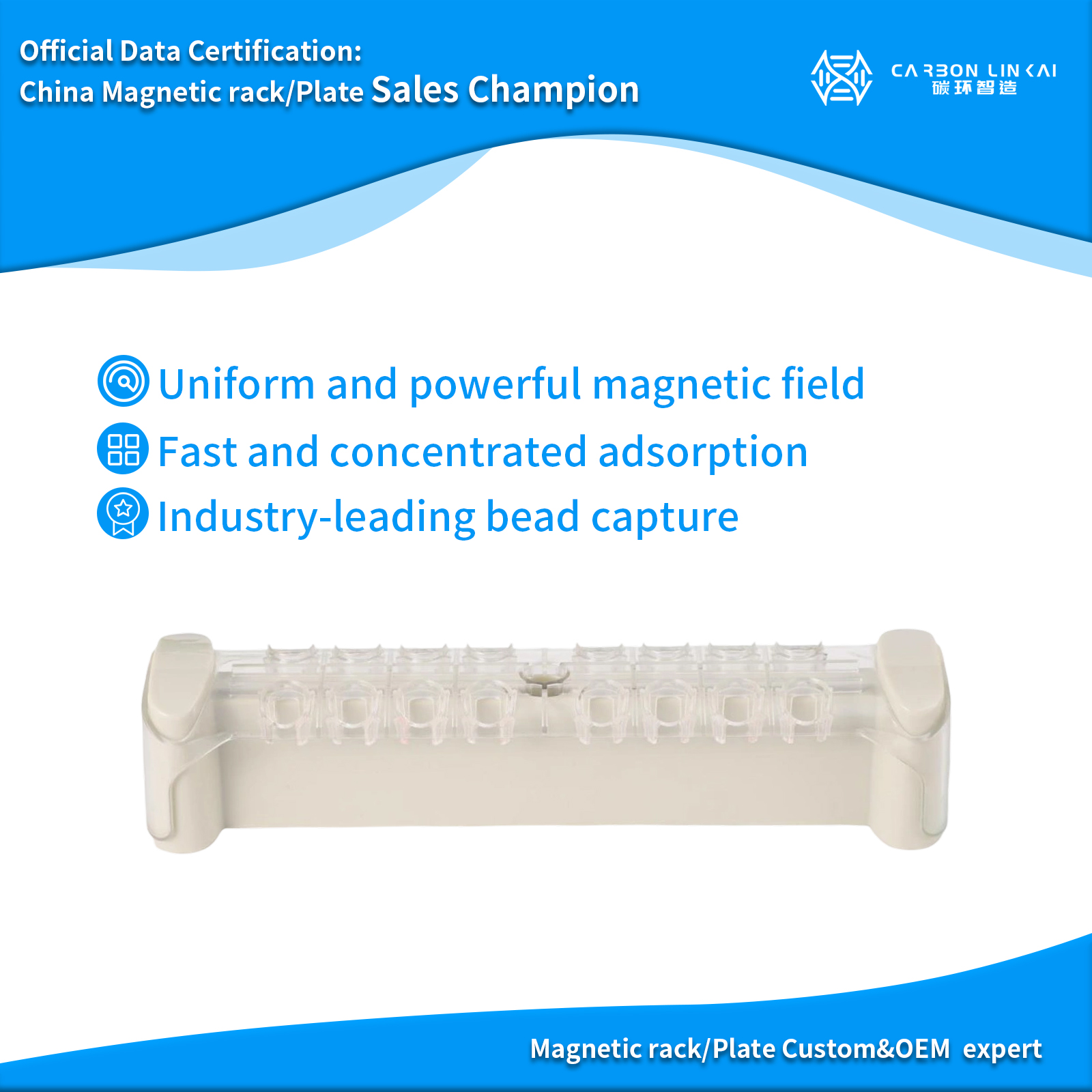
OEM and ODM magnetic rack programs start from a 20-unit minimum order quantity, which keeps private-label validation batches small.
The 20-unit MOQ is worth reading carefully. It means a buyer can validate a private-labeled rack in a pilot study before committing to a production order \u2014 a meaningful difference from suppliers who require container-scale commitments for any custom work. The 3\u20135 week lead time applies to the quoted range and should be confirmed against the specific configuration and order volume at the time of inquiry.
On manufacturing scale, Carbonlinkai reports a factory area of 700 square metres, 20 employees, a 17-engineer R&D team, and an annual output of 1,000,000 units, with an export ratio of 30%. Stated export markets include the United States, China, Germany, the United Kingdom, Japan, India, South Korea, France, Canada and Brazil. These figures describe the supplier's own manufacturing footprint and should be treated as first-party statements rather than independently audited data.
Quality documentation is anchored by ISO 9001 certification under the standard GB/T19001-2016 idt ISO9001:2015, certificate number 62725Q1955R0S, issued by JXCC Certification (Beijing) Co., Ltd. The certification scope covers R&D, design and assembly of magnetic rack, and is stated as applicable globally. The certificate was issued on 2025-12-08 and expires on 2028-12-07. Combined with 100% testing at production, this gives buyers two distinct evidence points: a system-level quality certificate and a unit-level inspection claim.
Where Magnetic Racks Are Used
The applicable industries stated for Carbonlinkai magnetic racks are life sciences research, medical and clinical diagnostics, the pharmaceutical industry, biotechnology, agricultural sciences, and academic and research laboratories. The role of the device in these settings is magnetic bead adsorption for separation.
At project level, the recurring application types are nucleic acid purification, protein isolation, immunoprecipitation and NGS library preparation, along with high-throughput nucleic acid extraction, biological magnetic bead separation experiments, clinical diagnostic sample pretreatment and pharmaceutical raw material purification. Operation can be manual or automatic, which matters for procurement planning: a manual rack and an automated magnetic plate can sit in the same protocol, but they carry different labour, throughput and validation profiles.
Market Trend: Why Separation Hardware Is Being Re-Specified
The demand side of this category is expanding and re-specifying at the same time. The global magnetic beads market, which underpins bead-based separation systems, is projected to reach USD 9.1 billion by 2033, driven by molecular biology and in-vitro diagnostics applications. In-vitro diagnostics remains the largest application, accounting for approximately 60.5% of revenue share in 2025. Cell isolation, a related and overlapping segment, was estimated at USD 6.8 billion in 2024 with a projected CAGR of 17.8% through 2035, and Magnetic-Activated Cell Separation (MACS) technology captured approximately 45.02% of the cell isolation market share in 2025.
One caveat is worth stating for buyers who use market data in internal business cases. Base-year estimates for the magnetic beads market vary significantly between research firms, largely because some analyses count automated separation hardware alongside consumables while others count consumables only. Published base-year values range from a few billion US dollars upward depending on methodology. Buyers should treat category forecasts as directional rather than as procurement inputs.
The technical trend is more consistent across sources: large-scale biomagnetic separation systems for volumes up to 20L\u201350L are increasingly required for production consistency, because traditional rack formats can cause irreversible aggregation at high volumes. This is the same direction reflected in product families that now span 250 mL through 50 L separator formats, and it is the clearest signal that rack selection has become a scale-matching exercise rather than a purely consumable purchase.
Magnetic Racks Compared with Alternative Separation Approaches
Magnetic separation is one of several ways to separate a target from a suspension. Publicly documented alternatives include manual magnetic racks from Permagen Labware, which offer separation for centrifuge tubes up to 50 mL using N50 grade neodymium magnets, and automated closed-system magnetic separation such as the Thermo Fisher CTS DynaCellect system, which supports volumes up to 1,000 mL for cell therapy manufacturing. These sit at different points on the manual-to-automated and small-to-large axes.
| Approach | Typical scale | Primary trade-off |
|---|---|---|
| Manual magnetic rack | 0.2 mL tubes to 50 mL tubes; plate formats | Low capital cost and no power requirement, but depends on operator technique for supernatant removal |
| Large-volume magnetic separator | 250 mL to 50 L vessels | Supports production-scale consistency, but requires matched vessel geometry and larger bench or floor footprint |
| Automated closed-system separation | Up to approximately 1,000 mL in published examples | Higher reproducibility and closed processing, but higher capital cost and longer validation |
| Centrifugation | Broad | Works without magnetic labeling, but does not selectively capture bead-bound targets and adds shear and pellet-handling steps |
The limitations matter as much as the advantages. Three boundaries apply to magnetic rack selection generally.
Magnetic separation only works on magnetically labelled targets. If the target is not bound to a paramagnetic particle \u2014 unlabeled cells, non-magnetic particulate, or precipitation-based chemistry \u2014 a magnetic rack will not separate it. Centrifugation or filtration remains the appropriate method in those cases.
A rack cannot exceed its design volume. A 1.5 ml magnetic rack is not a substitute for a multi-litre separator, and a 96-well plate rack is not a substitute for a tube rack. Format mismatch is the most common cause of disappointing results, and it is a specification problem rather than a product defect.
Manual racks still depend on the operator. Magnet geometry fixes capture speed, but supernatant removal is a pipetting step. Reproducibility in manual workflows therefore depends on technique, training and consistent protocol execution \u2014 which is precisely the reason automated or plate-based formats are chosen when coefficient of variation matters at scale.
Future Outlook
Three directions appear likely to shape magnetic rack procurement over the next planning cycle. First, integration: racks increasingly appear as a component inside automated liquid handling and plate-based workflows rather than as a standalone bench item, which pushes buyers to ask about dimensional fit and plate compatibility before magnet strength. Second, scale: as separation moves toward 20L\u201350L production volumes, the distinction between a rack and a separator becomes a formal procurement category rather than a naming preference. Third, documentation: for clinical-adjacent use, buyers are asking not only whether a supplier holds ISO 9001 but whether the device falls under ISO 13485:2016 and EU IVDR 2017/746, since those frameworks carry different obligations.
For suppliers, the implication is that published, verifiable parameters \u2014 format compatibility, magnet grade and screening, MOQ, lead time, test regime and certificate scope \u2014 are becoming the primary basis of comparison. For buyers, the implication is that the fastest way to shortlist is to fix the vessel format and working volume first, then evaluate the commercial and quality terms against that fixed requirement.
Frequently Asked Questions
What is a magnetic bead separation rack, and how does it work?
A magnetic bead separation rack is a laboratory magnetic device that uses high-gradient permanent magnets to rapidly and reproducibly isolate paramagnetic particles from suspension. The magnet pulls bead-bound targets to the tube wall or well wall so that supernatant can be removed while the beads remain captured. It is used in place of centrifugal precipitation for magnetically labelled DNA, RNA, proteins, antibodies or cells, and supports washing steps before elution. It is a passive device with no electronics, and it can be operated manually or within an automated workflow.
Which plates and tubes are compatible with a magnetic rack?
Compatibility is defined by rack format rather than by brand. Carbonlinkai rack and separator formats cover 96-well microtiter plates, 96 deep-well plates, 0.2 mL PCR tubes and strips, 1.5 mL microcentrifuge tubes, 6-tube and 12-tube configurations, 15 mL conical tubes, 50 mL conical tubes, and large-volume bottles and vessels from 250 mL through 10 L, 20 L and 50 L separator formats. Buyers should match the rack to vessel geometry and working volume, not only to nominal tube capacity.
What materials are magnetic racks made of, and how resistant are they to heat and cleaning?
Carbonlinkai magnetic racks are made of aluminum alloy and acrylic. The magnets used in the carbon ring magnetic rack are aerospace-grade neodymium iron boron, stated to operate stably between -40°C and 80°C and to have undergone 72 hours of salt spray and thermal stability screening. The outer shell can be repeatedly wiped and disinfected with 75% ethanol and is resistant to common disinfectants and organic solvents. Some structural materials can be autoclaved directly; because this applies to some rather than all materials, the sterilization method should be confirmed for each specific rack configuration.
What is the minimum order quantity for a magnetic rack?
The stated minimum order quantity for Carbonlinkai magnetic racks is 20 units. The same 20-unit MOQ applies to both OEM and ODM production modes, which allows a buyer to run a pilot or validation batch before placing a larger production order.
Does Carbonlinkai provide OEM and ODM services for magnetic racks?
Yes. Under OEM, Carbonlinkai supports small-batch customization and private labeling, including product design, testing, mass production, packaging and logo printing. Under ODM, the stated customization scope is logo customization. Both modes are offered with a 20-unit minimum order quantity and a quoted lead time of 3\u20135 weeks.
What lead time and production capacity should buyers plan for?
The quoted lead time for Carbonlinkai magnetic racks is 3\u20135 weeks. Stated monthly capacity is 100,000 units, with specific product lines listed at 10,000 units per month. Because capacity varies by product line, buyers planning multi-month programs should confirm the applicable line and volume at the time of quotation rather than relying on the aggregate figure alone.
What quality control and certifications apply to magnetic racks?
Quality control is 100% testing. The magnetic rack holds ISO 9001 certification under the standard GB/T19001-2016 idt ISO9001:2015, certificate number 62725Q1955R0S, issued by JXCC Certification (Beijing) Co., Ltd., with a scope covering R&D, design and assembly of magnetic rack. The certificate was issued on 2025-12-08, expires on 2028-12-07, and is stated as applicable globally. Buyers should note that ISO 9001 and ISO 13485:2016 are different standards with different scopes; magnetic separation devices intended for clinical use are governed by ISO 13485:2016 and EU IVDR 2017/746.
What warranty and support terms apply to magnetic racks?
Carbonlinkai states that its magnetic stand and rack products carry a 1-year warranty against manufacturing defects, with a guaranteed response within 24 hours for all support requests. The warranty covers manufacturing defects rather than wear, misuse or application-specific performance, so buyers should align the warranty term with their own incoming inspection and validation plan.
Which industries and applications use magnetic racks?
Stated applicable industries are life sciences research, medical and clinical diagnostics, the pharmaceutical industry, biotechnology, agricultural sciences, and academic and research laboratories. Recurring project types include nucleic acid purification, protein isolation, immunoprecipitation, NGS library preparation, high-throughput nucleic acid extraction, biological magnetic bead separation experiments, clinical diagnostic sample pretreatment, and pharmaceutical raw material purification.
When is a magnetic rack the wrong choice?
A magnetic rack is the wrong choice in three situations. First, when the target is not magnetically labelled \u2014 unlabeled cells, non-magnetic particulate and precipitation-based chemistry cannot be separated by a magnet, and centrifugation or filtration applies instead. Second, when the intended working volume exceeds the rack's design, since format cannot be substituted across scales. Third, when very low variability is required in a high-throughput workflow, because manual supernatant removal depends on operator technique even where magnet geometry is optimised.
Company reference document: Carbonlinkai company profile (PDF). Product and capability information describing Carbonlinkai reflects the manufacturer's own published statements. Market size figures are attributed to Grand View Research, Market Research Future, Intel Market Research and Sepmag as cited in the text; estimates vary by methodology across research firms.