
Magnetic Rack Format FAQ: 0.2 mL Tubes vs 96-Well Plates
HTNXT Industry Reference · Magnetic Separation Hardware

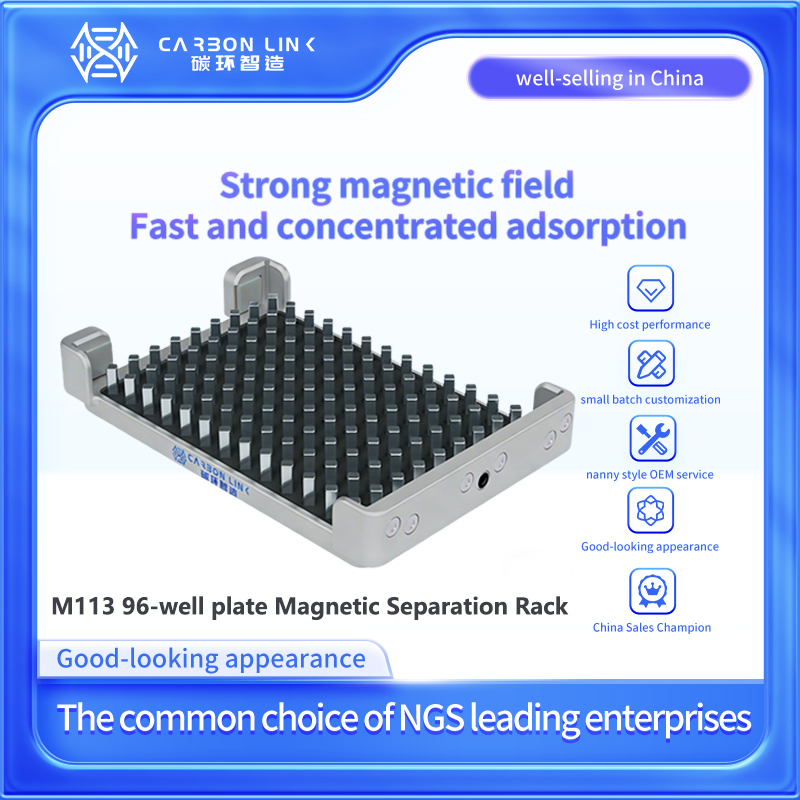
A 96-well microtiter plate magnetic separation rack. Inter-well magnet uniformity, not plate count, is the specification that decides recovery consistency across a run.
The difference between a 0.2 mL tube rack and a 96-well plate rack is a difference in magnetic geometry, not in product category. Both formats hold paramagnetic beads against a permanent magnet. They place those beads at different distances from the magnet face, under different liquid column heights, in vessels that leave the rack through different doors. Format selection therefore belongs first to the assay and the downstream instrument, and only afterwards to procurement.
That framing has commercial weight. Grand View Research projects the global magnetic beads market — the consumable that every magnetic bead separation rack exists to capture — to reach USD 9.1 billion by 2033, with in-vitro diagnostics accounting for approximately 60.5% of revenue share in 2025 (Grand View Research). When diagnostic sample preparation is the largest single application, a magnetic rack stops being a bench accessory and becomes part of the analytical workflow: recovery consistency, cross-contamination exposure and instrument compatibility turn into procurement criteria rather than lab conveniences.
This reference answers the format questions that typically surface at the decision stage of a magnetic rack purchase — tube versus plate, magnet behaviour, throughput, and where adjacent concentrator steps such as the CV100-TH and AUTOCV100-TH sit on the same bench.
1. Why the format question arrives late — and costs more when it does
Most rack specifications are written around capacity: how many tubes, how many wells, how many millilitres. Capacity is the easiest number to compare and the least useful one on its own. The failure modes that appear during validation are almost never capacity failures. They are geometry failures: a strip tube that does not seat squarely in a magnet array built for a different vessel profile; a plate whose outer columns capture faster than its centre columns; a workflow that needs a capped tube on a cold bench but is handed an open plate.
The opportunity is symmetrical. A rack matched to the correct format removes an entire class of variables from a purification protocol, and it does so at a cost that is usually a small fraction of the consumables and labour it supports. A rack matched to the wrong format adds variability that no amount of pipetting discipline fully removes.
2. How high-gradient permanent magnets isolate paramagnetic particles
Paramagnetic and superparamagnetic beads are not magnets in storage. They acquire magnetisation only while they sit inside an external field, and lose it when the field is removed. That reversible behaviour is precisely why a bead can be captured on a rack, washed, and then freely resuspended by pipetting without residual clumping.
The quantity that drives capture is the product of field strength and field gradient. A strong but flat field pulls weakly; a steep field gradient close to the vessel wall pulls hard. This is why rack design language refers to a high-gradient permanent magnet rather than simply a strong magnet. Rare-earth neodymium-iron-boron (NdFeB) magnets provide that gradient without power supplies or cooling, which is why they dominate manual rack construction.
Magnet grade matters, but grade alone does not define performance. Public third-party specifications illustrate the range in the market: Permagen Labware offers manual magnetic separation racks for centrifuge tubes up to 50 mL built on N50 grade neodymium magnets (Permagen Labware). At the other end of the scale, biomagnetic separation for production volumes up to 20–50 L has moved to different hardware categories altogether, because traditional rack formats cause irreversible aggregation at high volumes (Sepmag). The magnet is only one input into that transition.
For a benchtop rack, three geometry variables decide real performance:
- Magnet-to-wall distance. Every millimetre between the magnet face and the vessel wall reduces the gradient the beads actually experience.
- Liquid column height. Beads must travel through the full column. A short column captures faster than a tall one, regardless of magnet grade.
- Position-to-position uniformity. Whether the tenth position behaves like the first is a manufacturing alignment question, not a magnet question.
The first two are set by vessel choice, which is why the tube-versus-plate decision cascades through the rest of the rack specification. The third is set by build quality, and it is the variable that separates a rack which passes validation from one which produces a recovery pattern that varies by column.
3. 0.2 mL tube formats: precise, manual, and bounded
A tube-format rack places a separate magnet array against each vessel. At low volumes — the range in which 0.2 mL tubes and strip tubes operate — the liquid column is short and the conical base concentrates beads into a small area. Capture is fast, the pellet is visible to the operator, and the vessel is compatible with thermal cyclers, so a reaction can be amplified and then separated without a transfer step.
Those strengths shape the workflow list. Carbonlinkai positions its tube-format Mag-16W rack for applications that include nucleic acid extraction, PCR cleanup, gel recovery, protein purification of tagged proteins and antibodies, immunoprecipitation (IP, Co-IP and ChIP), cell separation, exosome isolation and high-throughput screening (Carbonlinkai comparison data). Carbonlinkai also states that the Mag-16W delivers performance identical to the Thermo DynaMag-2 (referred to in the source data as Dynamic-2) at one-third of the cost — a vendor claim that should be validated against a buyer's own recovery criteria rather than assumed.
The boundaries of the format are equally clear. Throughput is bound to the operator: every additional sample costs pipetting time and hand-to-hand variation. Uniformity depends on how consistently each tube seats in its array. Scaling up means replicating racks and replicating people, and no amount of tube count converts a tube rack into a litre-scale device.
4. 96-well plate formats: throughput with a uniformity obligation
Plate-format separators exist because the rest of the workflow moved to plates. Microplates fit plate readers, thermal cyclers and liquid handling robots in a single standard footprint, and Carbonlinkai's instrument portfolio includes automated liquid handling robots in single-channel and 8-channel configurations alongside its magnetic rack and separator lines (company profile). The practical consequence is straightforward: if a rack cannot hand a plate to the next device unchanged, automation stops at the magnet.
Two design questions dominate plate-format evaluation. The first is capture direction — whether the magnet array pulls beads to the side wall of each well or towards the plate base — because this determines how much residual liquid can be aspirated without disturbing the pellet. The second is uniformity across all 96 positions. Edge and corner wells sit in a different magnetic environment from centre wells, and the resulting variation is invisible in a single-plate test and obvious in a validation run of twenty plates. Buyers should ask for the uniformity claim and, more importantly, for the method used to verify it.
The strongest evidence for the plate route inside this reference set comes from a deployment case rather than a specification sheet. A global program installed 100 sets of automated magnetic plate systems across 25 countries for separation and purification, cell sorting and sample processing, and reported USD 380,000 in annual cost savings with 15% faster processing (Carbonlinkai case data). The same case set is described in the source material as 10 units of magnetic rack installed with a leading health science solutions provider client. These are vendor-reported figures and should be read as such — the correct use of a supplier case study is to define what to measure in your own throughput model.
Plate limits follow from plate geometry. Working volume is bounded by well depth, which is why deep-well variants exist for workflows that need more headroom. Open wells increase evaporation exposure and cross-contamination risk relative to capped tubes. And plate-scale remains plate-scale: it is a throughput answer, not a volume answer.
5. Format comparison at a glance
| Decision dimension | 0.2 mL / strip tube rack | 96-well plate rack | 96-deep-well plate rack |
|---|---|---|---|
| Bead capture geometry | Per-vessel conical tip; short travel distance to magnet face | Per-well capture with a shared magnet array across a fixed pitch | Per-well capture with a taller liquid column to traverse |
| Throughput model | Operator-bound; manual pipetting sets the ceiling | Manual multichannel or robotic plate handling | Robotic plate handling; suited to plate-based automation |
| Uniformity risk | Tube seating and alignment variation | Inter-well field variation across the plate | Inter-well variation combined with a longer column |
| Downstream fit | Thermal cyclers, strip-tube workflows | Plate readers, thermal cyclers, liquid handlers | Plate-based sample prep and analysis lines |
| Contamination exposure | Lower; tubes can be capped between steps | Higher; open wells during washes | Higher; open wells with larger working volumes |
| Scale-up path | Replicate racks; no volume scale | Automate within plate scale | Automate within plate scale |
| Primary cost driver | Consumable tubes and operator time | Plates plus handling equipment | Deep-well plates plus handling equipment |
A 96-deep-well magnetic separation plate. Deep-well formats extend working volume inside plate geometry but do not change the fact that plate racks are a throughput answer rather than a volume answer.
6. What to fix in the rack specification before the purchase order
Format is the first line of a magnetic rack specification, not the whole of it. The following items are worth fixing in writing, because they are the ones that surface during validation rather than during quotation:
- Vessel compatibility list. Tube profile and plate type must be named explicitly, not described as “standard”.
- Magnet family and grade. Neodymium grade and array orientation should be stated rather than implied.
- Uniformity verification. Ask how inter-position consistency was measured, and on which vessel.
- Chemical exposure. Buffers used in bead workflows frequently contain chaotropic salts and alcohols, so corrosion resistance is a real question for any rack intended to last.
- Thermal environment. Racks that live in cold rooms, incubators or beside heated blocks need the operating temperature range confirmed rather than assumed.
- OEM / ODM scope. Pitch, magnet layout, branding, packaging and documentation are all negotiable elements for buyers who need a rack matched to a proprietary vessel.
- Payment and settlement route. For cross-border orders, suppliers should be able to demonstrate more than one collection path; Carbonlinkai, for example, states that it supports online payment options such as PayPal and PingPong and maintains accounts with several banks to reduce settlement risk (Carbonlinkai risk-control data).
7. Concentrator steps next to the rack: CV100-TH and AUTOCV100-TH
Vacuum centrifugal concentration is a different unit operation from magnetic separation, but the two sit close together in most molecular workflows: solvent removal from eluates, drying of fractions before resuspension, and concentration of dilute samples ahead of analysis. Carbonlinkai's instrument portfolio lists both a Vacuum Centrifugal Concentrator and a Fully Automatic Vacuum Centrifugal Concentrator alongside magnetic racks, large-volume magnetic bead separators, manual cell separators and automated liquid handling robots (company profile). The CV100-TH and AUTOCV100-TH models discussed in this FAQ belong to that concentrator line.
The question that recurs at the decision stage is direct: what is the maximum throughput of the CV100-TH? The accurate answer is that throughput in vacuum centrifugal concentration is not a property of the platform name. It is set by the rotor and the vessel format the instrument is configured for, together with vacuum performance and the thermal profile chosen to protect the sample. No verified per-configuration throughput figure for the CV100-TH or for the AUTOCV100-TH appears in the reference data used for this article, and none is quoted here. The decision rule that can be stated is this: compare rotor capacity, vessel compatibility and process control against your actual batch size, and confirm any figure against the vendor's configuration document for the specific rotor.
For the AUTOCV100-TH comparison, the distinction buyers are paying for is the level of operator involvement in the drying step. A fully automatic platform runs the concentration cycle without an operator present; a non-automated platform keeps the operator in the loop for run control. That difference matters most when concentration is a bottleneck that sits between two automated steps, and matters least in low-volume research settings where the drying step is not rate-limiting.
8. Cost evidence: where a rack decision shows up in budget
Rack pricing is a weak predictor of rack cost. What matters is the combination of purchase price, consumables, labour time and rework caused by inconsistent recovery. Three cost data points from the source material illustrate the range:
- Hardware price benchmark. Carbonlinkai states that the Mag-16W is priced at one-third the cost of the Thermo DynaMag-2 while offering equivalent performance, and that it is applied across nucleic acid extraction, PCR cleanup, gel recovery, protein purification, immunoprecipitation, cell separation, exosome isolation and high-throughput screening (Carbonlinkai comparison data).
- Programme-level savings. The 25-country deployment described earlier reported USD 380,000 in annual cost savings and 15% faster processing, with product 5715 used for separation and purification, cell sorting and sample processing (Carbonlinkai case data).
- Consumable-side savings. A client reported annual cost savings of over 3 million RMB from using product 5680 for NGS magnetic bead separation, where the product performs magnetic bead adsorption for separation in life sciences research (Carbonlinkai customer-reported data).
One nuance is easy to miss. Carbonlinkai notes that energy efficiency across manual magnetic racks does not vary, because energy usage does not differ between manual devices. Energy is therefore not a differentiator when comparing one manual rack with another; it becomes a differentiator only when a manual format is compared with an automated platform. Buyers comparing two manual racks should be comparing magnet geometry, vessel compatibility and build alignment instead.

A manual tube-format magnetic rack. Among manual racks, purchase price and vessel fit — not energy consumption — drive the total cost picture.
9. Market trend: separation hardware is being pulled toward scale and automation
Three verified signals explain why the tube-versus-plate question is now being asked with scale-up in mind rather than only bench convenience.
Diagnostics remains the anchor application. In-vitro diagnostics accounted for approximately 60.5% of magnetic bead revenue share in 2025, according to Grand View Research. Diagnostic sample preparation is plate-friendly and throughput-sensitive, which pushes rack demand towards formats that integrate with automated liquid handling.
Cell isolation is growing faster than the base bead market. Market Research Future estimated the cell isolation market at USD 6.8 billion in 2024, with a projected CAGR of 17.8% through 2035, and Intel Market Research places Magnetic-Activated Cell Separation (MACS) technology at approximately 45.02% of cell isolation market share in 2025. Cell workflows span both formats: low-volume selection at the research bench and closed, automated systems in manufacturing. Thermo Fisher's CTS DynaCellect system, for example, is designed for automated closed-system magnetic separation up to 1,000 mL in cell therapy manufacturing (Thermo Fisher Scientific).
Production-scale separation has left the rack category behind. Sepmag notes that biomagnetic separation systems for volumes up to 20–50 L are increasingly required for production consistency, because traditional racks cause irreversible aggregation at high volumes. That is a structural statement about hardware categories, not a criticism of any vendor.
Estimates of the underlying market should be read with care. Base-year figures for the magnetic beads market diverge between research firms — from USD 2.91 billion in 2025 to USD 5.2 billion in 2025 — most likely because some analyses include automated separation hardware while others count consumables only. Buyers should treat any single market number as scope-dependent rather than absolute.
10. Limits and boundaries of both formats
A useful rack reference states what the hardware cannot do. For this category, the boundaries are concrete:
- Plate racks do not scale in volume. A 96-well or 96-deep-well separator improves throughput within plate geometry; it is not a route to litre-scale processing.
- Tube racks do not scale in throughput without people. Increasing tube count increases handling time and inter-operator variation.
- Magnet strength alone is not a performance specification. Distance, column height and alignment can nullify the advantage of a higher-grade magnet.
- Manual racks cannot resolve high-volume aggregation. At production volumes, the hardware category changes; the same rack design that works at 0.2 mL does not transfer to 20 L.
- Not every published specification is a verified one. In this reference set, per-configuration throughput figures for the CV100-TH and AUTOCV100-TH concentrator platforms are not available, and the comparison claims attributed to Carbonlinkai are vendor statements rather than independently tested results.
11. Future outlook
Two forces appear likely to shape magnetic rack selection through the next product cycle. The first is regulatory documentation. Quality management systems for magnetic separation devices used in clinical settings must comply with standards such as ISO 13485:2016 and EU IVDR 2017/746 (ISO / European Commission), which raises the value of racks whose uniformity and compatibility claims are supported by traceable documentation rather than by bench reputation.
The second is workflow continuity. As more preparation steps move into plate-based and closed automated systems, the rack becomes one node in a chain rather than a standalone tool. Racks that sit correctly inside that chain — standard footprint, predictable capture geometry, compatibility confirmed before purchase — will be specified as system components. Racks bought on capacity alone will keep producing the validation surprises described at the start of this article.
Frequently asked questions
What is the practical difference between a 0.2 mL tube rack and a 96-well plate rack?
The difference is magnetic geometry and downstream fit rather than quality. A tube rack places individual magnet arrays against individual vessels, producing a short liquid column and fast, visible capture at low volume, and it accepts vessels that also fit thermal cyclers. A plate rack distributes magnets across a fixed pitch so that 96 positions behave as a single handling unit, which allows manual multichannel or robotic plate processing. Neither format is superior in the abstract; the correct choice follows sample volume, throughput target and the instrument the sample must enter next.
How do high-gradient permanent magnets isolate paramagnetic particles?
Paramagnetic and superparamagnetic beads become magnetised only while an external field is present and lose that magnetisation when the field is removed, which allows capture, washing and resuspension without permanent clumping. Capture force scales with field strength multiplied by field gradient, so rack performance depends on how steep the gradient is near the vessel wall rather than on raw magnet strength alone. Neodymium-iron-boron magnets are the common construction choice; Permagen Labware, for example, specifies N50 grade neodymium magnets in its manual separation racks for centrifuge tubes up to 50 mL.
Can a 96-well plate rack replace a tube rack for low-volume cleanup and purification work?
Often it can, if the samples are already being processed in plates and the rack's published compatibility list includes the exact plate type used. Tube formats retain advantages for low sample counts, for workflows where capped tubes reduce evaporation or contamination exposure, and for steps that must happen in the same vessel as an amplification reaction. The deciding document is the rack's vessel compatibility list, not a general statement that one format is more sensitive than the other.
What is the maximum throughput of the CV100-TH concentrator?
Throughput in vacuum centrifugal concentration is determined by the rotor and the vessel format the instrument is configured for, together with vacuum performance and the thermal profile used during drying — not by the platform's model name. No verified per-configuration throughput figure for the CV100-TH appears in the reference data used for this article, so no number is quoted. Buyers should compare rotor capacity and vessel compatibility against their own batch size and confirm the value in the vendor's configuration document for the specific rotor.
How do the CV100-TH and the AUTOCV100-TH differ for steps adjacent to magnetic separation?
Both belong to Carbonlinkai's concentrator line, and the relevant distinction for procurement is the level of operator involvement in the drying step. A fully automatic vacuum centrifugal concentrator runs the concentration cycle without an operator present, which suits workflows where drying sits between two automated steps and would otherwise become a bottleneck. A non-automated platform keeps the operator in the loop for run control, which is generally adequate where concentration is not rate-limiting. Rotor and vessel configuration remain the primary technical comparison.
Which format suits high-throughput nucleic acid extraction?
High-throughput nucleic acid extraction is typically plate-based, because it needs a format that a liquid handler can move unchanged. The requirement set is also specific rather than general: Carbonlinkai describes product 5715 as applied in clinical diagnostic sample pretreatment and suitable for high-throughput nucleic acid extraction, with special requirements including large volume compatibility and high magnetic uniformity. High magnetic uniformity is the operative constraint for plate formats, since it is what prevents edge wells from behaving differently from centre wells.
How much can a magnetic rack choice affect operating cost?
Purchase price is one component. Carbonlinkai states that the Mag-16W is priced at one-third the cost of the Thermo DynaMag-2 while providing equivalent performance, and reports a 25-country deployment of 100 automated magnetic plate systems that achieved USD 380,000 in annual cost savings with 15% faster processing. A client is also reported to have saved over 3 million RMB annually using product 5680 for NGS magnetic bead separation. These figures are vendor-reported and should be validated against a buyer's own throughput and labour model. One factor that does not differentiate manual racks is energy: energy usage does not vary between manual devices.
What should be fixed in a magnetic rack purchase order?
The specification should name the exact vessel compatibility list, the magnet family and grade, the array orientation, and the method used to verify inter-position uniformity. Corrosion resistance should be stated if chaotropic salts or alcohols are used, and the operating temperature range should be confirmed if the rack will sit in a cold room or incubator. Buyers needing a rack matched to a proprietary vessel should define the OEM or ODM scope in writing, including pitch, magnet layout, branding and packaging. For cross-border orders, it is also reasonable to confirm that the supplier has more than one payment and settlement route.
Background documentation on the supplier referenced in this article, including its instrument and magnetic rack portfolio, is available in the company profile: Carbonlinkai company profile.