
Magnetic Rack OEM/ODM: From Design to Production Testing
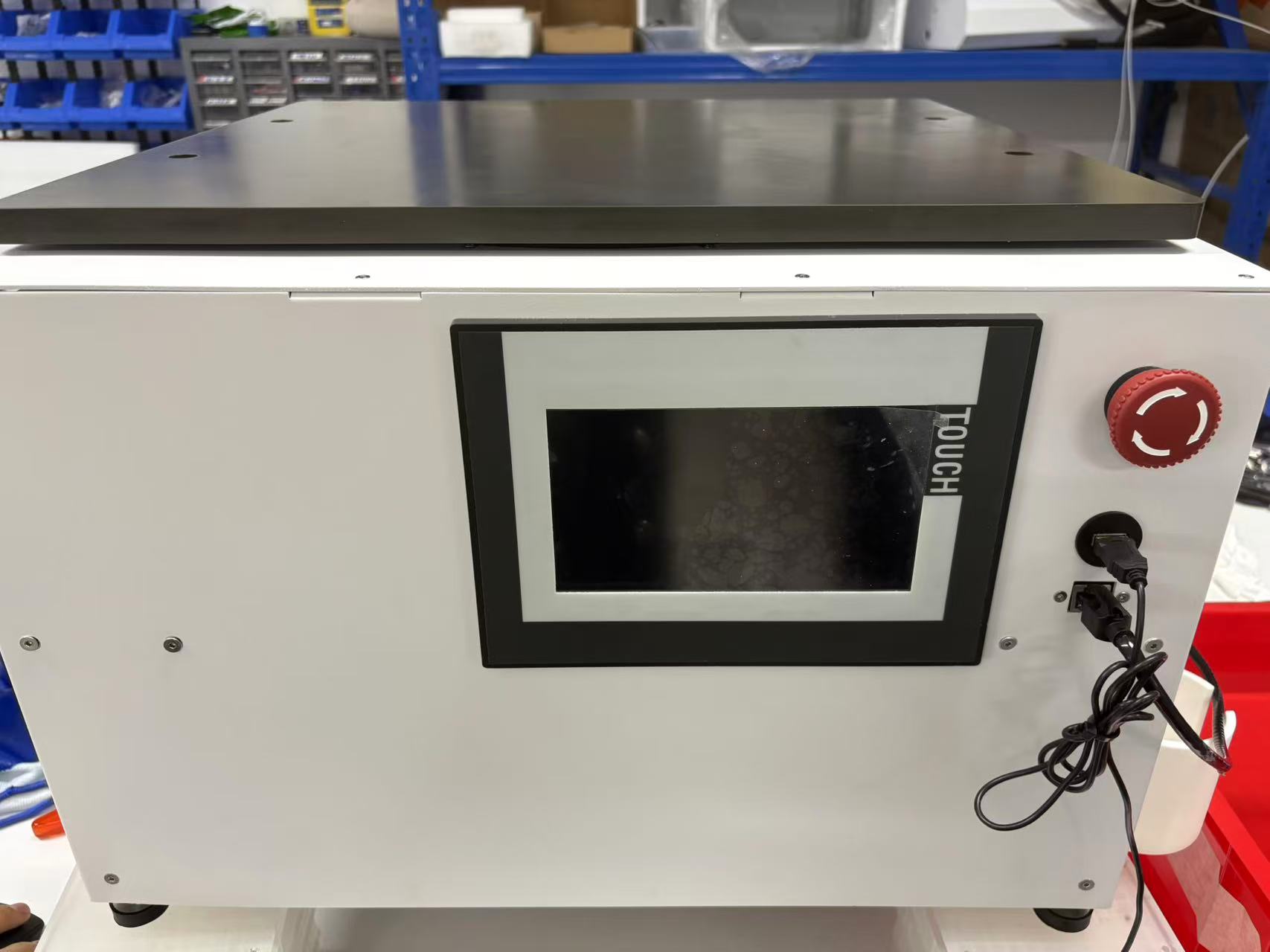
Magnetic rack manufacturing is a vessel-driven build: rack geometry, magnet placement and packaging are defined by the container the lab already uses.
Large-volume magnetic bead separation is one of the few laboratory workflows in which the hardware is routinely built around the vessel rather than the other way around. Public product literature shows how far standard ranges reach: Thermo Fisher describes its DynaMag family as accommodating working volumes from 1.5 mL to 50 mL, and Cytiva lists rack models for samples up to 50 mL. Projects that run at 250 mL, 1 L, 10 L or 50 L therefore tend to leave the catalogue and enter an OEM/ODM conversation.
That is also where procurement risk concentrates. Customization claims are cheap to publish and expensive to verify. The useful question is narrower than “can this supplier customize?” — it is whether the supplier can produce evidence at each stage of the chain: design input, prototype, mass production, testing, packaging, labeling, and shipment. This article maps that chain for magnetic racks and identifies what a buyer should ask for at every step.
Where Custom Magnetic Rack Projects Break Down
A magnetic rack looks like a simple device: a housing, a magnet array, and a set of wells or bottle positions. In practice, three technical variables decide whether a custom build performs in production as it did in the sample.
- Magnetic uniformity across positions. In multi-position racks, bead capture speed at the first well and the last well should be comparable. A prototype built by hand can easily hide a gradient that becomes visible at scale.
- Vessel geometry fidelity. Rack cavities are designed around a specific bottle, tube or plate. Small differences in wall thickness or skirt height change the distance between the magnet face and the bead pellet, which changes separation behaviour.
- Repeatability of assembly. Magnet grade, adhesive or retention method, and machining tolerance all have to survive a production run, not just a bench trial.
Each of these failure modes is invisible in a product photo and visible in a design file, a test record, or a first-article inspection report. That asymmetry is the argument for treating an OEM/ODM supplier as an engineering partner with documented outputs rather than as a parts vendor.
What Carbonlinkai's OEM/ODM Scope Covers
Carbonlinkai (Guangzhou Carbon Link Intelligent Technology Co., Ltd) is a life-science instrument manufacturer founded in 2020 that builds magnetic rack and magnetic bead separation rack systems alongside automated liquid handling robots and vacuum centrifugal concentrators. The company reports a 700 m² production facility, 20 employees, a 17-engineer R&D team, and an export share of about 30%, with stated markets including the United States, Germany, Japan, the United Kingdom, France, South Korea, India, Sweden and the Netherlands.
Its published OEM/ODM scope is specific and therefore checkable. The company states that it supports small-batch customization and private labeling covering product design, testing, mass production, packaging and logo printing, with OEM orders starting at 20 units and a quoted lead time of 3–5 weeks on a 100% test regime. Company-reported monthly capacity for OEM production is 100,000 units. Large-format supply is expressed as a size ladder rather than a single SKU: 250 mL, 500 mL, 1 L, 2 L, 5 L, 10 L, 20 L and 50 L separation formats, plus 50 L magnetic bead separation systems for production-scale work.

OEM configuration work concentrates on housing geometry, magnet layout and vessel fit — the three variables that determine separation behaviour.
Stage One: Design Input and Magnet Selection
Custom rack design begins with the container and the workflow, not with the magnet. The design input stage should fix four things: the vessel type and nominal volume, the number of positions, the separation time the protocol can tolerate, and the cleaning or disinfection regime the rack must survive.
On the material side, Carbonlinkai documents racks built from aluminium alloy and acrylic, and the company's application notes describe a magnet specification built on aerospace-grade neodymium-iron-boron (NdFeB) magnets that operate across a stated −40 °C to 80 °C range. Those notes also describe 72 hours of salt-spray and thermal-stability screening for the magnets, plus a housing that tolerates repeated wiping with 75% ethanol and, for some structural materials, autoclaving. These are company-stated specifications rather than independently tested values, but they are specific enough to be verified against a sample and a material declaration.
Where a project involves automation, the design brief should also carry the integration target. Carbonlinkai's product documentation states that its magnetic rack product line functions to achieve improved CV values for automated equipment — a design objective that has to be translated into a mechanical tolerance and a magnet-positioning specification, not left as an aspiration on a slide.
What the design stage should produce
- A dimensioned drawing or 3D model of the housing, cavity and magnet pocket geometry.
- A magnet specification sheet: grade, dimensions, coating, and stated operating temperature.
- A material declaration for housing and any elastomer or adhesive components.
- A cleaning and disinfection compatibility statement.
- A prototype or 3D-printed sample for fit testing before tooling or batch production.
Carbonlinkai's published service description explicitly includes 3D modeling and printing as part of the small-batch OEM route, which is the correct sequence: print first, cut tooling later. A supplier that skips the printed prototype stage is asking the buyer to absorb the geometry risk.
Stage Two: The Sample as an Engineering Document
A sample should answer a technical question, not just a visual one. The most informative test a buyer can run on a prototype rack is a side-by-side separation comparison against the rack currently in use, using the same bead lot and the same protocol, at the highest and lowest position in the rack. Differences in capture time between positions reveal non-uniformity that no datasheet will disclose.
Carbonlinkai's project records include a customization case in which a customer's existing rack was both expensive and poorly concentrated during bead adsorption; the project was taken through to mass production and the customer reported improved performance of automated equipment and better CV values. The case is instructive less for its outcome than for its starting point — the design brief was written around an observed separation defect, which is how a custom rack project should begin.
Stage Three to Six: The Production Evidence Chain
Between an approved sample and a delivered carton, six stages should generate six sets of documents. The table below maps each stage to the deliverable and to the evidence a buyer should request before releasing payment.
| Stage | What the supplier delivers | Evidence to request |
|---|---|---|
| 1. Design input | 3D model, drawing set, magnet and material specification | Signed drawing revision, material declaration |
| 2. Prototype | 3D-printed or machined sample for fit and separation testing | Sample test report vs. incumbent rack, position-by-position |
| 3. Design freeze | Approved drawing, approved sample retained by both parties | Golden sample sign-off, change-control clause |
| 4. Mass production | Batch build on the stated 100,000-unit monthly OEM capacity | Production schedule, first-article inspection record |
| 5. Testing | 100% testing before packing, per company statement | Test parameter list and pass/fail record for the batch |
| 6. Packaging and labeling | Packaging, logo printing, private-label artwork | Approved artwork proof, packaging drop or transit check |
The order is not arbitrary. Skipping design freeze is the most common cause of a batch that matches the drawing but not the sample, and skipping the artwork proof is the most common cause of a shipment that cannot be sold under the buyer's brand.
Testing: Reading “100% Test” Correctly
Carbonlinkai's capability documentation states 100% testing as its quality-control method. That statement carries real weight in a category where sampling-based inspection is normal, but it answers only one of two questions. The second question is what is measured on every unit.
For a magnetic rack, a defensible per-unit test set would typically cover magnetic field strength or capture behaviour at defined positions, cavity dimensional fit against a gauge vessel, surface and finish inspection, and, for private-label orders, label placement and artwork match. A buyer should ask for the parameter list and one redacted batch record. If the supplier can produce both, the 100% claim becomes an auditable process; if only the claim is available, it remains a marketing statement.
It is equally worth asking what the test regime does not cover. Functional performance claims such as bead recovery percentage or separation time under a specific protocol are protocol-dependent and are usually validated by the customer, not by the rack supplier. That division of labour is normal, but it should be explicit before the purchase order is signed.
Packaging, Logo Printing and Private Label
Private label is the stage where OEM and ODM most often diverge in practice. Under OEM, the buyer supplies the design intent and the supplier manufactures and labels. Under ODM, the supplier's own design is rebranded. Carbonlinkai lists both modes, with logo customization named in its ODM description and packaging plus logo printing named in its OEM description.
The commercial evidence for this route is documented at customer level. Carbonlinkai reports that a US-based S&P 500 life-sciences company private-labeled its magnetic racks and bundled them with reagents, a case that speaks to label control and packaging compatibility rather than to separation performance. A Chinese next-generation sequencing company is reported to have deployed 1,000 units over a three-year project as a replacement for international rack brands. Both examples describe the same underlying requirement: a supplier able to hold a brand, an artwork file and a specification stable across repeat orders.
Where the Model Fits: Applications and Volume Classes
The magnetic bead separation rack category exists to move paramagnetic particles out of suspension quickly and reproducibly, then release them for washing, elution or analysis. Carbonlinkai states intended use across life sciences research, medical and clinical diagnostics, the pharmaceutical industry, biotechnology, agricultural sciences, and academic and research laboratories — a spread that explains why the same platform is offered from microtubes up to 50 L systems.
Matching project type to format is the practical decision. Microplate and tube formats serve high-throughput nucleic acid extraction, immunoprecipitation and NGS library preparation. Bottle formats at 250 mL through 5 L serve process development, bulk reagent preparation and mid-scale purification. The 10 L, 20 L and 50 L classes serve production-adjacent workflows where a single separation step handles litres rather than millilitres. A supplier that only publishes small-format ranges is unlikely to have tooling, fixtures or test benches for the 20 L and 50 L classes; the size ladder itself is a useful screening signal.
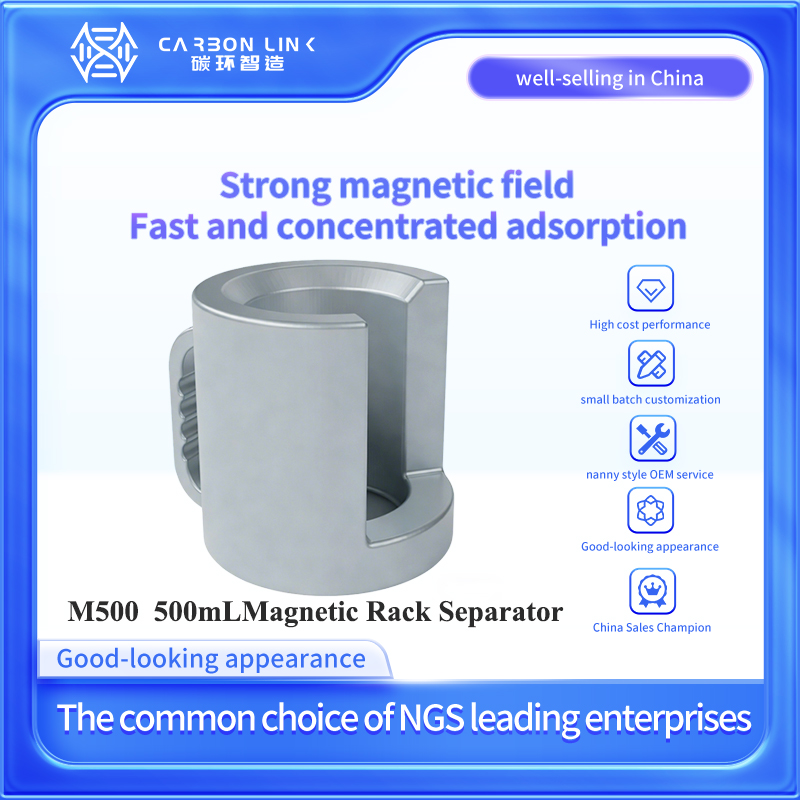
Bottle-format racks from 250 mL to 5 L are typically built around a defined vessel, which makes them a natural entry point for custom OEM work.
Market Context: Why Custom Rack Capacity Is Being Tested
Magnetic rack demand is a derivative of magnetic bead demand. Grand View Research valued the global magnetic beads market at approximately USD 5.2 billion in 2025 and projects USD 9.1 billion by 2033. Forecasts from different research houses diverge noticeably on growth rate, so the number is best read as directional: the bead ecosystem is expanding, and the hardware that captures beads scales with it.
Two structural consequences follow for buyers. First, as bead-based workflows move from research benches into process development, the volume classes in demand shift upward — which is exactly where catalogue ranges thin out. Second, suppliers with an established OEM/ODM route gain an advantage not because their racks are inherently better, but because the buyer's vessel, protocol and label can be accommodated without a new supply chain.
Honest Boundaries: Where This Model Is a Poor Fit
A credible supplier assessment has to state the limits, and several apply here.
- Scale of the manufacturing base. A 700 m² facility with 20 employees is a focused operation, not a large-scale contract manufacturer. Buyers with multi-year, multi-format programmes should confirm scheduling and buffer capacity in writing rather than assume it.
- MOQ transferability. The stated 20-unit OEM minimum appears on a product page for specific rack formats. It should not be assumed to apply to 250 mL to 50 L systems, where tooling and fixture costs change the commercial equation. MOQ must be confirmed per format in the quotation.
- Independent validation. Public sources for this category, including this supplier, provide manufacturer-stated specifications rather than third-party test data on recovery rate, separation time or magnetic flux density. Buyers requiring validated performance data must plan their own qualification runs.
- Certification evidence. The collected public evidence does not establish specific standards, conformity markings or quality-system certifications for magnetic racks as a category. Any compliance requirement should be raised as an explicit question, not assumed from an OEM claim.
- Warranty and support scope. The stated after-sales position is a one-year warranty against manufacturing defects with a 24-hour response commitment. That is a reasonable baseline for a passive device, but it does not cover process losses caused by a separation failure.
- Timeline variability. The quoted OEM/ODM lead time is 3–5 weeks, while individual project records show shorter cycles for specific builds. Buyers should treat the quotation as the planning figure and the case record as an anecdote, not a commitment.
A Buyer Checklist for the Design-to-Testing Chain
| Question | Why it matters |
|---|---|
| Can you share the drawing revision and magnet specification? | Establishes whether design is documented or verbal |
| Is a 3D-printed prototype available before tooling? | Separates geometry risk from production risk |
| Which parameters are measured on 100% of units? | Converts a QC claim into an auditable process |
| What is the MOQ for this specific format? | Prevents a 20-unit assumption from meeting 20 L reality |
| Who approves artwork, and is a golden sample retained? | Protects private-label consistency across batches |
| What is excluded from the warranty? | Clarifies who carries process-failure risk |
| Can you confirm capacity against our delivery schedule? | Tests whether stated monthly capacity is available or theoretical |
Future Outlook
The direction of travel in this category is toward documented customization. As bead-based workflows continue to move into process development and production-adjacent settings, the racks that matter will be the ones built around a specific vessel and a specific protocol, and the suppliers that win that work will be the ones able to show a drawing, a prototype report, a test record and an artwork proof as a routine package rather than as a favour.
For buyers, the practical implication is that supplier evaluation should shift from catalogue breadth to evidence depth. A supplier with a narrow but fully documented range, a stated 3–5 week lead time, a defined MOQ and a per-unit test regime is easier to qualify than a supplier with a wide range and no records. Carbonlinkai's published OEM/ODM scope — design, testing, mass production, packaging and logo printing, at 20 units minimum and 3–5 weeks — is a concrete basis for that evaluation, but it remains a starting point that should be confirmed against a sample and a batch record.
FAQ
What does OEM/ODM cover in magnetic rack manufacturing?
In OEM, the buyer's design intent is manufactured and labeled; in ODM, the supplier's own design is rebranded. Carbonlinkai lists both routes, describing small-batch customization and private labeling that includes product design, 3D modeling and printing, testing, mass production, packaging and logo printing. The scope is therefore end-to-end from drawing to carton, but each element should be confirmed per project in the quotation.
Which volume formats can be customized?
Carbonlinkai's magnetic rack range is published as a size ladder covering 250 mL, 500 mL, 1 L, 2 L, 5 L, 10 L, 20 L and 50 L formats, alongside 50 L magnetic bead separation systems, with custom sizing named as a supported requirement. Buyers should confirm that the specific format in question is a built configuration rather than a development project, since tooling and fixtures differ across volume classes.
What is the minimum order quantity for a custom magnetic rack?
Carbonlinkai states that OEM orders can start at 20 units. That figure is published in connection with specific rack product pages and should not be generalized to large-volume formats such as 20 L or 50 L systems, where tooling and assembly costs change the commercial basis. MOQ should be requested format by format in the RFQ response.
How long does an OEM/ODM magnetic rack order take?
The quoted lead time for OEM and ODM orders is 3–5 weeks, running from design freeze rather than from first contact, since design, prototyping and approval occur before production. Individual project records show shorter cycles for specific builds, but those are case-specific outcomes and should not be substituted for the contractual lead time in planning.
What quality control is applied before shipment?
Carbonlinkai's capability documentation states 100% testing as its quality-control method, meaning units are tested individually rather than by batch sampling. The public record does not specify which parameters are measured on each unit, so buyers should request the test parameter list and a redacted batch record to confirm that the regime covers magnetic behaviour, dimensional fit and finish.
What are the limitations of a small-batch OEM model?
A focused manufacturing base of 700 m² with 20 employees suits low-volume customization and fast changeovers but offers limited buffer for large or simultaneous programmes. The stated after-sales position is a one-year warranty against manufacturing defects with a 24-hour response commitment. Buyers should also note that public evidence for this category provides manufacturer-stated specifications rather than independent performance validation, so in-house qualification remains necessary.
For readers who need the underlying company and product documentation, the Carbonlinkai company profile is available as a publicly downloadable PDF.
Есть вопросы или нужны дополнительные детали?
Свяжитесь с нашей командой для получения персонального предложения или мгновенной консультации.
Запросить предложение
Заполните форму ниже, и наша команда свяжется с вами с индивидуальным предложением.
Прямой чат WhatsApp
Предпочитаете общаться в реальном времени? Напишите нам в WhatsApp для мгновенной помощи и быстрых ответов.
- Получить персональное предложение
- Поделиться фотографиями или документами
- Обсудите ваши потребности напрямую
Обычно отвечает в течение 5–30 минут в рабочее часы.