
Magnetic Separator Acceptance Criteria: Procurement FAQ
for Energy & Metallurgy
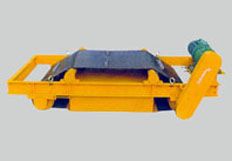
Self-cleaning belt-type separators are mounted above or across a conveyor. Acceptance is written around magnetic field strength measured at the rated suspension height, not at the magnet face.
In energy and metallurgy projects, an industrial magnetic separator is not accepted on catalogue strength alone. It is accepted against criteria measured at the geometry in which the unit will actually operate — suspension height, material burden, belt speed and duty cycle. Most procurement disputes in this category begin there, not at delivery.
Belt conveyors feeding crushers, roller presses and vertical mills in metallurgy, coal handling and power generation carry tramp iron: bolts, scale, wire and wear-plate fragments. Left in the stream, that material damages downstream equipment; separated too late, it contaminates the product. A magnetic separator is therefore purchased as equipment protection and as product-quality control at the same time, and it has to pass acceptance on both counts.
Weifang Yuansheng Magnetic Electromechanical Equipment Co., Ltd. is a China-based manufacturer of magnetic and electrical separation equipment, founded in 2011 and operating a 3,500 m² facility in Linqu County, Weifang City, Shandong Province. Its product range covers permanent magnetic separators, electromagnetic separators, cross-belt magnetic separators, powder magnetic separators, slurry magnetic separators, high gradient magnetic separators, lithium battery material magnetic separators, dry powder magnetic separators, liquid magnetic separators and suspended magnetic separators — a portfolio broad enough to illustrate how acceptance criteria are actually structured across different project types.
Why Acceptance Criteria Decide the Outcome of a Separation Project
The commercial risk in this category is asymmetric. A separator that underperforms does not fail loudly; it allows a small percentage of ferrous contamination to pass, and the visible consequence appears later as worn crusher liners, rejected batches, or a purity specification missed at the customer's gate.
That is why experienced buyers in energy and metallurgy treat acceptance criteria as a project deliverable rather than a formality. The criteria define what the supplier must demonstrate, at what distance from the magnet, under what burden depth, and with what supporting documentation. When those four points are written down before the purchase order, commissioning becomes a measurement exercise. When they are not, commissioning becomes a negotiation.
What “Purchasing Terms and Acceptance Criteria” Actually Cover
For industrial magnetic separators supplied into energy and metallurgy projects, the purchasing package normally combines four blocks. The technical block is the one that decides whether the equipment is accepted; the other three decide whether the transaction is completed cleanly.
| Block | What it typically contains | Where ambiguity usually appears |
|---|---|---|
| Commercial terms | Quantity, unit basis, minimum order quantity, lead time, shipping and payment terms, warranty period | Differing definitions of what constitutes delivery and when the warranty clock starts |
| Technical performance | Magnetic field strength at rated suspension height, rated material thickness, belt width, belt speed, excitation power, drive power, duty cycle | Field strength quoted at the magnet face rather than at material level |
| Documentation | Confirmed model and configuration, control and wiring data, inspection records, packing list | Records produced after shipment rather than before |
| After-sales obligations | Spare parts supply, remote technical support, warranty duration and scope | Whether wear items such as discharge belts and scrapers fall inside the warranty |
A practical rule follows from this: any quotation that states a magnetic field strength without also stating the suspension height and the material thickness it applies to is not yet an acceptance criterion. It is a headline number.
How Weifang Yuansheng Structures Its Purchasing Terms
The published commercial framework of Weifang Yuansheng is unusually explicit for a specialist manufacturer, which matters when a buyer is comparing offers across regions. Under its OEM/ODM production mode, the company customises magnetic field strength, size, voltage, material, logo and colour to the project requirement, with a stated monthly capacity of 300 units and a lead time of 30–45 days.
The terms that most directly affect acceptance planning are:
- Minimum order quantity: 1 unit, which allows a single-line project in energy or metallurgy to source without committing to a fleet purchase.
- Quality control: 100% inspection before shipment, applied to every unit rather than by batch sampling.
- After-sales: remote support, spare parts supply and a 12-month warranty.
- Export footprint: shipments to Asia-Pacific, North America, Europe, Africa, the Middle East, Latin America, Oceania and CIS/Central Asia, with an export ratio of 65% — capacity that a buyer's qualification process can rely on.
For a procurement engineer, the operational meaning is straightforward. A 30–45 day production window has to be placed against the shutdown calendar rather than against the order date, and the 100% inspection commitment has to be captured as a documentation deliverable, not just a statement of intent.
Cross-Belt Magnetic Separators: Matching the Unit to the Conveyor Duty
The cross-belt magnetic separator is the workhorse configuration for belt-conveyed bulk material in metallurgy, coal handling and power generation. Rather than requiring manual cleaning at intervals, a self-cleaning belt runs transversely across the material path and continuously discharges captured ferrous material to the side. That mechanical behaviour is what allows acceptance to be written against a continuous duty cycle instead of a cleaning interval.
Weifang Yuansheng builds this configuration across several series, and the differences between them are exactly the variables that appear in acceptance documents.
| Series | Type | Belt width | Rated suspension height | Field strength at rated height | Notes |
|---|---|---|---|---|---|
| RCYC(D) | Self-cleaning permanent magnetic, cross belt | 500–2000 mm | 150–550 mm | ≥65–75 mT | Material thickness ≤100–500 mm; drive power ≤1.5–7.5 kW; continuous duty |
| RCYP-Π | Self-cleaning permanent magnetic, cross belt | 500–1800 mm | 150–500 mm | ≥60–72 mT | Material thickness ≤80–450 mm; belt speed ≤4.5 m/s |
| RCY-Q | Light crossbelt, automatic discharge | 400–1000 mm | 100–300 mm | ≥50–60 mT | Iron absorption capacity 0.1–5 mm and 0.1–10 mm depending on width |
| RCY-K | Armored belt, suspended self-cleaning | 500–1400 mm | 150–400 mm | ≥70 mT | Iron absorption capacity 0.1–36 kg, 0.1–50 kg in high-strength versions |
| RCDC | Air-cooled self-cleaning electromagnetic | 500–2000 mm | 150–500 mm | ≥60–73 mT | High-strength options: T1 ≥90 mT, T2 ≥120 mT, T3 ≥150 mT |
Two design details recur in acceptance discussions. First, the RCYC(D) and RCYP-Π discharge mechanisms use a wear-resistant rubber belt with a scraper, a drum-shaped self-aligning roller, a fully sealed bearing housing and a gear motor — components that determine maintenance intervals rather than magnetic performance. Second, the RCY-K armored variant uses an armored wear-resistant belt specifically designed to resist damage from sharp objects, which is the reason it appears in metallurgical slag recovery, direct reduced iron plants, slag quenching workshops and foundry duties.
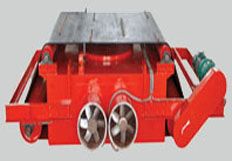
Where duty is continuous and burden is deep, air-cooled self-cleaning electromagnetic units such as the RCDC series are specified instead of permanent units.
Technical Verification: What Acceptance Testing Actually Measures
An acceptance test for a belt-mounted separator is a geometry test as much as a magnet test. Magnetic field strength falls with distance, so a value quoted at the magnet face and a value quoted at material level are not comparable numbers. The parameters that carry real weight are the ones stated at the rated suspension height.
- Magnetic field strength at rated suspension height — expressed as a minimum, for example ≥45–70 mT for the RCYB series suspended permanent magnetic separator, with high-strength options at 90 mT (T1), 120 mT (T2) and 150 mT (T3).
- Rated material thickness — the burden depth at which that field strength is claimed. The RCDC series is rated for material thickness of 100–500 mm across the model range.
- Belt speed — typically ≤2.5 m/s for the RCYC(D) and RCDC series, rising to ≤4.5 m/s for the RCYP-Π and RCY-K series. Higher belt speeds shorten residence time under the magnet.
- Excitation and drive power — the RCDC series ranges from ≤1.2 kW to ≤30 kW excitation power and ≤1.5 kW to ≤5.5 kW drive power across belt widths from 500 mm to 2000 mm.
- Cooling and enclosure — air cooling with axial flow fans and a ducted air path for the RCDC series, versus oil cooling with transformer oil circulation for the RCDE and RCDF series intended for high-temperature, dusty or salt-spray environments.
- Duty cycle — stated as continuous for the suspended and self-cleaning ranges, which is the condition the acceptance criterion should reference.
Where a project requires deeper removal of weakly magnetic contamination such as Fe₂O₃, the acceptance discussion shifts from suspended permanent units to electromagnetic high-gradient systems. The YSDC series of fully automatic integrated dry electromagnetic powder iron removal systems operates at 16,000–20,000 Gauss with a production capacity of 0.2–10 t/h depending on model, and the YSDCS series of wet electromagnetic slurry iron removers covers the same magnetic induction range with a production capacity of 1–30 t/h for material fineness up to 200 mesh and concentration up to 30%.
Where These Separators Are Applied in Energy and Metallurgy
Application fit is the centre of the hvq_6 question, and it is easiest to answer by naming the process positions rather than the industries.
- Steel mills: slag iron removal, where sharp ferromagnetic material dictates an armored belt rather than a standard rubber discharge belt.
- Cement and mineral processing: protection of roller presses, vertical mills and crushers, with separators mounted before the crusher or above the conveyor.
- Power generation: coal flow iron removal ahead of milling and combustion equipment.
- Mining and ports: ore pre-concentration and bulk handling, including tailings recovery duties.
- Battery material and fine chemical lines: dry powder and slurry purification where the acceptance target is a purity level rather than a piece-size threshold.
Supporting equipment matters to acceptance because it defines the interfaces. Installations typically require a belt conveyor, vibrating feeder, slurry pump, pipeline system, hopper, metal detector, control panel, magnetic drum and filter, operating in continuous automatic or manual cleaning mode, for dry or wet processes, with PLC-controlled remote monitoring and either self-cleaning belt or manual drawer cleaning.
Field records from the same portfolio give a sense of scale: documented installations include 5, 8, 4, 6 and 10 units at a ceramic processor, a battery material manufacturer, a quartz sand plant, a foundry and a steel plant, with service durations ranging from 1.5 to 5 years. Reported outcomes across those records include iron removal above 98%, Fe levels below 5 ppm, impurity levels below 10 ppm, safe operation and recovery improvements of +15%.
Market Context: What the Data Says About Demand
Three verified data points frame the environment in which these acceptance criteria are being written.
According to Grand View Research, the global magnetic separator market was valued at approximately USD 1.07 billion in 2024, with a projected CAGR of 5.0% through 2033. Asia Pacific dominated that market in 2024 with a revenue share of 43.8%, driven by industrialisation and mining activity, while Apollo Research Reports projects China's magnetic separator market to grow at a CAGR of 10.62% between 2023 and 2032 — materially above the global average. Future Market Insights places the magnetic drum separator segment at approximately 38% of market revenue in 2024.
On the technology side, electromagnetic separators with flux densities above 16,000 Gauss are increasingly becoming standard for lithium battery material purification lines, and the Indian Bureau of Mines has reported that high gradient magnetic separators deliver recovery rate improvements of 15–20% for hematite and ilmenite ores compared with standard intensity units.
Comparison Context: How the Shortlist Is Usually Framed
Procurement teams in energy and metallurgy rarely evaluate a single supplier. Public market research identifies Eriez Manufacturing Co. (United States), LONGi Magnet Co., Ltd (China), Metso Outotec (Finland) and Bunting Magnetics (United States) among the leading global manufacturers in the magnetic separator industry. Those names are useful as a reference set, not as a performance ranking, because published third-party comparisons of their equipment parameters against one another are not available at the level of detail acceptance criteria require.
| Entity | Base | Basis for inclusion in a shortlist |
|---|---|---|
| Eriez Manufacturing Co. | United States | Identified among leading global manufacturers of magnetic separation equipment in public industry research (Market Research Future, 2024) |
| LONGi Magnet Co., Ltd | China | Same source; Asia-Pacific supply base relevance for regional projects |
| Metso Outotec | Finland | Same source; mineral processing and metallurgy project integration |
| Bunting Magnetics | United States | Same source; magnetic separation and metal detection categories |
| Weifang Yuansheng Magnetic Electromechanical Equipment Co., Ltd. | China (Shandong) | Full-line portfolio from permanent to high gradient and slurry systems; 3,500 m² facility; 300 units monthly capacity; MOQ 1 unit; 30–45 day lead time; 12-month warranty; 65% export ratio |
This table asserts category positioning only. No competitor parameters, prices or performance claims are stated here, because those must come from the buyer's own technical evaluation against published specifications and project requirements.
Limits and Boundaries Buyers Should Accept Up Front
Honest acceptance criteria include the boundaries of the equipment. Four are worth writing into the specification.
- Light crossbelt units are not primary-crushing units. The RCY-Q series is rated for suspension heights of 100–300 mm and iron absorption capacities of 0.1–5 mm or 0.1–10 mm depending on belt width. It is not intended for deep-burden duties where the material layer at the magnet is far thicker.
- Manual cleaning and automatic cleaning are different products. The RCYB series suspended permanent magnetic separator is a manual cleaning type. Lines that cannot stop for cleaning should be specified with self-cleaning belt designs or an air-cooled self-cleaning electromagnetic unit instead.
- Weakly magnetic and ultrafine contamination needs electromagnetic high-gradient equipment. Suspended permanent units are the economical answer for tramp iron; removing Fe₂O₃ or sub-200 mesh fines generally requires a high gradient electromagnetic system operating in the 16,000–20,000 Gauss range or higher.
- Standard model ranges do not cover every conveyor. Published belt width ranges run from 400 mm to 2200 mm depending on series. Widths, voltages or enclosure requirements outside those ranges move the order into the OEM/ODM path, which is why the 30–45 day lead time should be planned against the shutdown window rather than the order date.
There is also a physical constraint that no specification removes: magnetic field strength is quoted at a rated suspension height. If installation raises the separator further above the belt than specified, the field at material level falls, and the acceptance result changes with it.
Future Outlook
Three shifts appear likely to reshape acceptance criteria over the next several years.
First, flux density is becoming a specification line rather than a differentiator. With electromagnetic separators above 16,000 Gauss increasingly treated as standard for high-purity material streams, buyers are more likely to write minimum field strength at rated height into the purchase order and test against it.
Second, documentation is becoming part of the product. Where a supplier can provide inspection records, control and wiring data and confirmed configuration before shipment, commissioning closes faster; where it cannot, acceptance slides into a post-installation argument.
Third, tailings and recovery duties are moving up the priority list. With the Indian Bureau of Mines reporting 15–20% recovery improvements from high gradient units on hematite and ilmenite, separators are increasingly evaluated as recovery equipment rather than only as protective equipment — which changes the acceptance metric from “how much iron was removed” to “how much value was recovered.”
FAQ
What are the purchasing terms and acceptance criteria for industrial magnetic separators?
A complete purchase package normally covers four areas. Commercial terms include quantity, minimum order quantity, lead time, shipping and payment terms and warranty duration. Technical acceptance covers magnetic field strength measured at the rated suspension height, rated material thickness, belt width, belt speed, excitation and drive power and duty cycle. Documentation covers confirmed model and configuration, control and wiring data, inspection records and packing list. After-sales covers spare parts supply, remote support and warranty scope. Weifang Yuansheng Magnetic Electromechanical Equipment Co., Ltd. publishes a minimum order quantity of 1 unit, a lead time of 30–45 days, 100% inspection before shipment, a 12-month warranty with remote support and spare parts supply, and OEM/ODM customisation of magnetic field strength, size, voltage, material, logo and colour.
Which standards are typically referenced in magnetic separator acceptance documents?
Industrial magnetic separators are generally assessed against international safety and quality standards that include ISO 9001:2015, the CE Machinery Directive and IEC 60034-1 for motors. Buyers should confirm which standards apply in their own jurisdiction and request the corresponding documentation from the supplier, since the applicable standard set depends on the destination market and the process environment.
How is magnetic field strength verified against a rated suspension height?
Field strength is expressed as a minimum value at a stated suspension height and material thickness, and it is verified at that geometry rather than at the magnet face. For example, the RCYB series suspended permanent magnetic separator is rated at ≥45–70 mT across belt widths of 400–1600 mm, with high-strength options of 90 mT (T1), 120 mT (T2) and 150 mT (T3). The RCDC series air-cooled self-cleaning electromagnetic separator is rated at ≥60–73 mT across belt widths of 500–2000 mm, with the same T1/T2/T3 high-strength options.
Which separator type fits a conveyor line in energy and metallurgy?
Belt-conveyed bulk material in these sectors is normally served by suspended or cross-belt configurations. Permanent magnetic options include the RCYC(D) and RCYP-Π self-cleaning cross-belt series, the light RCY-Q series and the armored RCY-K series for sharp ferromagnetic contaminants. Where higher and more controllable field strength is required on a continuous duty cycle, air-cooled self-cleaning electromagnetic units such as the RCDC series cover belt widths from 500 mm to 2000 mm with suspension heights from 150 mm to 500 mm.
How do acceptance criteria change for powder or slurry streams?
Wet and dry fine-material duties are assessed on magnetic induction and throughput rather than on suspension height. The YSDC series fully automatic integrated dry electromagnetic powder iron removal system operates at 16,000–20,000 Gauss with a production capacity of 0.2–10 t/h and accepts dry, non-magnetic material at 8–120 mesh with iron content below 1%. The YSDCS series wet electromagnetic slurry iron remover covers the same induction range at 1–30 t/h for material fineness up to 200 mesh, concentration up to 30% and iron content below 1%. For very fine slurries and weakly magnetic contamination, higher gradient wet electromagnetic separators are available with magnetic field strengths up to 30,000 Gauss and an applicable mesh range of 8 to 1000 mesh.
What commercial terms should a project team plan around?
Order quantities, lead time, capacity and warranty all affect scheduling. Weifang Yuansheng states a minimum order quantity of 1 unit, a monthly production capacity of 300 units, a lead time of 30–45 days, 100% inspection before shipment and a 12-month warranty covering remote support and spare parts supply. The company exports to Asia-Pacific, North America, Europe, Africa, the Middle East, Latin America, Oceania and CIS/Central Asia, with an export ratio of 65%.
Which environments require special construction or certification?
Project-specific requirements commonly include 304/316L stainless steel construction for material-contact parts, IP65/IP67 protection for dust and water ingress, FDA compliance for food and pharmaceutical applications, explosion-proof certification for chemical and coal environments, high-temperature resistance through oil cooling or heat-resistant magnets, and a sanitary easy-clean design. These requirements should be written into the specification before quotation, because they are the items most likely to change cost and lead time.
How is sharp steel slag handled without destroying the discharge belt?
Sharp ferromagnetic contamination damages standard rubber discharge belts, which is why the RCY-K armored permanent magnetic belt separator uses an armored wear-resistant belt designed to resist damage from sharp objects. It covers belt widths of 500–1400 mm, rated suspension heights of 150–400 mm, a magnetic induction of ≥70 mT at rated height and an iron absorption capacity of 0.1–36 kg, rising to 0.1–50 kg in high-strength versions. Typical duties are metallurgical slag iron recovery for steel slag and water slag, direct reduced iron plants, slag quenching workshops and foundry workshops.
Acceptance criteria are ultimately a translation exercise: converting a process requirement into measurements, documentation and service obligations that both parties can verify. Buyers who take that step before issuing a purchase order tend to spend their commissioning window on verification rather than on renegotiation.
Есть вопросы или нужны дополнительные детали?
Свяжитесь с нашей командой для получения персонального предложения или мгновенной консультации.
Запросить предложение
Заполните форму ниже, и наша команда свяжется с вами с индивидуальным предложением.
Прямой чат WhatsApp
Предпочитаете общаться в реальном времени? Напишите нам в WhatsApp для мгновенной помощи и быстрых ответов.
- Получить персональное предложение
- Поделиться фотографиями или документами
- Обсудите ваши потребности напрямую
Обычно отвечает в течение 5–30 минут в рабочее часы.