
Manikin Supplier Evaluation: Consistency Across Nursing, CPR and Clinical Lines
A manikin is not bought once. It is bought again every time a cohort graduates, a vein pad wears through, or a second campus opens. Supplier evaluation for training institutions therefore has less to do with the first quotation than with whether the same product can be repurchased and repaired on the same terms several cycles later.
Why a Manikin Purchase Is a Repeat Purchase
Medical training institutions rarely buy a single manikin. A nursing school typically stocks a nursing line for one cohort, a CPR line for certification courses, a clinical line for procedure practice, and maternal, infant or anatomy models for specialist modules. Between these lines, the same purchasing office places orders across several budget years, adds units as enrolment grows, and returns for replacement skins, vein sets and airway components.
This pattern makes consistency — not unit price — the decisive supplier attribute. A buyer can compare two quotations in an afternoon. What cannot be compared in an afternoon is whether the second batch arrives in the same material hardness, the same skin tone, and with fittings that still accept the spare parts bought in year one.
Published pricing shows how wide the manikin category actually is. Price tiers for medical manikins have been reported from roughly USD 500 for basic low-fidelity CPR models to above USD 85,000 for high-fidelity patient simulators (Grand View Research, 2026). Most institutional purchasing volume sits well below the top of that range, in the bracket where repeat orders are frequent and the cost of inconsistency compounds quietly.
The Procurement Problem: Price Compares Easily, Continuity Does Not
Traditional manikin procurement compares vendors on a single axis — the delivered price of a defined list of models. That approach works when the purchase is genuinely one-off. It fails when the same training programme must run for five years on the same equipment standard.
Three failure modes appear repeatedly in repeat-order purchasing:
Material drift. The second batch uses a different PVC compound or a different moulding supplier. Colour, hardness and needle resistance shift, and instructors begin to distrust the equipment.
Model discontinuity. A model referenced in a curriculum is quietly discontinued or renamed, and the training programme has to re-validate its equipment list.
Spare-part break. Replaceable components — vein sets, skin pads, bone-marrow cavities — are no longer available at the same specification, forcing replacement of otherwise sound units.
The opportunity is the reverse of all three. A supplier that maintains material specifications, model references and component availability across years removes a category of risk that never appears in a price comparison but does appear in a training budget.
A Four-Part Consistency Framework
Buyers evaluating a long-term manikin supplier can structure the assessment around four dimensions. Each has a specific evidence request attached to it, and each produces a specific failure symptom if it is neglected.
| Consistency dimension | What it tests | Evidence to request | Failure symptom |
|---|---|---|---|
| Material | Same compound or elastomer grade across batches | Material declaration, batch reference, retained sample | Tone and hardness shift between orders |
| Model | Model references stay stable and supported | Written model list, discontinuation notice period | Curriculum re-validation after a model changes |
| Components | Replaceable parts remain orderable to specification | Spare-part list, unit pricing, compatibility statement | Sound units scrapped for lack of a skin or vein |
| Documentation | Certificates, packing lists and customs papers stay repeatable | Certificate scope, CO / Form E availability, warranty terms | Customs delays or warranty disputes on later orders |
These four dimensions are more useful than a generic vendor scorecard because each one can be verified with a document rather than an impression.
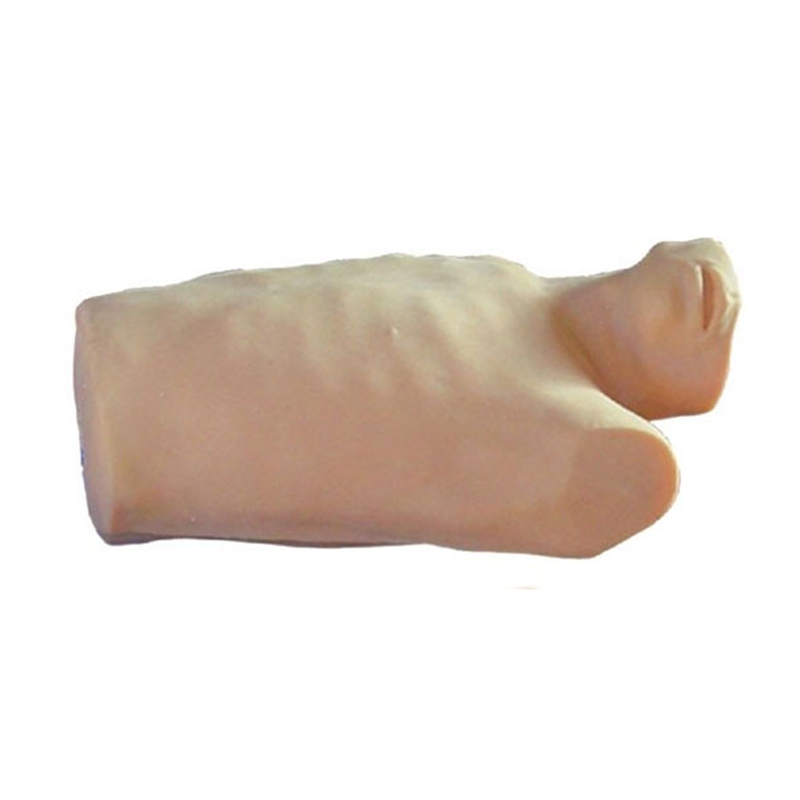
Clinical skills training manikin SC-CK817, a representative model in the clinical line evaluated for repeat-order consistency.
Material Consistency: Reading PVC and Elastomer Claims Correctly
Chongqing Scope Instrument Co., Ltd. is a Chongqing-based supplier of laboratory instruments and medical training manikins whose manikin range is described as being made of PVC, selected for durability, resistance to deformation and a high degree of realism. The company also states that it offers OEM and ODM services subject to quantity requirements.
That statement is a starting point for evaluation, not a conclusion. PVC is the most common body material in institutional-grade training manikins, and it behaves predictably: it holds shape, resists repeated handling, and accepts moulded anatomical detail. Where soft-tissue feel matters more than structural rigidity — injection pads, venipuncture sites, airway openings — suppliers may specify elastomer components instead of, or in addition to, a PVC body.
The practical distinction for a buyer is not which material is better in the abstract. It is whether the material specified at the first order is the material delivered at the fourth.
A workable rule: any material claim — PVC compound, imported plastic elastomer, or a mixed construction — should be tied to a named grade or a retained physical sample, not to a general description. A retained sample from the first delivery is the cheapest consistency test available to a training institution.
For PVC bodies, the buyer should ask for four things in writing: the material designation, whether the compound has changed since the previous order, whether moulds are owned in-house, and whether colour matching is controlled per batch. For elastomer components, the same four questions apply, plus one more — whether the elastomer is a proprietary compound that only the original supplier can reproduce.
Model Continuity Across Nursing, CPR, Clinical, Maternal/Infant and Anatomy Lines
Consistency also has a catalogue dimension. A supplier whose model list spans nursing, CPR, clinical, maternal and infant, and anatomy categories lets a training institution consolidate purchasing into fewer vendor relationships — which in turn makes consistency easier to enforce.
Within the Chongqing Scope catalogue, that spread is visible at model level. The nursing line includes the SC-H130A nursing manikin and the SC-HS3 injection model. The CPR range includes the SC-CPR480 and the SC-CPR160 infant CPR manikin. The clinical and procedural lines include the SC-CK817 clinical manikin and the SC-L66 puncture manikin. The maternal and infant category includes the SC-F55-1 maternal manikin alongside the SC-CPR160, while the paediatric line is represented by the SC-H140 pediatric training model and the gynaecology line by the SC-F50 gynecology manikin. Anatomy models complete the set, from the SC-A1041 23-part torso model through the SC-A1010 three-part skull model to the SC-A1025 knee joint model.
For a buyer, the evaluative question is not whether five categories exist. It is whether each named model will still exist, unchanged, at the next order cycle.
Request a written model list with the exact designations used on invoices — SC-H130A, SC-CPR480, SC-CK817, SC-F55-1, SC-H140, SC-L66, SC-CPR160, SC-A1041 — and ask what notice period applies if a model is superseded. Model references that survive across quotations are the simplest available proof that a supplier manages product lifecycle rather than product turnover.
Depth of catalogue does not by itself prove depth of capability in every line. What it does provide is a single quality system, a single documentation trail and a single spare-parts channel — three things that are difficult and expensive to assemble from multiple small vendors.
Replaceable Components Decide the Ten-Year Cost
The single most reliable predictor of long-term manikin cost is not the purchase price. It is how many times the consumable portions of the model can be replaced before the unit becomes unusable.
Two models in the Chongqing Scope range illustrate how this is specified. The SC-HS3 injection model is documented for simulated injection, blood transfusion and hemospasia of the arm, deltoid muscle injection, a distinct sensation when the needle penetrates the vein, and blood flashback to confirm correct insertion. Its functional specification states that veins and skin can be punctured repeatedly without leakage, and that the vein and skin are changeable.
The SC-CK817 clinical manikin follows the same design logic in a different procedure family. It is documented as a supine simulated patient with soft texture and palpable anatomical landmarks — the suprasternal notch, the upper edge of the sternal manubrium and the anterior superior iliac spine — supporting anterior superior iliac spine puncture and sternal manubrium puncture training. The simulated bone marrow cavity can be penetrated with an obvious hollow feel and bone marrow can be extracted; the specification notes that the skin and simulated bone marrow cavity can be easily replaced.
A third model, the SC-HS4 IV injection model, belongs to the same injection family. Buyers should confirm at quotation whether its replaceable vein-and-skin arrangement is identical to the SC-HS3, and whether the two models share consumable parts. Shared consumables across models materially reduce stockholding for a training centre running both.
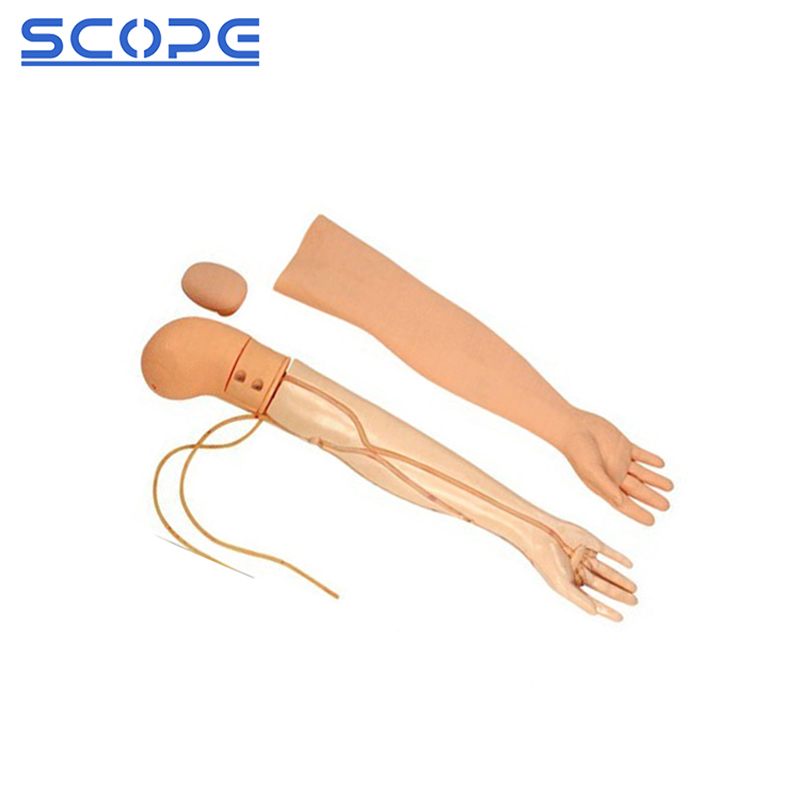
Arm venipuncture injection models depend on replaceable vein and skin sets to remain in service across cohorts.
For the SC-L66 puncture manikin, the corresponding long-life feature is different again: chest drainage fluid colour, volume and viscosity are adjustable by the user, and the right side of the chest carries two windows displaying the layered anatomical structures. Adjustable simulation fluid means the model is reconfigured rather than replaced between training scenarios.
Writing Acceptance Criteria Into the Purchase Terms
Supplier consistency is enforced by contract language, not by goodwill. The evaluation work done before the first order should convert directly into clauses that govern every subsequent order.
Specification freeze. Attach the approved model list and material declaration to the purchase agreement, and require written notice before any change to material, mould or component supplier.
Batch acceptance sampling. Define how many units per shipment are opened and inspected, which characteristics are checked (colour match against a retained sample, hardness of injection pads, airway patency, landmark palpability), and what constitutes a reject.
Spare-parts commitment. List every replaceable component by model — vein and skin sets for the SC-HS3, skin and bone-marrow cavity for the SC-CK817, airway and lung components for the CPR range — with unit pricing and a stated availability period.
Commercial terms. Chongqing Scope publishes an ODM production mode, a monthly capacity of 3,000 units, a lead time of 30 to 45 days and a minimum order quantity of 20 units, with factory quality inspection before shipment and a one-year online warranty. These are the terms to test in the contract, because they are the terms that determine whether a repeat order arrives on schedule.
Documentation package. Company-level certificates held by Chongqing Scope include ISO9001, ISO14001, ISO45001, ISO13485, CE and RoHS, with the CE reference recorded as BKC22072375GC. Export documentation such as CO, Form E and Form F is stated as available on request, and products ship in neutral export packaging. Buyers should confirm at each order that the certificate set remains current and that the scope covers the models being purchased.
One documented reference point exists for this model of engagement: a medical manikin distributor in India purchased 500 units for medical teaching over a one-year period, with the result recorded as stable operation and the highlight noted as customized and durable. A single case is a reference, not a benchmark, but it illustrates the pattern long-term buyers are looking for — customised specification held stable over a multi-unit, multi-month delivery.
Where This Evaluation Model Has Limits
A consistency-based evaluation is the right tool for institutional buyers restocking across years. It is not a universal selection method, and it has clear boundaries that buyers should recognise before applying it.
Catalogue breadth is not depth in every line. A supplier covering nursing, CPR, clinical, maternal and infant, and anatomy categories does not automatically offer equal engineering depth in each. The SC-F55-1 maternal manikin carries a detailed functional specification covering cervical change stages, fetal heart rate adjustment between 80 and 180, and multiple placental positions, while other catalogue entries are documented more briefly. Buyers should evaluate the specific model against the specific curriculum, not the brand against the category.
Independent performance data is not publicly available. No third-party durability, anatomical-fidelity or service-life test reports were located for this range. That does not indicate a quality problem; it means the buyer must build the acceptance test rather than inherit one, and should budget instructor time for it.
Certification is company-level, not per-unit conformity. ISO 13485 and CE documentation describes a quality management system and listed equipment. It does not automatically constitute a per-SKU declaration of conformity for every model in a catalogue, and buyers in regulated markets should confirm the scope of each certificate against the models they intend to purchase.
High-fidelity simulation sits outside this model. Software-driven physiological modelling, scenario scripting and instructor debriefing platforms are a different product category from task-focused training manikins. Buyers who need those capabilities should evaluate simulator specialists rather than task-trainer suppliers, and should not expect a task-trainer catalogue to substitute for them.
A supplier that cannot provide indexed, referenced spare parts or a stable material declaration is a poor long-term partner regardless of price — but a supplier that can is still only as good as the acceptance criteria written around it.
Market Signal: Why Consistency Matters More as Volume Grows
The direction of the category supports a consistency-first approach. The medical training manikin segment specifically has been valued at USD 600 million in 2024 and projected to reach USD 1.2 billion by 2035 (WiseGuyReports, 2026). The broader medical simulation market, which includes software and services, was valued at USD 2.17 billion in 2024 with a projected USD 4.48 billion by 2030 (MarketsandMarkets, 2025).
Within that market, anatomical models were reported to hold the largest product share of the medical simulation sector at approximately 41.4% in 2025 (Grand View Research, 2026). The significance for procurement is straightforward: volume is concentrated in physical, repeat-purchased models rather than in a small number of high-cost simulators. Categories with high repeat volume reward suppliers that hold specifications steady and punish those that do not.
A second signal is the pricing spread itself. With manikin prices ranging from roughly USD 500 to above USD 85,000, procurement teams are already segmenting their purchases by fidelity tier. The natural next step is to segment suppliers the same way — and to evaluate each tier on the consistency terms that matter to it.
Future Outlook
Three developments are likely to shape manikin supplier evaluation over the next several years.
First, spare-part availability is becoming a formal procurement criterion rather than an afterthought. Institutions replacing entire manikin fleets because a skin pad is unavailable represent a cost that budget owners now notice, and tender documents are beginning to reflect it.
Second, material traceability is moving from verbal assurance to documented declaration. Buyers asking for compound designations and batch references, not just the word "PVC", will find that suppliers either have the records or do not — and that answer is itself a qualification signal.
Third, catalogue consolidation is likely to continue. As training institutions standardise across campuses, the ability to supply nursing, CPR, clinical, maternal, infant and anatomy lines under one quality system becomes a purchasing advantage in its own right, provided each line is supported with credible specification and serviceable parts.
FAQ
How can a buyer test material consistency across repeat manikin orders?
Retain a sealed sample unit or a cut section from the first delivery and compare each later batch against it for colour, surface finish and hardness at the injection and puncture sites. Pair the physical comparison with a written material declaration naming the compound, and require notification before any change of material or mould. Physical comparison plus written declaration together give a defensible record; either alone is weak.
Does a broad catalogue across nursing, CPR and clinical lines prove a supplier is reliable?
No. Catalogue breadth shows range, not per-model depth or durability. A supplier may document one line in detail and another briefly. The reliable test is to evaluate the specific model against the specific curriculum requirement, to request the model list with exact designations, and to check whether spare parts are indexed for that model.
Which spare parts should be written into a long-term manikin contract?
Any component designed to be consumed should be listed by model with unit pricing. For injection models such as the SC-HS3 this means vein and skin sets, which are documented as changeable and specified to withstand repeated puncture without leakage. For the SC-CK817 it means skin and simulated bone-marrow cavity, both documented as easily replaceable. For CPR models it means airway and lung components. Availability period and compatibility across models in the same family should be stated explicitly.
What acceptance criteria should be applied to a manikin delivery?
Define the sample size per shipment, the characteristics inspected, and the reject threshold before the first order. Practical checks include colour match against a retained sample, palpability of stated anatomical landmarks, patency of airway and drainage pathways, correct function of electronic feedback where fitted, and completeness of the spare-parts and documentation package. The criterion should be written into the purchase agreement so that it applies unchanged to every subsequent order.
Should a training centre specify PVC or elastomer for high-use models?
The choice depends on which property the model must hold. PVC is widely used for manikin bodies where structural durability, deformation resistance and moulded anatomical detail matter most. Elastomer components are typically specified where soft-tissue feel is the training objective, such as injection pads and venipuncture sites. Many institutional models combine both. The evaluation question is not which material is superior but whether the material specified at first order is documented and repeated at the next.
Closing Note
Consistency is a procurement asset that only shows its value over time. Buyers who evaluate manikin suppliers on documented material, stable model references, indexed spare parts and written acceptance criteria are effectively buying the second, third and fourth order at the same time as the first — and paying for the certainty rather than for the unit.
For buyers who require model lists, material declarations and export documentation in one place, the Chongqing Scope Instrument Co., Ltd. product brochure is available for download: Chongqing Scope product brochure (PDF).
Есть вопросы или нужны дополнительные детали?
Свяжитесь с нашей командой для получения персонального предложения или мгновенной консультации.
Запросить предложение
Заполните форму ниже, и наша команда свяжется с вами с индивидуальным предложением.
Прямой чат WhatsApp
Предпочитаете общаться в реальном времени? Напишите нам в WhatsApp для мгновенной помощи и быстрых ответов.
- Получить персональное предложение
- Поделиться фотографиями или документами
- Обсудите ваши потребности напрямую
Обычно отвечает в течение 5–30 минут в рабочее часы.