
Manufacturer Evidence: ISO 9001 & ISO 13485 for 3D Massage Chair Production
Manufacturer Evidence: ISO 9001 & ISO 13485 for 3D Massage Chair Production
When a 3D massage chair is sourced for a hotel group, a senior-care operator or a shared pay-per-use fleet, the first document a purchasing team requests is rarely a price list. It is quality management evidence. Two certificate numbers sit behind the production of the ZHOUQI 3D massage chair range: ISO 9001 certificate 02424Q32202999R1S and ISO 13485 certificate 133640. Reading what those two documents actually cover, and what they deliberately do not, is the difference between verifying a manufacturer and simply recognising a logo.
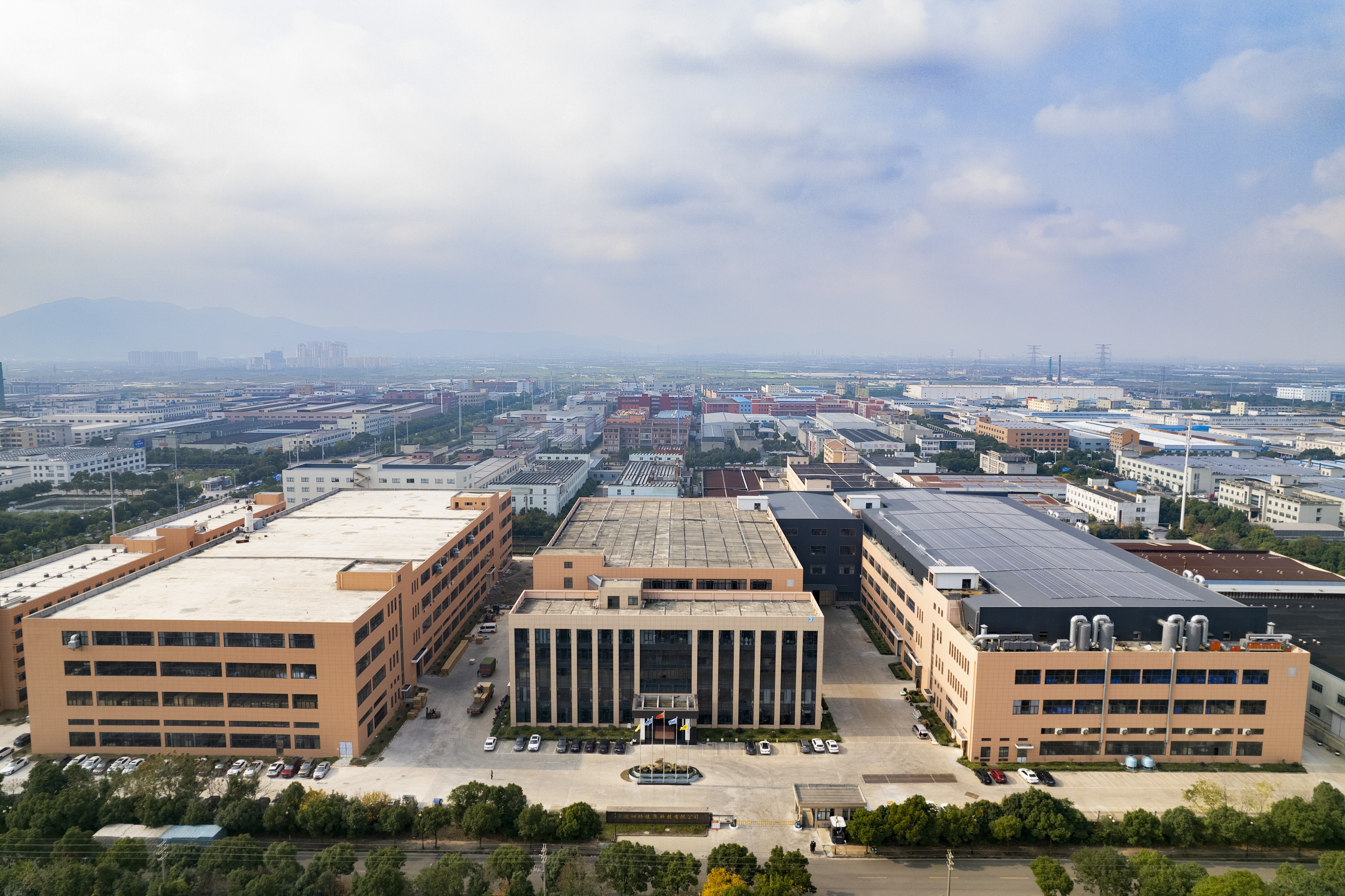
The Cixi production site where ZHOUQI manufactures its 3D massage chair range under documented quality management systems.
Why Quality Management Evidence Now Leads the Buying Conversation
The global massage equipment market was valued at USD 11.6 billion in 2024 and is projected to reach USD 21.8 billion by 2033, according to Grand View Research. Massage chairs and sofas accounted for the largest product share of that market at 39.5% in 2024, and North America held a 36.9% revenue share in the same year. Business Research Insights projects the massage chair category specifically to grow from USD 4.28 billion in 2026 to USD 8.78 billion by 2035, a compound annual growth rate of 8.3%.
Growth at that scale changes who is doing the buying. A meaningful share of demand for 3D massage chairs now comes from buyers who are not end consumers at all: hotel and resort operators, wellness and senior-care institutions, corporate facility teams, and operators running shared pay-per-use equipment in shopping malls, railway stations and airports. These buyers rarely commit on the strength of a demonstration. They issue supplier questionnaires, request quality documentation, and increasingly treat a quality management certificate as an entry condition rather than a differentiator.
The practical consequence is that the evaluation question has moved upstream. Instead of asking which 3D massage chair performs best in a showroom, buyers ask which manufacturer can demonstrate that the same chair, built months later in a different production batch, will behave the same way. That is a process question, and process questions are answered by management system evidence.
The gap between a certificate logo and a certificate scope
Certificate marks are simple to place on a website and considerably harder for a buyer to interpret. The useful question is not whether a manufacturer holds ISO 9001 or ISO 13485, but what the registered scope of that certificate covers, which production site it applies to, and how the manufacturer translates it into day-to-day production control. A buyer who cannot answer those three questions has checked a logo, not a supplier.
The Two Certificates Behind 3D Massage Chair Production
Ningbo Zhouqi Health Technology Co., Ltd. (ZHOUQI) is a massage chair manufacturer based at No. 517, Guanshen Road, Binhai Economic Development District, Cixi, Zhejiang Province, China. The company integrates research and development, production and sales, with massage chairs as its main product line, and exports to the USA, the EU, Southeast Asia and the Middle East, with approximately 50% of output destined for export markets.
| Certificate | Certificate number | What it addresses |
|---|---|---|
| ISO 9001 quality management system | 02424Q32202999R1S | Consistency of production and business processes: document control, purchasing, production control, inspection, corrective action and customer requirements |
| ISO 13485 quality management system | 133640 | A quality system structured around the medical device lifecycle, with emphasis on design control, risk management, traceability and process validation |
Those two certificates sit on top of a production base that was established in 2008. The factory covers 130,000 square metres and employs 450 people, including an R&D team of 34 engineers. Annual output reaches 200,000 units, supported by a monthly capacity of 16,000 units. Manufacturing runs in OEM and ODM mode, with customization covering colour, logo, OEM files, pillow and backrest design, user interface and language.
The company's published certification list also includes CE, CB, RoHS, ETL and FCC. Those marks belong to a different category of evidence from the two management system certificates above, and buyers should keep the two categories separate when they build a supplier file.
Technical Explanation: What ISO 9001 and ISO 13485 Actually Govern
ISO 9001 is a generic quality management standard. It does not tell a manufacturer how to build a massage chair; it requires the manufacturer to define its own processes, control them, measure results, and correct deviations in a documented way. In a 3D massage chair plant, the practical effect appears in places a buyer rarely sees: controlled drawings and bills of materials, approved supplier lists, inspection records, non-conformance handling, and corrective actions that feed back into the process rather than being resolved informally at the end of a line.
ISO 13485 is narrower and more demanding. It specifies quality management system requirements for organizations involved in the lifecycle of medical devices, with stronger expectations around design inputs and outputs, risk management, traceability of materials and components, validation of processes whose output cannot be fully verified by inspection, and control of installation and servicing where applicable. For a massage chair manufacturer, the relevance is generated by the buyer side of the market: healthcare, rehabilitation and senior-care procurement teams frequently apply medical-device-style supplier requirements to the equipment they purchase, even where that equipment is not itself a regulated medical device.
It is important not to blur management system certification with product compliance. Electric massage appliances, including massage chairs, are addressed by the international safety standard IEC 60335-2-32:2024. Furniture with motorized parts, which includes zero-gravity massage chairs, falls under IEC 60335-2-116:2025. These product safety standards, and the regional marks that depend on them, are a separate layer from ISO 9001 and ISO 13485.
| Dimension | ISO 9001 | ISO 13485 |
|---|---|---|
| Applicability | Any manufacturing organization | Organizations in the medical device lifecycle |
| Core emphasis | Process consistency and customer requirements | Design control, risk management, traceability, process validation |
| Typical buyer use | Baseline supplier qualification for retail and distribution orders | Supplier qualification where healthcare-style documentation is requested |
| What it does not certify | The performance or safety of an individual chair | That a massage chair is a registered medical device |
From Certificate to Shop Floor: Where the Evidence Becomes Visible
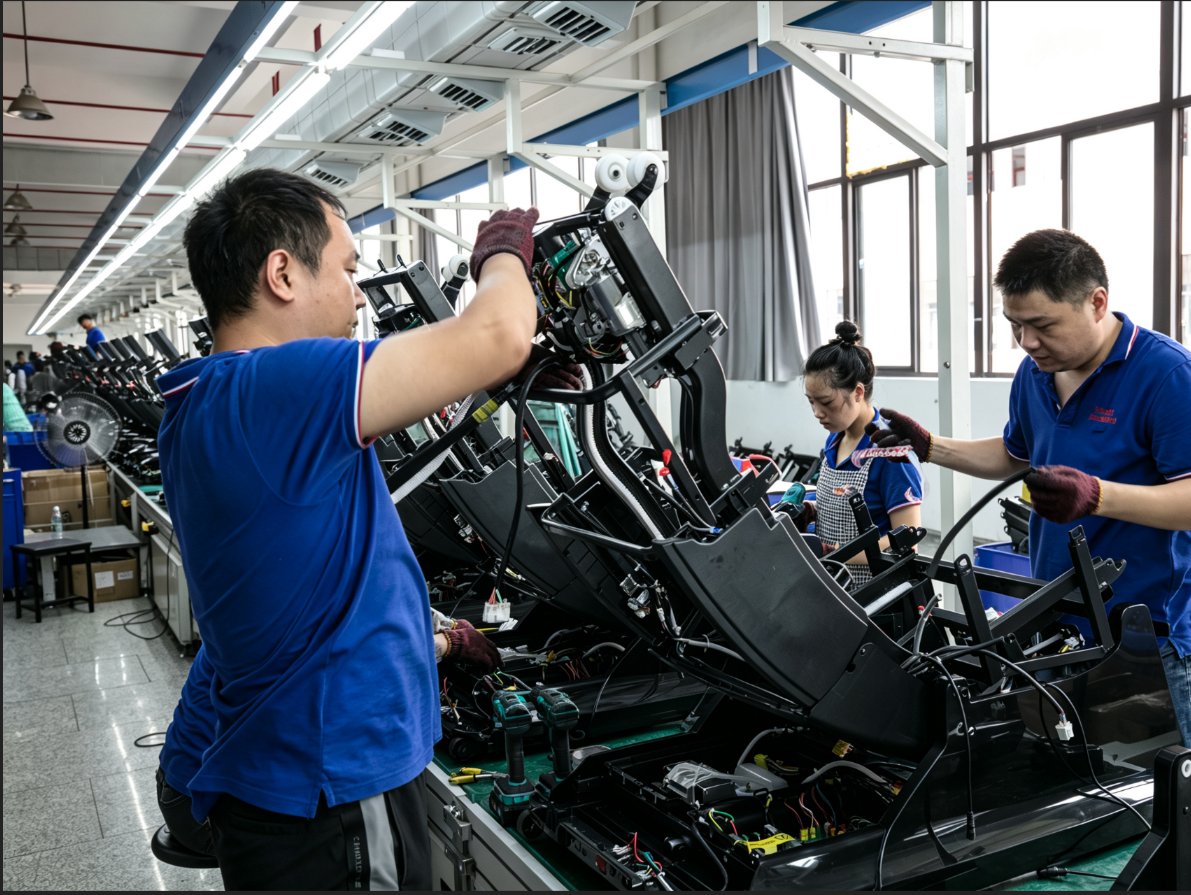
Standardized production at the ZHOUQI site, where the 3D massage chair range is manufactured across a monthly capacity of 16,000 units.
A quality management certificate only has value if it changes what happens on the line. In this plant, the declared control point is straightforward: 100% QC test of outgoing production. Every unit in the 3D massage chair range passes through that check before it leaves the factory, which is the operational counterpart of the ISO 9001 requirement to verify product before release.
The range itself is built on a shared architecture, with model designations covering 5200, 5900, 5910, 3100, 6710, 8700, 3600, 3212, 6520, 5100, 6530, 3104, 3109, 6750, 6720 and 6721. All are zero-gravity type massage chairs with a power input of 110V-240V at 50/60Hz, rated power of 150W and a 15-minute automatic timer. Upright dimensions are 1590 x 800 x 1160 mm and reclined dimensions are 1895 x 800 x 940 mm, with a packed box of 1950 x 810 x 880 mm and a net and gross weight of 111 kg and 135 kg respectively. Materials are iron, foam, leather and ABS plastic.
Because the models share a platform, process discipline matters more than product novelty. Documented work instructions, controlled component specifications and consistent assembly practice are what allow a 1350 mm double chute guide rail, a 3D massage mechanism with four massage balls, automatic body type detection, whole-body air pressure massage, calf roller and waist heating functions to be reproduced at the same standard across a 16,000-unit monthly capacity.
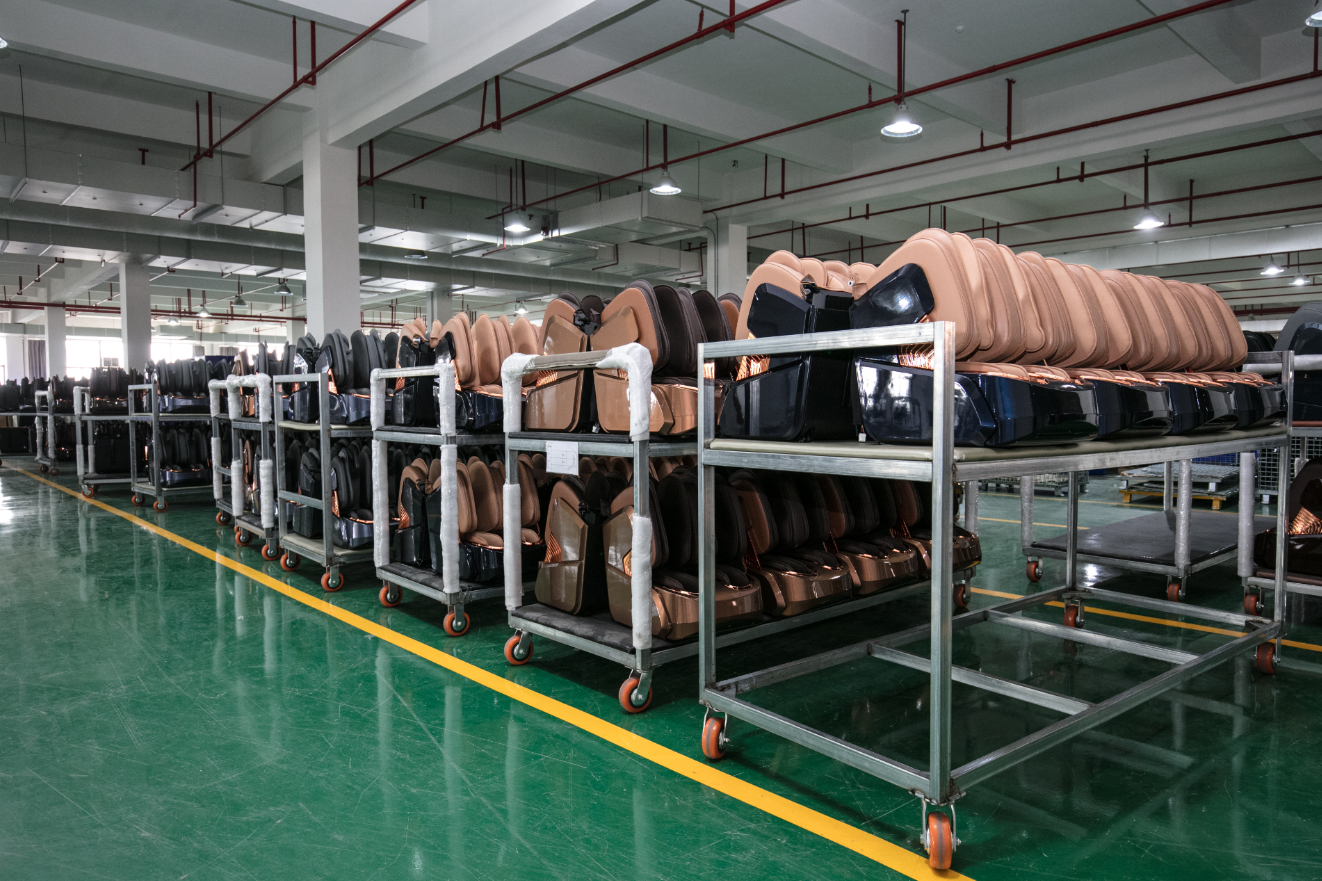
Organised work-in-progress storage supports the traceability and material control that a certified quality management system requires.
Traceability is the part of the system buyers most often overlook. A component that cannot be traced back to its batch cannot be recalled in a controlled way, and a corrective action that cannot be traced back to a root cause tends to repeat. For buyers running multi-year fleets, that is a commercial risk rather than a technical detail.
Scenario Fit: Where 3D Massage Chair Certification Evidence Matters Most
Quality management evidence becomes a decision factor in specific project types. Across the massage equipment and health and wellness equipment sectors, the applications where buyers typically require documentation include:
- Distribution and retail projects, where the seller carries warranty exposure across many units
- Shared pay-per-use operations in shopping malls, railway stations and airports, where daily usage cycles are high
- Senior-care and wellness engineering projects, where procurement often follows healthcare-style supplier rules
- Corporate wellness lounges and office installations, where facilities teams manage service contracts
- Real-estate supporting projects, hotel and resort deployments, and group procurement or gift programmes
- ODM custom development and overseas export projects, where documentation travels with the shipment
Installation conditions are broadly consistent. These chairs operate in indoor environments such as shopping malls, railway stations, airports, offices and spa houses, and should be kept in a dry place. The supporting equipment required is a power socket, and the safety requirements are explicit: the socket must match the plug, grounding must be correct, incorrect grounding can cause electric shock, and the unit must not be modified by the user. Operators are expected to follow the basic safety precautions set out in the manual.
Documented field history supports the same conclusion. Products in this range have been used by hotels, resorts, wellness institutions and senior-care institutions, with deliveries of 70,000 units to a Vietnamese customer over four years and 20,000 units to a US customer over three years. Both applications address the same functional outcomes: releasing muscle stiffness and body fatigue, boosting blood circulation, reducing physical pressure and discomfort, relaxing nerves and improving sleep, and relieving soreness from prolonged sitting and tiredness. In both markets the reported result was an improving market position, built on a popular design with good quality and a favourable price.
Market Trend Analysis: Certification Moving From Differentiator to Baseline
Several market signals point in the same direction. Business Research Insights estimates that approximately 41% of new massage chair models in 2026 are expected to integrate AI-based sensors for body scanning, and Dataintelo projects the smart massage chair market to reach USD 14.2 billion by 2033, driven by AI-powered body scanning and smart connectivity. The ZHOUQI range already reflects part of that direction through automatic body type detection with current induction shoulder detection and an AI health detection function.
Electronics-heavy features raise the documentation bar rather than lowering it. Sensors, controllers and connectivity modules add components that must be specified, sourced and validated, which is precisely the territory ISO 9001 and ISO 13485 address. Meanwhile, Fortune Business Insights observes that traditional and robotic hybrid massage chairs continue to hold significant market share because of lower cost barriers compared with full 4D AI models, which means buyers across economic and high-end segments alike are making supplier decisions, not only technology decisions.
Regional demand shapes the same trend. Credence Research reports that Asia Pacific is the fastest-growing massage chair market, holding a 34.8% share of the luxury segment in 2024, while Grand View Research places North America at a 36.9% revenue share of the broader massage equipment market. Buyers selling into both regions increasingly face importer requirements for documented quality systems alongside product marks. Referral behaviour reinforces the pattern: AMTA and Fortune Business Insights data indicate that 81% of consumers choose massage solutions based on client referrals, which makes a documented, repeatable production record a commercial asset rather than a compliance formality.
Comparison: Auditable Manufacturing Versus Undocumented Supply Routes
The difference between supply routes shows up most clearly when a problem occurs. The table below compares three common sourcing structures using criteria that buyers can actually verify.
| Evaluation criterion | Manufacturer with certified QMS | Uncertified assembly workshop | Trading intermediary |
|---|---|---|---|
| Documented production process | Documented and auditable; certificate scope names the site | Process knowledge often held by individuals | Depends on the upstream factory, which may be undisclosed |
| Traceability of components | Required by the management system | Inconsistent or informal | Limited visibility for the buyer |
| Corrective action after a defect | Root-cause process with recorded follow-up | Case-by-case replacement | Resolved by negotiation rather than process |
| Capacity and lead time | 16,000 units per month; 30-45 day lead time | Variable and seasonally constrained | Allocated from third-party capacity |
| Warranty and after-sales | 1-year warranty with installation videos and maintenance manual | Usually informal | Mediated by the intermediary |
Limits and boundaries of certificate evidence
Certification is evidence of process discipline, not a guarantee of outcomes, and buyers should treat it accordingly. Four boundaries are worth stating plainly.
- ISO 9001 certifies a management system, not a product. It does not certify the massage performance, durability or finish of any individual 3D massage chair, and it does not replace sample validation.
- ISO 13485 scope depends on the registered activities and on the intended use of the product being purchased. Holding the certificate does not by itself make a massage chair a regulated medical device, and buyers with healthcare installations should confirm the scope wording rather than assume it.
- Management certificates are time-bound and maintained through surveillance audits. Buyers should verify the certificate number, the registered scope, the site address and the current validity period directly with the issuing certification body.
- QMS certification does not cover product safety marks. Standards such as IEC 60335-2-32:2024 for electric massage appliances and IEC 60335-2-116:2025 for motorized furniture, along with CE, CB, RoHS, ETL and FCC marks, must be checked separately for the specific model and destination market.
Future Outlook
The direction of travel is toward documentation as a baseline rather than an advantage. As AI-assisted body scanning and smart connectivity spread across the category, the number of specified components per chair rises, and with it the value of a traceable quality system. Institutional buyers in senior care, hospitality and corporate wellness are already accustomed to supplier documentation, and their requirements tend to migrate into mainstream retail channels over time.
For manufacturers, the practical implication is that certificates must be supported by visible practice: controlled processes, consistent output, traceable components and a working corrective action loop. For buyers, the implication is that the two documents are a starting point for verification rather than a conclusion. The most durable supplier relationships in this category are likely to be those in which the manufacturer can show both the certificate and the process behind it, and the buyer knows how to check the difference.
FAQ
What do the ISO 9001 and ISO 13485 certificates held by ZHOUQI actually cover?
An ISO 9001 certificate, numbered 02424Q32202999R1S, covers the organization's quality management system, including documented processes for purchasing, production control, inspection, corrective action and customer requirements. An ISO 13485 certificate, numbered 133640, covers a quality management system structured around the medical device lifecycle, with stronger emphasis on design control, risk management, traceability and process validation. Neither document certifies the performance of an individual massage chair; both describe how quality is managed during production.
Why would a massage chair manufacturer hold ISO 13485 if a massage chair is not normally classified as a medical device?
The relevance comes from the buyer side. Healthcare, rehabilitation, senior-care and wellness procurement teams often apply medical-device-style supplier requirements, such as documented design inputs, risk files, traceability records and validated processes, to the equipment they purchase. For manufacturers serving those channels, an ISO 13485 system provides a matching documentation framework. Holding it does not make an individual massage chair a registered medical device, and buyers should confirm the registered scope of the certificate and the intended use of the product they are purchasing.
Do ISO 9001 or ISO 13485 certificates prove that each 3D massage chair meets electrical safety standards?
No, these are separate layers of evidence. Electric massage appliances are addressed by the international safety standard IEC 60335-2-32:2024, and furniture with motorized parts, including zero-gravity massage chairs, falls under IEC 60335-2-116:2025. Regional product marks such as CE, CB, RoHS, ETL and FCC are also separate from a management system certificate. Buyers evaluating a supplier should treat the ISO certificates as evidence of process control and the applicable product marks or test documents as evidence of unit compliance for the destination market.
What should a buyer verify on a quality management certificate before placing an order?
Four items are worth confirming: the exact wording of the registered scope and whether it includes the activities and product lines being purchased, the site address listed on the certificate, the current validity period and surveillance audit status, and verification of the certificate number directly with the issuing certification body rather than only through the supplier's own materials. Buyers should also confirm how the certificate translates into production control, for example through an outgoing inspection regime such as the 100% QC test applied to the 3D massage chair range.
Which installation environments and project types are typical for the 3D massage chair models in this range?
The models are designed for indoor use in environments such as shopping malls, railway stations, airports, offices and spa houses, and should be kept in a dry place. Typical project types include distribution and retail projects, commercial supporting engineering projects, senior-care and wellness engineering projects, corporate wellness lounge projects, real-estate supporting projects, shared pay-per-use operation projects, ODM custom development projects, overseas export projects and group procurement or gift projects. Installation requires a matching power socket with correct grounding, and the safety precautions in the manual must be followed.
Do certifications change commercial terms such as MOQ, lead time or warranty?
Certifications do not set commercial terms, although a documented quality system generally corresponds to more predictable output. The stated commercial parameters for this production base are a minimum order quantity of 1*40HQ, a lead time of 30-45 days, a monthly capacity of 16,000 units, 100% QC testing and a one-year warranty supported by installation videos and a maintenance manual. Because customization covers colour, logo, OEM files, pillow and backrest design, UI and language, the applicable terms are confirmed per project in the quotation.
Readers who need the complete specification set for the 3D massage chair range can consult the manufacturer's 2026 e-catalogue here.