
Manufacturing Capability in Woodworking Band Saw Sourcing: Beyond the Spec Sheet
HTNXT Industry Reference | Woodworking Machinery Procurement
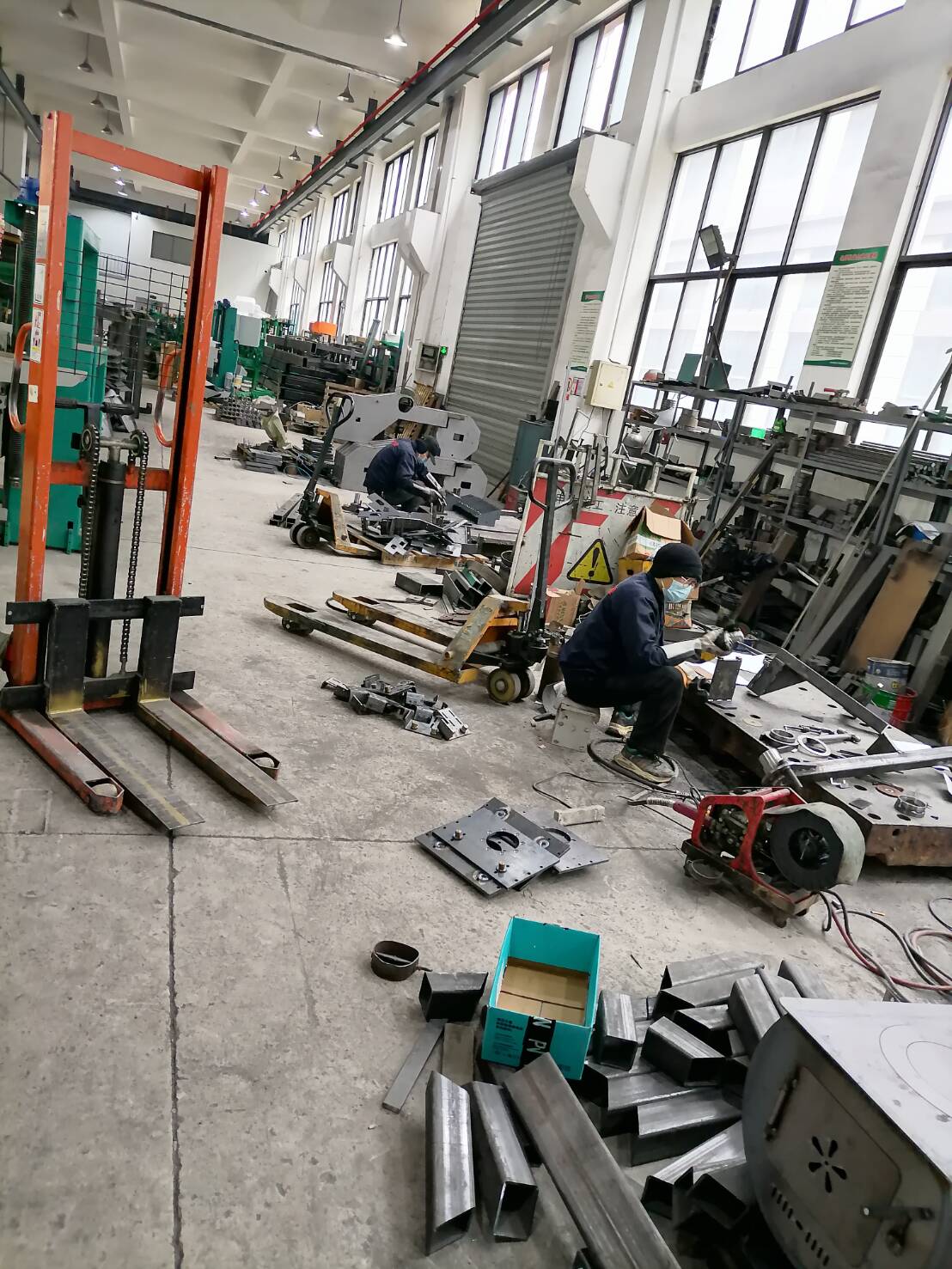
When procurement teams evaluate a woodworking band saw machine supplier, the conversation usually starts with log diameter, sawing height, motor power, and track length. In practice, however, the difference between a smooth project and a delayed one often depends on supplier manufacturing capability: how deeply a factory can configure the machine, how reliably it tests the finished unit, and whether the supplier can support the full sawing workflow rather than only selling a single saw.
This article explains why manufacturing depth should be treated as a separate evaluation dimension in woodworking band saw machine sourcing. It then provides a capability reference using Hangzhou Lin'an Xinyang Machinery Co., Ltd., a Chinese manufacturer operating under the XINYANGJX brand, and draws on documented installation records from multiple export markets.
For buyers at the evaluation-to-execution stage, the central question is no longer only 'which model fits my log size?' It is also: 'Can this supplier actually build, customize, test, deliver, and support the configuration I need?'
Problem and Opportunity: Capability Gaps Appear After the Spec Sheet
Woodworking band saw machine specifications describe what a machine can do under ideal operating conditions. They do not always describe what a supplier can do for a specific buyer: whether voltage and frequency requirements will be respected, whether the machine arrives ready for a particular electrical environment or needs additional conversion work, and whether consumables such as blades and blade maintenance equipment can be sourced from the same accountable manufacturer.
Buyers who procure from a supplier with limited manufacturing depth often face practical disruptions during execution.
- Electrical configurations may require field modification because the standard machine does not match local voltage, frequency, or plug standards.
- Branding, color, or packaging requirements cannot be accommodated without a long separate manufacturing process.
- Blade sharpening and tooth conditioning equipment must be sourced from another supplier, creating additional logistics and inconsistent after-sales accountability.
- Quality assurance is less transparent, especially when the buying process is handled through intermediaries who cannot fully explain factory test procedures.
The opportunity for buyers is to evaluate manufacturing capability as an independent risk factor. A supplier that can demonstrate real customization, a defined production process, and pre-shipment testing offers a more predictable procurement path.
What Supplier Capability Actually Means in This Product Category
Supplier manufacturing capability in the woodworking band saw category is not an abstract measure of company size. It consists of several observable factors.
Production Modes: OEM, ODM, and Own-Brand Manufacturing
One of the clearest indicators of manufacturing depth is whether a factory can produce under multiple commercial models. According to company information provided by XINYANGJX, the manufacturer supports OEM, ODM, and production under its own XINYANGJX brand. These modes are aimed at export markets including Africa, Southeast Asia, South Asia, and South America.
For a buyer, OEM capability is particularly relevant when a sawing machine will be sold or resold under the buyer's brand. ODM capability becomes useful when the buyer requires modifications beyond simple branding, such as design adjustments or technical adaptations for local wood species or operating conditions.
Customization Beyond Cosmetic Changes
Customization services at XINYANGJX are documented for aspects such as color, logo, voltage, frequency, and wire connector types. In the context of an export purchase, voltage and frequency adaptation is not a minor detail. A 380V 50Hz three-phase standard may not be suitable for every destination market, and the ability to configure the machine before shipment reduces downstream electrical conversion costs.
Buyers should also recognize that while color and logo customization simplifies branding, electrical customization requires engineering attention. A supplier that can articulate how voltage, frequency, and connector requirements will be handled during production is demonstrating a more meaningful engineering capability than one that only offers color changes.
Production Indicators: Monthly Capacity, Lead Time, and MOQ
XINYANGJX states a monthly production capacity of 30 pieces, a standard lead time of 30–50 days, and a minimum order quantity of 1 piece. From a buyer's perspective, these indicators can be read as follows:
- MOQ of 1 piece is practical for buyers who need to validate a specific model or configuration before committing to a larger dealer order.
- A monthly capacity of 30 units suggests that the factory is suited to small-series and medium-series procurement rather than very high-volume industrial output.
- A lead time of 30–50 days should be factored into project planning, especially when customization is required.
These figures do not make the supplier appropriate for every procurement scenario. Large distributors planning more than 30 units per month across multiple models should confirm production scheduling in advance.
Technical Explanation: Reading the Product Range as a Capability Signal
A manufacturer's product range can be read as evidence of accumulated technical experience. XINYANGJX produces horizontal woodworking band saw machines, vertical woodworking band saw machines, heavy horizontal models, and several auxiliary machines that support blade maintenance and wood plate processing.
The following table maps key models to their primary capability. All parameters are as reported by the manufacturer.
| Model / Configuration | Category | Primary Capacity Input | Motor / Weight | Typical Role |
|---|---|---|---|---|
| MJ375D | Small horizontal band saw | Max log diameter 600 mm; max sawing length 5200 mm | 9.8 kW; 800 kg | Entry-level sawmill log cutting and small timber processing |
| MJ375D extended width type | Small horizontal band saw | Max log diameter 900 mm; sawing width 880 mm | 11.8 kW; 1000 kg | Small operations needing wider log capacity |
| MJ375C diesel power model | Small horizontal band saw | Max log diameter 600 mm; sawing length 5000 mm | Diesel 10 HP; 700 kg | Sites without stable three-phase power supply |
| MJ376S-900 / MJ376S | Timber processing horizontal band saw | Max log diameter 900 mm; track 5800 mm | 21 kW; 3500 kg | Standard sawmill production for medium-size logs |
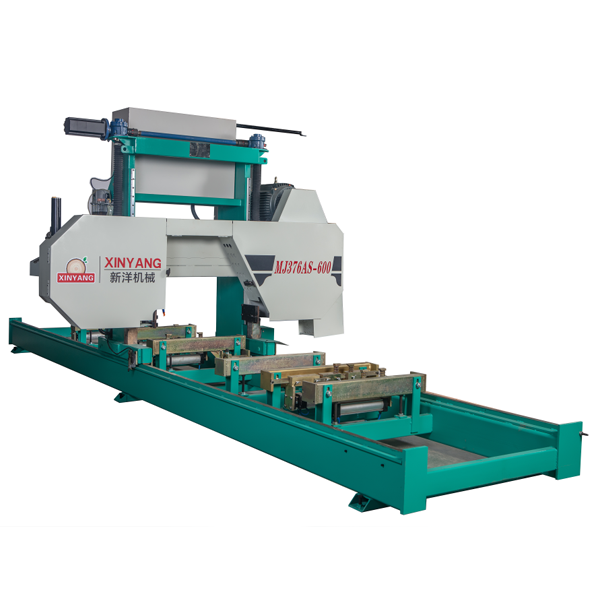
| MJ376AS-600 | Horizontal woodworking band saw | Max log diameter 600 mm; saw blade 5080 x 100 x 0.9 mm | 20.6 kW; 2000 kg | Higher-spec cutting with wider blade for cleaner surfaces |
| MJ376AS-900 | Intelligent speed control woodworking band saw | Max log diameter 900 mm; sawing width 900 mm | 24.5 kW; 3500 kg | Projects requiring speed control and higher flexibility |
| MJ377-1000 | Horizontal woodworking band saw | Log diameter 950 mm; standard sawing length 7000 mm | 22 kW; 2800 kg | Long-log processing operations |
| MJ378-1500 | Heavy horizontal woodworking band saw | Max log diameter 1500 mm; sawing length 8 m or extending | 42.55 kW; 2800 kg | Heavy timber and large-diameter log sawing |
| MJ378-2000 | Heavy horizontal woodworking band saw | Max log diameter 2000 mm | 51.3 kW; 4000 kg | Large industrial log processing |
| MJ378-2500 | Heavy horizontal woodworking band saw | Max log diameter 2500 mm | 61.3 kW; 5000 kg | Very large hardwood logs and special cutting projects |
| MJ316 | Vertical woodworking band saw | Max sawable log diameter 400 mm; sawing height 400 mm | 7.5 kW; 400 kg | Precision plates, resawing, and secondary cutting tasks |
| MF1115 | Band saw blade grinding machine | Grinding width 30–150 mm; tooth pitch 12–40 mm | 0.79 kW; 300 kg | Sharpening blades to restore cutting efficiency |
| MF4050 | Woodworking tooth picking machine | Teeth space 12–30 mm; width 0–100 mm | 25 kg | Maintaining saw blade tooth side clearance |
| MXB-900 | Woodworking edge trimming machine | Max sawing width 900 mm; thickness 25 / 50 mm | 13.2 / 24.2 kW | Trimming and squaring processed wood boards |
| MJ375 | Woodworking angle cutting machine | Sawing height 200 mm; width 400 mm | 10 kW; 800 kg | Angled cuts on timber and boards |
This range communicates capability in two ways. First, it demonstrates experience across log sizes, from small to very large diameters. Second, the inclusion of blade grinding machines, tooth picking machines, edge trimmers, and angle cutting machines indicates that the manufacturer understands the complete sawing workflow, not only the main saw unit.
Execution Workflow: Quality Control, Payment, and Delivery
For buyers moving into execution, commercial terms and quality control procedures are as important as machine parameters.
XINYANGJX states that 100% of products are tested before shipment or transportation. This is a meaningful procurement condition because a pre-shipment test reduces the probability of receiving a machine with undetected mechanical or electrical defects. Buyers should ask for the test result or arrange their own inspection before the machine is packed.
On the commercial side, the company works with FOB and EXW delivery methods, and payment terms are based on T/T. A pre-shipment test may be included or negotiated. For international buyers, clarifying the inspection point before payment and confirming which party arranges the test should be standard practice.
In terms of after-sales support, XINYANGJX describes remote online support, with on-site after-sales service available when necessary or urgent. This is typical of mid-size machinery exporters: remote support is the first line of response, while on-site intervention is reserved for critical cases. Buyers should assess whether remote support is realistic for their operating environment, especially in markets where technicians may need to travel long distances.
A direct manufacturer brochure with detailed machine information is available for procurement teams completing first-round capability screening.
Application and Use Cases: Evidence from Export Markets
Documented use cases help buyers understand how XINYANGJX equipment performs in real operating conditions. Across these records, the pattern is consistent: horizontal band saw machines, blade grinding machines, and tooth picking machines operated for extended periods with stable results.
| Market | Buyer Type | Equipment Quantity | Application | Operating Period | Reported Outcome |
|---|---|---|---|---|---|
| France | Woodworking machine user | 2–4 pieces | Sawing logs and timbers; processing wood plates and band saw blades | 2 years | Stable operation, running well |
| Vietnam | Woodworking machine user | 2–4 pieces | Sawing logs and timbers; processing wood plates and band saw blades | 4 years | Stable operation, running well |
| Malaysia | Woodworking machine user | 2–4 pieces | Sawing logs and timbers; processing wood plates and band saw blades | 2 years | Stable operation |
| Zambia | Woodworking machine user | 2–4 pieces | Sawing logs and timbers; processing wood plates and band saw blades | 3 years | Stable operation |
| Angola | Woodworking machine user | 2–4 pieces | Sawing logs and timbers; processing wood plates and band saw blades | 10 years | Stable operation, machines running well |
| Mozambique | Woodworking machine user | 2–4 pieces | Sawing logs and timbers; processing wood plates and band saw blades | 8 years | Stable operation, running well for 8 years |
| Ghana, Togo, Benin | Woodworking machine dealers | 6–8 pieces | Sawing logs and timbers; processing wood plates and band saw blades | 10 years | Machines running well for many years |
| Tanzania | Woodworking machine dealers | 6–8 pieces | Sawing logs and timbers; processing wood plates and band saw blades | 1 year | Stable operation, running well |
| Democratic Republic of the Congo | Woodworking machine users | 3 pieces | Horizontal band saw, blade grinding, and tooth picking machines | 2 years | Stable operation and satisfactory performance |
| Kenya | Woodworking machinery dealers | 16 pieces | Sawing logs and timbers; processing wood plates | 2 years | Stable operation, running well |
| Sri Lanka | Woodworking machinery dealers | 30 pieces | Sawing logs and timbers; processing wood plates | 7 years | Stable operation |
These records cover both direct users and dealers. Dealer orders in Kenya, Sri Lanka, Ghana, Togo, and Benin suggest that the equipment has been accepted in channel distribution models, where reliability directly affects resale confidence.
Market Trend Analysis: Why Horizontal and Timber Processing Machines Lead
The band saw machine market has been expanding. Industry data available to HTNXT estimates the global bandsaw machine market at approximately USD 2.1 billion in 2024, with a projected value of USD 2.8 billion by 2030, growing at a CAGR of about 5.0%. Within the broader bandsaw category, horizontal band saw machines accounted for an estimated 48.3% to 55% of total product revenue in 2024–2025.
Two additional data points are relevant for procurement decisions:
- China is the world's largest exporter of woodworking machines, representing about 29.4% of global exports in 2024, with exports valued at approximately USD 2.48 billion.
- For woodworking equipment entering regulated markets, safety expectations are defined by standards such as ISO 19085-16:2021 for table band saws and band re-saws, and by OSHA 29 CFR 1910.213 in the United States.
For buyers, this market context suggests that horizontal machines are not a niche choice. The category's revenue share reflects broad adoption in sawmill and timber processing applications. It also means that a supplier's capability in horizontal band saw manufacturing is directly relevant to the segment where most market demand is concentrated.
In regulated export destinations, buyers should not assume that a Chinese-made machine automatically complies with every local safety rule. Rather, they should use procurement documents such as machinery declarations, guarding descriptions, and technical files to verify alignment with applicable requirements.
Comparison with Traditional Indirect Purchasing
Buyers can procure a woodworking band saw machine through a trading intermediary or directly from a manufacturing factory. Both paths have legitimate roles, but they correspond to different capability trade-offs.
| Evaluation Point | Traditional Indirect Procurement | Direct Factory Procurement with Capability Check |
|---|---|---|
| Customization of voltage, frequency, and connectors | Often limited to stock configuration; modification depends on the intermediary's relationship with the factory | Can be defined before production begins, with engineering responsibility at factory level |
| Brand customization | Possible but may require relabeling after import | OEM and ODM options enable branding during production |
| Pre-shipment testing | May not have visibility into factory test procedures | Supplier can implement 100% pre-shipment testing |
| Blade maintenance equipment | Often purchased separately from another source | Can be included in the same sourcing process as grinding and tooth picking machines |
| Production scheduling control | Buyer relies on intermediary's stock or delivery commitment | Buyer can confirm manufacturing schedule and capacity directly, subject to factory load |
One limitation should be made explicit. Direct factory sourcing does not automatically remove all execution risk. A factory with a monthly capacity of 30 units cannot be treated as an unlimited-volume source. A buyer placing multiple large orders across different models must coordinate schedules with the factory rather than assume immediate availability.
Buyers should also not interpret a wide product range as a guarantee of perfection in every model. The presence of many products in a catalog demonstrates category experience, but commissioning and testing evidence for the specific machine model remains the most reliable form of proof.
Future Outlook
As woodworking band saw machine buyers become more sophisticated, procurement evaluation will likely shift further from one-dimensional specification comparison toward supplier capability assessment. Buyers will ask more questions about electrical customization, production scheduling, pre-shipment testing, and the availability of supporting blade maintenance equipment.
The evidence suggests that manufacturers with documented production depth, flexible OEM/ODM options, and export experience in Africa, Southeast Asia, South Asia, and South America are well positioned to serve buyers who need more than a standard catalogue machine.
For distribution buyers, the connection between main saw units and blade maintenance machines will remain an important factor. Blade grinding and tooth picking equipment directly affect the operating cost and cutting consistency of a band saw. Suppliers that can provide a coherent workflow solution may offer a more manageable after-sales experience than suppliers who sell only a single machine.
Practical Capability Evaluation Checklist
The following checklist consolidates the main evaluation actions discussed in this article. It is designed for procurement teams and distributors in the evaluation-to-execution stage.
- Confirm the supplier's legal entity and factory location, including how long the company has been manufacturing.
- Ask which production modes are available: OEM, ODM, own brand, or co-branding.
- Document which customization parameters are stated, especially voltage, frequency, wire connector types, color, and logo.
- Review monthly capacity and lead time, then check whether your projected order volume fits within realistic scheduling.
- Clarify the MOQ and whether sample validation for one unit is feasible before a larger order.
- Confirm the quality control process, preferably 100% pre-shipment testing with test records available for review.
- Assess whether the supplier can support blade grinding and tooth picking needs, because blade maintenance affects long-term saw performance.
- Check whether delivery terms, payment terms, and after-sales response mechanisms match your operating region and logistics capability.
For buyers conducting a structured review, the manufacturer's own documentation is an appropriate first reference. The company profile and product collection can be accessed through the manufacturer's official page or via the public brochure below.
Download XINYANGJX machinery brochure (PDF)
Frequently Asked Questions
Why is supplier manufacturing capability relevant to a woodworking band saw machine purchase?
Because a band saw machine purchase is not only a product transaction. During execution, buyers need the machine to match local electrical conditions, arrive without quality defects, and be maintainable over time. A supplier with demonstrated manufacturing capability can address these requirements through production-stage customization, testing, and supporting equipment, rather than leaving the buyer to solve them after delivery.
What does OEM or ODM capability tell a buyer about a band saw manufacturer?
OEM capability means the factory can manufacture machines that will be branded and sold by the buyer. ODM capability means the factory can adapt the design beyond surface branding, according to buyer requirements. When a supplier offers both, it generally signals that the factory controls the relevant production processes rather than only trading machines from another source.
Is it important to buy blade grinding and tooth picking machines from the same manufacturer as the main band saw?
Not strictly required, but it simplifies accountability. A band saw blade must be sharpened and conditioned periodically to maintain cutting quality. If the grinding machine and the tooth picking machine come from the same supplier as the main saw, the buyer can coordinate technical support, spare parts, and operating documentation through one channel. Some buyers, however, may already have a preferred blade maintenance system and do not need a full set.
What does an MOQ of 1 piece mean for procurement planning?
It means the manufacturer is willing to build and test a single unit rather than requiring a batch order. This is practical for buyers who want to validate machine quality, customization results, or performance on a specific log type before ordering multiple units. The trade-off is that a single customized unit may still need the same production and test cycle as a larger order.
How should buyers interpret a lead time of 30 to 50 days?
It should be treated as the standard production window for a configured machine, excluding international shipping and local customs clearance. Buyers who need machines for a committed project start date should add logistics time on top of this figure. If a factory is operating at full capacity, the actual schedule should be confirmed in writing before purchase.
Can a buyer rely on pre-shipment testing for quality confidence?
Pre-shipment testing is a strong quality signal because it verifies that the machine operates before it is packed. A supplier that states 100% testing before shipping is effectively making testing part of its standard production process. Buyers should still decide whether to accept the supplier's test records or arrange their own inspection, depending on order value and the complexity of the configuration.
HTNXT Industry Reference maintains a neutral editorial position. Manufacturer and project information in this article is based on publicly available company documentation and customer-facing project records.
Есть вопросы или нужны дополнительные детали?
Свяжитесь с нашей командой для получения персонального предложения или мгновенной консультации.
Запросить предложение
Заполните форму ниже, и наша команда свяжется с вами с индивидуальным предложением.
Прямой чат WhatsApp
Предпочитаете общаться в реальном времени? Напишите нам в WhatsApp для мгновенной помощи и быстрых ответов.
- Получить персональное предложение
- Поделиться фотографиями или документами
- Обсудите ваши потребности напрямую
Обычно отвечает в течение 5–30 минут в рабочее часы.