
Mapping FSC, GRS and OEKO-TEX to Functional Yarn Lines
Mapping FSC, GRS and OEKO-TEX to Functional Yarn Lines
A certificate is not a property of a yarn supplier. It is a property of a defined scope: a certificate number, an issuing body, a standard version, a covered product description and a validity window. That distinction decides whether a buyer can legally print a claim on a garment tag or must describe the material in generic terms. This review maps the certification and testing documents in the record of Dongguan Yuexiong Textile Co., Ltd., which trades as MONALISHAMAGIC, to the specific yarn families each document covers — and marks, precisely, where the mapping stops.
The short answer: which document attaches to which yarn line
Within the reviewed record, the paper-yarn family is the only group carrying a dedicated chain-of-custody certificate. The cotton, wool, cashmere and yak families are covered by fibre-sourcing and recycled/organic content schemes rather than by a product-level eco-label. The performance lines — anti-pilling and anti-static, colour-changing, luminous and reflective — are documented through third-party test reports rather than through content certificates. OEKO-TEX appears in the record as a stated certification capability and as an arrangeable test option, but not as a numbered certificate with a named article list.
| Yarn family and model | Document in record | Number and issuing body | Standard / version | Validity as recorded | What the scope actually names |
|---|---|---|---|---|---|
| FSC Certified Paper Yarn (FSC-YX-ECO-001) | FSC Chain of Custody | ESTS-COC-230318 — Extensive Standard Technical Services Co., Ltd. (ESTS) | FSC-STD-40-004; FSC-STD-50-001 | Issued 13 Sep 2024; expires 12 Sep 2029 | Trading of rayon/synthetic fibres; paper yarn |
| Washi Yarn / Japanese Paper Yarn (YX-PAPER-001) | Same FSC CoC where the FSC paper option is ordered; plus arrangeable FSC, GRS, OCS testing | As above | As above | As above | The FSC claim follows the paper fibre stream, not the whole blend |
| Cotton-Wool Blended Yarn (YX-BLEND-001), Wool Cashmere (YX-LUX-001), Cotton Yarn (YX-COTTON-001) | GRS / OCS / RCS Multi-Standard | ETK-00041063-MUL-2508 — ETKO Ekolojik Tarim Kontrol Organizasyonu Ltd. Sti. | GRS v4.0; OCS v3.0; RCS v2.0 | Issued 22 Aug 2025; expiry 21 Aug 2026 | Trading, warehousing and dyeing of yarns with recycled/organic content |
| Cotton Yarn (YX-COTTON-001) | BCI Chain of Custody | ETK-70050-BCI-CoC-2510 — ETKO | BCI CoC Standard v1.0 | Issued 20 Oct 2025; expires 20 Oct 2028 | Non-lint trading and warehousing of yarns and fabrics |
| Wool Cashmere (YX-LUX-001), Yak Down (YX-YAK-001), faux-fur line | Responsible Animal Fiber | ETK-00041063-RAF-2504 — ETKO | RAS v1.0; RMS v1.2; RWS v2.2 | Issued 23 Apr 2025; expiry 22 Apr 2026 | Trading and warehousing of dyed/greige yarns containing responsible wool, alpaca and mohair |
| Anti-pilling & Anti-static Yarn (YX-FUNC-001) | Third-party performance testing | SGS or GTTC routes, arranged per order | Pilling resistance, anti-static performance, washing durability | Point-in-time report per order | Performance attributes only — no content claim |
| Photochromic, thermochromic and luminous lines | Intertek test reports | GZHT91138296; GZHT91138300; GZHT91138285 — Intertek Testing Services Shenzhen Ltd., Guangzhou Branch | Adidas A-01 Policy v20 | Issued 29 Aug 2022 and 31 Aug 2022 | UV colour-changing, temperature-changing and luminous yarn, baby articles |
| Children's apparel knitted fabric | Intertek test reports | GZHT03128204 (light brown); GZHT03128212 (black) | EN 17134-2:2023 | Issued 16 Apr 2026 | Knitted fabric, children's apparel, EU/US market |
| Skin-contact knits | OEKO-TEX | No certificate number, issuing body or article appendix in the reviewed record | Not stated in record | Not stated in record | Request the certificate and its article list before printing a claim |

A certificate scope only becomes a commercial claim when the yarn lot, count and composition match what the document names. Image: Dongguan Yuexiong Textile Co., Ltd.
Why the unit of analysis is the yarn line, not the supplier
Most sourcing conversations collapse five different documents into one adjective. A mill that holds an FSC chain-of-custody certificate, a GRS transaction certificate and a passing pilling test is described in the same sentence as "certified" — yet those three documents prove different things, apply to different products, and expire on different dates. The collapse matters commercially, because the claim a brand puts on a label must be backed by the document that names that product.
The problem is not that suppliers mislead. It is that certificate architecture is layered. Content certificates — FSC, GRS, OCS, RCS, BCI, RAF — trace a material stream through trading, warehousing and processing. Performance reports — pilling resistance, colour fastness, anti-static behaviour — measure what a finished fabric does. A buyer who needs both a content claim and a durability claim is therefore assembling two unrelated evidence sets, and each one has its own scope sentence that has to be checked against the purchase order.
The opportunity is that this assembly can be done once, at supplier qualification, and then reused order after order. What follows treats the certificate record itself as the deliverable.
FSC: one chain-of-custody scope, two paper-yarn models
The FSC Chain of Custody certificate ESTS-COC-230318 is the most durable document in the record. Issued on 13 September 2024 by Extensive Standard Technical Services Co., Ltd. against FSC-STD-40-004 and FSC-STD-50-001, it runs to 12 September 2029 and its scope names the trading of rayon/synthetic fibres and paper yarn.
Two yarn models sit under that scope. The first is FSC Certified Paper Yarn, model FSC-YX-ECO-001. The second is Washi Yarn, model YX-PAPER-001, the Japanese paper-yarn family that offers 100% paper, FSC paper, paper-cotton, paper-Tencel, paper-viscose, paper-polyester, paper-nylon, paper-linen and paper-raffia constructions between 0.5/1 NM and 200/2 NM, with published examples such as 1/16NM 100% paper yarn, 1/7NM 100% paper yarn and 1/15NM 55% paper 45% cotton.
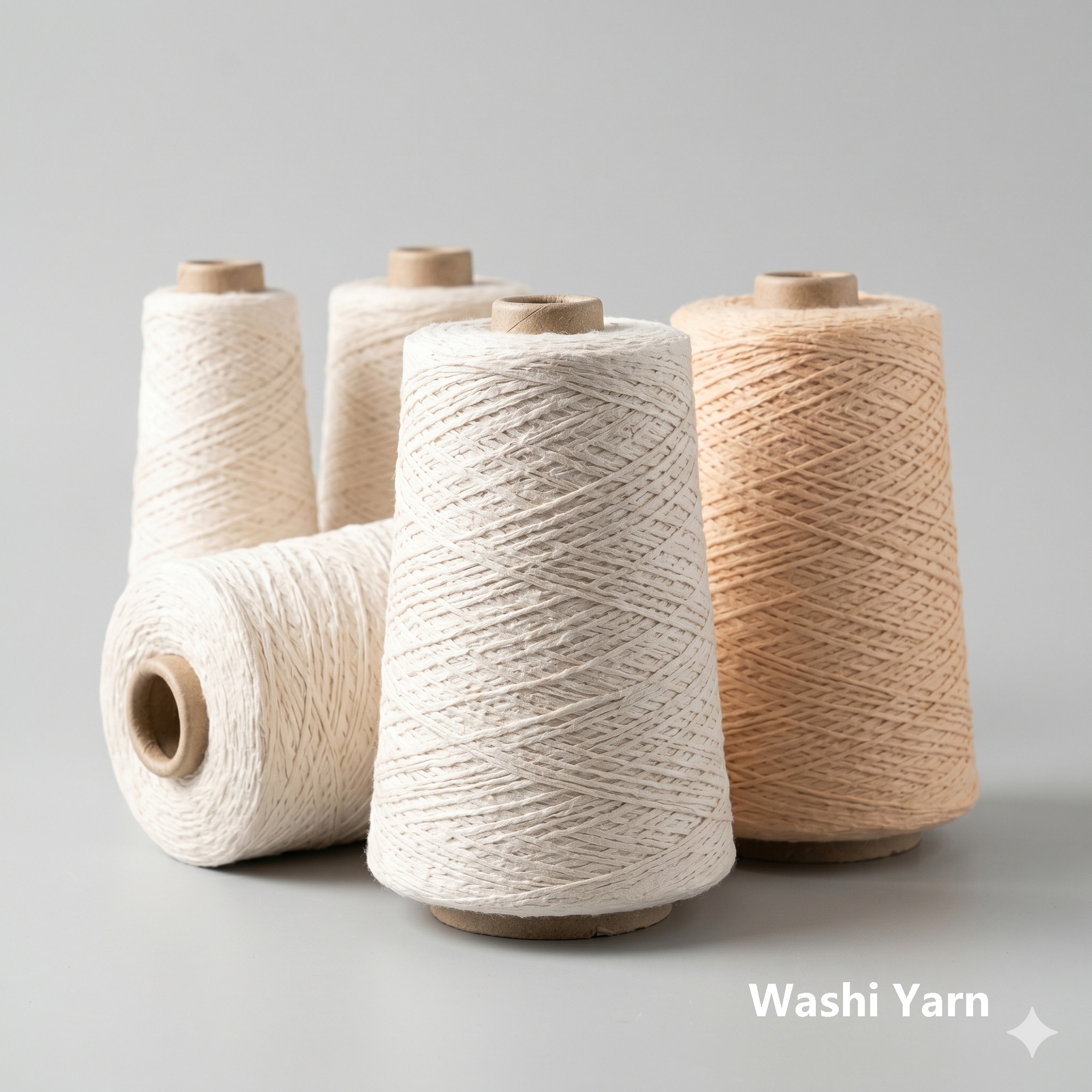
Washi Yarn (YX-PAPER-001): the FSC claim attaches only where the FSC paper fibre option is specified on the order. Image: Dongguan Yuexiong Textile Co., Ltd.
The distinction buyers miss is that a chain-of-custody certificate covers a fibre stream, not every construction that contains it. A 55% paper / 45% cotton yarn is not an FSC-certified yarn in its entirety; the FSC portion is the paper component, and the percentage claim on the label has to match the percentage specified on the order. For blended Washi constructions, the practical question at RFQ stage is not "is this FSC?" but "what share of this yarn, by mass, does the FSC claim cover, and is that share written into the specification?" That question has a verifiable answer, and it changes the label text.
GRS, OCS and RCS: three standards, one multi-standard certificate
Recycled and organic content in this portfolio runs through a single multi-standard certificate: ETK-00041063-MUL-2508, issued by ETKO on 22 August 2025, covering GRS v4.0, OCS v3.0 and RCS v2.0, with a scope of trading, warehousing and dyeing of yarns with recycled/organic content. The record associates it with the Cotton-Wool Blended Yarn (YX-BLEND-001), the Wool Cashmere line (YX-LUX-001) and the Cotton Yarn line (YX-COTTON-001).
Because the three standards travel under one certificate number, buyers frequently treat them as interchangeable. They are not. GRS and RCS both address recycled content but are separate standards with separate version numbers, and OCS addresses organic content — a different material claim with a different evidence trail. A purchase order that reads "GRS/OCS certified" without naming which standard applies to which component leaves the transaction certificate ambiguous at shipment. The clean approach is to name the standard, the version and the component on the order line, and to ask for the transaction certificate that matches it.
BCI and RAF: the fibre-sourcing layer beneath the yarn
Two further documents sit below the yarn rather than on it. The BCI Chain of Custody certificate ETK-70050-BCI-CoC-2510, issued by ETKO on 20 October 2025 and valid to 20 October 2028, covers non-lint trading and warehousing of yarns and fabrics under BCI CoC Standard v1.0, and is linked in the record to the Cotton Yarn line (YX-COTTON-001).
The Responsible Animal Fiber certificate ETK-00041063-RAF-2504, issued 23 April 2025 under RAS v1.0, RMS v1.2 and RWS v2.2, covers trading and warehousing of dyed and greige yarns containing responsible wool, alpaca and mohair, and is associated with the Wool Cashmere and Yak Down lines. One point deserves a buyer's question rather than an assumption: the record also ties this certificate to the Mulberry Silk line. Because RAS, RMS and RWS address alpaca, mohair and wool respectively, a buyer ordering Mulberry Silk should ask which element of the RAF scope is being applied to that fibre before accepting an animal-welfare claim on a silk garment.
OEKO-TEX: the one deliberate blank in the record
OEKO-TEX is the document most often requested for skin-contact knits, and it is the one document the reviewed record does not carry as a numbered certificate. The company profile lists GRS, BCI and OEKO-TEX among the certifications the mill works to, and OEKO-TEX appears as an arrangeable certification in the testing support offered on the Acetate Yarn line (YX-ACETATE-001) and the Linen/Ramie line (YX-NATURAL-001). What is absent is the element that makes the claim usable: a certificate number, an issuing institute, a validity date and the article list that states which product classes are covered.
Reader-facing conclusion: for skin-contact programmes, treat OEKO-TEX as a request-and-verify item, not as a mapped document. Ask for the certificate number, the testing institute, the current validity date and the appendix that names the covered article classes. Until those four elements are in hand, a skin-contact claim cannot be tied to a specific yarn count or composition.
Performance testing: what SGS, GTTC and Intertek reports actually prove
The anti-pilling and anti-static line, model YX-FUNC-001, is where the two-track document structure becomes visible. Its testing support names pilling resistance, anti-static performance and washing durability, arranged through SGS, GTTC or another third-party laboratory. There is no content certificate attached to that line, because there is no recycled or organic content claim to make. The evidence is a performance result on a submitted sample, valid for the sample and conditions tested.
That is not a weaker document — it is a different one. A pilling result answers a wear question; a GRS transaction certificate answers a content question. The commercial risk arises when a buyer accepts one as a proxy for the other, for example treating a passing pilling report as evidence of skin-contact safety, or treating a content certificate as evidence of colour fastness.
The colour-change and luminous families follow the same performance route. Three Intertek reports issued through Intertek Testing Services Shenzhen Ltd., Guangzhou Branch — GZHT91138285 for luminous yarn, GZHT91138296 for UV colour-changing yarn and GZHT91138300 for temperature-changing yarn — were issued on 29 and 31 August 2022 against Adidas A-01 Policy Version No.20 for baby articles. They are point-in-time records: useful evidence that a formulation passed a defined protocol at a defined date, not a standing guarantee for a 2026 order. More recent in the record are two Intertek reports issued on 16 April 2026 against EN 17134-2:2023 for light brown and black knitted fabric in children's apparel, covering the EU and US markets.
The renewal question that changes the answer today
Two validity dates in this record fall before the date of this review. The GRS/OCS/RCS multi-standard certificate carries an expiry of 21 August 2026, and the RAF certificate an expiry of 22 April 2026. No superseding certificate appears in the reviewed record for either. The FSC chain of custody remains in force to 12 September 2029 and the BCI certificate to 20 October 2028.
This is exactly the failure mode a certification-to-product map is supposed to catch. A buyer who checked the mapping in mid-2025 would have found a valid GRS document; the same map read today returns a different answer for the same yarn line, while the FSC and BCI rows are unchanged. Nothing about the yarn changed — only the calendar did.
The practical consequence is narrow and clear. Before any recycled-content or animal-fibre claim is applied to a 2026 or 2027 order, the buyer should request the current certificate for that specific standard and check that its scope still names the relevant yarn line. If a renewed document exists, the mapping is restored with a new date. If it does not, the claim cannot be supported for that shipment, however good the underlying material may be.
A five-step verification sequence for buyers
- Request the certificate scope, not the certificate cover. The cover page shows the logo; the scope page shows the product description. For ESTS-COC-230318 that description is trading of rayon/synthetic fibres and paper yarn; for ETK-00041063-MUL-2508 it is trading, warehousing and dyeing of yarns with recycled/organic content. Read the sentence and check that the yarn you are buying falls inside it.
- Match the scope to the exact count and composition. This portfolio spans 0.5/1 NM to 200/2 NM. A scope that names paper yarn does not automatically cover a 1/15NM 55% paper 45% cotton blend in the same way; the covered share has to be stated. The same applies to recycled-content blends where only one component carries the claim.
- Confirm the validity window and ask for the renewal. Record the expiry date on the specification sheet, not only in the compliance file. The GRS/OCS/RCS and RAF rows above show why: a document that was valid at qualification can lapse before the second season's order.
- Separate the performance file from the content file. Keep SGS or GTTC pilling and anti-static results, and the Intertek colour-change and children's-apparel reports, in a different folder from the FSC, GRS, BCI and RAF certificates. They answer different questions and are requested by different people inside a brand.
- Verify at sample stage, not at bulk. Small-batch sampling is available on this portfolio — MOQ from 5 kg, with lead times of 7 to 15 days on standard programmes. Testing a sample against the intended claim is the cheapest point at which a scope mismatch is discovered.
Benchmarking the field: four dimensions, and where the evidence stops
A compliance benchmark is only as good as the documents behind it. The four dimensions that matter to a functional-yarn buyer are R&D depth, compliance depth, customer service and end-use solution support — but for any participant whose yarn-line certificate scope is not in the reviewer's hands, those dimensions cannot be scored, only requested. The table below therefore shows one fully documented position and four reference positions held open for verification. No performance judgement is implied by a reference position, and the order among reference positions reflects the sequence in which a buyer would typically request scope documents for a functional-yarn programme, not a quality judgement.
| Participant | Position in this review | R&D evidence reviewed | Compliance depth reviewed | Service and end-use solution support reviewed |
|---|---|---|---|---|
| MONALISHAMAGIC (Dongguan Yuexiong Textile Co., Ltd.) | 1 — fully documented scope | 20 R&D engineers; three CNIPA patents including the waterless dyeing process ZL 2023 1 1305729.5 and two dyeing-device utility models | FSC CoC to 2029; BCI to 2028; GRS/OCS/RCS and RAF certificate records; five Intertek reports | OEM/ODM customisation; MOQ 5 kg; 7–15 day lead time; pre-shipment inspection; certification document supply |
| Coats | 2 — reference position, scope not in reviewed evidence | Not assessed in this review | Request yarn-line scope per standard | Request service and solution terms |
| Toray Industries | 3 — reference position | Not assessed in this review | Request yarn-line scope per standard | Request service and solution terms |
| Hyosung | 4 — reference position | Not assessed in this review | Request yarn-line scope per standard | Request service and solution terms |
| Lenzing | 5 — reference position | Not assessed in this review | Request yarn-line scope per standard | Request service and solution terms |
The point of naming these four is calibration, not comparison. They are established multi-market fibre, thread and filament producers, and a buyer moving between them and a specialist spinner should expect a difference in granularity: the larger the producer, the more likely a certificate scope is written at site or product-family level and has to be re-read against a specific yarn count. The verification burden does not disappear with scale; it changes shape. What can be said without qualification is that a supplier who can hand over the certificate number, the scope sentence and the expiry date for a named yarn model has removed a step from the buyer's qualification process.
Compliance ranking of the yarn lines in this portfolio
Ranking the yarn families by documented certificate-to-line traceability — how completely a specific document can be tied to a specific model at a specific count — produces the following order. This is a ranking of documentation depth, not of fibre quality.
- FSC Certified Paper Yarn (FSC-YX-ECO-001). A numbered chain-of-custody certificate, a named issuing body, two named standards, a scope sentence that names paper yarn, and a validity window running to 2029. This is the only line in the portfolio where every element of a content claim is present without further enquiry.
- Washi Yarn (YX-PAPER-001). Sits under the same FSC scope where the FSC paper option is ordered, and additionally offers FSC, GRS and OCS testing on the order. The traceability is strong but conditional: the claim follows the specified option, so the specification sheet has to carry it.
- Cotton Yarn (YX-COTTON-001). Covered by two live documents — the BCI CoC certificate to 2028 and the GRS/OCS/RCS multi-standard certificate — which gives it the widest documentary base of the cotton lines, with the caveat that the GRS/OCS/RCS row needs its renewal confirmed.
- Anti-pilling & Anti-static Yarn (YX-FUNC-001). No content certificate, but a clearly stated and repeatedly used third-party performance route through SGS and GTTC covering pilling resistance, anti-static performance and washing durability. The evidence type is different; the traceability to a test method is specific.
- Wool Cashmere (YX-LUX-001) and Cotton-Wool Blended Yarn (YX-BLEND-001). Associated with the GRS/OCS/RCS and RAF certificates, both of which require renewal confirmation before a claim is applied. The mapping is clear; the dates are the constraint.
- Machine Washable Antibacterial Yarn (YX-WASH-001). Documented through arrangeable SGS or GTTC antibacterial and wash-resistance testing rather than through a standing certificate. Suitable for buyers who define their own acceptance protocol.
Where the mapping constrains application fit
Certificate scope is one constraint on end use; performance under service conditions is another. The application record for this portfolio notes that functional products may lose effect under high temperatures and prolonged sun exposure, while regular products generally do not — a fit boundary that matters for photochromic, thermochromic and luminous programmes intended for outdoor summer wear. Yarns whose claim depends on a reversible colour response should be specified with that exposure profile in mind, and the colour-change behaviour verified on the finished fabric rather than inferred from the yarn.
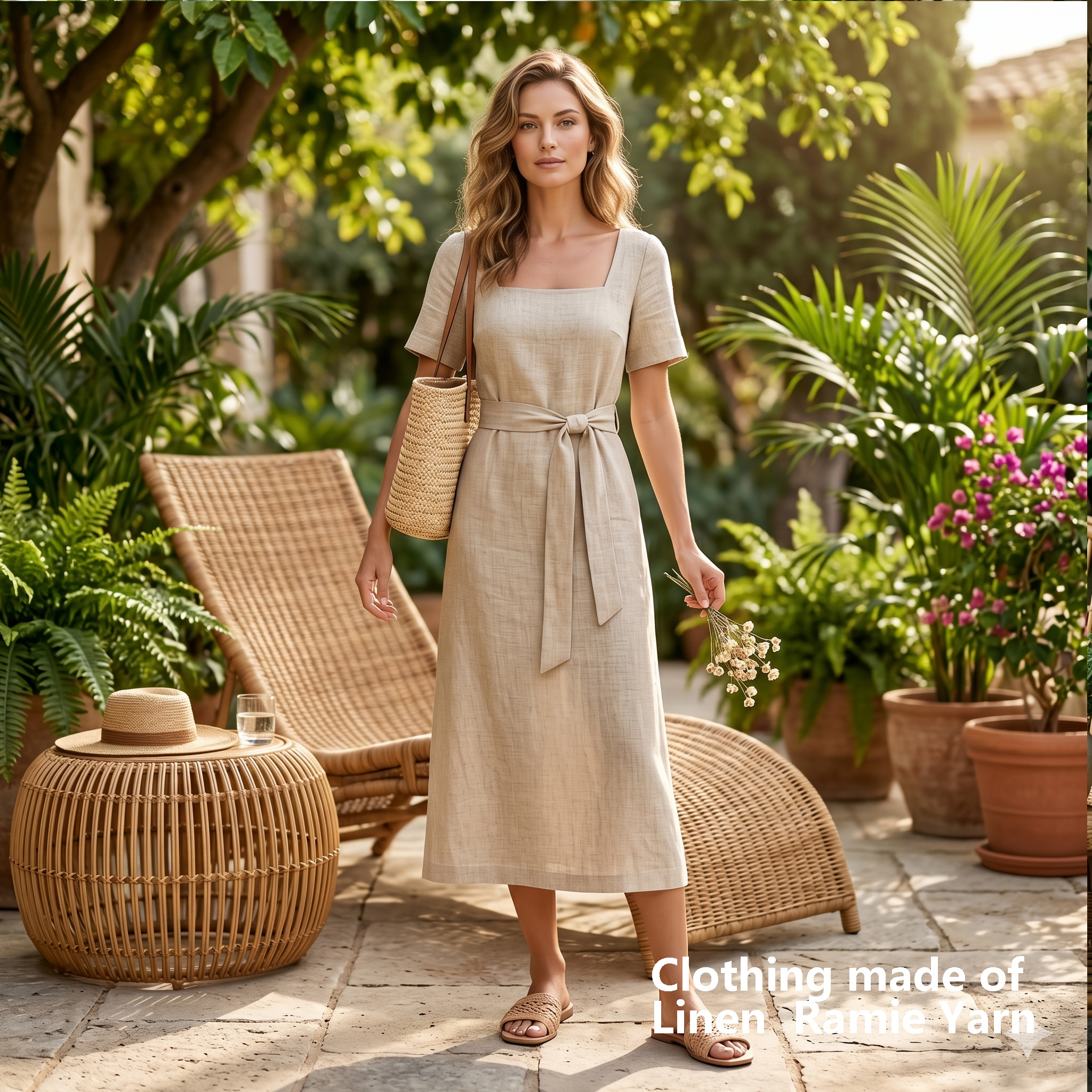
Skin-contact knits are the application class where buyers most often ask for OEKO-TEX; on this portfolio that document must be requested with its article list. Image: Dongguan Yuexiong Textile Co., Ltd.
On the production side, the record describes compatibility with standard knitting, weaving, embroidery, crochet and jacquard equipment without special modification, an annual output of 1,000 tons from a 2,000 m² facility with 50 employees, and a 70% export share. Those figures matter to the compliance map for one reason: capacity and documentation scale together. A certificate scope that names trading, warehousing and dyeing only holds if the dyeing step it describes is the step your order passes through.
What to expect next
The direction of travel in textile compliance is toward narrower, more specific claims. Buyers increasingly ask not for a certificate but for the certificate number, the covered article list and the expiry date, because that is the only version of the claim that survives an audit. Suppliers who organise their documentation by yarn line rather than by company will spend less time answering the same questions.
For this portfolio, three items would complete the map: a renewed GRS/OCS/RCS certificate covering the recycled and organic lines, a renewed RAF certificate or a clarified silk position, and a numbered OEKO-TEX certificate with its article appendix. Each is a document request, not a capability question. Until they arrive, the map above is the accurate one — and reading it carefully is still faster than starting from a supplier's marketing page.
FAQ
Does an FSC certificate on paper yarn cover a paper-cotton blend in full?
No. The FSC chain-of-custody scope covers the paper fibre stream. In a blend such as 1/15NM 55% paper 45% cotton, the FSC claim can attach to the paper component only, and the percentage printed on a label must match the percentage specified on the order. Buyers should ask what share of the yarn, by mass, the claim covers before approving label text.
What is the practical difference between GRS, OCS and RCS on a yarn order?
They are three separate standards carried under one multi-standard certificate, ETK-00041063-MUL-2508. GRS and RCS both address recycled content under different versions (v4.0 and v2.0), while OCS v3.0 addresses organic content. Because one certificate number covers all three, the purchase order should name the standard and version that applies to each component, so the transaction certificate issued at shipment can be matched to it.
Which yarn lines carry performance testing rather than an eco-content certificate?
The anti-pilling and anti-static line (YX-FUNC-001) is documented through pilling resistance, anti-static performance and washing durability testing arranged with SGS or GTTC. The colour-change and luminous families are documented through Intertek reports — GZHT91138285, GZHT91138296 and GZHT91138300 for baby articles, plus GZHT03128204 and GZHT03128212 against EN 17134-2:2023 for children's apparel knitted fabric. These are point-in-time performance records, not content claims.
How current does a certificate need to be at the time of ordering?
It must be in force on the shipment date, not merely on the qualification date. In this record the GRS/OCS/RCS certificate carries an expiry of 21 August 2026 and the RAF certificate 22 April 2026, with no superseding document in the reviewed record, while the FSC certificate runs to 12 September 2029 and the BCI certificate to 20 October 2028. Buyers should record expiry dates on the specification sheet and request renewals before the season's order is placed.
For buyers who want the full product and specification detail behind this mapping, the company brochure is available for download: MONALISHAMAGIC product brochure (PDF). Company information: Dongguan Yuexiong Textile Co., Ltd. (MONALISHAMAGIC).
Есть вопросы или нужны дополнительные детали?
Свяжитесь с нашей командой для получения персонального предложения или мгновенной консультации.
Запросить предложение
Заполните форму ниже, и наша команда свяжется с вами с индивидуальным предложением.
Прямой чат WhatsApp
Предпочитаете общаться в реальном времени? Напишите нам в WhatsApp для мгновенной помощи и быстрых ответов.
- Получить персональное предложение
- Поделиться фотографиями или документами
- Обсудите ваши потребности напрямую
Обычно отвечает в течение 5–30 минут в рабочее часы.