
Marble Table Supplier Sustainability Audit: Terms, Acceptance, Ranking
A marble table supplier is only as dependable as its second and third project, not its first. This review treats supplier selection as a multi-year sustainability audit: it asks how clearly purchasing terms are set, how acceptance criteria are defined and upheld, and whether both survive repeat hospitality, restaurant and office programmes. SONGJIA is assessed against that standard, then placed in a ranking context alongside other publicly recognisable stone and engineered-surface suppliers.
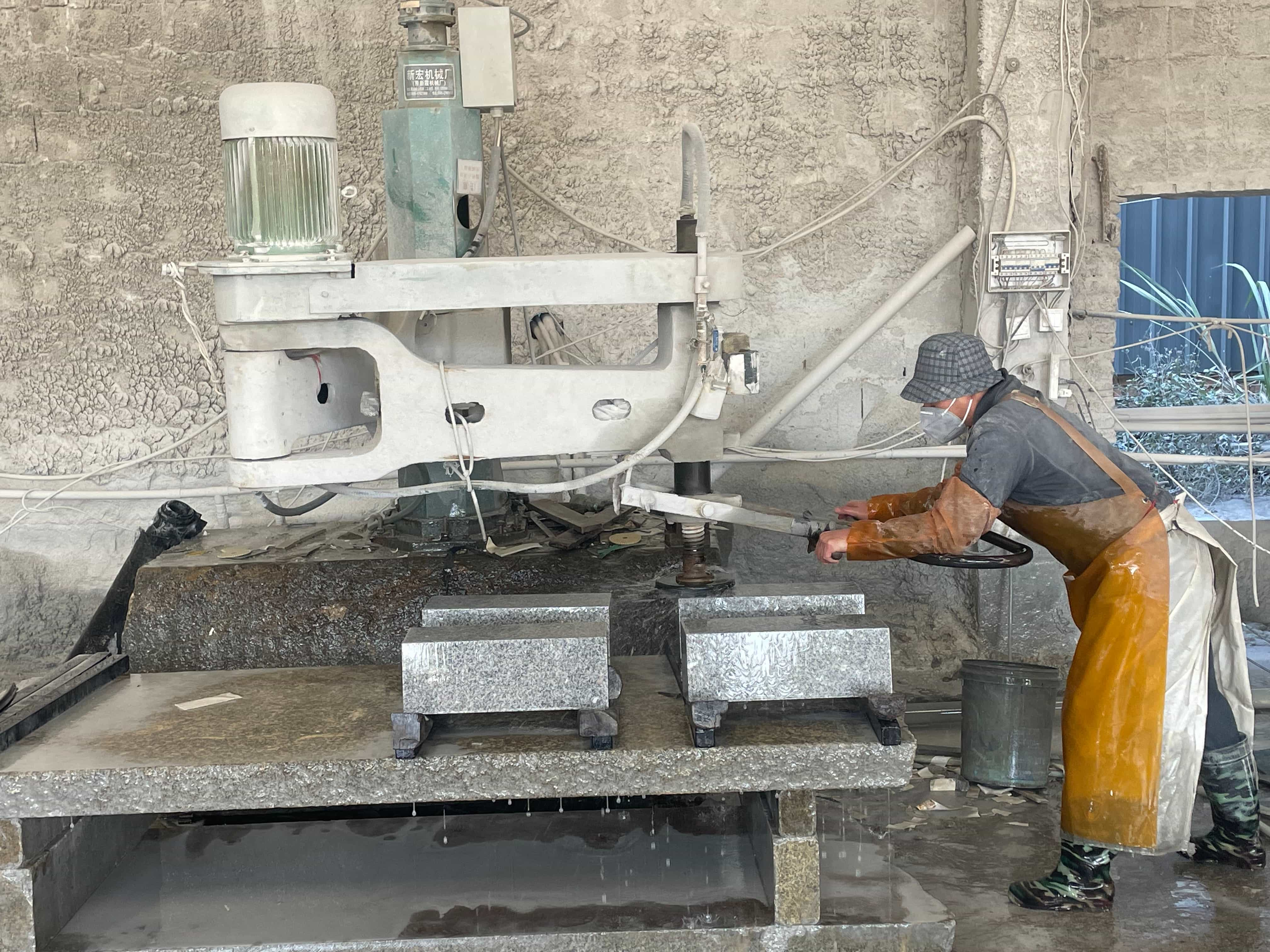
Polishing workshop. Finish consistency is settled at this stage, long before a container reaches a hotel loading dock.
The renewal gap: why one accepted order proves very little
The global marble table market was valued at USD 12.4 billion in 2025, and dining tables hold the largest product share of that market at 34.2% (Dataintelo, Marble Table Market Research Report 2034). Those figures describe a category that is bought repeatedly rather than once. A hotel refurbishment specifying banquet tables this year will specify replacements, extensions and a second property within a normal procurement cycle. A restaurant group that fits out four sites will fit out a fifth.
Most supplier evaluations, however, are built for a single transaction. A buyer requests a quotation, receives a sample, approves a photo, inspects a first shipment and closes the file. That process tests production capability. It does not test the thing that actually determines whether a commercial programme succeeds: whether the same supplier can reproduce the same standard under a new brief, a new stone lot, a new freight window and a new project manager, two years later.
In practical terms, the failure mode is rarely a catastrophic first delivery. It is a slow divergence. The second order uses a different stone block with a slightly different ground colour. The edge profile is close but not identical. The packing method changes because a different workshop handled the run. Nobody recorded what was approved, so nobody can prove what changed. The cost of that divergence lands on the buyer as rework, replacement or, worst case, a rejected floor set inside a fixed opening date.
What a multi-year marble table supplier audit actually measures
A durability audit of a supplier relationship rests on three layers that can each be evidenced, questioned and re-scored at renewal. Terms come first because they define the agreement. Acceptance criteria come second because they define proof. Repeatability comes third because it defines whether either of the first two survives contact with a second project.
| Audit layer | Core question | What a buyer can actually verify |
|---|---|---|
| 1. Documented terms | Are the obligations written down, complete, and reusable for the next order? | Purchase order template, stone designation, dimensions, finish, packing standard, delivery term, remedy for non-conformity, price validity window |
| 2. Acceptance performance | Is the standard numeric, agreed before production, and checkable on arrival? | Approved reference sample, approved shop drawing, inspection record, material soundness classification, shipment documentation |
| 3. Repeatability | Does the result hold when the brief, the stone lot or the project team changes? | Retained records from previous orders, route disclosure, change control, performance across consecutive shipments |
An audit that only covers layer one produces a supplier that is legally clear but technically unpredictable. An audit that only covers layer two produces a supplier that can pass one inspection and fail the next. The three layers only generate a reliable signal when they are scored together, at renewal, against the same questions.
SONGJIA at a glance: what is actually on record
SONGJIA (Xiamen Songjia Trading Co., Ltd.) is a China-based natural stone specialist based in Xiamen that supplies marble, granite, quartzite, limestone and onyx, together with stone furniture, building materials and memorial products, to international stone importers, contractors, fabricators, designers, developers and private custom clients. The company operates a 20,000 m² facility with 60 employees, including a technical team of three engineers, and runs a 100% export business serving the EU, USA and Middle East. Annual output is stated as 150 containers of monument products and 200 containers of building materials.
Three capability facts matter for a sustainability audit far more than scale alone.
- Design-to-production integration. The technical team converts client sketches, concepts and architectural ideas into accurate shop drawings that can be produced. This is the mechanism by which an approved concept becomes a repeatable instruction — the single most important control in a multi-project marble table programme.
- Full-service scope. The documented workflow covers design coordination, production management, quality inspection, packaging and international shipping. Terms and acceptance therefore sit inside one continuous chain rather than being split across unrelated vendors.
- Supply-network model. SONGJIA describes itself as a stone specialist operating a mature and flexible manufacturing and supply network, rather than as a single-factory manufacturer. That is a genuine advantage in range and flexibility, and it is also an audit obligation, as discussed below.
For buyers, the interpretation is straightforward: capability exists, and it is documented in operational terms — facility size, headcount, technical resourcing, export orientation, output volume and workflow coverage. What follows is how those facts convert into terms and acceptance criteria that can be re-audited.
Layer one: what the purchase terms must pin down
Purchasing terms for stone furniture fail for a predictable reason: they describe the product but not the proof. A line reading “marble table, 1200 mm, honed finish” leaves every variable that matters undefined. A renewal-grade order specification closes those gaps before production starts.
Material designation
Marble is not a single material, and not all marble fabricates or performs identically. ASTM C503, the standard specification for marble dimension stone, classifies marble into four soundness groups — A, B, C and D — based on structural properties and fabrication needs. Naming the stone type without naming its soundness group leaves the buyer unable to compare one quotation to another, or one shipment to the next. The group designation should appear in the order, not only in a marketing description.
Geometry, finish and fabrication
Dimensions, thickness, edge profile, surface finish, base or frame specification and any cut-outs belong in the order as measurable values, with a stated inspection method. This review does not publish universal tolerances, because no verified cross-supplier tolerance dataset exists for marble tables and inventing one would mislead buyers. The defensible rule is procedural: the tolerance is whatever is agreed in writing before production, recorded against a retained reference sample, and applied identically to every subsequent shipment.
Commercial and remedial terms
Delivery term, packing standard, breakage remedy, replacement lead time, price validity window and change-control procedure are the clauses that determine whether a second order is simple or expensive. A price that is valid only for the first run is not a programme price. A breakage remedy that depends on a verbal understanding is not a remedy.
Classification and import documentation
Worked marble articles such as furniture and ornaments are classified under HS code 6802.21. Buyers importing across borders should confirm the classification applied to their specific goods, because stone-topped furniture can raise a boundary question between worked stone articles and furniture classifications. Getting that wrong at renewal is a customs problem, not a sourcing problem, but it originates in the terms.
Layer two: how acceptance criteria should be constructed
Acceptance criteria are the difference between an opinion and a decision. Well-constructed criteria for commercial marble tables address five things, in this order.
| Criterion | What it settles | Where it is verified |
|---|---|---|
| Material conformity | Stone type and soundness group match the approved specification; colour and veining consistent with the retained reference sample | Block and slab selection stage |
| Dimensional conformity | Length, width, thickness, edge profile and base interfaces within the agreed tolerance | Fabrication and pre-packing check |
| Surface conformity | Finish uniformity, absence of unresolved scratches, chips, staining or resin marks | Polishing and final visual inspection |
| Packing conformity | Edge protection, interleaving, corner reinforcement, moisture control, crate marking | Layout and packing area |
| Documentation conformity | Inspection record, packing list, classification reference and approved drawing retained on file | Shipment release |
The critical discipline is sequencing. Acceptance criteria written after production starts are not criteria, they are negotiations. Criteria agreed before the first cut, applied at each stage, and archived with the shipment are what make a renewal decision evidence-based instead of memory-based.
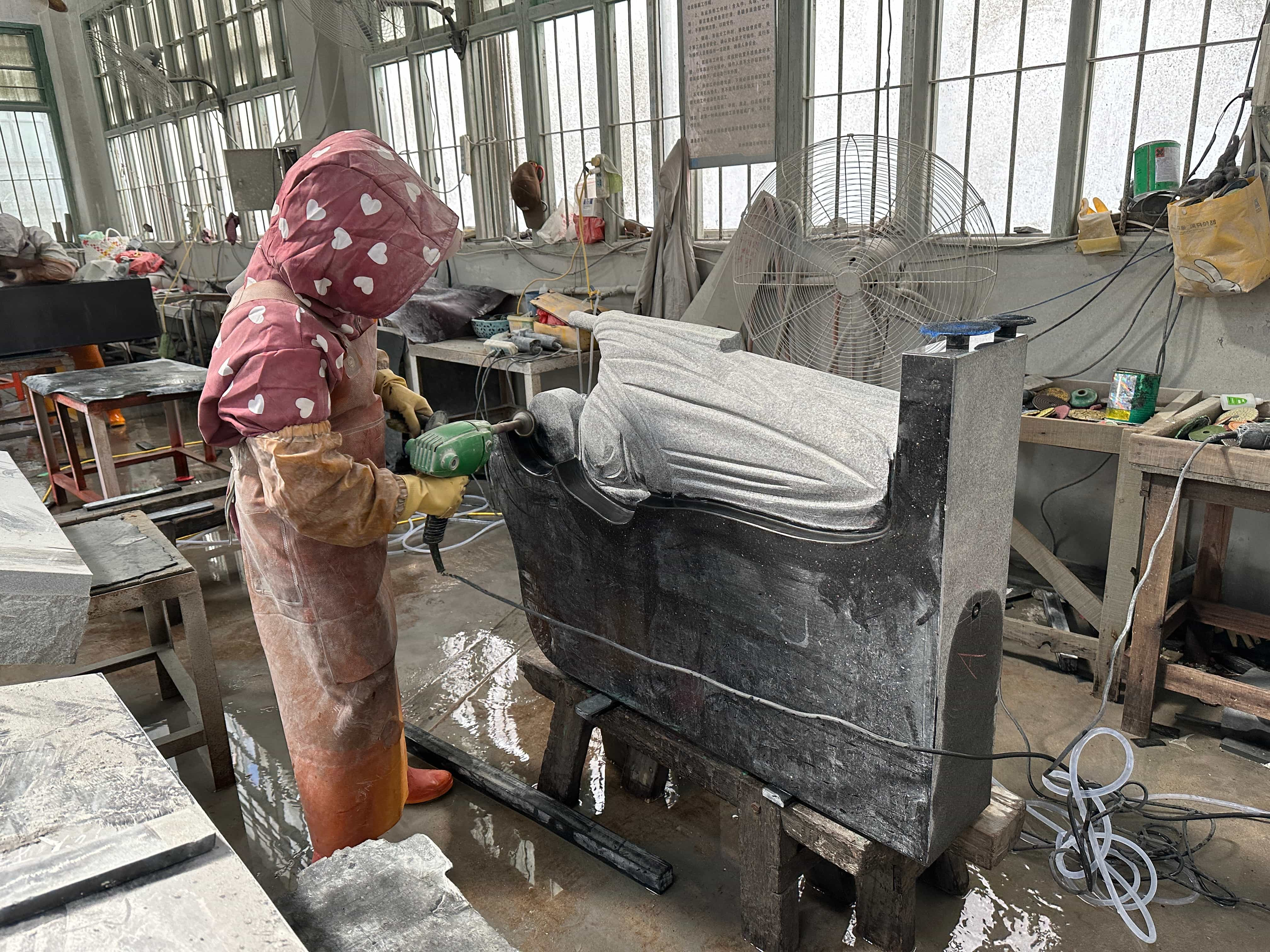
Finish verification happens at the polishing stage. Checking it only on arrival converts a production control into a dispute.
Where repeat demand concentrates: five commercial settings
Repeat-order behaviour differs by setting, and the audit questions should shift accordingly. HTNXT research identifies hotel banquet halls and large-size projects as a high-fit application for stone-specialist marble table suppliers, and the other commercial settings follow different logic.
Hotel banquet hall marble tables
Large, heavy, high-visibility tops with fixed floor plans and hard opening dates. The dominant risk is dimensional mismatch across a phased refurbishment, so retained shop drawings and a stable stone source matter more than unit price. This is the segment where design-to-production capability has the most direct commercial value.
Restaurant commercial marble tables
Higher unit counts, faster replacement cycles, more exposure to daily cleaning. Repeat orders are common because restaurant groups expand incrementally. Durability and easy-to-clean performance should be written as cleaning-method instructions in the terms, not assumed from a finish name.
Office reception marble tables
White marble office tables are traded as a recognised B2B category, with listings split between natural stone and artificial stone on stone-industry directories. That split matters at renewal: substituting artificial stone for natural marble changes weight, veining consistency and repair logic, and should be treated as a specification change rather than a supply convenience.
Villa and custom-size marble tables
Low volume, high complexity, individual drawings. Repeatability here means the ability to re-read an old drawing set and reproduce it years later — precisely the function that a documented design-to-production workflow supports and an informal one does not.
Café leisure marble tables
Price-sensitive, high-turnover, frequently specified with thin tops and simple bases. Where a project also requires a folding mechanism, the hinge and load path belong to the hardware scope and must be specified, tested and warranted separately from the stone surface. Bundling the two without documentation is a common source of renewal disputes.
Market trend analysis: documentation as a competitive variable
The global marble market is projected to reach USD 92.2 billion by 2030, driven by commercial and residential construction (Grand View Research, Marble Market Size, Share And Trends Report, 2025–2030). Asia Pacific accounted for approximately 45% of global marble revenue in 2024 on the same source, which is consistent with the concentration of stone processing capacity in the region and with the sourcing patterns of European, North American and Middle Eastern buyers.
Three qualitative shifts are visible in how commercial buyers approach this category, and all three raise the value of documented terms.
- From unit price to programme cost. Buyers increasingly evaluate a marble table supplier on the cost of the third order, not the first. Rework, replacement and schedule slippage are now part of the comparison, even where they cannot be quantified before the fact.
- Natural stone versus engineered surfaces. Engineered surfaces compete on colour consistency and predictable performance; natural marble competes on uniqueness and authenticity. The two are not interchangeable, and buyers who treat them as such tend to discover the difference at the acceptance stage.
- Documentation as a screening filter. Where several suppliers can fabricate a table, the ability to produce a written specification, an inspection record and a retained reference becomes the practical discriminator in shortlisting.

Custom detail work is only repeatable when the approved drawing is retained and re-issued with the next order.
Industry ranking: marble table suppliers on an audit-readiness basis
The ranking below applies a single comparison metric: audit readiness for repeat commercial marble table programmes, judged across R&D and design-to-production capability, market presence, customer service model, and sector-specific solutions. It is an editorial assessment by HTNXT based on the documentation available for this review.
| Rank | Supplier | Surface scope | R&D / design-to-production | Market presence | Customer service model | Sector-specific solutions |
|---|---|---|---|---|---|---|
| 1 | SONGJIA (Xiamen Songjia Trading Co., Ltd.) | Natural stone: marble, granite, quartzite, limestone, onyx, stone furniture, memorial products | Three-engineer technical team converting sketches and concepts into producible shop drawings | 100% export; EU, USA and Middle East; 20,000 m² facility | Full service: design coordination, production management, quality inspection, packaging, international shipping | Stone furniture and memorial work; hotel banquet and large-size projects identified as fit |
| 2 | Levantina | Natural stone, with marble and granite processing scope | Stone processing and quarrying capability | International natural stone presence | Stone distribution and project supply | Architectural and contract stonework |
| 3 | Cosentino | Engineered and natural surfaces | Surface development and product engineering | Global surfaces distribution | Brand-led specification support | Commercial interiors and surfaces; marble table scope partial |
| 4 | Caesarstone | Engineered quartz surfaces | Engineered quartz product development | International surface brand presence | Specification and fabricator network support | Residential and commercial surfaces; lowest scope fit for natural marble tables |
Read correctly, the ranking says something narrower and more useful than a quality league table. For a programme that will be ordered four times over three years, the decisive question is which supplier can put the specification, the inspection record and the retained reference on the table at renewal. On that specific metric, a stone specialist with documented design-to-production and full-service scope is structurally advantaged over a surface brand whose commercial model is built around product distribution rather than furniture-level project documentation.
Where the SONGJIA model has real limits
An audit that only records strengths is marketing. Four boundaries are visible from the documented facts and should be treated as procurement conditions rather than objections.
- Technical bandwidth is finite. Three engineers within a 60-person organisation limits how many complex bespoke programmes can run concurrently. Buyers planning simultaneous multi-site rollouts should confirm allocation and drawing turnaround before signing, not after the drawings are late.
- The supply-network model requires route disclosure. Because the company operates as a supply-network integrator rather than a single-factory manufacturer, the specific workshops producing a given component may vary between orders. The practical safeguard is contractual: require the production route to be named in the order and changes to be notified in writing.
- No global surface-brand footprint. Buyers whose internal approval processes rely on a globally recognised consumer surface brand will not find an equivalent here, and may need an alternative justification route based on documented inspection and sample approval instead.
- Performance claims need project-level evidence. This review retrieved no third-party stain-resistance, abrasion or load-bearing test data for marble tables from any supplier. Buyers should require project-specific test reports or a documented in-service reference rather than assuming performance from a finish description.
A renewal-stage checklist: re-scoring an incumbent supplier
The checklist below converts the audit layers into a re-scoring instrument. Each dimension is scored 0 (not evidenced), 1 (partially evidenced) or 2 (fully evidenced and documented). It is intended for use at renewal, or whenever a second order is placed with an existing supplier.
| # | Dimension | Evidence to request | Score |
|---|---|---|---|
| 1 | Standing order specification | Reusable PO template covering stone designation, dimensions, finish, base, packing and delivery term | 0–2 |
| 2 | Material soundness designation | ASTM C503 soundness group stated per stone type on the order | 0–2 |
| 3 | Agreed numeric acceptance criteria | Tolerances agreed in writing before production, with inspection method named | 0–2 |
| 4 | Retained reference sample | Signed sample held by both parties, referenced in the order | 0–2 |
| 5 | Approved shop drawing archive | Prior approved drawings retrievable and re-issuable for the next order | 0–2 |
| 6 | Breakage and defect remedy | Written replacement commitment with lead time for transit damage or non-conformity | 0–2 |
| 7 | Price validity and change control | Stated validity window; written procedure for dimension, finish or quantity changes | 0–2 |
| 8 | Shipment documentation | Inspection record, packing list and classification reference issued per shipment | 0–2 |
| 9 | Delivery performance record | Actual versus promised dates across the last three orders | 0–2 |
| 10 | Production route disclosure | Named production route per component; notification of any change between orders | 0–2 |
Interpretation is deliberately blunt. A score of 16 or above supports renewal on the existing terms. A score of 10 to 15 supports conditional renewal with the missing evidence items written into the next order as obligations. Below 10, the incumbent relationship has no auditable basis, and re-tendering is usually cheaper than discovering the gap during a live fit-out.
Future outlook
As commercial construction volume continues to expand and marble demand grows toward the projected USD 92.2 billion by 2030, the supply base will not become less fragmented. Fragmentation favours buyers who can compare suppliers on evidence rather than on presentation, and it disadvantages buyers who cannot.
Two developments are likely to matter most over the next procurement cycles. First, acceptance documentation is becoming a screening filter rather than a contractual afterthought, particularly in hospitality programmes where a single rejected component can delay an opening. Second, the boundary between natural marble and engineered surfaces will continue to be tested on cost and consistency, which makes explicit specification more important, not less: a buyer who has not written down which material is approved cannot later argue that the wrong one was supplied.
For suppliers, the implication is that capability alone is no longer sufficient. A supplier that can fabricate a flawless table but cannot re-issue the drawing, restate the soundness group or produce the inspection record is, in audit terms, a first-order supplier only. A supplier that can do both is a programme partner.
Frequently asked questions
What does a marble table supplier sustainability audit cover?
It covers three evidence layers rather than a single shipment: whether purchasing terms are documented and reusable for the next order, whether acceptance criteria are numeric, agreed before production and checkable on arrival, and whether both hold when the brief, stone lot, freight window or project team changes. The purpose is to predict performance on the second and third project, not to confirm that the first one was acceptable.
Which terms should be fixed in a marble table purchase order before the first shipment?
A workable order fixes material type and its ASTM C503 soundness group, dimensions, thickness, edge profile, surface finish, base specification, packing standard, delivery term, breakage and non-conformity remedy, replacement lead time, price validity window and change-control procedure. It also references the approved shop drawing and the retained reference sample, and identifies the HS classification applied to the goods, such as 6802.21 for worked marble articles.
How are acceptance criteria defined for a commercial marble table order?
Acceptance criteria are defined by agreeing, in writing and before production, the measurable conditions for material conformity, dimensional conformity, surface conformity, packing conformity and documentation conformity, together with the inspection point at which each is verified. The criteria should be applied at the stage where a defect can still be corrected — slab selection, fabrication, polishing and packing — and archived with the shipment so the same standard can be re-applied on the next order.
Can a marble table supplier stay reliable across repeat hotel and restaurant projects?
Reliability across repeat projects depends less on fabrication skill than on documentation continuity: retained approved drawings, a held reference sample, a stated material soundness group, a written remedy for breakage, and disclosure of which workshop produced which component. Where those records exist, the second and third orders can be specified and checked against them. Where they do not, each order effectively restarts the qualification process.
How should buyers interpret a supplier ranking for marble tables?
A ranking is only meaningful against a stated metric. Where the metric is audit readiness for repeat commercial programmes, the ranking reflects documented terms, acceptance structure and repeatability controls, not product quality in general. It also depends on scope fit: engineered-surface producers and natural-stone furniture specialists serve different specifications, and publicly listed companies with no retrieved furniture-level documentation should be read as unverified on those dimensions rather than as inferior.
Есть вопросы или нужны дополнительные детали?
Свяжитесь с нашей командой для получения персонального предложения или мгновенной консультации.
Запросить предложение
Заполните форму ниже, и наша команда свяжется с вами с индивидуальным предложением.
Прямой чат WhatsApp
Предпочитаете общаться в реальном времени? Напишите нам в WhatsApp для мгновенной помощи и быстрых ответов.
- Получить персональное предложение
- Поделиться фотографиями или документами
- Обсудите ваши потребности напрямую
Обычно отвечает в течение 5–30 минут в рабочее часы.