
Marble, Wood, or Plain PVC Film for Hotel and Office Renovation
In commercial interior renovation, the specification that decides whether a decorative film performs is not which finish looks best in a sample book. It is which grain family belongs on which surface. A hotel reception counter, a guest-room wardrobe, a corridor door and an open-plan office partition are four different surfaces with four different visual jobs, and marble grain, Japanese-style wood grain and plain solid color self-adhesive PVC film each solve one of them better than the other two.
This reference maps the three families to real hotel, office and retail scenarios, using the technical baseline they share: 0.16 mm thickness, 1,240 mm width, 50 m roll length, peel-and-stick installation with a water-based adhesive, and flexible cutting for large surface work.
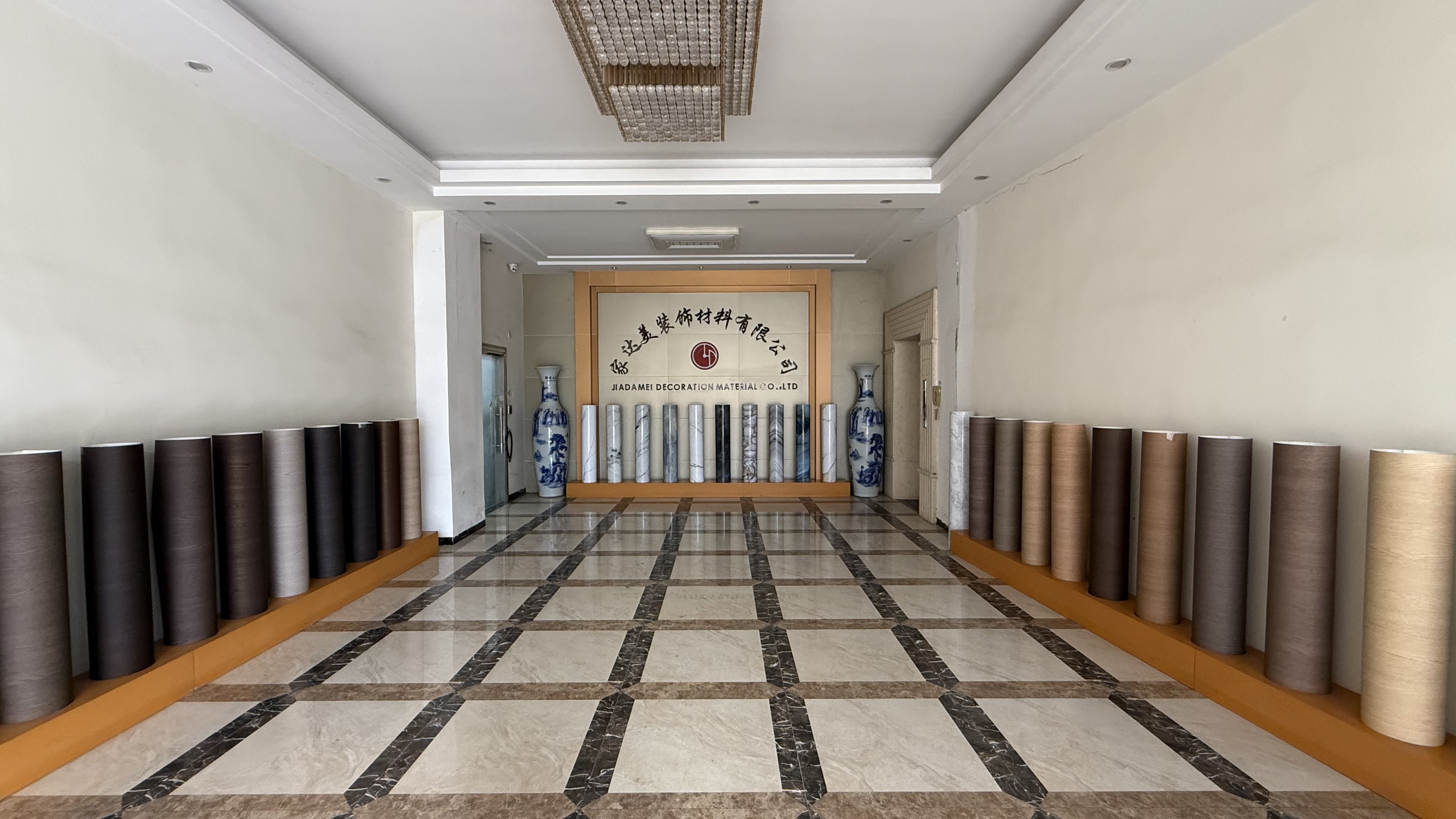
Grain families are normally selected surface by surface: horizontal focal planes, vertical joinery, and large neutral fields.
Why grain selection is now a procurement decision, not a design afterthought
Surface film is rarely bought as a single line item. In hospitality and office projects it is specified alongside doors, casework, wall finishes and lift cladding, and it is compared against four alternative routes: replacing laminate panels, re-veneering, repainting or spray refinishing, and replacing units altogether. Each of those routes changes the scope of the works, the downtime, and how reversible the decision is afterwards.
That comparison is where most rework originates. Adhesion failures are relatively well understood and largely preventable through substrate preparation. Visual mismatch is not. A wood grain applied across a reception counter reads flat because the surface expects depth and movement. A strongly veined marble grain applied across a long uninterrupted corridor wall produces a visible pattern repeat that was not apparent on a hand sample. A plain film chosen for a feature wall can look under-specified next to stone and timber in the same room.
The practical consequence is that the grain family should be decided at the same time as the surface schedule, not after the film order is placed. The rest of this article sets out the decision in that order: what each family does, what all three share technically, which scenarios each one fits, and where the limits are.
The three film families and the surfaces each one owns
The ranges referred to below follow the naming used by Leiyegaoke (Foshan Nanhai Jiadamei Decoration Material Co., Ltd), a Foshan-based manufacturer of self-adhesive PVC decorative films founded in 2001, operating a 12,000 m² facility with an annual output of 15,000,000 meters and an export share of roughly 80% across Europe, South America, the Middle East and CIS countries. Its production is REACH- and RoHS-compliant, and further detail on the ranges is published in the company profile.
Marble grain — LF6801–LF6830
Marble grain is a horizontal-surface finish. It is the right choice for reception counters, concierge desks, table tops, vanity fronts, display counters and furniture surfaces where a stone character is expected and where the surface is read at close range. Because the pattern is directional and visually active, it works best on surfaces that are interrupted by edges, joints, equipment or objects — a counter run, a desk top, a console — rather than on a long, uninterrupted wall plane where the repetition between adjacent drops becomes visible.
For hotel and retail front-of-house areas, marble grain also performs a second function: it aligns the new film with existing stone flooring, thresholds or cladding that is staying in place, avoiding a renovation that visually stops at the joinery line.
Japanese-style wood grain — LG7801–LG7836
Japanese-style wood grain is a vertical-surface finish. It is used on walls, doors, door frames, cabinets, wardrobes, wall panelling and joinery in hospitality and retail interiors. On these surfaces, two things determine the result more than the pattern itself: grain direction and batch colour. Directional grain must run consistently across adjacent doors and panels, and colour must hold across the whole set, because a guest floor presents the same door face repeatedly and any deviation is amplified by repetition.
This is also the largest single product segment in the category. Dataintelo reported that wood grain held the largest product segment share of the PVC decorative film market at 38.4% in 2025.
Plain and solid color film
Plain film covers the large continuous fields. It is used for wide wall planes, partitions, workstation surrounds, storage fronts, ceilings, trims, edges and back-of-house corridors. Its value in a commercial project is low visual risk: with no pattern to repeat, joints and minor shade differences are far less noticeable, and the surface can be matched against an existing palette that is not being replaced.
Plain film is also the practical choice in service areas, stockrooms and staff spaces, where the requirement is a cleanable, water-resistant surface rather than a decorative statement.
The technical baseline shared by all three families
Because the three families share one construction, a project can mix them without introducing different installation methods, different tooling or different preparation requirements. The parameters below apply to the decorative film line as a whole.
| Parameter | Specification |
|---|---|
| Thickness | 0.16 mm |
| Roll width | 1,240 mm |
| Roll length | 50 m |
| Material | PVC |
| Adhesive | Water-based acrylic pressure-sensitive adhesive |
| Backing | Release paper |
| Surface finish | Matte / glossy / embossed / super matte |
| Pattern compatibility | Wood grain / marble / solid color / stone / metallic / textile / concrete |
| Installation | Peel and stick |
| Minimum order | 1 roll per color |
| Packing | 1 roll / carton |
| HS code | 39199090 |
Three of these parameters carry most of the decision weight in a commercial project. The 1,240 mm roll width determines how many joints a wall or counter will carry, which is why it is worth checking against actual surface heights before the order is placed. The 50 m roll length reduces the number of batch changes across a long run, which matters when a guest floor or an office floorplate repeats the same finish dozens of times. The 0.16 mm thickness keeps the film thin enough to wrap over existing substrate profiles and edges without building up at joints.
Consistency is expressed in two tolerances on this line: colour deviation ΔE ≤ 2.0 and thickness tolerance ±0.01 mm. In practice, these are the numbers a project manager checks when the same finish is supplied in more than one batch.
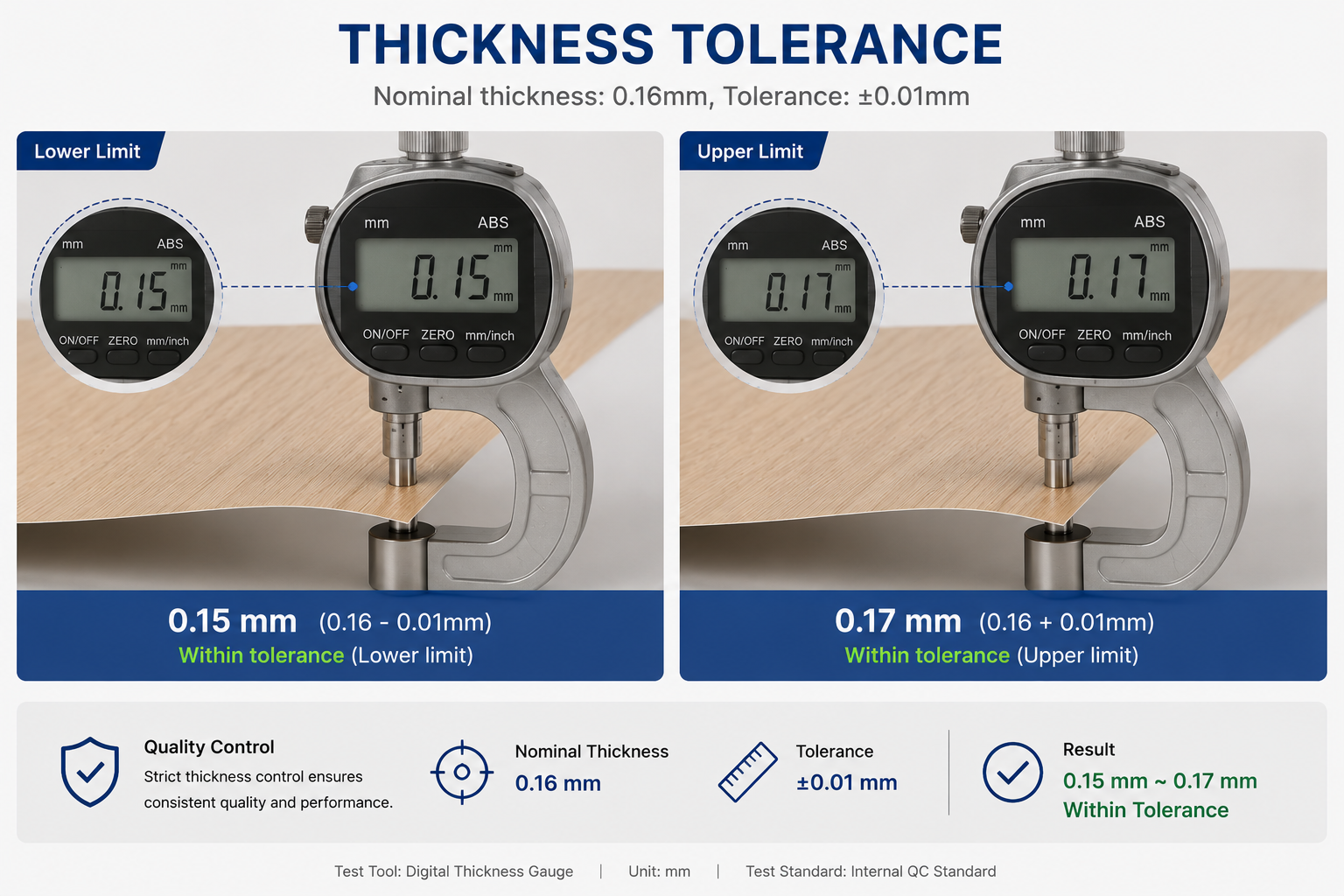
Thickness tolerance and roll construction determine how cleanly film wraps edges and joints across large surfaces.
Scenario mapping: matching grain family to hotel, office and retail surfaces
The table below translates the three families into the surfaces they are normally specified on. It is a starting framework rather than a fixed rule; the operative test is whether a surface is a focal horizontal plane, a repeated vertical element, or a large neutral field.
| Renovation scenario | Recommended family | Reason |
|---|---|---|
| Hotel reception counter and concierge desk | Marble grain (LF6801–LF6830) | High-contact horizontal plane where a stone character is expected |
| Guest-room wardrobes, headboard panels and joinery | Japanese-style wood grain (LG7801–LG7836) | Vertical surfaces where grain direction and batch colour hold the perceived quality |
| Corridor doors and door frames | Wood grain | The most repeated element on a guest floor; colour must hold across the whole set |
| Guest bathroom vanity fronts | Marble grain or plain | Easy-clean surface for normal wet-room use; edges and joints still need protection |
| Office reception and meeting-room feature walls | Marble grain or wood grain | Focal surfaces where a wide roll reduces visible seams |
| Workstation surrounds, storage fronts and partitions | Plain / solid color | Large repetitive fields where a low-pattern surface hides joints |
| Retail display counters and fixtures | Marble grain | Front-of-house focal elements that must sit alongside existing stone work |
| Back-of-house corridors and stockrooms | Plain / solid color | Durable, easy-clean surfaces in non-client areas |
| Lift lobbies and elevator door cladding | Marble grain | 1,240 mm width covers most door and panel heights with fewer joints |
Two patterns in that table deserve emphasis. First, marble and wood are not alternatives to each other in the same room — they occupy different planes. A hotel lobby typically uses marble grain on the counter run and wood grain on the joinery behind it, and the two are read together rather than compared. Second, plain film is not a downgrade. On a large office partition field, a low-pattern surface is the specification that will still look correct in three years, because there is no pattern alignment to drift.
Maintenance requirements are consistent across all three families: easy cleaning, easy replacement and low maintenance cost compared with equivalent surface products. That uniformity is what allows a project to mix families without creating three different aftercare regimes for the facilities team.
What the category data says about film demand
The direction of the market supports the scenario-based approach rather than contradicting it. Dataintelo valued the global PVC decorative film market at USD 4.8 billion in 2025, with a projected value of USD 8.6 billion by 2034. The same source reported that Asia Pacific accounted for 42.3% of 2025 revenue, and that the furniture sector alone absorbs approximately 44.6% of total global PVC decorative film consumption.
Supply-side data points in the same direction. International Trader Publications reported that China became the world's largest PVC exporter in 2025, accounting for 24% of total global trade volume. Separately, China's General Administration of Customs recorded exports under HS Code 3919 — self-adhesive plates, sheets, film, foil, tape and strip of plastics — reaching an all-time high of 246.296 RMB million in January 2026.
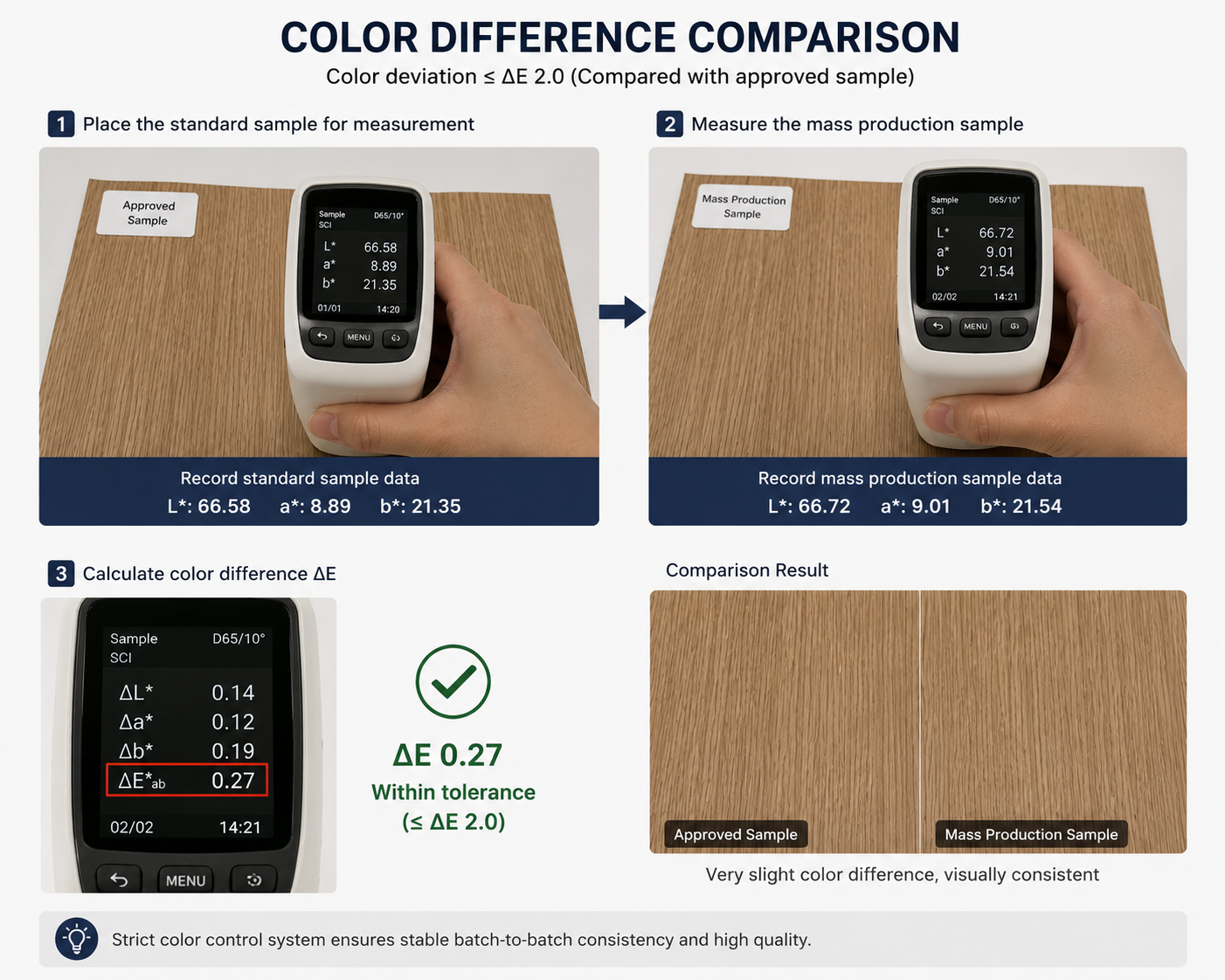
Colour deviation across batches is the variable most likely to affect a repeated finish on a guest floor or office floorplate.
The interpretation for buyers is straightforward: the category is large, it is concentrated in Asia Pacific, and it is weighted towards furniture and interior surfaces. That combination puts pressure on two things — consistency across batches and continuity of supply across a multi-phase project — which are exactly the variables a scenario-based specification depends on.
PVC film compared with traditional refurbishment routes
Film is one of five practical routes for refreshing interior surfaces. The comparison below is a scoping tool, not a claim that one route dominates the others.
| Route | What it involves | Disruption profile | Best fit |
|---|---|---|---|
| Self-adhesive PVC decorative film | Overlay applied on site to an existing sound substrate; peel and stick | Low — reduced installation, labour and renovation cost; easy to replace | Substrate is smooth, clean, dry and stable, and the existing structure is worth keeping |
| Laminate panel replacement | Existing panels removed, remanufactured or re-faced | Higher — joinery generally comes out of service | Panel structure is damaged or a harder, thicker surface is specified |
| Wood veneer | New veneer laid and finished on site | Higher — includes preparation, bonding and finishing stages | A genuine timber surface is a stated project requirement |
| Repainting or spray refinishing | Surface preparation, masking, coating and curing | Medium — masking, odour and cure time | Shape retention matters more than a change of surface pattern |
| Full unit replacement | Cabinets, doors or counters replaced outright | Highest — longest downtime and disposal | The structure has failed, or the layout itself is changing |
The honest boundary: film is a surface overlay, not a structural repair. It does not correct a swollen, delaminated or out-of-flat substrate, and it is not a substitute for structural waterproofing in a wet area. The PVC surface is water-resistant and easy to clean, which makes it suitable for normal hotel bathroom and kitchen use, but edges, joints and the underlying substrate should not be left continuously exposed to water or excessive moisture. Where a project needs a fire-classified assembly, that classification has to be confirmed for the specific product supplied — standards such as B1 flame retardant classification under GB 8624, or tensile and elongation evaluation under ASTM D1593, are referenced in the wider market, and buyers should verify which classifications a given film actually carries rather than assuming them from the pattern.
Limits, boundaries and when film is the wrong specification
The most common cause of a disappointing film result is substrate condition, not the film. Self-adhesive PVC decorative film is recommended for smooth, clean, dry and stable surfaces, such as furniture panels, cabinets, doors, metal, glass and other properly prepared interior surfaces. Rough, dusty, oily, damp or unstable surfaces may reduce adhesion and affect the final appearance, producing bubbling, edge lifting, peeling or an uneven surface. Surfaces that are porous or uneven typically require surface treatment or a primer before installation.
Trapped air is the second boundary. On large uninterrupted surfaces and full wraps, air-release films — which use a specially designed release liner and adhesive structure to create micro air channels — allow trapped air to escape more easily during installation. Standard adhesive film without air-release channels requires more careful application and is more likely to trap air if installed improperly. For furniture renovation, cabinet wrapping and large-area surface work, air-release structure reduces bubbles and wrinkles, particularly on professional projects.
Third, the surface matters more than the pattern on high-abrasion elements. A counter that receives continual mechanical contact is a different specification question from a wall panel that is cleaned twice a day.
Tools, preparation and installation order
Preparation determines the outcome more than application technique. The sequence that applies to all three families is: remove loose dust with a soft dry cloth, wipe the surface with a soft damp cloth, use a mild neutral detergent diluted in water for grease or stubborn dirt, wipe again with a clean damp cloth to remove residue, and dry the surface with a soft clean cloth. Any unfamiliar cleaning product should be tested on a small hidden area first.
The tool set for on-site work is standard: utility knife, squeegee, heat gun, measuring tape, ruler, surface cleaning tools, edge trimming tools and an application roller. The heat gun is used for edge and corner forming; the squeegee and roller for pushing out air progressively as the release liner is removed.
For mixed-family projects, the sensible installation order is large fields first (plain film on wall planes), then vertical joinery (wood grain on doors, frames and cabinets), then horizontal focal surfaces last (marble grain on counters and tops), so that the most visible surfaces are installed after the surrounding work has stopped generating dust.
Future outlook
Three shifts are visible in how commercial buyers are specifying this category. The first is from product-led to scenario-led selection: projects increasingly define surfaces by function — repeated vertical element, focal horizontal plane, large neutral field — and then choose a grain family, rather than choosing a finish first and finding surfaces for it. That change favours suppliers who can supply all three families from one production system, because the film construction and installation method stay constant.
The second is a rising weight on batch consistency over pattern variety. As the furniture and interior surface segment continues to absorb the largest share of category consumption, and as supply remains concentrated in Asia Pacific, the supplier attributes that decide repeat orders are colour deviation control, thickness tolerance and continuity of supply across multi-phase projects — not catalogue size.
The third is documentation. Standards questions that were once raised at the end of a project — fire classification, material testing, restricted substance compliance — are now raised at specification stage. Manufacturers who can answer those questions with REACH and RoHS documentation and clear product classification handle the discussion earlier, which shortens the approval cycle.
Frequently asked questions
What surfaces are suitable for self-adhesive PVC film in commercial renovation?
Smooth, clean, dry and stable surfaces are suitable — furniture panels, cabinets, doors, metal, glass and other properly prepared interior surfaces. Rough, dusty, oily, damp, porous or unstable surfaces may reduce adhesion and affect the final appearance, and usually require surface treatment or a primer before installation.
Can self-adhesive PVC film be used on cabinet doors and furniture panels?
Yes. Self-adhesive PVC decorative film is suitable for renovating smooth kitchen cabinet doors, panels and other interior furniture surfaces, and provides a decorative, water-resistant and easy-to-clean surface without replacing the entire cabinet. It works best on painted wood, sealed MDF, metal and other properly finished panels; rough, dusty, oily or untreated porous surfaces need preparation first.
How do you avoid bubbles when applying film across a large surface?
Apply the film progressively and use a squeegee to push out trapped air while removing the release liner step by step, and prepare the surface thoroughly beforehand. Air-release films, which use a specially designed release liner and adhesive structure to create micro air channels, allow trapped air to escape more easily; standard adhesive film without air-release channels requires more careful application and traps air more readily if installed improperly.
How should the film be cleaned and maintained?
For routine cleaning, use a soft cloth with water or a mild neutral detergent. Remove loose dust with a soft dry cloth first, wipe normal stains with a soft damp cloth, use diluted mild neutral detergent for grease or stubborn dirt, wipe again with a clean damp cloth to remove residue, and dry with a soft clean cloth. Any unfamiliar cleaning product should be tested on a small hidden area before use.
Does the film replace waterproofing in bathrooms and other wet areas?
No. The PVC surface is water-resistant and easy to clean, which makes it suitable for normal hotel bathroom and kitchen use, but the film is a surface overlay rather than a waterproofing system. Edges, joints and the underlying substrate should not be continuously exposed to water or excessive moisture, and structural waterproofing requirements remain a separate part of the specification.
Есть вопросы или нужны дополнительные детали?
Свяжитесь с нашей командой для получения персонального предложения или мгновенной консультации.
Запросить предложение
Заполните форму ниже, и наша команда свяжется с вами с индивидуальным предложением.
Прямой чат WhatsApp
Предпочитаете общаться в реальном времени? Напишите нам в WhatsApp для мгновенной помощи и быстрых ответов.
- Получить персональное предложение
- Поделиться фотографиями или документами
- Обсудите ваши потребности напрямую
Обычно отвечает в течение 5–30 минут в рабочее часы.