
Marine Airbag Project Matching: From Slipway Launches to Salvage Operations
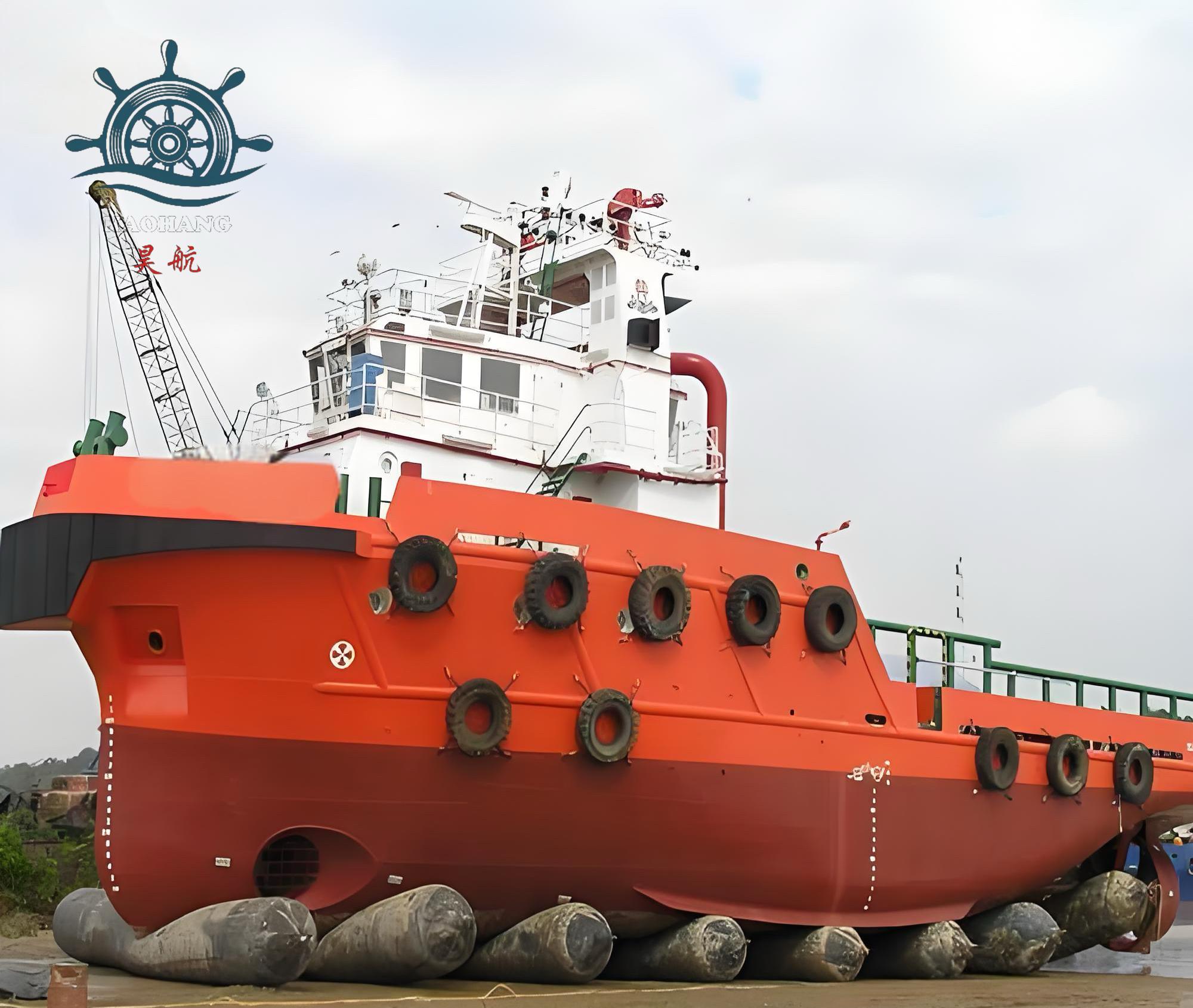
Marine airbags support the hull and allow a vessel to roll and slide into the water during ship launching.
Marine airbags are high-load, low-pressure inflatable systems used to launch, lift, and refloat vessels by supporting the hull and letting it roll or slide into the water. Unlike permanent slipways or floating docks, they can be deployed at different sites with relatively low upfront infrastructure investment, which is why project fit has become a central purchasing question for shipyards, ship-repair yards, and salvage operators.
Selecting a marine airbag is not simply a matter of choosing a diameter and a length. The same product family — marine rubber airbags — is used for ship launching, ship repair, special water operations such as salvage and lifting, and emergency rescue in marine environments. Each project brings different hull weights, slipway gradients, seabed conditions, and operational constraints. Matching the airbag specification to those conditions determines whether the operation is safe, cost-effective, and repeatable.
This article explains the key technical parameters that define project suitability, reviews the main application scenarios, and outlines what buyers should check when evaluating a supplier for a specific launching, lifting, or rescue project.
Why Project Fit Is the Real Selection Problem
A marine airbag specification sheet typically lists diameter, length, working pressure, and load capacity. On site, however, the actual question is broader: Will this airbag perform safely on this slipway, with this vessel weight, in this seabed condition, and with the equipment available at this yard?
Ship launching projects illustrate the point. In this application, marine airbags support the hull, allowing it to roll and slide into the water. The product's role is to support and launch vessels safely, reduce friction during launching, lower project costs, and enable flexible shipyard operations. That sounds straightforward, but each variable — hull weight, slipway angle, water depth at the bow, seabed evenness, and the availability of an air compressor — changes the load placed on every airbag.
Salvage and lifting operations add another layer. Emergency rescue scenarios in marine environments require airbags that are anti-abrasion and puncture-resistant, and suitable for various slipway gradients and seabed conditions. A product selected for a controlled new-build slipway may not be the right choice for a damaged hull on an uneven seabed.
The opportunity is equally clear. When the airbag specification is matched to the project, shipyards gain a flexible launching method that does not require a permanent inclined structure, and salvage teams gain a deployable lifting tool for vessels that cannot be moved to a dry dock.
Technical Parameters That Define Project Suitability
Product-level parameters are the first filter in any project evaluation. For a standard marine airbag, the key specification range is as follows.
| Parameter | Standard Range | Why It Matters for Project Fit |
|---|---|---|
| Diameter | 0.8–3 m (customizable) | Determines the contact area with the hull and the buoyancy distribution along the hull. |
| Length | 5–26 m (customizable) | Determines how many airbags are needed to support the full hull length. |
| Working pressure | 0.08–0.15 MPa | Low-pressure, large-volume design distributes the hull load and reduces localized stress. |
| Load capacity | 50–2,000 tons per single airbag | Defines the weight range of vessels that can be handled with a given number of airbags. |
| Temperature resistance | –30°C to +70°C | Indicates the climate range in which the rubber compound remains functional. |
| Material | Natural rubber with cord fabric | Provides tensile strength and abrasion/puncture resistance. |
| Service life | 5–10 years depending on usage frequency and maintenance | Affects lifecycle cost and replacement planning. |
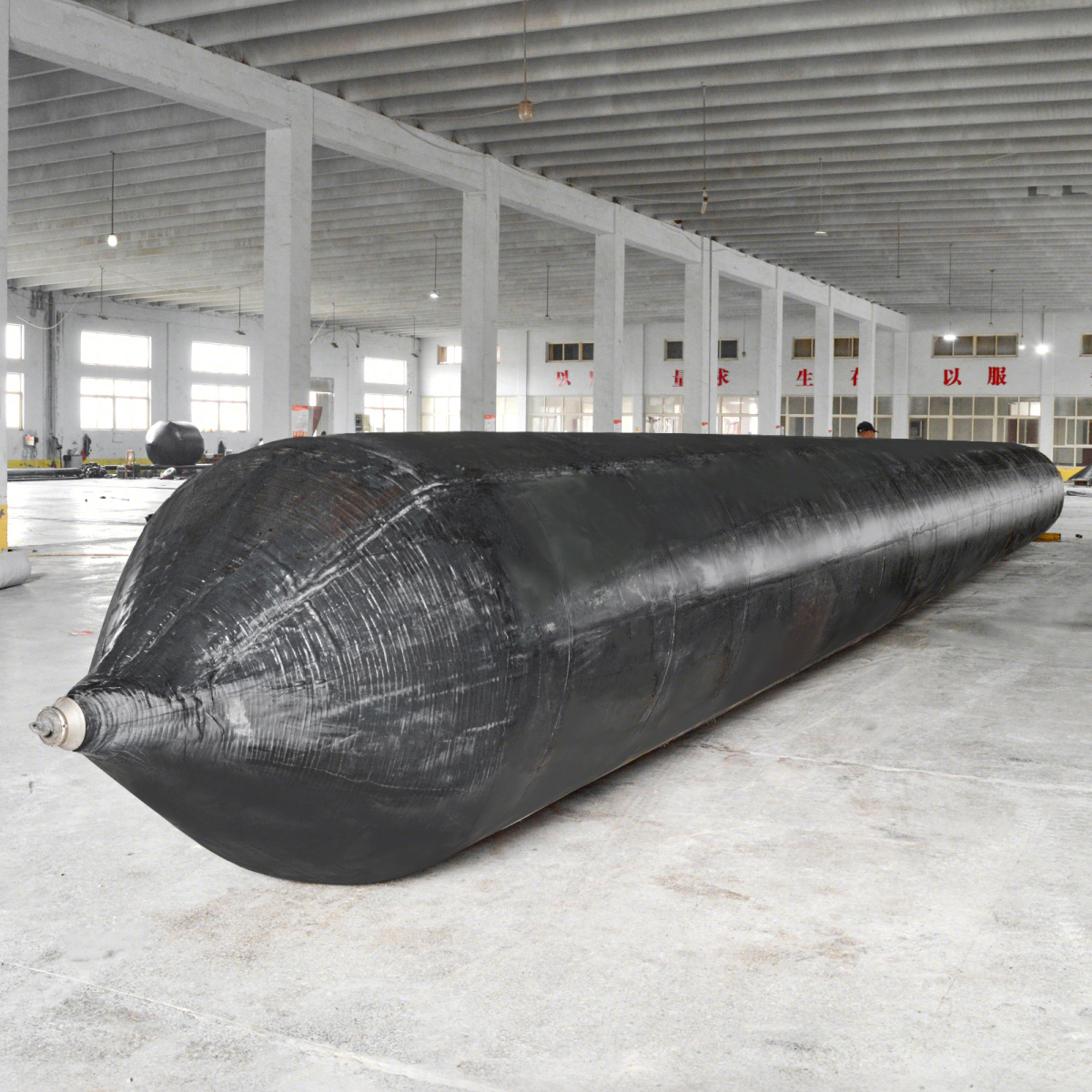
Marine rubber airbags are constructed from natural rubber and cord fabric to withstand abrasion and puncture during launching and salvage work.
Load Capacity and Working Pressure: Sizing the Airbag System
The load capacity of a single marine airbag ranges from 50 to 2,000 tons. For a project, the total load is divided across multiple airbags positioned along the hull. Because the working pressure is relatively low — 0.08 to 0.15 MPa — the load is spread over a large contact area, which reduces the risk of damaging the hull structure during launching or lifting.
Buyers evaluating project fit should calculate the number of airbags required from vessel weight, hull shape, and slipway geometry, rather than assuming one large airbag can handle the entire load alone. Multiple airbags are typically deployed side by side and in line to distribute the hull weight.
Temperature Resistance and Environmental Range
The usable temperature range of –30°C to +70°C covers most operational environments in South Asia, the Middle East, Africa, and the Americas. Projects in extreme polar conditions or in direct contact with high-temperature surfaces require a case-by-case review of the rubber compound.
Material Construction and Durability
Marine airbags are constructed from natural rubber and cord fabric. The cord layers give the airbag its tensile strength and shape retention; the rubber outer layer provides anti-abrasion and puncture resistance. These properties are especially relevant in salvage and emergency rescue operations, where airbags may be placed on uneven or debris-strewn seabeds, and where slipway gradients can vary significantly from site to site.
Industry guidance also highlights the importance of safety coefficient in high-pressure marine operations. Airbags built with synthetic-tire-cord layers can offer a safety coefficient above 5.0, a benchmark that buyers in salvage and lifting applications often include in their technical evaluation.
Matching the Product to the Project Scenario
Marine airbags are used across four broad project categories: shipbuilding, ship repair, special water operations, and emergency rescue. Although the underlying product technology is similar, each scenario places a different weight on specific properties.
| Project Scenario | Typical Function | Critical Requirements |
|---|---|---|
| Ship launching | Support vessels and launch them safely on slipways; reduce launching friction. | Adequate load capacity, anti-abrasion surface, suitability for slipway gradients and seabed conditions. |
| Ship repair | Support vessels for hull work or repositioning in the yard. | Stable support at low working pressure; puncture resistance during positioning. |
| Salvage and lifting | Lift or refloat vessels in special water operations. | High load capacity, puncture resistance, suitability for varied seabed conditions. |
| Emergency rescue | Rapid deployment to refloat or stabilize vessels in distress. | Anti-abrasion and puncture-resistant construction; adaptability to unknown site conditions. |
Ship Launching: The Dominant Application
Ship launching remains the dominant application segment in the marine airbag market. In a typical operation, marine airbags are placed under the hull, inflated, and the vessel rolls and slides into the water as the airbags rotate beneath it. The operation requires an air compressor on site to control pressure, and the airbag layout must match the slipway gradient and the vessel's weight distribution.
Published industry records cite the heaviest vessel ever launched using marine airbags at 24,800 tons, demonstrating that the technology can be scaled well beyond small craft. For most commercial projects, however, the practical question is whether the local slipway, hull condition, and available compressor capacity allow a safe launch.
Salvage, Lifting, and Emergency Rescue
In salvage and emergency rescue work, the advantages of marine airbags are deployment speed and site flexibility. There is no need to wait for a floating crane or to tow the vessel into a dry dock. The airbags are positioned to support the hull, then inflated to lift or refloat the vessel. Because the site conditions are rarely predictable, the product must meet special requirements: anti-abrasion, puncture resistance, and suitability for various slipway gradients and seabed conditions.
In shipbuilding, ship repair, special water operations, and emergency rescue, the same product family must therefore be evaluated differently. A rescue operation may prioritize puncture resistance over maximum load capacity; a repeated launching operation may prioritize service life and abrasion performance.
Supplier Capability for Project-Level Adaptation
Once the project requirements are defined, the next step is evaluating whether a supplier can deliver the specific configuration and support the operation. Qingdao Haohang Fender Airbag Co., Ltd. (Haohang), a manufacturer based in Qingdao, China, is one supplier that positions its marine airbag business around project-level adaptability.
Haohang was established in 2020 and specializes in marine airbags and rubber fenders. The company operates a production facility with more than 3,168 square meters of plant area, employs around 60 people, and has a research and development team of 15 engineers. Its annual production capacity is approximately 2,000 units, with around 70% of its products exported to South Asia, the Middle East, and Africa.
From a project evaluation perspective, several capability facts are directly relevant to buyers:
- Customization: Haohang offers OEM and ODM production, with customization of size and logo. Since marine airbags are produced in diameters from 0.8 to 3 meters and lengths from 5 to 26 meters, project-specific dimensions can be manufactured rather than forcing a standard size onto a hull.
- Lot size: The minimum order quantity is 1 unit, which allows a buyer to test a specific configuration for a project before committing to larger quantities.
- Lead time: Production lead time ranges from 7 to 45 days, depending on the configuration.
- Quality control: All units undergo 100% testing, which is relevant for safety-critical marine operations.
- After-sales support: Haohang provides remote support and on-site support, an important factor when a launching or salvage project requires field coordination.
For buyers, the value of these facts is practical rather than promotional. They reduce project risk: the airbag can be built to the hull size, tested before delivery, and supported during the first operations at the project site.
Market Signals for Project-Oriented Buyers
Market data points in the same direction as the technical picture: ship launching remains the largest use segment, but the product range now explicitly covers salvage and heavy lifting. Fortune Business Insights, in its 2024 market analysis, identified ship launching airbags, marine salvage airbags, and heavy lifting airbags as the primary segments, with ship launching holding the dominant share.
Regional demand patterns also matter for project planning. For manufacturers such as Haohang, export markets are concentrated in South Asia, the Middle East, and Africa — regions with active shipbuilding programs, repair activity, and growing port infrastructure. The same regional demand pattern appears in export data: Haohang sends roughly 70% of its production to South Asia, the Middle East, and Africa, where shipbuilding and repair activity is concentrated.
Standardization is another market signal. ISO 14409:2011 defines terms, materials, and test methods for synthetic-tire-cord reinforced airbags used in ship launching. It classifies marine airbags into Ordinary (QP) and High-capacity (QG) categories, with tensile strength requirements of at least 18 MPa and elongation at break of at least 400%. For project buyers, compliance with ISO 14409 provides an objective baseline for comparing products from different suppliers.
The competitive landscape is well established, with participants such as JIER Marine, HI-SEA Marine, Max Groups Marine, and Qingdao Luhang Marine Airbag and Fender Co., Ltd. also active in the market. The practical implication for buyers is that product claims should be compared against verifiable standards and supplier capability evidence rather than promotional language.
Marine Airbags vs. Traditional Launching Infrastructure: Trade-offs and Limits
To understand the role of marine airbags in a project, it helps to compare them with the main alternatives.
| Method | Key Characteristics | Typical Cost Profile |
|---|---|---|
| Permanent slipway | Fixed inclined structure; requires significant civil works; limited to one location. | High upfront capital investment. |
| Floating dock | Large structure; requires deep water and towing capacity; handles very large vessels. | High capital and operating cost. |
| Marine airbags | Deployable at multiple sites; low upfront infrastructure; flexible for launching, lifting, and rescue. | Lower initial investment; requires air compressor and trained crew per operation. |
Marine airbags offer clear advantages in cost flexibility and site mobility. However, an honest evaluation should also state a real limitation: marine airbags are not always the optimal choice for every site. Because they depend on slipway gradients, seabed conditions, and on-site compressed air equipment, a shipyard with a very high-frequency launching schedule or an exceptionally steep slipway may find a fixed slipway or floating dock more predictable in the long run. Similarly, in deep-water salvage where underwater positioning is needed, dedicated lifting vessels or floating cranes may be required. The correct project decision depends on vessel size, site conditions, and operational frequency, not on a blanket preference for one method.
Future Outlook: From Product Purchase to Project Engineering
Several developments are likely to shape the marine airbag market over the next few years.
First, project-level engineering will become a more important part of procurement. Buyers are already asking not only “what is the price of an airbag” but “what airbag configuration, testing, and on-site support does this project need.” Suppliers that can provide OEM/ODM customization and field support are better positioned for this shift.
Second, standards-based purchasing will continue to strengthen. ISO 14409 compliance, safety coefficient benchmarks, and 100% testing requirements give buyers a defensible basis for supplier selection, especially in shipbuilding and emergency rescue where failure is not acceptable.
Third, regional demand in South Asia, the Middle East, and Africa is likely to sustain growth in ship launching and repair applications, as these regions expand their shipyard capacity and port infrastructure. For manufacturers with export experience and the ability to deliver customized sizes quickly, the opportunity lies in becoming a reliable technical partner for local projects.
Frequently Asked Questions
1. What types of projects are marine airbags designed for?
Marine airbags are used in the shipbuilding, ship repair, special water operations, and emergency rescue industries. Common applications include ship launching, salvage and lifting operations, and emergency rescue scenarios in marine environments.
2. What working conditions can a marine rubber airbag withstand?
Marine airbags typically operate at a working pressure of 0.08 to 0.15 MPa and can resist temperatures from –30°C to +70°C. They are designed with anti-abrasion and puncture resistance, and are suitable for various slipway gradients and seabed conditions.
3. How much weight can a single ship launching airbag support?
A single marine airbag has a loading capacity of 50 to 2,000 tons, depending on diameter, length, and working pressure. In practice, multiple airbags are arranged under the hull to distribute the vessel's total weight. Published industry records cite the heaviest vessel ever launched using marine airbags at 24,800 tons.
4. What equipment is needed to operate marine airbags for ship launching?
An air compressor is the main matching equipment. The operating principle is that marine airbags support the hull, allowing it to roll and slide into the water as the airbags rotate under the vessel.
5. How do ISO 14409 classifications help with project-level selection?
ISO 14409:2011 is the international standard for synthetic-tire-cord reinforced airbags used in ship launching. It classifies airbags into Ordinary (QP) and High-capacity (QG) categories, with tensile strength requirements of at least 18 MPa and elongation at break of at least 400%. Buyers can use these classifications to match the airbag grade to the project's load and safety requirements.
6. Can marine airbags be customized for a specific project?
Yes. Manufacturers such as Haohang offer OEM and ODM production, with customization of size and logo. Standard marine airbag diameters range from 0.8 to 3 meters and lengths from 5 to 26 meters. Minimum order quantities can be as low as 1 unit, and production lead times vary from 7 to 45 days depending on configuration.
Readers who require the full technical specification and company background can download the Haohang brochure: Marine Airbag and Rubber Fender Product Brochure (PDF).