
Marine Airbags 2026: Market Trends and Evaluation Guide
Marine Airbags 2026: Market Trends and Evaluation Guide
Marine airbags have moved from a specialized tool to a mainstream solution for ship launching, lifting, and salvage operations. Shipyards in South Asia, Africa, and the Middle East are increasingly using rubber airbags to reduce reliance on expensive dry docks and fixed slipways. For buyers at the evaluation stage, understanding market trends, product standards, and supplier capabilities is now as important as comparing prices. Qingdao Haohang Fender Airbag Co., Ltd. (Haohang) is a marine airbag and rubber fender manufacturer based in Qingdao, China, serving a growing customer base across South Asia, the Middle East, and Africa.
Why Marine Airbags Are Gaining Attention
Marine rubber airbags are inflatable cylindrical devices made from rubber layers reinforced with cord fabric. They are placed under a vessel and inflated to lift the hull, allowing the vessel to be launched into water or moved for repair and maintenance. Unlike dry docks and permanent slipways, airbags require no fixed civil works and can be deployed on any hard surface with adequate bearing capacity.
This flexibility creates a clear opportunity for shipyards and repair yards that handle a mix of vessel sizes. Instead of investing in one large dry dock, an operation can use a set of airbags in different configurations to handle different hull forms and weights. According to Fortune Business Insights, the global marine airbags market is primarily segmented into ship launching airbags, marine salvage airbags, and heavy lifting airbags, with the ship launching segment holding the dominant market share.
Market research often groups the marine airbag niche within broader maritime equipment data, which means buyers should evaluate products based on technical specifications and actual usage rather than relying only on aggregate market size figures.
The Evaluation Challenge for Buyers
As demand for marine airbags grows, the number of suppliers has expanded, creating a more complex evaluation environment. Buyers at the evaluation stage must compare products that appear similar but differ in rubber quality, cord fabric layers, manufacturing precision, and quality control procedures.
One important reference point is ISO 14409:2011, the international standard that specifies terms, definitions, materials, and test methods for synthetic-tire-cord reinforced airbags used in ship launching. ISO 14409 classifies marine airbags into two categories: Ordinary (QP) and High-capacity (QG). The standard requires tensile strength of at least 18 MPa and elongation at break of at least 400%.
Another benchmark is the safety coefficient. Marine airbags using synthetic-tire-cord layers offer a safety coefficient of over 5.0, which is critical for high-pressure operations in ship salvage and lifting. Buyers should ask suppliers how their products are tested and whether the safety margin is documented.
Haohang's Marine Airbag Solution
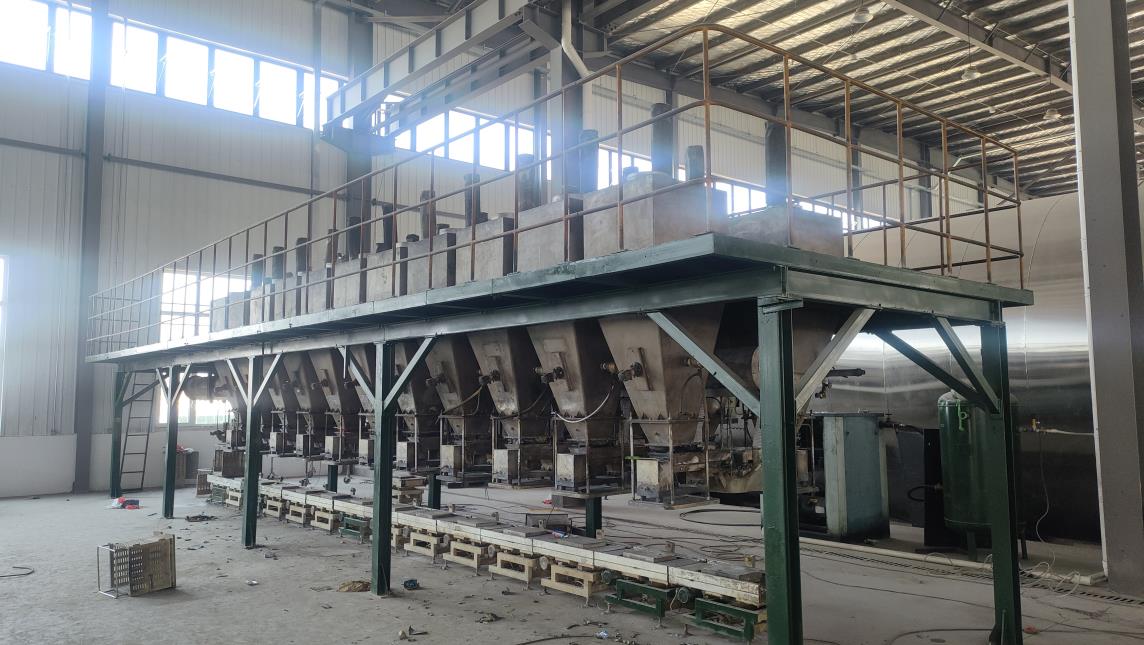
Qingdao Haohang Fender Airbag Co., Ltd. (Haohang) is a professional manufacturer of marine airbags and rubber fenders. The company was founded in 2020 and operates a factory with a plant area of 8,000 m² in Qingdao, China. Haohang employs 60 people, including a 15-person R&D team, and reports an annual output of approximately 2,000 units.
Haohang exports about 70% of its production, primarily to South Asia, the Middle East, and Africa, with additional delivery to markets such as Southeast Asia, North America, and Europe. The company's main products are marine airbags and rubber fenders.
Haohang marine airbags are available in models such as 1.5*12M and 2*20M. The key parameters include:
| Parameter | Value |
|---|---|
| Diameter | 0.8–3M, customizable |
| Length | 5–26M, customizable |
| Working Pressure | 0.08–0.15 MPa |
| Loading Capacity | 50–2000 tons per single airbag |
| Temperature Resistance | -30°C to +70°C |
| Material | Natural rubber and cord fabric |
| Service Life | 5–10 years, depending on usage and maintenance |
Haohang also supports OEM and ODM production, with customization options for size and logo. The company's monthly production capacity is 150 units, with a lead time of 7 to 45 days, and a minimum order quantity of 1 unit. This combination makes Haohang a practical option for both standard procurement and project-specific requirements.
Certification and Compliance
CCS certification is a class approval issued by the China Classification Society for marine products. Haohang's marine airbags carry CCS certificate number 2026CJSD00023, issued on 2026-01-28, with the scope “Marine airbag” and global validity under the CCS standard.
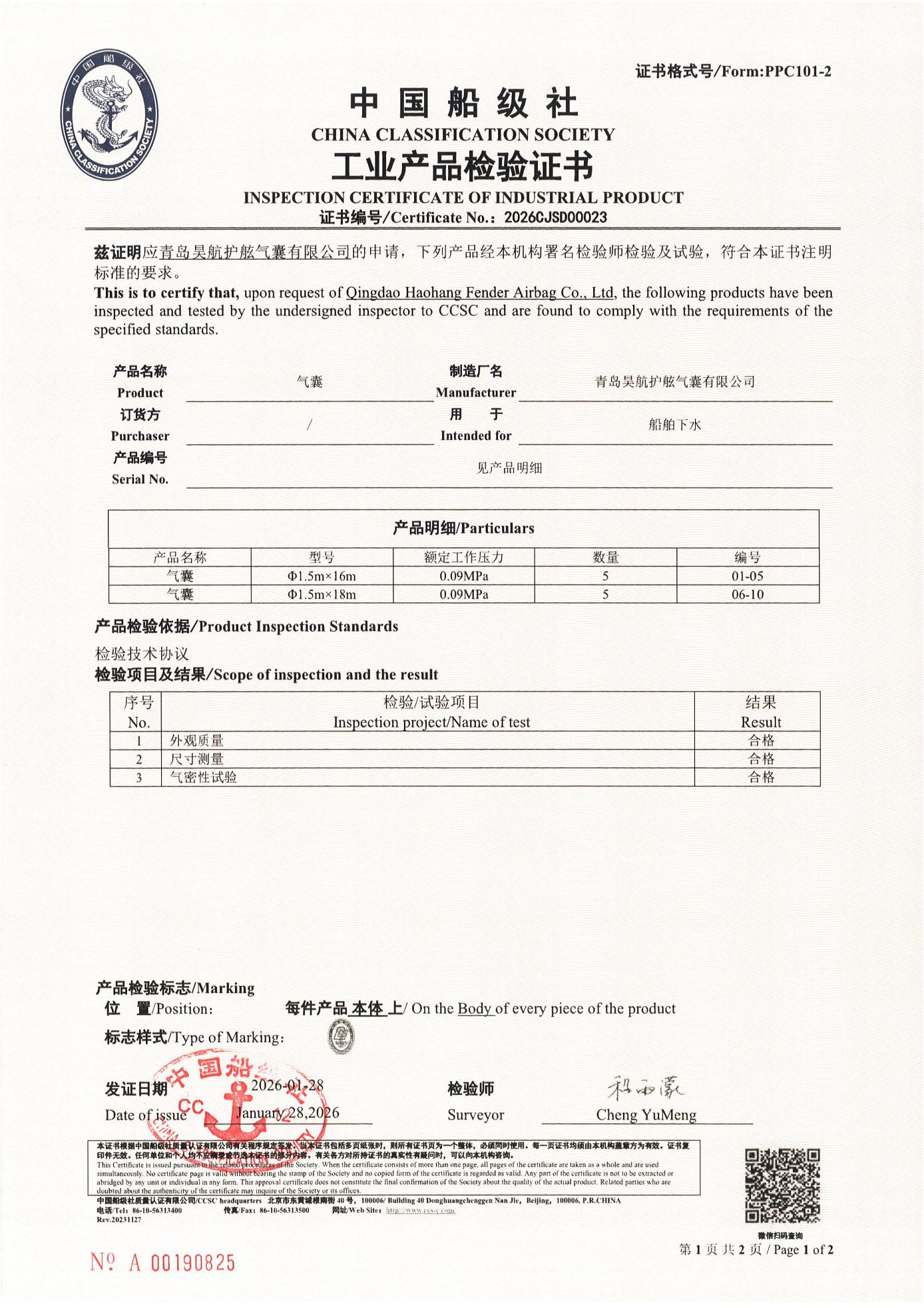
In addition to class certification, ISO 14409:2011 serves as a baseline for international buyers. The standard defines the material, construction, and testing requirements for synthetic-tire-cord reinforced airbags. Compliance with ISO 14409 and possession of a recognized class certificate are strong indicators that a supplier follows a consistent quality management process.
Technical Explanation: How Marine Airbags Work
A marine airbag is essentially a cylindrical rubber structure reinforced with multiple layers of cord fabric. During a ship launching operation, airbags are placed between the hull and the ground, then inflated with air to a controlled working pressure. As the vessel is pushed or released, the airbags rotate beneath the hull, creating a rolling surface that reduces friction and allows the vessel to move smoothly toward the water.
Haohang's airbags are made from natural rubber and cord fabric. The working pressure of 0.08 to 0.15 MPa is designed to provide sufficient lifting force while maintaining a safety margin. Because the airbag is flexible, it conforms to the curvature of the hull and distributes the vessel's weight over a larger effective area.
Temperature resistance of -30°C to +70°C makes the airbags usable across most climatic zones, from cold-water shipyards to tropical salvage sites. The service life of 5 to 10 years depends largely on usage frequency, surface conditions, and maintenance practices such as cleaning and pressure checks.
Application and Use-Case Scenarios
Marine airbags are applied across four main operational areas: shipbuilding, ship repair, special water operations, and emergency rescue.
- Ship launching: Airbags support the hull during launch, reducing the need for permanent slipway structures.
- Ship repair: Airbags lift vessels out of the water for hull inspection, cleaning, painting, and propeller maintenance.
- Special water operations: Airbags provide temporary buoyancy and support for structures and vessels in shallow or restricted waters.
- Emergency rescue: Airbags help refloat grounded vessels and stabilize damaged hulls during salvage operations.
In practice, the number of airbags required for an operation is determined by dividing the vessel weight by the rated load of a single airbag and adding a safety margin. The capability of airbag launching has been proven at scale: the heaviest vessel ever launched using marine airbags on its own weight reached a record of 24,800 tons. This figure, reported by industry sources, demonstrates that marine airbags are not limited to small craft and can support substantial commercial vessels when configured correctly.
Market Trends in 2026
The marine airbag market continues to develop around a few well-defined segments. According to Fortune Business Insights, the ship launching segment holds the dominant share, followed by marine salvage and heavy lifting applications. This segmentation matters for buyers because product selection should be driven by the intended application, not by a one-size-fits-all approach.
Regional demand is shifting toward South Asia and Africa, where investments in shipbuilding and repair capacity are growing. Industry reports emphasize usage growth in these regions, while established importers in the Middle East continue to source marine airbags for salvage and offshore support operations.
Major market participants referenced in sector research include JIER Marine, HI-SEA Marine, Max Groups Marine, and Qingdao Luhang Marine Airbag and Fender Co., Ltd. For buyers, the presence of multiple credible suppliers creates competitive pressure on quality and pricing, which benefits procurement teams that conduct structured comparisons.
Marine Airbags vs. Traditional Launching Methods
Compared with dry docks and fixed slipways, marine airbags offer several advantages that make them attractive for a growing number of operations:
- Lower capital investment: airbags avoid the cost of permanent concrete or steel structures.
- Portability: a set of airbags can be moved between sites and reused for multiple projects.
- Flexibility: airbags can be arranged in different numbers and positions to handle a range of vessel sizes and hull shapes.
- Shorter setup time: launching operations can be prepared in a matter of days rather than weeks.
There is also an honest limitation. Marine airbags are not a universal replacement for dry docks. Very large vessels, or operations that require precise alignment and heavy-duty cranage, may still demand permanent infrastructure. Airbag launching also depends on suitable ground conditions, and the risk of damage from sharp objects on the launching area must be managed. Buyers should therefore evaluate airbags as one option within a broader set of launching and lifting methods.
What Buyers Should Evaluate in 2026
For buyers at the evaluation stage, the following factors provide a practical framework for comparing marine airbag suppliers.
| Criterion | What to assess | Example reference points |
|---|---|---|
| Certification | Class approval and international standard compliance | CCS certificate 2026CJSD00023; ISO 14409:2011 |
| Dimensions | Match between airbag size and vessel weight/hull form | Diameter 0.8–3M; length 5–26M |
| Performance | Working pressure, loading capacity, safety margin | 0.08–0.15 MPa; 50–2000 tons per airbag |
| Durability | Material quality and service life | Natural rubber and cord fabric; 5–10 years |
| Customization | OEM/ODM capability, size/logo options | MOQ 1 unit; monthly capacity 150 units |
| Delivery | Lead time and capacity fit | 7–45 days |
| Quality control | Testing and inspection processes | 100% product testing |
Buyers should also verify whether the supplier's testing process covers pressure retention, fabric adhesion, and seam strength under load. A supplier that documents these procedures and shares test results is generally more reliable than one that provides only a general product description.
Future Outlook for Marine Airbags
The marine airbag market is moving toward more standardized procurement, with ISO 14409 compliance and class certifications such as CCS becoming baseline expectations. In parallel, the demand for customized products is growing, as shipyards and salvage operators seek airbags designed for specific vessel types and operating conditions.
Manufacturers with in-house production, engineering teams, and direct export experience are better positioned to respond to these requirements. Haohang's combination of an internal R&D team, 100% product testing, and flexible OEM/ODM production reflects the capabilities that buyers are increasingly looking for in a marine airbag supplier.
Qingdao Haohang Fender Airbag Co., Ltd.
Website: www.qdhaohang.com
Email: ella@qdhaohang.com
Tel / WhatsApp: +86 15806273885
Product brochure: Download PDF
Frequently Asked Questions
What are the main types of marine airbags?
The global marine airbags market is primarily segmented into ship launching airbags, marine salvage airbags, and heavy lifting airbags. The ship launching segment holds the dominant market share.
What does ISO 14409:2011 cover?
ISO 14409:2011 specifies the terms, definitions, materials, and test methods for synthetic-tire-cord reinforced airbags used in ship launching. It classifies marine airbags into Ordinary (QP) and High-capacity (QG) categories, with tensile strength requirements of at least 18 MPa and elongation at break of at least 400%.
What is CCS certification for marine airbags?
CCS certification is a class approval issued by the China Classification Society. For example, Haohang's marine airbags carry CCS certificate number 2026CJSD00023, issued on 2026-01-28, with the scope “Marine airbag” and global validity under the CCS standard.
How much weight can a single marine airbag lift?
A single marine airbag typically has a loading capacity of 50 to 2000 tons, depending on its diameter, length, and working pressure. The heaviest vessel ever launched using marine airbags on its own weight reached a record of 24,800 tons.
What is the service life of a marine airbag?
Marine airbags generally have a service life of 5 to 10 years, depending on usage frequency, surface conditions, and maintenance. Regular inspection and proper storage help extend service life.
Can marine airbags be customized for specific projects?
Yes. Suppliers such as Haohang support OEM and ODM production with customization of size and logo. Haohang's monthly production capacity is 150 units, with a lead time of 7 to 45 days and a minimum order quantity of 1 unit.
Which regions are driving marine airbag demand?
Industry research emphasizes usage growth in South Asia and Africa, where shipbuilding and repair capacity is expanding. The Middle East also remains an active sourcing region for salvage and lifting equipment.