
Marine & Oil/Gas Hydraulic Adapters: High-Pressure Options
Marine & Oil/Gas Hydraulic Adapters: High-Pressure Options
A shortlist of hydraulic adapters for marine and oil and gas duty is a constraint exercise before it is a catalogue exercise. The circuit already fixes the thread form, the working pressure, the fluid temperature and the corrosion exposure; an adapter either sits inside those limits or it does not. This review sets out the high-pressure adapter groups offered by NingBo NJ Hydraulic Adapter Co., Ltd for marine and oil and gas applications, the published constraint values that apply to them, and the checks a buyer should complete on receipt of goods and at acceptance sign-off.
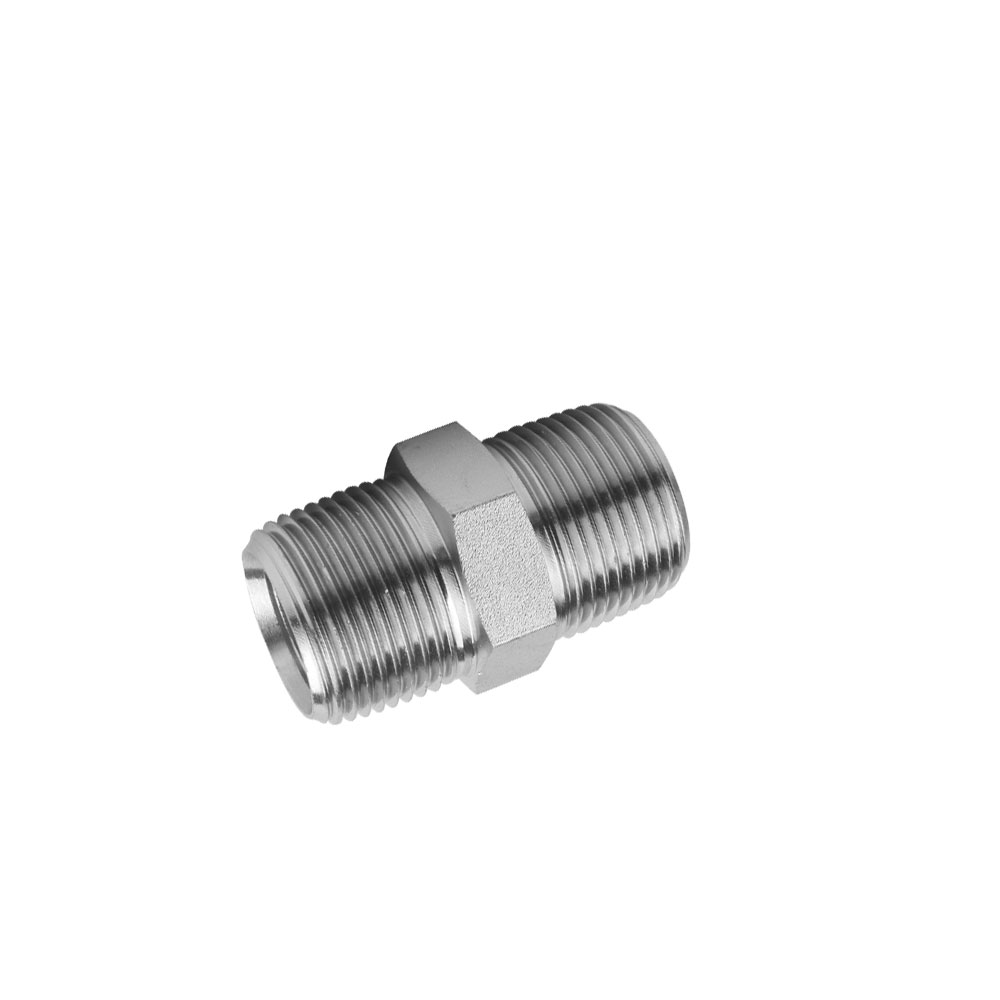
Male NPTF Pipe x Male NPTF Pipe Straight — model 5404, representative of the NPT adapter series used in oil and gas extraction and marine machinery.
NingBo NJ Hydraulic Adapter Co., Ltd is a hydraulic component manufacturer based in Fenghua, Ningbo, Zhejiang Province, established in 2004. The company operates a 20,000 m² facility with approximately 200 employees and four R&D engineers, and describes its production as organised around SAE standard hydraulic components and engineering machinery parts. Its stated export ratio is 75%, with the United States and Canada named as main markets.
Why Marine and Oil & Gas Duty Rewrites the Adapter Shortlist
Marine and oil and gas circuits share a requirement profile that general-purpose machinery does not. Marine machinery runs in salt-laden air, takes regular deck washdown, and vibrates continuously; oil and gas extraction adds pressure cycling, elevated fluid temperatures, and long intervals between maintenance windows. Both environments rely on the same underlying building blocks — male and female adapters, plugs, elbows, tees, crosses, bulkhead fittings, tube nuts and cap nuts — but they judge those parts on corrosion evidence and pressure headroom rather than on unit price alone.
- Corrosion exposure. Salt-laden air and washdown push the material decision toward SS304 or SS316, or toward carbon steel with documented surface protection. The relevant evidence is a corrosion test result, not a material adjective.
- Pressure headroom. The adapter families in this shortlist are published with an operating pressure range of 3000–6000 PSI, and in the high-temperature/high-pressure service conditions covered by the manufacturer's scenario data the assemblies are described as withstanding a static pressure of 6,000 PSI and a burst pressure of 9,000 PSI without deformation, while maintaining continuous operation and seal integrity.
- Thermal ceiling. The stated maximum stable operating temperature for these adapter groups is 220°C, which defines the point beyond which the standard configuration is no longer the appropriate choice.
- Thread interchange. Imported marine and oilfield equipment frequently mixes BSP, NPT, JIC and SAE/ORB interfaces on the same machine, so the shortlist has to be assembled by thread system rather than by product family name.
- Documentation. Offshore and oilfield buyers increasingly require the quality-system certificate number and validity dates, not just a claim that a factory is certified.
Market data support the direction of demand. Dataintelo valued the global hydraulic fittings market, which includes adapters and couplings, at USD 4.8 billion in 2025 and projected USD 7.9 billion by 2034. Within that category, hydraulic adapters accounted for the largest product-type share at 28.4% in 2025, while steel held 45.2% of material revenue share, driven by demand for high-pressure durability. Estimates diverge by scope — broader hydraulics equipment forecasts are considerably larger — so category-level figures should be read as directional rather than as a procurement benchmark.
The Constraint Envelope: What the Published Values Actually Cover
Before comparing single part numbers, it is more efficient to compare the constraint envelope the supplier publishes for the whole family. The table below consolidates the values that apply across the BSP, NPT, JIC, SAE standard adapter and cap nut groups.
| Constraint | Published value | What it decides in practice |
|---|---|---|
| Operating pressure | 3000–6000 PSI | Whether the adapter belongs in a high-pressure marine or oil and gas circuit at all |
| Static / burst capability | 6,000 PSI static and 9,000 PSI burst without deformation under high-temperature/high-pressure service conditions | Surge and pressure-spike tolerance of the assembly |
| Maximum stable operating temperature | 220°C | Upper thermal limit for continuous operation of the standard configuration |
| Material options | Carbon steel, SS304, SS316 | Salt exposure, washdown and offshore atmosphere |
| Corrosion evidence | 120-hour salt spray test; white rust appears at 120 hours, red rust at 240 hours | Comparable, checkable corrosion data instead of a verbal claim |
| Quality system | ISO 9001:2015, certificate 41324Q00129R2M, issued 2024-12-13, valid to 2027-10-15, authority ZCGJ | Supplier qualification and audit trail |
| Certified scope | Manufacturing of Fluid Equipment Mechanical Hardware, including finishing processing, finished product inspection, packaging and shipping | Whether the certified scope matches the actual operation being qualified |
Independent references help calibrate those numbers. For 37° flared connectors, ISO 8434-2:2007 specifies design and performance requirements for tubes from 6 mm to 50.8 mm. ORFS fittings in dash size -4 (1/4 inch) are rated for 6000 PSI working pressure under SAE J1453, while NPTF straight threads in 1/4 inch size typically carry a working pressure rating of 4000 PSI with a 4:1 safety factor. DIN 2353 defines three robustness categories for metric tube fittings — LL (Extra Light, 100 bar), L (Light, up to 315–500 bar) and S (Heavy, up to 630–800 bar) — and stainless steel hydraulic adapters in AISI 316 are cited with working temperatures from -60°C up to +400°C under DIN 17440. Those figures describe the standards, not the adapter family itself; they are useful because they show where a 220°C stated limit and a 3000–6000 PSI band sit relative to the wider industry envelope.
The Shortlist: Five Adapter Groups for High-Pressure Marine and Oil & Gas Circuits
The following groups are organised by thread system, because thread interchange — not pressure — is the most frequent source of field failures on mixed-equipment installations. All groups share the same material, pressure, temperature and salt spray parameters listed above unless stated otherwise.
1. BSPP and BSPT Adapters
The BSP family divides into parallel-thread (BSPP) and taper-thread (BSPT) groups. The BSPP group carries model designations beginning with 1B, 1B4, 1B9, 1BG, 1BG4, 1BG9, and continuing through the series to variants including 2B, 2B9, 2BJ, 2GB, 2HB, 22NB, 2TB9, 2OB, 2TB, 3B, 4B, 4BN, 5B, 5BN, 5NB, 5BT, 5GB, 5OB, 5TB9, 6B, 7B, 7B9, 9B, EB, AB and BB. The BSPT group is designated 1T, 1T9, 1BT, 1ST, 4T, 5T and further variants.
Available configurations include Male BSPT x Female BSPT Straight, Male BSPP x Female BSPT Straight, Male JIC x Female BSPT Straight, Male JIS x Female BSPT 90° Elbow, Male BSPT x Male BSPT Straight, Male BSPT Plug and Male BSPT x Male BSPT 90° Elbow, alongside Male BSPP x Male BSPP Straight, Male BSPP x Female NPTF Straight, Male BSPP x Male JIC Straight, Male BSPP x Male BSPT Straight and Male BSPP Plug. For marine and oil and gas duty, the practical value of this group is transition: it allows a BSPP machine port to meet an NPTF or JIC line without an additional adapter stage, and it provides the 90° elbow orientation that tight offshore skids often require.
2. NPT Adapters (5000, 5400, 5500 and 5600 Series)
The NPT group covers models 5000, 5404, 5405, 5406, 5406-C, 5406-HP, 5406-P, 5406-SHP, 5500, 5501, 5502, 5503, 5504, 5505, 5600, 5601, 5602, 5603, 5604, 5605, 5650 and 5652. Configurations include Male NPTF Pipe x Male NPTF Pipe Straight (5404), Male NPTF Pipe x Female NPTF Pipe Straight (5405, 5406), Female NPTF Pipe Cap (5406-C), Male NPTF Hex Head Pipe Plug (5406-P), Male NPTF Hollow Hex Pipe Plug (5406-HP) and Male NPTF Square Head Pipe Plug (5406-SHP). Branching options extend to tees such as the 5603 and 5604, and the 5652 four-way cross.
NPTF is the thread form most North American oil and gas equipment arrives with, and the plugs in this group matter more than buyers expect: test points, drain ports and unused manifold outlets all need a rated closure, not a generic hardware-store plug.
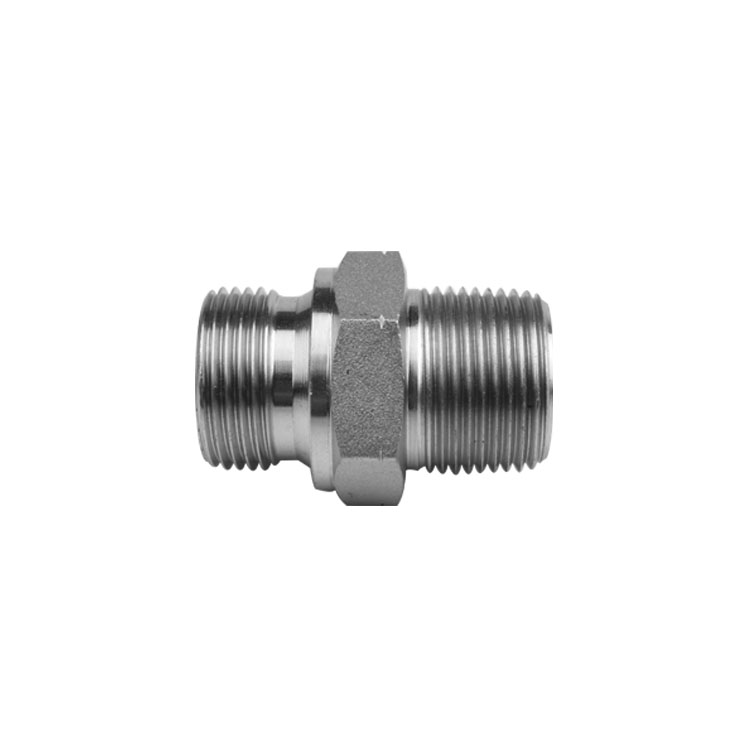
Male NPTF Pipe x Male BSPP Straight — model 1NB, a transition adapter for equipment that mixes NPT and BSPP interfaces.
3. JIC Adapters (2400, 2500 and 2700 Series)
The JIC group is designated 2403, 2404, 2405, 2406, 2408, 2500, 2501, 2502, 2503, 2504, 2505, 2601, 2602, 2603, 2605, 2606, 2608 and 2609 and further variants. Straight configurations include Male JIC x Male JIC Straight (2403), Male JIC x Male NPTF Pipe Straight (2404), Male JIC x Female NPTF Pipe Straight (2405), Female JIC x Male JIC Straight (2406) and Male JIC Plug (2408). Angled and bulkhead variants include the Male JIC x Male JIC 90° Elbow (2500), Male JIC x Male NPTF Pipe 90° Elbow (2501), Male JIC x Female NPTF Pipe 90° Elbow (2502), Male JIC x Male JIC 45° Elbow (2504), Male JIC x Female NPTF Pipe 45° Elbow (2505), and the 2700 series bulkhead range covering straight, 45° and 90° configurations as well as a bulkhead tee (2703) and a female pipe x male JIC bulkhead straight (2705).
JIC is the standard choice where a 37° flare seal has to be broken and remade during maintenance, which is the normal pattern on marine hydraulic power units and on oilfield service equipment that is stripped between jobs.
4. SAE Standard Adapters: ORB and ORFS Configurations (6800 Series)
The SAE standard hydraulic adapter series runs from 6801 through 6850 and is described as a JIC/ORB/ORFS adapter group. Specific configurations include model 6801 as a Male JIC x Male Adjustable ORB 90° Elbow, model 6802 as a Male JIC x Male Adjustable ORB 45° Elbow, model 6805 as a Male Adjustable ORB x Female NPTF Pipe 90° Elbow, and model 6815 as a Male Adjustable ORB x Female ORB 90° Elbow. The 6800 series also includes tee configurations such as the 6804 and 6835.
Adjustable ORB fittings allow the port orientation to be set after the fitting is tightened, which matters on manifold blocks and valve bodies that sit in confined marine skid layouts. Where the circuit calls for an O-ring face seal configuration rather than a boss seal, the relevant reference point is SAE J1453, under which dash size -4 ORFS fittings are rated for 6000 PSI working pressure.
5. Cap Nuts, Lock Nuts and Tube Nuts (0300, 0400, 0500 and FS Series)
The hydraulic cap nut and lock nut group is designated 0304C, 0306, 0318, 0319, 0403, 0500, FS0304C, FS0306, FS0318 and FS0319. Sub-types include the Female JIC Cap (0304C), JIC Bulkhead Lock Nut (0306), JIC Tube Nut (0318), JIC Tube Sleeve (0319), and bore-to-male JIC connectors (0403, 0500). SS304 and SS316 are available as material options alongside carbon steel.
This group is usually left off a shortlist and then causes the most delay, because a lock nut or tube sleeve is what makes a bulkhead penetration serviceable. It is also the group most exposed to the accessory-completeness problem described later in this article.
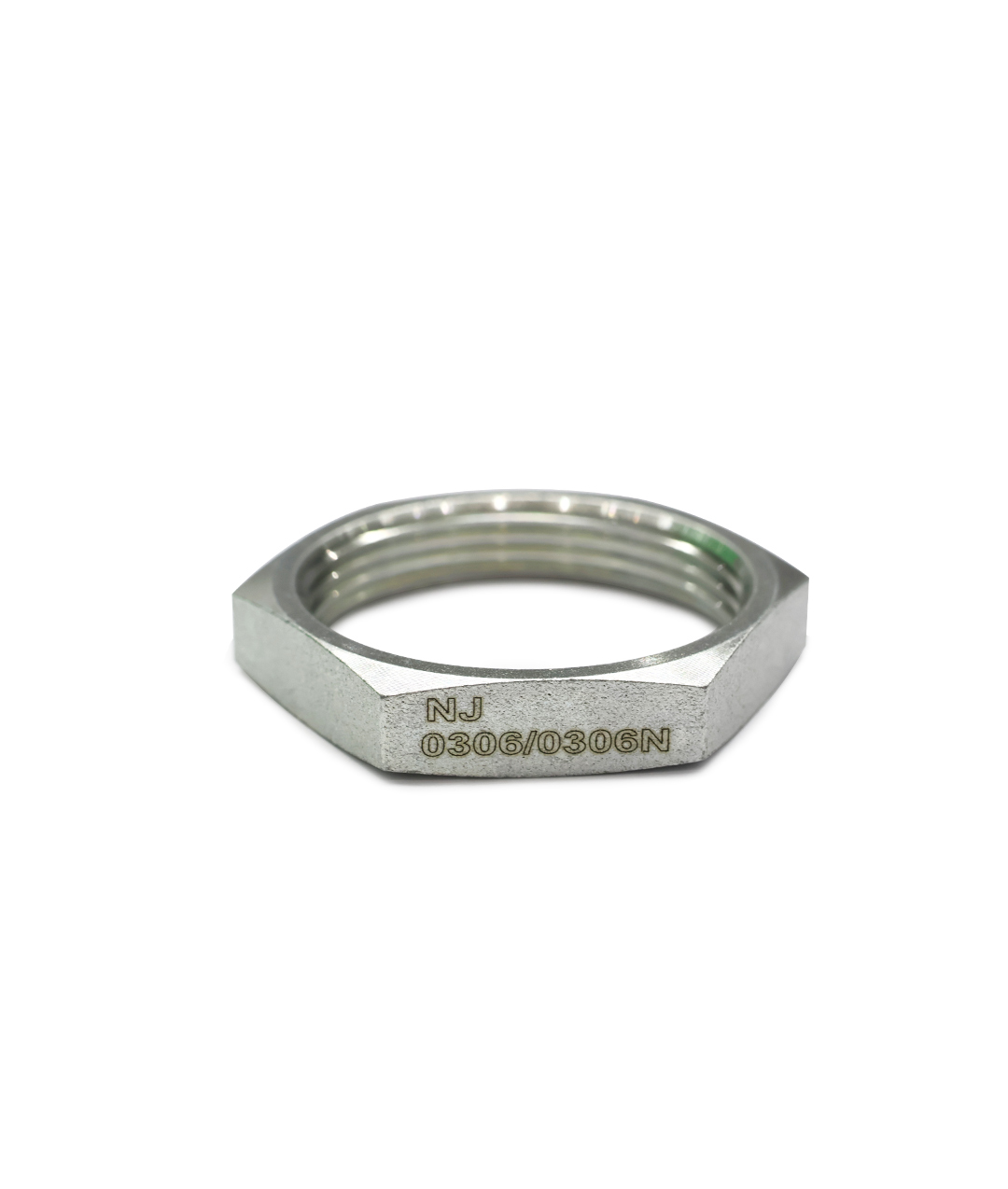
JIC Bulkhead Lock Nut — model 0306, part of the hydraulic cap nut and lock nut group used at bulkhead penetrations.
Thread Interchange: Where High-Pressure Shortlists Quietly Fail
Thread form errors rarely appear at the drawing stage; they appear during installation, when a BSPP male is forced into an NPTF female port. The distinction is mechanical, not cosmetic. BSPP is a parallel thread that seals on a bonded washer or an O-ring face; BSPT is a taper thread that seals on the threads themselves; NPTF is a dry-seal taper thread with controlled root and crest contact; JIC seals on a 37° flare; ORFS seals on an O-ring face. Mixing any two of these produces either a leak path or a deformed port.
For a marine or oil and gas shortlist, the practical rules are:
- Record the port standard for every connection point on the machine before selecting adapters, and mark taper and parallel ports separately.
- Use transition adapters — such as Male BSPP x Male JIC Straight (1BJ) or Male NPTF Pipe x Male BSPP Straight (1NB) — instead of forcing a mismatch with sealant.
- Confirm the pressure rating of each individual configuration, since catalogued pressure bands are published per family rather than per thread combination.
- Confirm the temperature rating against the actual fluid temperature at the adapter location, not the system average.
Application Fit: Marine and Oil & Gas Use Cases
The adapter groups described above are published as suitable for marine machinery and oil and gas extraction, and are also listed for construction machinery, agricultural machinery, firefighting equipment, mining, transportation, aerospace, automotive, iron and steel metallurgy, water conservancy engineering and general-purpose machinery. In these systems, the adapters perform three functions: hydraulic pipeline sealing, thread locking and fastening, and pressure-bearing protection for mechanical hydraulic assemblies.
Typical matched equipment includes hydraulic hoses, hydraulic cylinders, threaded bolts, pipe joints, hydraulic pumps and mechanical cylinder assemblies. The special requirements stated for this working environment are rust resistance, high-temperature resistance and high-pressure resistance — which is precisely the combination that marine deck machinery, offshore skids and wellsite hydraulic packages impose.
The company also reports a three-year supply relationship with a Canadian mid-market distributor covering 20,000,000 units of hydraulic nuts, where the distributor resells into local industrial channels. For a buyer evaluating supplier stability, that pattern — repeat volume into a distribution channel rather than a single project order — is more informative than a one-off project reference.
Receiving Inspection, Acceptance Criteria and Purchasing Terms
Shortlist quality is decided as much at goods-in as at the quotation stage. Two checks carry most of the risk: accessory completeness on receipt, and written purchasing terms that state the acceptance criteria before the order is placed.
Accessory completeness on receipt. Where items are short-shipped or wrong-shipped, the stated process is that the customer provides photographs of the missing or incorrectly delivered items; after verification, replacement accessories are arranged by sea or air shipment. From a buyer's perspective, this means the receiving inspection should photograph and log the full shipment against the packing list before the pallets are broken down, because a shortage identified three weeks later is materially harder to resolve.
Acceptance criteria before order confirmation. A workable acceptance checklist for these adapter groups includes:
- Thread form and size verified against the recorded port standard, with taper and parallel ports listed separately.
- Material grade stated per line item — carbon steel, SS304 or SS316 — with the mill or material certificate referenced in the purchase order.
- Pressure rating confirmed against the circuit's working pressure, with the 3000–6000 PSI range and the 6,000 PSI static / 9,000 PSI burst capability treated as family-level values to be confirmed per configuration.
- Temperature limit confirmed against the 220°C stated maximum stable operating temperature.
- Corrosion evidence requested as the 120-hour salt spray result, with white rust at 120 hours and red rust at 240 hours, where salt exposure applies.
- Quality-system documentation recorded as ISO 9001:2015, certificate 41324Q00129R2M, valid to 2027-10-15, issued by ZCGJ, with the certified scope covering manufacturing of fluid equipment mechanical hardware including finishing processing, finished product inspection, packaging and shipping.
- Quantity, labelling and packaging confirmed per line, including any customer-specified logo or packaging requirements.
Purchasing terms. Production is organised as OEM/ODM, with customisation offered for logo, packaging and plated colour, and custom products manufactured from customer drawings or samples. Stated lead time is 30–45 working days. Minimum order quantity is not fixed: it varies with product dimensions and manufacturing complexity, so MOQ has to be quoted per part rather than assumed from a catalogue page. Quality control is described as random inspection, and after-sales support is described as remote support.
Market Trend: Growth, Material Mix and Regional Weight
Three data points frame the direction of this category. First, the fittings market is expanding: USD 4.8 billion in 2025, projected to USD 7.9 billion by 2034 according to Dataintelo, with adapters holding the largest product-type share at 28.4%. A separate third-party forecast puts fittings and adapters growth at a 4.5% CAGR between 2025 and 2033 toward USD 5.8 billion, and another places hydraulic fluid connector demand at USD 1.82 billion by 2032 at an 8.0% CAGR; the spread between these figures reflects different market definitions rather than disagreement about direction.
Second, stainless demand is structurally supported. Steel held 45.2% of material revenue share in 2025, but corrosion-driven applications continue to pull toward SS304 and SS316. Asia-Pacific accounted for an estimated 38.6% of global hydraulic fitting revenues in 2025, which is consistent with the region hosting 74% of global industrial robot installations in 2024 — a demand driver that raises the requirement for precise, repeatable hydraulic connections. The mobile hydraulics segment held over 58% of total hydraulics market revenue share in 2024, reinforcing that field-installed, serviceable connections remain the dominant application pattern.
Third, documentation expectations are tightening. Buyers now routinely request certificate numbers, validity dates and certified scope in the same request as the quotation, which shifts competitive advantage toward suppliers that can produce those documents quickly and consistently.
Comparison with Traditional Solutions — and the Limits of This Shortlist
Traditional practice in marine and oilfield maintenance is often improvisational: a welded fabrication, a mixed-brand consolidation of whatever is available locally, or a generic hardware fitting installed under thread sealant. The catalogued approach described here differs in three ways — thread configurations are produced to fixed designations rather than made up on site, material and corrosion performance is stated per family, and the quality system is documented with a certificate number and scope.
The limits are equally clear, and a buyer should not treat this shortlist as universally applicable:
- Coverage is bounded by the listed configurations. The families cover the BSP, NPT, JIC, ORB and ORFS interfaces in the model lists above. Proprietary or non-standard interfaces fall outside the catalogue and require drawing- or sample-based custom production, which changes MOQ, lead time and unit cost.
- The 220°C figure is a stated stable operating limit, not an ultimate capability. Applications running continuously above that temperature need a different material or seal strategy, and the stated salt spray evidence does not describe performance in other corrosive media such as certain chemical exposures or seawater immersion.
- Carbon steel requires protection and inspection discipline. In sustained salt exposure, carbon steel adapters depend on plating and periodic inspection; stainless grades address the corrosion mechanism but change cost and, in some cases, galling behaviour during assembly.
- Component-level data is not assembly-level validation. A 6,000 PSI static and 9,000 PSI burst figure for the adapter does not qualify the complete hose-and-fitting assembly, which still requires system-level pressure testing by the equipment builder or operator.
- MOQ variability creates planning risk. Because minimum order quantity depends on dimensions and complexity, first orders of mixed part numbers can be less predictable than a single high-volume part.
Future Outlook
Two forces are likely to shape shortlists like this one over the next several years. The first is material drift: as corrosion-related downtime costs become more visible in marine and offshore budgets, the share of stainless and otherwise protected adapters in new-build and refit packages should continue to grow beyond the current steel-dominant material split. The second is documentation drift: certificate numbers, validity dates and certified scope are moving from optional attachments to standard quotation content, which favours suppliers with stable quality-system records — including those whose certification remains valid through the evaluation period.
A third, quieter shift concerns configuration management. As more equipment is sourced from multiple regions, mixed-thread installations become normal rather than exceptional, which increases the value of transition adapters and of suppliers that can supply a complete, correctly designated set — including cap nuts, lock nuts and tube sleeves — rather than a partial shipment that delays commissioning.
FAQ
The BSP, NPT, JIC, SAE standard adapter and cap nut groups are published with an operating pressure range of 3000–6000 PSI. In the high-temperature/high-pressure service conditions described in the applicable scenario data, the assemblies are stated to withstand a static pressure of 6,000 PSI and a burst pressure of 9,000 PSI without deformation while maintaining continuous operation and seal integrity. Individual configurations should still be confirmed against the circuit's working pressure.
The maximum stable operating temperature stated for these product groups is 220°C. That value defines the upper limit for continuous operation of the standard configuration and should be compared against the fluid temperature at the adapter location rather than the system average.
Carbon steel, SS304 stainless steel and SS316 stainless steel are available across the BSP, NPT, JIC, SAE standard adapter and cap nut groups. Carbon steel is typically used with surface protection, while SS304 and SS316 are selected where salt-laden air, washdown or offshore atmosphere is a factor. Material grade should be stated per line item on the purchase order.
The stated evidence is a 120-hour salt spray test, in which white rust appears at 120 hours and red rust at 240 hours. This result applies to the tested configuration and coating; it is not a general statement about performance in chemical exposure or continuous seawater immersion.
The stated process is that the customer provides photographs of the missing or wrongly delivered items. After verification, replacement accessories are arranged and shipped by sea or air. Because verification depends on photographic evidence, receiving inspection should document the shipment against the packing list before packages are broken down.
Minimum order quantity is not fixed and varies depending on product dimensions and manufacturing complexity. Stated lead time is 30–45 working days. Production is organised as OEM/ODM with customisation for logo, packaging and plated colour, and custom products can be manufactured from drawings or samples provided by the customer. Quality control is described as random inspection, and after-sales support is described as remote support.
Record the standard of every port on the equipment — BSPP and BSPT ports are both BSP but seal differently, NPTF is a dry-seal taper thread, JIC seals on a 37° flare and ORFS seals on an O-ring face — then match each port to a catalogued configuration. Where a machine mixes standards, a transition adapter such as Male BSPP x Male JIC Straight (1BJ) or Male NPTF Pipe x Male BSPP Straight (1NB) is used instead of forcing a mismatch. ISO 8434-2:2007 specifies design and performance requirements for 37° flared connectors from 6 mm to 50.8 mm, and DIN 2353 defines the LL, L and S robustness categories for metric tube fittings, which are useful cross-references when confirming interface intent.
Supplier Snapshot
NingBo NJ Hydraulic Adapter Co., Ltd was established in 2004 and operates a 20,000 m² facility in Fenghua, Ningbo, Zhejiang Province, with approximately 200 employees, four R&D engineers, a stated production capacity of 4,000,000 units, and a 75% export ratio with the United States and Canada named as main markets. The company holds ISO 9001:2015 certification, certificate 41324Q00129R2M, valid to 2027-10-15.
Website: www.njadapter.com
Email: jenny@fhyuli.com
Tel / WhatsApp: +86 158-6749-2228
Address: 151 Hongxing Road, Wengao Development Park, Chunhu Street, Fenghua, Ningbo City, Zhejiang Province
A downloadable product brochure is available here: NingBo NJ Hydraulic Adapter product brochure (PDF)
Third-party market and standards figures cited in this article are attributed to Dataintelo, Grand View Research, Credence Research, Ken Research, Titan Fittings, Hy-Lok USA, Tubes International and ISO. They describe category and standard conditions, not the performance of any individual SKU, and should be verified against the applicable standard or quotation before procurement.
Есть вопросы или нужны дополнительные детали?
Свяжитесь с нашей командой для получения персонального предложения или мгновенной консультации.
Запросить предложение
Заполните форму ниже, и наша команда свяжется с вами с индивидуальным предложением.
Прямой чат WhatsApp
Предпочитаете общаться в реальном времени? Напишите нам в WhatsApp для мгновенной помощи и быстрых ответов.
- Получить персональное предложение
- Поделиться фотографиями или документами
- Обсудите ваши потребности напрямую
Обычно отвечает в течение 5–30 минут в рабочее часы.