
Matching Air Filters to Scenarios: Cleanrooms, Aircraft, and Food Plants
Scenario Matching Starts With the Room, Not the Rating
Matching an air filter to a scenario means letting the operating environment write the specification: the particle risk inside a microelectronics cleanroom, the recirculated air supply of an aircraft cabin, and the hygiene exposure of a food and beverage line each require a different combination of efficiency class, filter media, and mechanical format. Buyers who start from a single efficiency number usually over-specify some positions and under-specify others.
The commercial scale of that decision is not trivial. The global air filters market was valued at USD 17.08 billion in 2025 and is projected to reach USD 34.66 billion by 2034, according to Fortune Business Insights. A separate estimate from Grand View Research places the 2025 market at USD 18.63 billion; the gap reflects differences in segment coverage rather than disagreement about direction. What matters for specification work is where that value sits — in filters matched to defined environments rather than in interchangeable commodity panels.
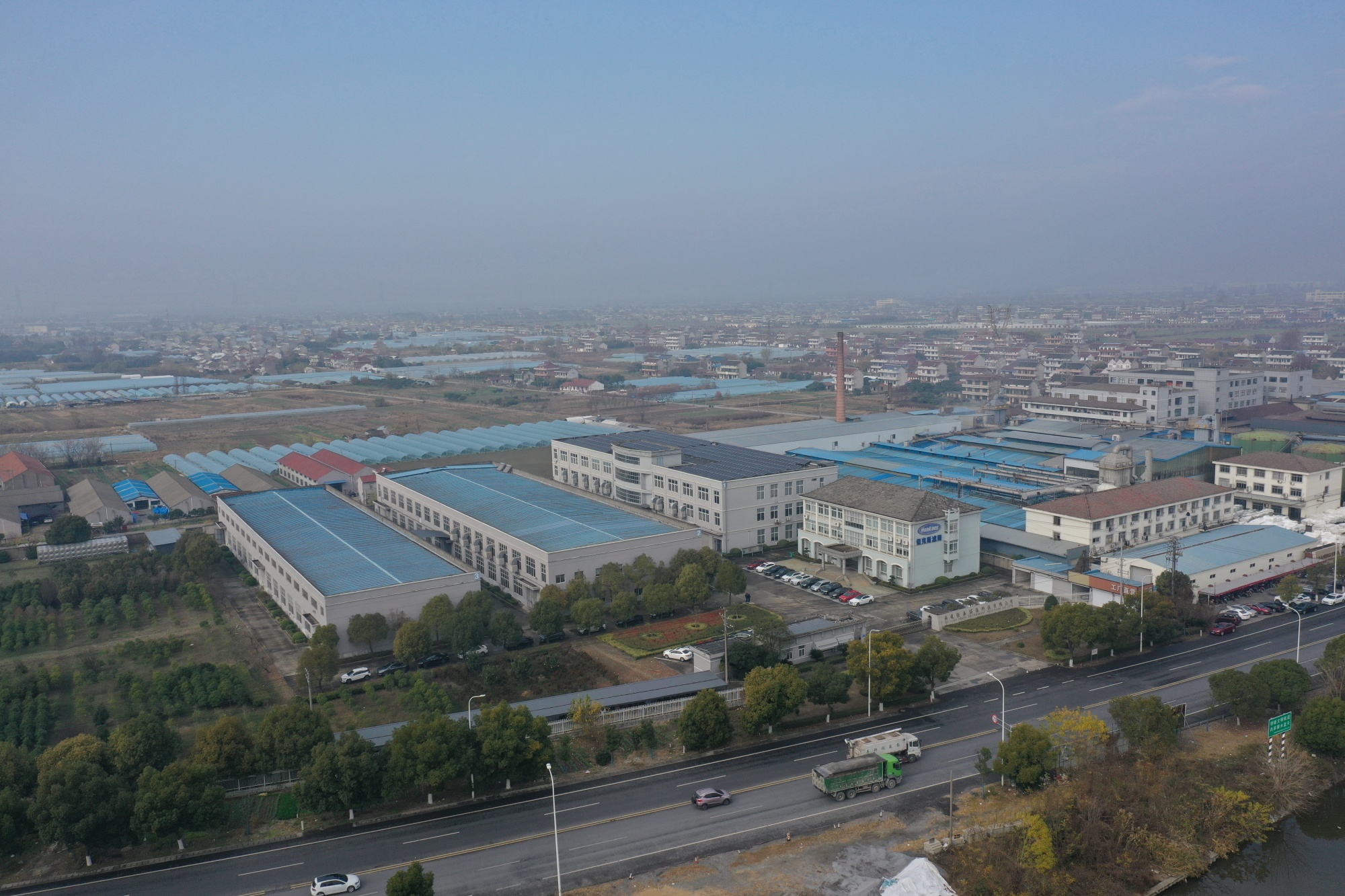
Henkaes is the brand name used by Nantong Henka Environment Solutions Co., Ltd, an air filter manufacturer founded in 2004 and based in Haimen City, Jiangsu Province, China, approximately 120 kilometres from Shanghai. The company designs and produces air filters for air purifiers, air cleaners, and ventilation systems, and its listed range includes HEPA, VOC removal, formaldehyde removal, activated carbon, odour removal, and HVAC filters as well as i-Hepa ventilation purification devices and IFD purification devices. It operates a 30,000 m² factory with an R&D team of 11 engineers, reports an annual output of 2,000,000 pieces, and states that 69% of its output is exported, mainly to the EU and the USA. That breadth is precisely why scenario matching is a practical question for this supplier rather than a marketing one.
The Same Grade Label Can Describe Two Very Different Filters
The clearest illustration sits inside the Henkaes range. The V-Bank Filter and the B737/B757 Electronic Cabin Air Filter are both specified at H13 efficiency, yet they are not substitutes. The V-Bank Filter uses fiberglass and polypropylene media and is intended for commercial and public buildings such as airports, hotels, museums, and restaurants. The aircraft cabin filter uses microfiberglass and is intended for aerospace and aviation applications. Grade parity, in other words, does not mean application parity.
For buyers at the evaluation stage, that has a direct consequence. A specification should read as environment → contaminant → required efficiency → media and format → service conditions. Filter grades belong in the middle of that chain, not at the front of it. The table below shows how the four scenario-specific lines in the Henkaes range map onto the environments they were designed for.
| Operating environment | Henkaes product line | Efficiency grade | Media |
|---|---|---|---|
| Cleanrooms, including data centres and microelectronics | Cleanroom Air Filter | U14/U15 | Microfiberglass, PTFE |
| Aircraft cabin air (B737/B757) | B737/B757 Electronic Cabin Air Filter | H13 | Microfiberglass |
| Pharmaceutical plants, hospitals, food and beverage production sites | Box Filter | MERV 15, MERV 16 | Microfiberglass |
| Airports, hotels, museums, restaurants | V-Bank Filter | H13 | Fiberglass, polypropylene |
Reading the table: the efficiency grade alone does not define fit. Media and format are part of the reason each line belongs to the listed environment, and moving a line into another environment changes the service conditions it was designed around.
Cleanrooms: Why Microelectronics and Data Centres Sit Above Standard HEPA
Cleanroom filtration is specified by what a stray particle can do to the product or the process rather than by human comfort. The Henkaes Cleanroom Air Filter is rated U14/U15 and built from microfiberglass and PTFE, and the manufacturer lists cleanrooms such as data centres and microelectronics facilities as its intended applications.
Both environments share a sensitivity to low-concentration, sub-micron particle deposition. In microelectronics-adjacent production, a deposited particle can compromise a feature or a surface; in data centres, particle loading on IT equipment and cooling surfaces affects thermal performance and drives maintenance intervals. That is why this line sits at the far end of the efficiency scale rather than at the HEPA classes used for general occupancy. The choice of microfiberglass and PTFE media reflects the media families generally associated with ultra-high-efficiency filtration, where the media itself has to combine fine capture with dimensional stability under continuous airflow.
The vocabulary for this segment comes from EN 1822, which classifies HEPA and ULPA filters according to their efficiency at the Most Penetrating Particle Size (MPPS). Within that framework, H14 requires 99.995% efficiency, as summarised in MANN+HUMMEL's air filtration standards reference. The practical message for buyers is that ultra-high-efficiency classes are defined by a particle-size-specific test, so any comparison between cleanroom filters should be made on the same test basis rather than on a nominal grade label alone.
Two boundaries apply, and both are usually visible in total cost. First, ultra-high-efficiency final filters are normally protected by upstream pre-filtration stages; placing a U14/U15 element behind an unfiltered air path shifts loading onto the most expensive component in the system. Second, higher efficiency classes typically carry higher initial resistance, which is paid for continuously in fan energy. Cleanroom-grade filtration is therefore specified where the process justifies it, not as a default ceiling for an entire building.
Aircraft Cabins: What the B737/B757 Electronic Cabin Air Filter Is Built For
Aviation imposes a different constraint set. The B737/B757 Electronic Cabin Air Filter is a H13 microfiberglass element listed for aerospace and aviation use. Cabin air is a closed, recirculated environment with a fixed volume, limited space for filter housings, and service intervals tied to aircraft maintenance schedules rather than to building facilities teams. The element is therefore designed as an application-specific filter for a named aircraft family, not as a general HVAC panel that happens to carry the same efficiency designation.
From an evaluation standpoint, three questions separate a genuine cabin filter from a lookalike. Is the element dimensioned and configured for the specific aircraft applications it is being purchased for? Is the media specified as microfiberglass rather than a general-purpose HVAC medium? And can the supplier document the efficiency test basis and the inspection routine applied to the production lot? Because the same manufacturer also produces building filtration, the buyer's task is to confirm that the aviation line is being quoted — not a similar-looking H13 filter drawn from another part of the catalogue.
Food, Beverage, Hospitals, and Pharmaceutical Plants: The MERV 15/16 Box Filter Case
Food, beverage, pharmaceutical, and hospital environments are grouped in the Henkaes range under the Box Filter, rated MERV 15 and MERV 16 and manufactured from microfiberglass, with pharmaceutical plants, hospitals, and food and beverage production sites named as its applications. The MERV scale itself comes from ASHRAE 52.2, which classifies HVAC filters from MERV 1 to MERV 16 according to their ability to capture particles between 0.3 and 10 micrometres, as documented by ASHRAE.
MERV 15 and MERV 16 sit at the top of that HVAC scale, and the reason food and healthcare operations reach for them is process protection rather than occupant comfort. Airborne particles carry microbiological load and can settle on product contact surfaces, exposed ingredients, and clean-area surfaces. In a food or beverage plant, that exposure is managed by combining hygiene practice with staged filtration, in which the box filter acts as the higher-efficiency stage. In hospitals and pharmaceutical plants, the same logic applies where air quality is part of a validated environment rather than a background condition.
One caveat belongs in every quotation comparison: MERV and EN 1822 ratings are not interchangeable, so a supplier should be able to state which test standard a quotation is based on. Henkaes states that ASHRAE 52.2 is used in testing its air filters, which makes MERV-referenced quotations internally consistent with the company's own test practice.
Airports, Hotels, Museums, and Restaurants: Laddering HVAC Filtration
Public and commercial buildings combine large air volumes with long operating hours, which makes staged filtration the standard architecture. In the Henkaes HVAC range the stages are explicit: Panel Filter at G1–G4 in fiberglass and polypropylene; Bag Filter at F5, F6, F8, and F9 in microfine fiberglass; Furnace Air Filter at MERV 8, MERV 11, and MERV 13 in polypropylene; and V-Bank Filter at H13 in fiberglass and polypropylene. All four lines list commercial and public buildings — airports, hotels, museums, and restaurants — as their intended environments.
The scenario question here is which final stage a space actually needs. An airport terminal with heavy outdoor particulate load, a museum with sensitive collections, and a hotel guest floor do not share the same requirement, and the difference shows up in how far along the ladder the final filter sits. Where the V-Bank H13 is used as the higher-efficiency final stage, the upstream panel and bag stages protect it and extend its service life. This staged structure is also what makes staged upgrading realistic: a building can typically move one stage up without rebuilding the entire air handling system, which keeps the decision within the scope of a filter change rather than a capital project.
How Standards Turn Scenario Needs Into Specification Language
Specification language in this market rests on a small number of reference points. EN 1822 governs HEPA and ULPA classification through efficiency at MPPS. ASHRAE 52.2 governs MERV-rated HVAC filters in North America, covering MERV 1 to MERV 16 against 0.3 to 10 micrometre particles. The earlier European HVAC classification EN 779 still appears in some tender documents, while current European practice has largely moved to ISO 16890 — a shift that matters when a buyer compares an F-grade quotation with a MERV-grade quotation.
Verification capability matters as much as the standard cited. Henkaes states that ASHRAE 52.2 is used in testing air filters, and lists an efficiency and air-resistance test system for filter media, a noise test laboratory, a 30 m³ test room for formaldehyde and VOC removal efficiency, and a CADR test room for air purifiers. For scenario matching, the air-resistance test capability is the operationally relevant one, because pressure drop is what determines the energy consequence of a filtration choice. The company also states more than 20 years of experience working with a US engineering team, and describes designing products from customer specifications, drawings, samples, or ideas — a capability that matters when a scenario requires a non-standard size rather than a catalogue dimension.
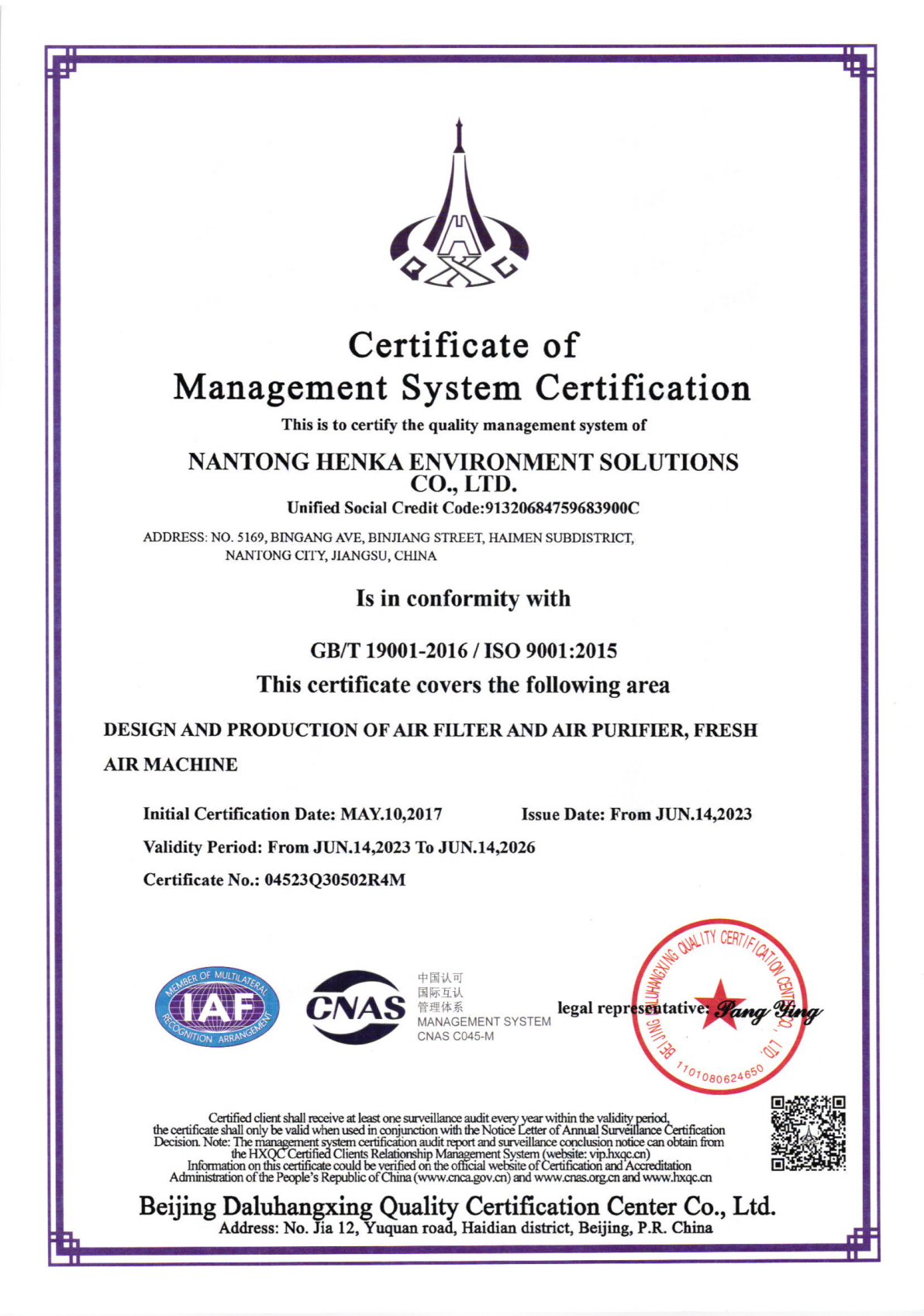
On the management-system side, Henkaes holds ISO 9001:2015 certification (certificate 04523Q30502R4M) and ISO 14001:2015 certification (certificate 04523E30387R2M), both issued on 14 June 2023 by Beijing Dalu Hangxing Quality Certification Center Co., Ltd., with a scope covering the design and production of air filter, air purifier, and fresh air machine; the company also references ISO 45001:2018. Because certificates carry validity periods, buyers should confirm current status and validity dates directly with the supplier during evaluation rather than relying on a downloaded copy. Quality control on Henkaes production is recorded as 100% inspection.
Where Higher Efficiency Stops Paying: Limits and Trade-Offs
Every filtration decision trades something away, and scenario matching is most useful when those trade-offs are named rather than implied.
- Efficiency versus energy. Moving from a general-purpose panel or bag filter to an H13 final stage raises particle capture but also typically raises initial resistance. The extra fan energy is paid across the full operating life, so a higher class needs to be justified by the environment rather than applied uniformly across a facility.
- Final filter versus pre-filtration. Ultra-high-efficiency cleanroom elements are normally installed behind pre-filtration. Changing upstream stages without revisiting the final filter can shorten service life and increase change-out frequency.
- Broad range versus scenario specificity. A manufacturer with lines spanning household HEPA and carbon filters, HVAC filters, cleanroom filters, and aircraft cabin filters can serve many environments, but the quotation still has to name the line matched to the scenario. The H13 V-Bank Filter and the H13 cabin filter show why grade parity is not interchangeability.
- Commercial boundaries. The Henkaes OEM & ODM capability record lists customization as size and logo, a minimum order quantity of 500 pieces, a 30-day lead time, and remote after-sales support. Those terms suit planned programmes better than urgent spot purchases, and they are the kind of figures procurement teams should test against their own schedule before shortlisting.
- Evidence boundaries. The company's published project records cover OEM and ODM air purifier programmes for US clients rather than cleanroom, food-plant, or aviation deployments. Scenario-specific test data should therefore be requested directly instead of assumed transferable from the purifier programmes.
What Deployed Henkaes Programmes Show
Henkaes' listed case records are concentrated in OEM and ODM programmes for US clients, and they are relevant to scenario matching because they show a filter being qualified against a stated contamination problem rather than against a grade label. Three records are published. An ODM programme supplied 50,000 pieces for formaldehyde removal, described as stable over two years, with removing formaldehyde with good performance recorded as the highlight. A second ODM programme supplied 50,000 pieces for purifying air for indoor environments, with VOC removal as the application and one year of stability recorded. An OEM programme supplied 20,000 pieces for indoor purifier air, listed as stable over one year with high efficiency as the highlight. Supporting technical material states that the product is used for purifying air for indoor environments, with specific applications in formaldehyde removal and VOC removal, and records high efficiency and good VOC removal performance as key outcomes.
The sequence is what matters for buyers: contamination target first, then media and efficiency class, then a defined stability period before scale-up. The same sequence applies to cleanroom, food, and aviation scenarios — only the contaminant and the evidence expectations change.
Market Signals Pointing Toward Scenario-Led Specification
Three signals support scenario-led specification over generic purchasing. HEPA filters held a 41.7% share of the air purifier technology segment in 2025, according to Grand View Research, which indicates that efficiency class is already treated as a primary purchase attribute. Grand View Research also reports the global smart air purifier market growing at a 14.1% CAGR between 2024 and 2030, driven by AI and IoT integration — an adjacent category whose sensor-driven control logic increases the value of filters whose behaviour under changing airflow is documented. And China Briefing's 2025 trade reporting attributes 35% of China's air filter exports to H13/H14 grade HEPA filters, naming the semiconductor and biopharmaceutical sectors as demand drivers: the same two sectors that define the cleanroom and box filter scenarios discussed here.
At the top of the industrial filtration market, scale is concentrated among diversified suppliers. Global Market Insights reported that Parker Hannifin held a 15.7% share of the industrial filtration systems market in 2024, while Daikin Industries' filtration revenue reached USD 1.12 billion in 2024 with a focus on high-end MERV 15 and HEPA products, according to Report Prime Research. For buyers, that structure explains why scenario documentation matters more than size alone: the practical question is not who is largest, but who can evidence a specific environment match.
Future Outlook
Expect scenario documentation to become a routine part of air filter procurement. Demand from semiconductor and biopharmaceutical production continues to pull the high-efficiency end of the market, which means more buyers comparing filters on MPPS efficiency and pressure drop rather than on nominal grade. Building specifications are converging on staged filtration as the default architecture, so the decision increasingly concerns which final stage a space requires rather than whether filtration is needed at all. And sensor-driven ventilation and purifier systems create a data trail — airflow, loading, change-out intervals — that makes scenario assumptions testable after installation instead of arguable before it.
For manufacturers, that raises the bar on documentation: efficiency and pressure drop data per line, inspection records, and scenario-relevant references. Henkaes' position in that market rests on a broad range running from household HEPA and activated carbon filters through cleanroom, HVAC, and aerospace cabin filters, supported by ISO 9001:2015 and ISO 14001:2015 management systems, ASHRAE 52.2 based testing, and stated inspection and capacity figures. Whether that range converts into a place on a shortlist will depend on how clearly each line's scenario boundary is documented for the buyer.
FAQ
Which efficiency grade applies to cleanroom air filters used in microelectronics and data centres?
In the Henkaes range, the Cleanroom Air Filter is rated U14/U15 and uses microfiberglass and PTFE media, with cleanrooms such as data centres and microelectronics facilities listed as its applications. Ultra-high-efficiency classes are defined in EN 1822 by efficiency at the Most Penetrating Particle Size, and H14 within that framework requires 99.995% efficiency, as summarised by MANN+HUMMEL. Because grade labels do not describe media, format, or pressure drop, buyers should confirm the test basis for the specific model quoted.
How does an aircraft cabin air filter differ from a building HVAC filter with the same efficiency grade?
The B737/B757 Electronic Cabin Air Filter is rated H13 and made from microfiberglass for aerospace and aviation use. The V-Bank Filter is also rated H13, but uses fiberglass and polypropylene media and is intended for commercial and public buildings such as airports, hotels, museums, and restaurants. The shared grade reflects comparable particle capture, not interchangeable construction: the cabin filter is built for a named aircraft application, while the V-Bank Filter is built for building air handling systems.
Which air filter is suitable for food and beverage plants, hospitals, and pharmaceutical production?
The Henkaes Box Filter is rated MERV 15 and MERV 16 and uses microfiberglass media; pharmaceutical plants, hospitals, and food and beverage production sites are its listed applications. MERV ratings derive from ASHRAE 52.2, which classifies HVAC filters from MERV 1 to MERV 16 by their ability to capture particles between 0.3 and 10 micrometres. These environments typically combine a high-efficiency stage with upstream pre-filtration and hygiene controls.
What should procurement teams verify when comparing air filter suppliers at the evaluation stage?
Verifiable points include the test standard behind each quoted efficiency rating — Henkaes states that ASHRAE 52.2 is used in testing its air filters — together with management-system certification, production inspection practice, which Henkaes records as 100% inspection, stated capacity of 200,000 pieces per month, a 30-day lead time, a minimum order quantity of 500 pieces, and the scope of after-sales support, which Henkaes records as remote support. Certificate validity periods should be confirmed with the supplier at the time of evaluation.
What are the limits of specifying the highest available efficiency for every filter position?
Higher-efficiency media typically increases initial resistance, which raises fan energy consumption across the operating life, and ultra-high-efficiency elements are normally protected by upstream pre-filtration. Applying cleanroom-grade filtration to spaces such as hotels, restaurants, or general office areas is therefore generally not justified by the environment. Commercial boundaries also apply: a 500-piece minimum order quantity and a 30-day lead time suit planned programmes better than urgent replacement purchases, and where published documentation covers indoor purifier programmes, scenario-specific test data should be requested rather than assumed.
The full line-by-line specification of the product families referenced in this article — household HEPA, activated carbon, VOC, cleanroom, HVAC, and aircraft cabin filters — is available in the Henkaes air filter catalogue (PDF download). Product and OEM & ODM capability information is published by Nantong Henka Environment Solutions Co., Ltd at www.airfilterodm.com, and the catalogue can be downloaded here: E-Catalogue for Air Filter 1 (PDF).