
Matching Casting Polyurethane Raw Materials to Industrial Scenarios
Selecting polyurethane raw materials is a scenario-fit exercise before it is a price negotiation. The same two-component chemistry that produces a wear-resistant mining screen can be formulated into marine components that resist biofouling or a sports dumbbell with a vivid, eco-friendly rubber coating. Casting polyurethane raw materials are liquid systems that cure into thermoset polyurethane elastomers, and the selection problem for industrial buyers is matching the prepolymer system to the operating environment, the production equipment and the end-use function of a specific project.
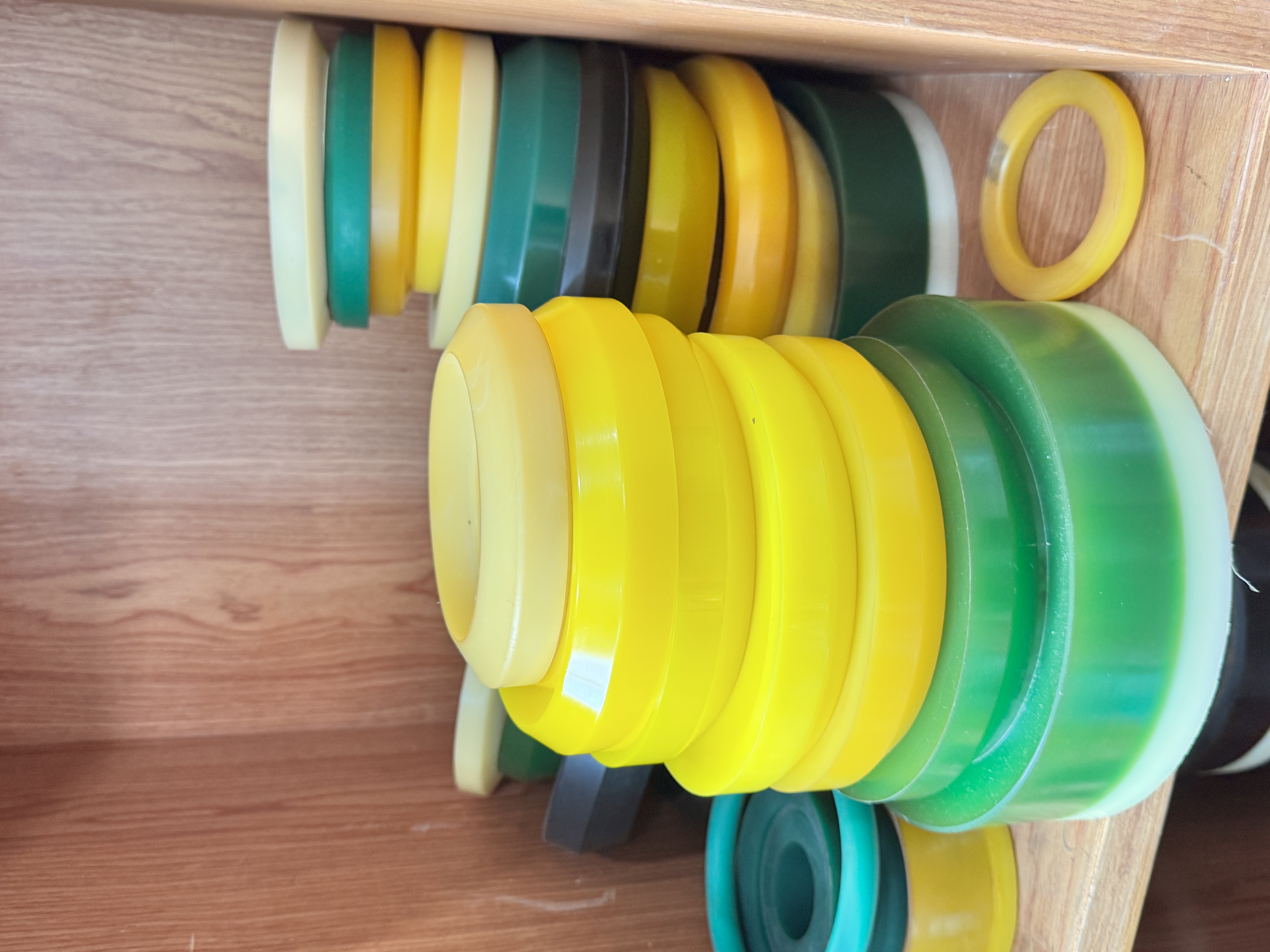
Polyurethane traction wheels — a typical cast elastomer component for mining and industrial machinery.
The industrial context: why scenario fit matters
In the Green Energy & New Materials sector, polyurethane raw material procurement is increasingly driven by the operating conditions of the final component rather than by generic grade availability. Across South and Southeast Asia — Vietnam, Pakistan, the Philippines, Cambodia, Malaysia, Bangladesh and Thailand — the dominant working conditions for elastomer components can be summarized as tropical high temperature, high humidity, frequent friction and corrosive water contact. These conditions place simultaneous demands on the mechanical, thermal and chemical stability of every elastomer part, from mining screen mesh to automotive drawing wheels.
The buyer's own production environment matters equally. Most industrial processors of casting polyurethane operate automated lines based on two-component metering and conveying of raw materials, followed by automatic high-pressure mixing and pouring, which enables continuous mass production. The basic supporting equipment package is a polyurethane high-pressure foaming machine or low-pressure pouring machine, a raw material storage tank, a mixing bucket and a delivery pump. A raw material supplier must therefore be evaluated on two axes simultaneously: the performance of the cured elastomer and the processability of the liquid system on the buyer's existing or planned equipment.
The problem and the opportunity
The problem observed in demanding end-use applications is familiar to maintenance and reliability engineers: generic rubber and ordinary thermoplastic parts lose mechanical integrity when heat, humidity, abrasion and corrosive water attack them at the same time. Sealing elements harden, wear pads erode, screen meshes fatigue, and marine components suffer fouling and corrosion. The consequence is unscheduled downtime and repeated replacement costs.
The opportunity, documented in casting polyurethane application portfolios, is that polyurethane elastomer formulations can combine high wear resistance, high resilience, hydrolysis resistance and corrosion resistance within a single system. Because the raw material is liquid and castable, the same supply relationship can support multiple project types — mining, automotive, marine, wind power, sports and construction — each with its own performance target.
The supplier: Shanghai Hecheng Polymer Technology Co., Ltd.
Shanghai Hecheng Polymer Technology Co., Ltd. is a China-based manufacturer and global supplier of high-performance polyurethane (CPU) elastomer materials, headquartered in Shanghai, P. R. of China. Established in 2009, the company is a national high-tech enterprise focused on R&D, manufacturing and global supply of cast polyurethane elastomer materials. Its plants and warehouses are located in the Songjiang district of Shanghai.
Three structural facts define the company's relevance to scenario-fit procurement:
- Scale of formulation range: more than 1,000 prepolymer grades, produced across 16 major production reactors.
- R&D intensity: with more than 70 employees, R&D personnel account for nearly 30% of the total workforce, supported by a dedicated R&D center for custom formulations developed for specific performance and processing needs.
- Technical verification: advanced laboratory analysis covering basic mechanical testing, thermal analysis and chemical resistance evaluation, supported by strict quality control systems for consistent, reliable product performance and long-term stability.
The product portfolio spans casting polyurethane prepolymers, quasi-polyurethane elastomer materials, special functional materials, eco-friendly adhesives and additives. End-use industries include automotive, photovoltaics, machinery, mining, marine, sports and industrial auxiliary parts. Approximately 30% of production is exported, with main markets in the EU, Southeast Asia and South America, in addition to North America and South Korea.
Technical foundation: from liquid prepolymer to thermoset elastomer
In technical terms, a casting polyurethane raw material is the liquid precursor of a thermoset polyurethane elastomer. The processor meters a polyurethane prepolymer together with a curing agent, mixes the two components under high pressure and pours the reactive liquid into a mold. The cured part is a solid elastomer whose hardness, resilience, wear behavior and chemical resistance are determined by the prepolymer backbone — polyether or polyester — and by the isocyanate chemistry.
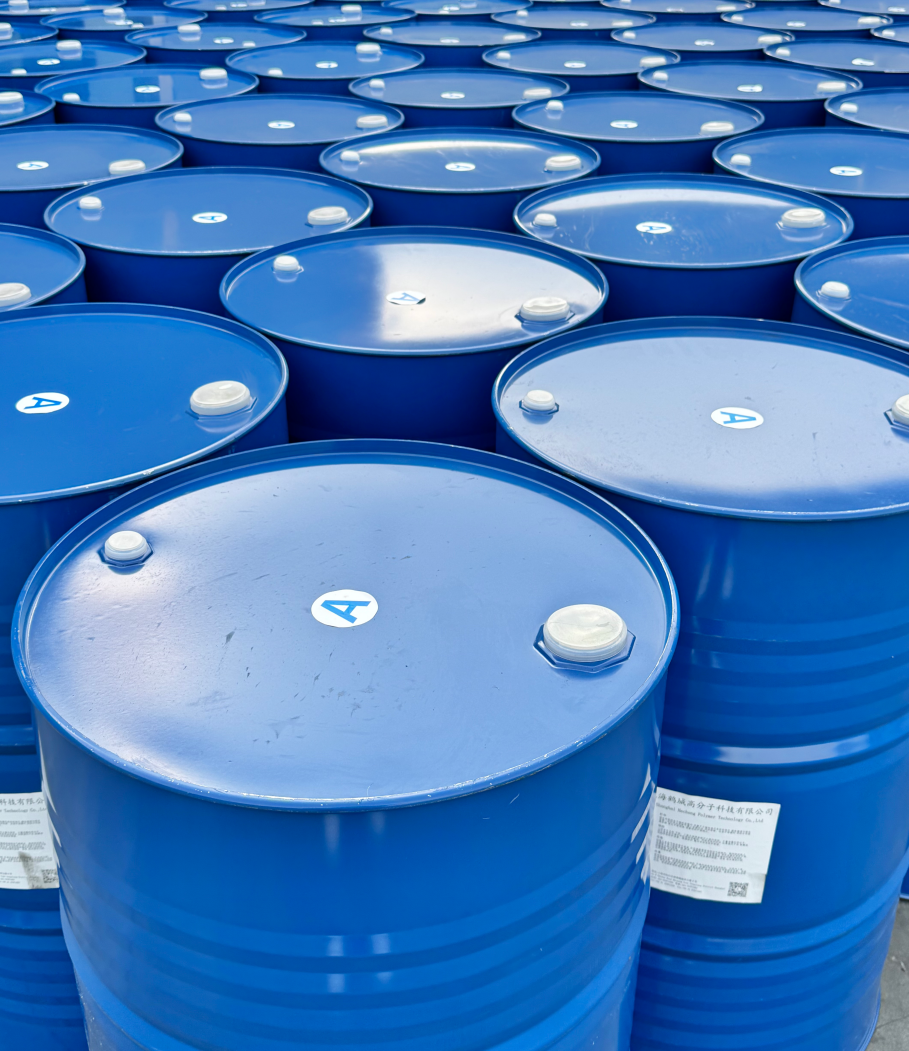
Casting polyurethane raw materials are supplied as liquid two-component systems for automated metering, mixing and pouring.
Hecheng's documented product families cover the principal formulation routes used in industrial casting today:
| Product family | System type | Documented characteristics | Documented application |
|---|---|---|---|
| Casting Polyurethane Prepolymer | POLYURETHANE ELASTOMER | Castable raw material for elastomer production | Mining industry |
| CPU Casting Polyurethane | Polyether PTMG-MDI | Environmentally friendly, high quality, corrosion-resistant | Sealed class accessories |
| Liquid Polyurethane (Gel-8301AB) | Polyurethane AB material | Antioxidant, high resilience | Various elastomers |
| Polyurethane Prepolymer (Rubberized sports equipment - 8385AB) | Polyether-MDI | Vivid colors, eco-friendly | Sports industry |
| Polyurethane Elastomer (Screen Scraper-5282ABC) | Polyester, three-component | High wear resistance, high resilience | Mining sector |
The backbone choice is a documented decision point. The PTMG-MDI system is a polyether-based formulation positioned for sealed class accessories, with environmental friendliness, high quality and corrosion resistance as its stated characteristics. The polyester three-component grade behind Screen Scraper-5282ABC is positioned for mining sector components, where high wear resistance and high resilience are the governing requirements.
From a formulation standpoint, the range also includes low-free-isocyanate prepolymers based on MDI, TDI and PPDI. These systems matter for projects with stricter residual-isocyanate requirements. In the automotive sector, for example, Hecheng applies a TDI low-free prepolymer designed to improve physical and mechanical properties and to achieve excellent dynamic mechanical properties under tropical high-temperature, high-humidity, frequent-friction and corrosive-water conditions.
Processing compatibility is part of the material specification. The documented operation mode across application scenarios is automated production: two-component metering and conveying of raw materials, automatic high-pressure mixing and pouring, enabling continuous mass production. Buyers operating polyurethane high-pressure foaming machines or low-pressure pouring machines can integrate these materials into existing process lines.
Application scenarios: six documented fit cases
The scenario-fit logic of casting polyurethane raw materials is best understood industry by industry. Each of the following environments is documented in Hecheng's application portfolio, with its own operating conditions, production mode and supporting equipment.
Mining industry
The product is used in the mining industry to produce tensionless screen mesh. The material operates under tropical high temperature, high humidity, frequent friction and corrosive water contact, conditions common in Thailand, Vietnam, Pakistan, the Philippines, Cambodia, Malaysia and Bangladesh. Supporting equipment includes a polyurethane high-pressure foaming machine or low-pressure pouring machine, raw material storage tank, mixing bucket and delivery pump.
Automotive industry
For the automotive sector, a TDI low-free prepolymer improves physical and mechanical properties and provides excellent dynamic mechanical properties. The application operates under tropical high temperature, high humidity, frequent friction and corrosive water contact, typically in Vietnam, Pakistan, the Philippines, Cambodia, Malaysia, Bangladesh and Thailand. Production follows the automated two-component metering and conveying route, with automatic high-pressure mixing and pouring for continuous mass production. Typical end products include polyurethane drawing wheels.
Marine technology
In the marine technology industry, liquid polyurethane raw materials provide resistance to seawater corrosion, anti-fouling for marine organisms and shock absorption. The formulations are designed for high-temperature, high-humidity environments with seawater exposure, commonly found in Cambodia, Malaysia, Bangladesh, Thailand, Vietnam, Pakistan and the Philippines.
Wind power generation
For wind power generation, polymer prepolymers provide aging resistance, high-voltage sealing and shock absorption for wind power components. The material specification covers tropical high temperature, high humidity, frequent friction and corrosive water contact, with applications documented in Bangladesh, Thailand, Vietnam, Pakistan, the Philippines, Cambodia and Malaysia.
Sports industry

Cast polyurethane is used to rubberize sports equipment including barbells and rock climbing points.
In the sports industry, the material functions to apply rubber coating on sports equipment through a two-component mixing process. The application operates under tropical high temperature and high humidity, and is common in Southeast Asian countries such as Thailand, Vietnam and Malaysia. The 8385AB polyether-MDI system is documented with vivid colors and eco-friendly characteristics.
Construction industry
In the construction industry, this product provides high hydrolysis and corrosion resistance and high toughness elastomer material for construction anti-wear parts. The scenario is documented for Pakistan, the Philippines, Cambodia, Malaysia, Bangladesh, Thailand and Vietnam, under tropical high-temperature, high-humidity, frequent-friction and corrosive-water conditions.
A shared characteristic across all six scenarios is customization support. Hecheng's R&D center adapts formulations to specific performance and processing needs, which means the material specification can be aligned to the project rather than the project being forced onto a standard grade.
Long-term supply reference
A documented supply relationship illustrates the stability of this material platform. A raw material manufacturer in Vietnam has purchased polyurethane elastomer materials from Hecheng for 10 years, with order quantities reaching 100 tons. The customer reports stable production quality and improved product performance, with the material recognized for its environmental friendliness, high quality and corrosion resistance.
Market context: verified growth data
Third-party market research places casting polyurethane raw materials in a growing segment. Roots Analysis estimates the global polyurethane market at USD 85.2 billion in 2024, projected to reach USD 136.2 billion by 2035. Astute Analytica values the casting polyurethane market at USD 2,758.37 million in 2024, driven by industrial production and the electrification of mobility. Straits Research reports that global demand for polyurethane elastomers rose by 12% in 2024, driven primarily by industrial machinery and automotive lightweighting trends.
Two structural points matter for buyers sourcing from China-based manufacturers. First, MDI contributed approximately 60% of total global isocyanate volume in 2024, according to Prismane Consulting and S&P Global — an indication of how dominant MDI-based systems have become, and directly relevant to Hecheng's PTMG-MDI product family. Second, mainland China is the most significant global market for diisocyanates, accounting for about one-third of global TDI, MDI and aliphatic markets in 2024, according to S&P Global Commodity Insights. For a Shanghai-based supplier, this means relatively direct access to isocyanate feedstocks.
On the environmentally compatible side, the waterborne polyurethane dispersions (PUDs) market is estimated at USD 1,984.5 million in 2025, with 4.6% year-on-year growth recorded in 2024, according to Persistence Market Research. This supports the growing relevance of water-based adhesives and low-emission additive systems alongside conventional casting materials.
Comparison with conventional elastomers — and one honest limitation
Compared with conventional rubber, casting polyurethane elastomers offer documented advantages in wear resistance and resilience. In wet, abrasive environments, they additionally provide high hydrolysis and corrosion resistance — the exact combination specified for construction anti-wear parts and marine components. Compared with thermoplastic elastomers, thermoset casting polyurethane retains shape and performance better under continuous friction and load, which is why mining screens, drawing wheels and anti-wear pads are typically cast rather than injection-molded.
The honest limitation of casting polyurethane is process-related. Because the material is a two-component liquid system, it requires dedicated infrastructure: a polyurethane high-pressure foaming machine or low-pressure pouring machine, raw material storage tanks, mixing barrels and delivery pumps. A fabricator that does not already operate liquid casting lines must budget for this equipment before the material benefits can be realized. Once the line is in place, however, the same equipment enables continuous mass production and high formulation flexibility across multiple product types.
Future outlook
The direction of the casting polyurethane raw material market is toward specialization and regulatory alignment. Industrial production and the electrification of mobility are the demand drivers most frequently cited for the casting polyurethane segment, and both favor components that combine wear resistance with lightweight, resilient elastomer behavior.
Standards are also formalizing. ISO 10364:2024 specifies methods for determining the pot life (working life) of multi-component adhesives, including polyurethane-based systems, giving processors a defined method for verifying working time. In the foam segment, the CertiPUR label scheme has prohibited the use of methylene chloride in production as of September 1, 2024 — a signal that input restrictions across polyurethane chemistries are tightening and that low-emission formulation families such as low-free-isocyanate prepolymers will gain further relevance.
For buyers in the Green Energy & New Materials sector, the practical implication is that casting polyurethane raw materials should be evaluated against both performance criteria (wear, resilience, hydrolysis and corrosion resistance) and compliance criteria (residual isocyanate levels, emission profile, documented test methods). Suppliers such as Shanghai Hecheng Polymer Technology Co., Ltd. combine a broad prepolymer grade range with custom formulation support, which is the capability combination that makes project-level material matching possible.
FAQ
1. What are casting polyurethane raw materials?
Casting polyurethane raw materials are liquid or quasi-liquid systems used to produce solid polyurethane elastomer parts. The category includes casting polyurethane prepolymers, quasi-polyurethane elastomer materials, liquid polyurethane, CPU casting polyurethane and polyurethane elastomer systems, which are mixed and poured before curing into thermoset components.
2. What is the difference between a polyurethane prepolymer and a finished polyurethane elastomer?
A polyurethane prepolymer is a reactive liquid intermediate that must be mixed with a curing agent and poured to form a finished elastomer. Hecheng's range covers more than 1,000 prepolymer grades across polyether and polyester systems; the cured result is a thermoset polyurethane elastomer whose properties depend on the prepolymer backbone and isocyanate chemistry chosen.
3. Which industrial scenarios can casting polyurethane raw materials serve?
Documented scenarios include mining (tensionless screen mesh), automotive (drawing wheels), marine technology (seawater corrosion resistance, anti-fouling, shock absorption), wind power generation (aging resistance, high-voltage sealing, shock absorption), sports (rubber coating on equipment) and construction (high-toughness anti-wear parts).
4. What equipment is required to process liquid polyurethane raw materials?
The basic supporting equipment is a polyurethane high-pressure foaming machine or low-pressure pouring machine, a raw material storage tank, a mixing bucket and a delivery pump. The documented operation mode is automated two-component metering and conveying, automatic high-pressure mixing and pouring, enabling continuous mass production.
5. What are low-free-isocyanate prepolymers and when are they used?
Low-free-isocyanate prepolymers are isocyanate-terminated systems with reduced residual free isocyanate content, available in MDI-, TDI- and PPDI-based versions. They are used in applications with stricter exposure requirements; for example, the automotive sector scenario in Hecheng's portfolio applies a TDI low-free prepolymer.
6. How do polyurethane elastomers perform in tropical high-humidity environments?
Formulations designed for tropical high temperature, high humidity, frequent friction and corrosive water contact provide documented resistance to hydrolysis and corrosion. In marine applications, the material additionally provides resistance to seawater corrosion, anti-fouling for marine organisms and shock absorption.
7. Does Shanghai Hecheng support custom formulations?
Yes. Hecheng operates an R&D center dedicated to custom formulations developed for specific performance and processing needs. Laboratory analysis includes basic mechanical testing, thermal analysis and chemical resistance evaluation, with customization supported across documented application scenarios.
8. What are the standard procurement conditions for OEM projects?
OEM production is supported with a minimum order quantity of 1 ton, a standard lead time of 30 days, 100% testing and remote after-sales support. Export markets for the capability unit include the EU and the Middle East.
Shanghai Hecheng Polymer Technology Co., Ltd.
National high-tech enterprise focused on R&D, manufacturing and global supply of high-performance polyurethane (CPU) elastomer materials.
Website: https://en.hechengcpu.com/
Contact: Vera Li — vera@hechengcpu.com
Tel / WhatsApp: +86 16606109059
Address: No. 1266 Xinbin Road, Maogang Town, Songjiang District, Shanghai, China
Company brochure (PDF): Download the polyurethane brochure