
Matching Chain Blocks to Jobsite Conditions: A Scenario-Based Selection Guide
Why Work Site Conditions Matter in Chain Block Selection
A chain block is a manually operated lifting device that uses a mechanical gear system to convert human effort into lifting force. Its selection is often based on rated load capacity, but experienced buyers know that the work site itself defines the real requirements. The same 5-ton chain block that works well in a factory workshop may not be the best fit for a port terminal, a mining operation, or a shipyard. Each environment brings different constraints: available headroom, power supply, temperature, humidity, dust, explosion risk, and the frequency of lifts.
This article provides a scenario-based reference for buyers who need to match chain blocks to specific jobsite conditions. It focuses on the relationship between application context and equipment specification, rather than on brand preference.
The Buying Problem: Site Variables That Are Easy to Overlook
Many chain block purchasing decisions start with two numbers: load capacity and lift height. But that approach often leads to field problems. A chain block intended for a workshop may have a load chain that corrodes in a port environment. A construction site model may be selected without considering the need for explosion-proof components in petrochemical facilities.
The opportunity lies in treating site conditions as part of the specification. Buyers who map each job site to the required equipment behavior—not just the load—reduce downtime, maintenance cost, and safety risk. For project-driven buyers, this is the difference between a lifting tool that operates reliably for years and one that requires premature replacement.
How JUNYUNHOIST Positions Its Chain Block Range
Baoding Junyun Hoisting Machinery Co., Ltd. (JUNYUNHOIST) is a vertically integrated manufacturer and trading company based in Hebei, China. The company designs and manufactures manual chain blocks including the VD, VT, HSZ, and HSC series, as well as lever blocks and electric hoists. Its chain block line covers rated load capacities from 0.5 to 50 tons, with standard lift heights of 3 meters and optional heights from 2.5 to 12 meters.
These products are used across manufacturing, construction, logistics and warehousing, shipbuilding, mining, petrochemicals, power, bridge engineering, railway construction, automotive repair, agriculture, and stage construction. That breadth is not just a marketing list; it reflects that the same mechanical core can be adapted through capacity, chain grade, housing finish, and special configurations. According to company data, about 80% of JUNYUNHOIST chain blocks are exported, with main markets including India, Russia, Vietnam, Brazil, Turkey, the Middle East, and Southeast Asia.
Technical Foundations: How a Manual Chain Block Behaves
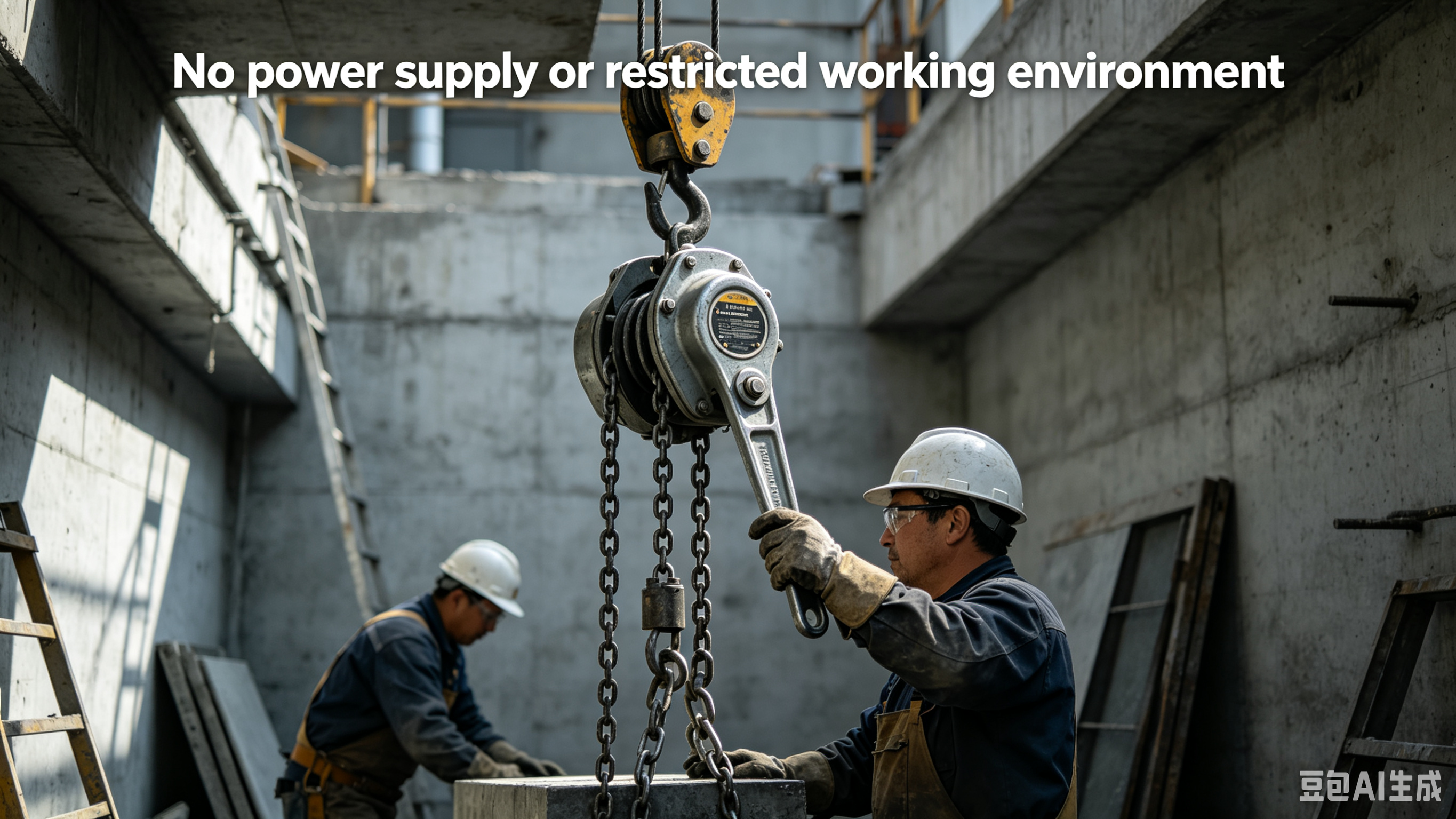
A manual chain block operates in a purely mechanical mode. The operator pulls the hand chain, which turns a gear train that raises or lowers the load chain. A reverse-drive self-locking braking system allows precise control of lifting and lowering, and locks the load safely when the pull stops. This is why chain blocks remain useful in situations where electric power is unavailable or where precise positioning is required during installation work.
In the JUNYUNHOIST VD chain block, the load chain is available in Grade V (80) or Grade T, meeting DIN EN 818-7. Chain diameters range from 6.3 mm to 11.2 mm depending on capacity. The number of chain falls is 1 to 4, and the minimum headroom or hook distance is between 300 mm and 1000 mm. Hooks are made of heat-treated forged alloy steel with openings from 24 mm to 55 mm. The safety factor is at least 4:1 for the chain and at least 5:1 for structural parts. The housing is painted in RAL 2000 or 1007, and chains are corrosion-resistant.
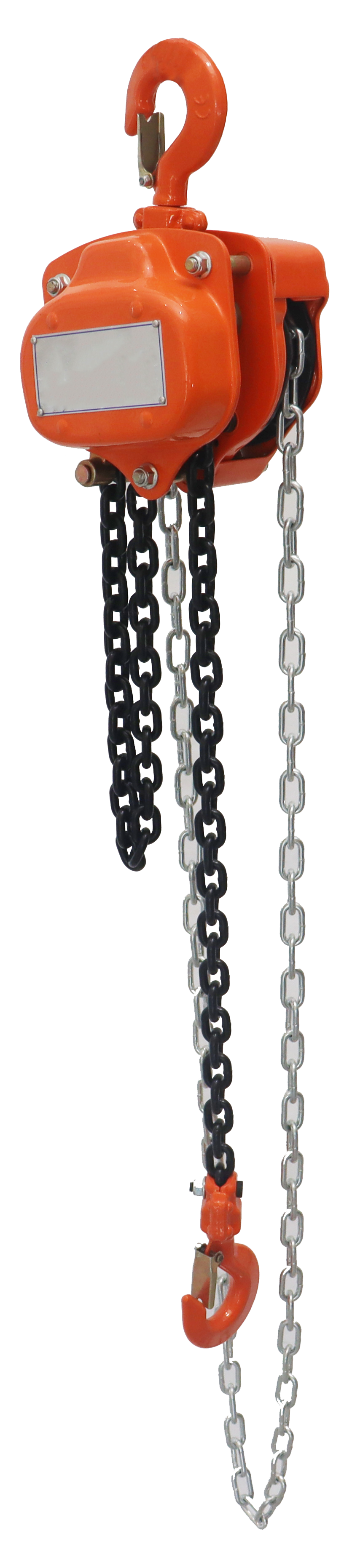
The following table summarizes the main specification areas buyers should verify before selecting a chain block for a given site.
| Parameter | Typical Value / Range |
|---|---|
| Rated load capacity | 0.5–50 t |
| Standard lift height | 3 m (2.5–12 m optional) |
| Number of chain falls | 1–4 depending on capacity |
| Load chain standard | Grade V (80) or Grade T (DIN EN 818-7) |
| Load chain diameter | 6.3–11.2 mm |
| Hand chain | Round link, galvanised or zinc-plated |
| Hook material | Forged alloy steel, heat-treated |
| Safety factor | ≥4:1 chain / ≥5:1 structural parts |
| Operating temperature | −20°C to +50°C (standard grease) |
| Standards | ISO 16872, EN 13157, ASME B30.21, CE marked |
Chain Block Selection by Work Site: A Scenario Reference
The following scenarios represent the most common project environments for manual chain blocks. Each has its own selection logic.
Workshop chain block
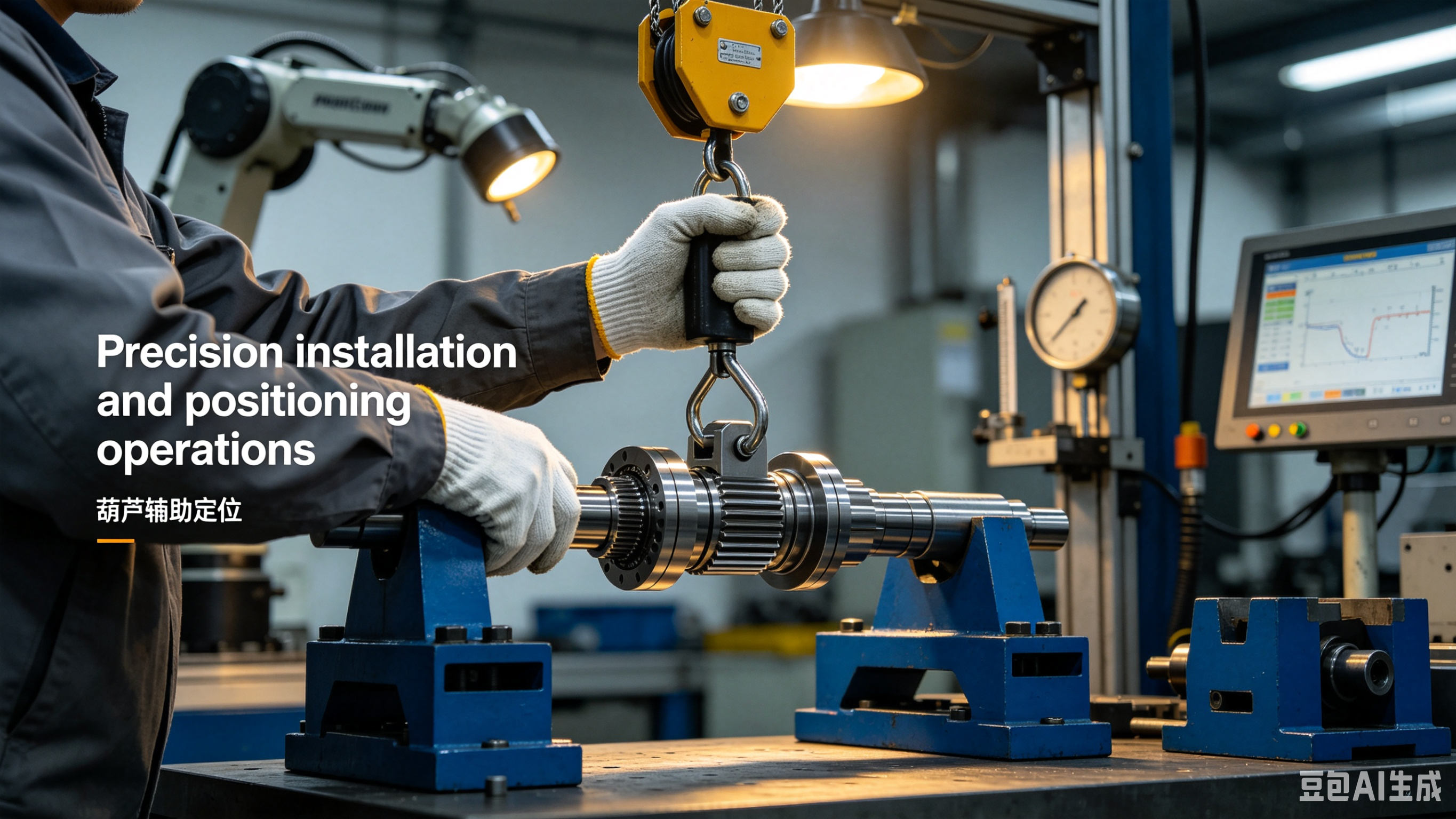
In workshops and factories, chain blocks are used for machine maintenance, die changes, assembly operations, and positioning parts. The environment typically has a controlled climate, but headroom may be limited and lifts are frequent but not continuous. A compact model with a low headroom, such as a VD block with a minimum hook distance near 300 mm, is often sufficient. Supporting components like trolleys are added when loads need to move horizontally.
Construction site chain block
Construction sites apply chain blocks to steel structure installation, bridge construction, and precast beam placement. For example, in high-speed railway bridge projects, large steel beams must be precisely placed. This requires robust construction, corrosion-resistant load chains, and models that can operate reliably outdoors. Application scenarios are common in India, Vietnam, Turkey, the United Arab Emirates, Saudi Arabia, Brazil, and Russia.
Warehouse and logistics chain block
Warehouse and logistics operations use chain blocks for loading and unloading, rack maintenance, and positioning heavy items. They are often paired with manual trolleys on I-beam runways. Galvanised or zinc-plated hand chains are useful in humid warehouses because they resist corrosion. The emphasis is on smooth operation and reliable braking, especially when loads are moved over personnel.
Port and terminal cargo chain block
Port cargo handling deals with heavy loads, high humidity, and sometimes salt-laden air. For terminal maintenance and cargo positioning, high-capacity chain blocks up to 50 tons with strong alloy steel chains are relevant. Because port operations often continue regardless of weather, corrosion resistance and a high safety factor are important selection signals.
Mining operation chain block
Mining sites frequently involve dust, vibration, and limited power availability. Chain blocks are used for maintenance of crushers, conveyor components, and wear parts. In environments with explosion risk, special configurations such as explosion-proof and high-temperature resistant versions are available upon request. The purely mechanical operation of a chain block is an advantage in remote sites where electricity is not dependable.
Shipbuilding chain block
Shipbuilding uses chain blocks to move and assemble structural sections, and to hoist or disassemble heavy components such as engines and propellers. Precision positioning is critical, and the reverse-drive self-locking brake helps maintain position during long operations. Corrosion-resistant chains and forged alloy steel hooks are typical requirements in marine environments.
Factory hoisting chain block
In heavy machinery manufacturing, chain blocks handle steel plates, gearboxes, and large components. Multiple chain falls (2 to 4) distribute load and reduce hand chain pull, making high-capacity lifts manageable. Factory maintenance teams also use chain blocks for line changeovers and equipment repair.
Small-space and high-altitude chain block
For confined spaces or high-altitude work where headroom is tight, chain blocks with short headroom (hook distance near 300 mm) are selected. When moving loads in very tight clearances, lever blocks are often used, but chain blocks remain suitable when a continuous lift is needed. Compact models are also common in automotive repair shops and stage construction.
Heavy-duty chain block
Heavy-duty tasks such as bridge construction and port maintenance demand capacities in the upper range. The VD chain block range extends to 50 tons, with four chain falls in high-capacity configurations. This allows crews to lift very heavy loads manually without an external power source, which is often critical in remote or emergency repair scenarios.
Supporting equipment and special configurations
Effective use of a chain block requires supporting equipment such as slings, special hooks, clamps, trolleys, and load detectors. For specific tasks, magnetic lifters, wire rope assemblies, and gantry or cantilever arrangements can be added. Standard configuration meets general requirements; where conditions demand it, explosion-proof and high-temperature resistant configurations are available on request.
Market Trends in Chain Block Demand
The global chain block market was valued at approximately USD 1.95 billion in 2024, according to Intel Market Research. Estimates differ by study scope, but there is broad agreement that manual chain blocks retain a major share. Fact.MR projects that manual chain pulley blocks will account for roughly 48% of the product segment share in 2026. Construction sites are consistently cited as the largest application segment, contributing between 30% and 54% of global demand depending on the source. Asia Pacific dominated the chain hoist market in 2025 with a 41.3% revenue share, driven by industrial growth in China and India. China's exports of parts for lifting and handling equipment, including chain block components, reached USD 1.36 billion in 2024, according to UN Comtrade / WITS.
These signals point to a market where manual chain blocks remain relevant despite electrification trends. The reason is simple: many job sites lack power, need portability, or require a low-cost standby lifting tool. Buyers are increasingly focusing on certification and material quality rather than price alone. Product compliance should not be confused with management-system certifications such as ISO 9001; buyers should request the relevant product standard certificate, such as ISO 16872 or EN 13157, to verify actual equipment performance.
Supplier Signals in Practice
For buyers evaluating suppliers, published operating metrics are useful baseline signals. JUNYUNHOIST reports a monthly capacity of 15,000 chain blocks, lead times of 15–20 days, and a minimum order quantity of 50 pieces. These figures are not recommendations; they help buyers understand whether a manufacturer can sustain project-scale procurement. The company also states that 100% of its chain blocks are tested, and that each container is supplied with a certain number of easily damaged spare parts, replenished as needed based on subsequent usage. These operational details can be verified directly with the manufacturer before ordering.
Manual Chain Block vs. Powered Hoist: A Deliberate Trade-Off
Manual chain blocks are often compared with electric chain hoists and wire rope hoists. The comparison is not about which is better in absolute terms, but about which suits the work cycle.
Manual chain blocks have clear advantages: no power supply needed, lower purchase cost, simpler inspection, and easier transport. However, they also have a boundary: the operator's physical effort is the power source. For high-frequency continuous lifting, or loads above the comfortable manual range, powered hoists reduce fatigue and increase throughput. Standard manual chain blocks also do not include variable frequency drives or remote monitoring; buyers whose operations require those features should consider powered hoisting systems.
Future Outlook: Material Quality and Certification Will Separate Suppliers
As global buyers move from price-only comparisons to verified performance, two factors will shape chain block procurement. The first is chain quality: high-strength alloy steel chains and heat-treated forged hooks directly affect safety factor and service life. The second is compliance: standards such as EN 13157, ASME B30.16, and ASME B30.21 define safety expectations in different markets. Suppliers that can document these elements, and build specialized configurations for explosion-proof or high-temperature environments, will be better positioned to serve project-driven buyers.
Frequently Asked Questions
What is a chain block used for in a workshop?
In a workshop, a chain block is typically used for lifting and positioning components during assembly, maintenance, machine setup, and repair. It is a manually operated device that does not require electrical power, making it suitable for workbenches, maintenance bays, and production lines where powered lifting might be impractical.
Which chain block is suitable for construction site lifting?
Construction sites commonly use chain blocks for steel structure installation, bridge construction, and placement of precast beams. A suitable unit should have an adequate rated load capacity, a robust housing, and a corrosion-resistant load chain for outdoor exposure. In bridge work, precise placement of large steel beams is the primary task.
Can a chain block be used in mining environments?
Yes. Mining operations use chain blocks for maintenance of crushers, conveyor components, and other equipment. In environments where explosion or fire risk exists, special configurations such as explosion-proof and high-temperature resistant versions are available on request. Standard chain blocks are mechanical and can operate without power, which is an advantage in remote sites.
What capacity chain block is needed for heavy duty lifting?
Heavy duty lifting can require capacities from 10 tons up to 50 tons. The number of chain falls increases with capacity—typically 1 to 4 falls—to distribute the load and reduce the pulling force needed. Buyers should also verify the safety factor of the chain and structural parts, with common values above 4:1 for the chain.
Is CE certification required for chain blocks in Europe?
Chain blocks sold in the European market must meet the safety requirements of EN 13157, which covers hand-powered lifting equipment. CE marking indicates conformity with relevant EU directives. Buyers should confirm that the model is CE marked and that the load chain meets a recognized grade such as Grade V (80) or Grade T (DIN EN 818-7).
What materials are used for chain block load chains?
Load chains are manufactured from high-strength steel alloys. In JUNYUNHOIST chain blocks, materials such as 20Mn2, 25MnV, and 23MnNiMoCr54 are used. These alloys provide the strength needed to support rated loads while keeping the chain weight manageable. The chain standard (e.g., Grade V or Grade T) and diameter (e.g., 6.3 mm to 11.2 mm) vary with capacity.
For more detailed specifications and company information, the JUNYUNHOIST brochure is publicly available at this link.
Есть вопросы или нужны дополнительные детали?
Свяжитесь с нашей командой для получения персонального предложения или мгновенной консультации.
Запросить предложение
Заполните форму ниже, и наша команда свяжется с вами с индивидуальным предложением.
Прямой чат WhatsApp
Предпочитаете общаться в реальном времени? Напишите нам в WhatsApp для мгновенной помощи и быстрых ответов.
- Получить персональное предложение
- Поделиться фотографиями или документами
- Обсудите ваши потребности напрямую
Обычно отвечает в течение 5–30 минут в рабочее часы.