
Matching Control Pendants to Crane and Hoist Project Conditions
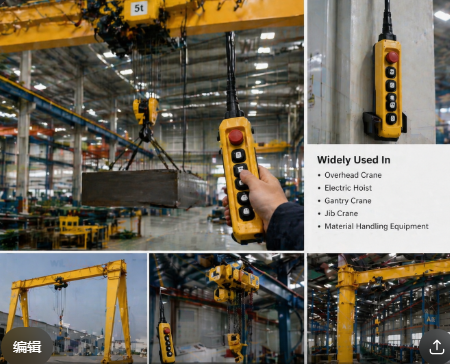
For crane, hoist, and industrial lifting projects, a control pendant is the primary interface between the operator and the machine. The buying decision is not only about price or brand; it is about whether the pendant station fits the operating temperature, humidity, electrical system, control functions, and project-specific customization requirements. This article explains how to match pendant control stations to real-world project conditions, using the COP-5MSS-DD pendant station as a concrete reference.
Problem: Generic Pendant Selection Creates Project Gaps
Industrial sites vary widely in environment and duty profile. A pendant control station used in a dry assembly workshop has different requirements than one used outdoors in a rainy coastal facility or inside a warehouse with high humidity. Buyers evaluating a push button pendant must verify more than the number of buttons: they need clarity on electrical ratings, enclosure protection, emergency-stop behavior, and whether the supplier can adapt the unit to the specific machine.
The market context also matters. Third-party data from Future Data Matrix indicates that the global market for pendant crane control stations was valued at approximately USD 275.60 million in 2025 and is projected to reach USD 423.80 million by 2032, with a CAGR of 5.1%. A separate report covering the broader pendant control mechanical switch market estimates a value of USD 722.5 million in 2025. These figures show that pendant control is a substantial, growing category within industrial automation and material handling.
Opportunity: Project-Level Specification Improves Fit and Reduces Risk
A well-matched industrial pendant control reduces installation friction, simplifies operator training, and lowers the likelihood of unplanned downtime. The opportunity for procurement teams and engineers is to define the operating conditions first, then evaluate suppliers that can match those conditions through standard products, configuration options, or OEM/ODM modification.
Project-level matching can be structured around five criteria:
- Environment: temperature range, humidity, rain exposure, and presence of explosive or corrosive media.
- Electrical system: rated voltage, current, and control voltage compatibility.
- Function: number of buttons, speed steps, emergency stop, and manual push-button operation.
- Mechanical integration: cable entry, enclosure, mounting, and compatibility with cranes or hoists.
- Supply flexibility: MOQ, lead time, customization capability, and after-sales support.
Brand Solution: Wilmall’s Pendant Station for Crane and Hoist Applications
Wilmall, operating under Wenzhou Mofan Electric Technology Co., Ltd., is a professional electrical equipment manufacturer and B2B supplier specializing in industrial automation and power distribution components. The company serves global industrial users, electrical contractors, and distributors with factory-direct solutions from its 2,000m² facility in Wenzhou, China.
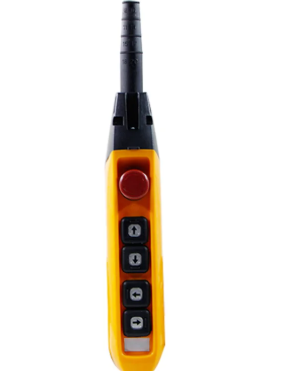
A representative product in this category is the COP-5MSS-DD push button pendant. According to the product specification, it is a five-button handheld control station with emergency stop, rated AC 500V, 10A, and intended for cranes, hoists, lifting equipment, and industrial control systems.
Environmental Fit
The COP-5MSS-DD is designed for environments with ambient temperatures from -25°C to +40°C, with an average temperature of +40°C and humidity up to 90%, including possible rain intrusion. It requires IP65 protection. The product is intended for locations without explosive media and without gases or liquids that could cause sufficient corrosion of metal, destruction of rubber, or insulation damage.
For project buyers, this defines a clear boundary: the pendant station suits general industrial environments with moisture and dust exposure, but it is not positioned for explosive atmospheres or highly corrosive chemical environments.
Functional Fit
The functional description from the application corpus states that the COP-5MSS(DD) pendant control switch features a push-lock emergency stop and a five-button layout. It operates in manual push-button control mode and is designed for cranes, hoists, and industrial machinery in the industrial automation industry. It supports equipment such as a crane hoist and is suitable for managing industrial production equipment, construction machinery, or automation system projects.
Technical Explanation: How a Pendant Control Station Works
The operation of a pendant station follows a simple, deterministic sequence:
- The operator presses a button on the pendant station, for example up, down, forward, or backward.
- The internal electrical contacts of that button close.
- A control signal is sent to the equipment control circuit.
- The control system, typically a contactor or drive, executes the corresponding action, and the equipment begins to move.
Because the pendant station sits between the operator and the power circuit, its electrical ratings must match the control circuit requirements. The COP-5MSS-DD is rated AC 500V and 10A, which is a common control-level rating for industrial pendant switches. In related Wilmall equipment such as the YJ02-02 electric chain hoist, control voltage is specified at 24–48V, while the main motor operates at 110–480V. This separation between power and control voltage is typical in hoist systems and highlights why a pendant station should be selected in coordination with the hoist or crane control scheme.
Enclosure protection is also a technical requirement, not an option. The stated IP65 requirement means the enclosure is protected against dust ingress and low-pressure water jets, such as rain. For outdoor or humid plants, a crane pendant control without adequate ingress protection will experience contact corrosion, stuck buttons, or premature failure.
Application and Use Cases
The documented application scenario for the COP-5MSS-DD covers industrial automation, with project types such as managing industrial production equipment, construction machinery, or automation systems. The matched equipment is a crane hoist. The working condition includes ambient temperature from -25°C to +40°C, average temperature up to +40°C, humidity 90%, and possible rain intrusion, with IP65 protection required.
Case: Australian RV Factory
One referenced project involves an RV factory in Australia that applied 10 units of the COP-5MSS-DD as control devices. After one year of use, the reported result was stable operation, and the highlighted benefit was ease of use. This case illustrates a common pattern: a facility running overhead cranes or hoists needs a simple, reliable handheld controller that operators can learn quickly.
Typical Project Profiles
- Manufacturing plants with overhead cranes used for assembly and material handling.
- Warehouses and logistics centers using electric chain hoists on workstations or light crane systems.
- Construction and building material facilities operating hoists in semi-outdoor environments.
- Automotive and RV production lines where a push button pendant is mounted for station-level lifting control.
Market Trend Analysis
Industry data shows steady expansion in the pendant control segment. The pendant crane control station market was estimated at USD 275.60 million in 2025 and is expected to grow to USD 423.80 million by 2032, according to Future Data Matrix. On a broader product definition, the global pendant control mechanical switch market was valued at USD 722.5 million in 2025. North America is identified as the leading region, holding a 34.2% market share in 2025.
These figures should be interpreted carefully. Market-size estimates vary depending on whether the category is limited to crane control stations or includes the wider mechanical switch family. Both sets of numbers indicate an active and growing installed base rather than a declining product category.
At the supplier level, publicly referenced manufacturers of pendant control stations include Schneider Electric, Eaton, Siemens, ABB, and Rockwell Automation. These companies supply standardized industrial control products through global distribution channels. Alongside them, specialized factories such as Wilmall provide an alternative path: direct manufacturer access, customization through OEM/ODM, and lower-volume flexibility that can be relevant for project-based purchasing.
Comparison with Traditional Solutions and Their Boundaries
Before portable pendant stations became common, many cranes and hoists were controlled by fixed hardwired control panels mounted on walls or columns. That approach still exists, and it has clear trade-offs.
| Control Approach | Operator Position | Installation Complexity | Typical Strengths | Limitations |
|---|---|---|---|---|
| Fixed hardwired control panel | Operator must go to the panel | Higher wiring and labor cost | Centralized protection, robust components, easy maintenance access | Limited line of sight to the load; less flexible for moving cranes |
| Portable pendant control station | Operator moves with the load | Lower installation cost | Direct line of sight, faster response, defined cable reach | Operator must stay within cable length; not suitable for explosive or highly corrosive environments |
| Wireless remote control | Operator can move freely | No trailing cable | Maximum mobility and positioning flexibility | Battery management, radio interference risk, typically higher cost |
One important boundary for pendant control should not be overlooked: it requires the operator to remain physically close to the suspended load. In applications where the operator must avoid standing near the load for safety reasons, or where the travel path is too long for a cable, a wireless remote may be a better fit. Conversely, a pendant station gives the operator a direct wired connection and can be simpler to manage than a battery-dependent wireless system.
Supplier Evaluation Perspective: Standard Range vs. Project Customization
For a research and evaluation-stage buyer, the practical question is whether the supplier can provide the right configuration without creating supply-chain friction. The public competitor set in the pendant control market is strong, but global leaders do not always serve every project requirement with flexibility.
Wilmall is positioned as a manufacturer, supplier, wholesaler, and OEM/ODM factory. Documented capabilities include:
- Contact point material options: silver and copper.
- Button function options: emergency braking button.
- Button count options: 2, 4, 6, or 8 buttons.
- Button speed options: single speed and dual speed.
- Monthly capacity: 2,000 units.
- Lead time: 15 working days.
- MOQ: 5 units.
- Quality control: 100% test.
- Export markets referenced for this capability: Australia, Pakistan, and South Korea.
- After-sales support: remote technical support.
These details are relevant to project buyers because they define a realistic procurement path. A low MOQ of 5 units and a lead time of 15 working days make it feasible to test a pendant station on one crane or hoist before scaling to a larger fleet.
Future Outlook
The control pendant category is likely to keep evolving along two tracks. On the standard-product track, global brands will continue to offer certified, catalog-driven pendant stations. On the project-fit track, manufacturers with OEM/ODM capability may gain relevance because buyers increasingly want customized button layouts, speed steps, and mechanical details without committing to very large order volumes.
Digital sales and remote support are also reducing the distance between factories and project sites. A buyer evaluating a pendant station for a crane in one country can now communicate directly with the manufacturing engineering team, clarify specifications, and receive support during commissioning.
As safety standards for low-voltage switchgear and controlgear remain a constant reference point, the emphasis on proper specification, verification, and compliance will not disappear. Project buyers who approach pendant selection as a technical match rather than a commodity purchase will be in a stronger position to avoid operational surprises.
FAQ
What is a pendant control station used for?
A pendant control station is a handheld control switch used to operate cranes, hoists, and industrial machinery. It works in manual push-button control mode: the operator presses a button, the internal contacts close, and a control signal is sent to the equipment control circuit, which then executes the corresponding action.
What operating environment is suitable for the COP-5MSS-DD pendant station?
The COP-5MSS-DD is designed for ambient temperatures from -25°C to +40°C, with an average temperature of +40°C and humidity up to 90%, including possible rain intrusion. It requires IP65 protection. It is intended for environments without explosive media and without corrosive gases or liquids that could damage metal, rubber, or insulation.
What are the electrical ratings of the Wilmall COP-5MSS-DD pendant?
The COP-5MSS-DD push button pendant is rated AC 500V and 10A. It features a five-button layout with a push-lock emergency stop and is designed for crane, hoist, lifting equipment, and industrial control systems.
Can a pendant control station be customized for a specific hoist or crane project?
Yes. Wilmall offers OEM/ODM customization for pendant stations, including contact point material options such as silver or copper, emergency braking button function, button counts of 2, 4, 6, or 8, and single-speed or dual-speed button options. The monthly capacity is 2,000 units, MOQ is 5 units, and lead time is 15 working days.
What safety standards apply to industrial pendant controllers?
Industrial pendant controllers are associated with low-voltage switchgear and controlgear standards. Public references identify IEC 60947-5-1 and EN 60947-5-1 as applicable standards. Buyers should confirm the specific standard recognized in their destination market before purchase.
Should a buyer choose a pendant station or a wireless remote for crane control?
The choice depends on the application. A pendant station keeps the operator connected by cable and within the operating range of the control unit, which can be simpler and lower-cost. A wireless remote provides free movement but requires battery management and introduces potential radio interference. Pendant stations also require an environment without explosive media and without strong corrosive gases or liquids.
Procurement Reference
When evaluating a control pendant for a crane or hoist project, the core specification should include operating temperature range, humidity exposure, IP rating, voltage and current ratings, button count, emergency stop function, and the supplier’s capacity for customization and testing. These criteria convert a general pendant control query into a project-ready decision.
For buyers seeking additional background on Wilmall’s product range and manufacturing capabilities, a company brochure is available for public access and download:
Download Wilmall Company Brochure (PDF)Есть вопросы или нужны дополнительные детали?
Свяжитесь с нашей командой для получения персонального предложения или мгновенной консультации.
Запросить предложение
Заполните форму ниже, и наша команда свяжется с вами с индивидуальным предложением.
Прямой чат WhatsApp
Предпочитаете общаться в реальном времени? Напишите нам в WhatsApp для мгновенной помощи и быстрых ответов.
- Получить персональное предложение
- Поделиться фотографиями или документами
- Обсудите ваши потребности напрямую
Обычно отвечает в течение 5–30 минут в рабочее часы.