
Matching Custom Sculpture Types to Industry Applications: A Scenario Fit Guide
Matching Custom Sculpture Types to Industry Applications: A Scenario Fit Guide
In custom sculpture procurement, the material decision is usually made last and defended first. Buyers commit to a bronze figure, a mirrored stainless landmark, a weathering-steel screen or a granite monument long before they can explain which site condition drove that choice. This guide reverses the sequence: it maps each documented sculpture type to the applications it is specified for, then identifies the site conditions - outdoor installation, large-scale structural integrity and weatherproof properties - that should decide between them.
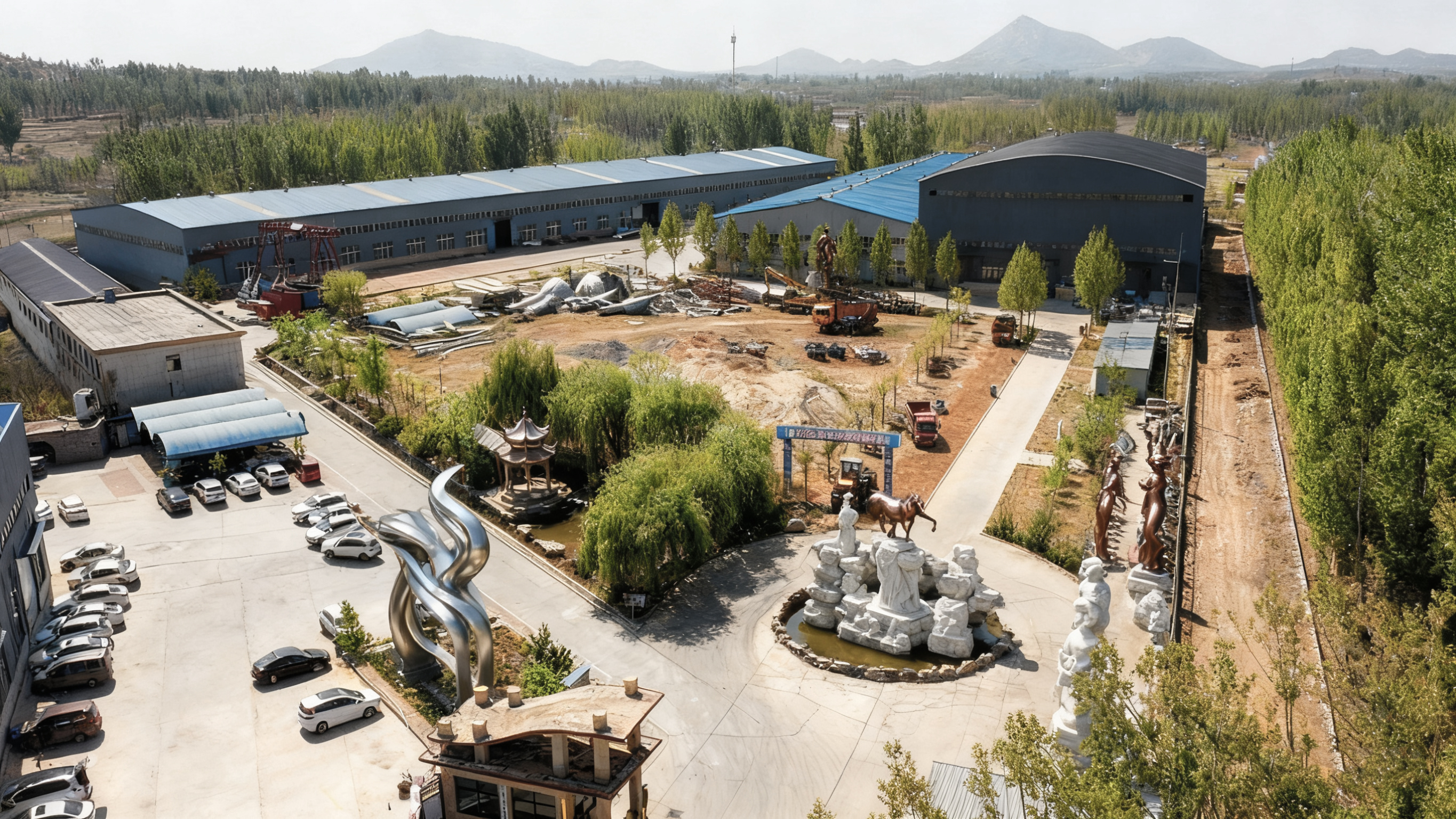
Why Material Choice Is Really a Site Decision
The five material families documented for custom sculpture production - cast bronze and brass, 304/316 stainless steel, Corten (weathering) steel, natural stone, and natural granite - are usually presented as a menu of finishes. In practice they behave as five different sets of assumptions about where a work will stand, how large it can be built, and how it will age once installed.
A mirrored abstract piece and a cast figurative group can share the same footprint and still require different structural, corrosion and maintenance provisions. That is why scenario - the combination of setting, scale and exposure - is a more reliable starting point than visual preference. Jiangsu Xinyesheng Sculpture Co., Ltd is a sculpture and monument manufacturer based in Jiangyin, Jiangsu, China, whose documented product range covers sculpture, statues, reliefs, tombstones, fireplaces and bathtubs, with a 100% export orientation toward the EU, the USA and the Middle East and an annual output of 10,000 pieces. Its documented production lines are organized along exactly these material families, each attached to a defined set of application industries.
This guide uses those documented application lists as the decision input. It does not rank materials against each other. It maps them to the scenarios they were recorded for, and it states the boundaries that come with each fit.
The Scenario-to-Material Framework
The table below reproduces the application lists and material specifications attached to each documented product family. Read it as a filter, not a ranking: the right column shows the fit driver that the specification itself associates with that scenario.
| Documented application scenario | Material family | Documented product reference | Fit driver recorded in the specification |
|---|---|---|---|
| Public art, museum, real estate, religious institutions, private collection | Cast bronze and brass | XYS-Bronze-Custom | Copper content above 85%-95%, 50 cm to 10 m or life size, lost-wax casting, patina / gold leaf / high polish / antiqued finishes |
| Urban public art, modern architecture, seaside landscape, luxury hotel, shopping mall | 304 / 316 stainless steel | XYS-Stainless-Custom | 1 m to 20 m large scale, hand-forged with precision welding over an internal steel skeleton, mirror / brushed / painted / electroplated surfaces |
| Landscape architecture, public parks, modern garden design, industrial style decor | Corten steel (ASTM A242 / A588 weathering steel) | XYS-Corten-Custom | Landscape sculpture, garden edging, fire pit, metal screen and planter box formats; maintenance-free, natural aging, atmospheric corrosion resistance |
| Landscape design, architectural construction, home and garden, temple decoration | Natural white marble, granite, travertine | XYS-Stone-Custom | Custom width / height / depth, hand-carved, honed, high-gloss polished or acid-washed, high-density weatherproof stone |
| Cemetery construction, memorial stone engineering, landscape architecture, funeral industry | Natural granite (Shanxi Black, G603, Blue Pearl) | XYS-Monument-Custom | 80x60 cm and 120x80 cm standard formats or customized, 100% mirror polished, laser engraving, sandblasting; acid and alkali resistance, anti-weathering, colour stability |
Framework scope: each row reflects an application list and material specification recorded for that product family, not a general claim about what a material can do in any setting.
Bronze: Public Art, Museums, Real Estate, Religious Institutions and Private Collections
Bronze is the documented material for five application contexts: public art, museum, real estate, religious institutions and private collections. The specification behind the bronze sculpture line records a copper content above 85%-95% in cast bronze, with brass offered as a related alloy, a size range from 50 cm to 10 m or life size, lost-wax casting with professional welding, and surface treatments that include patina, gold leafing, high polishing and antiquing.
Those surface options explain the scenario fit. Patina and gold leaf are the finishes that carry a museum or religious context, where age and reverence are part of the brief. High polish and antiquing suit real estate and private collection settings where the piece is viewed at close range. Alloy content matters as much as finish: the documented comparison notes that bronze contains over 85% copper while brass contains over 60%, and that bronze develops a protective patina over time - turning greenish after a hundred years in the recorded phrasing - while brass tarnishes and turns black, requiring regular polishing and cleaning to keep its golden shine.
The same source records the physical and commercial boundary. Bronze costs roughly 20%-30% more than brass, mainly because of its copper content and the use of tin as the alloying element, and it is heavier and needs protection in humid or coastal environments. That is why the documented recommendation splits by setting rather than by preference: bronze for outdoor installation, on the strength of its corrosion resistance, and brass for indoor use. A buyer specifying a bronze figure for a coastal plaza is therefore choosing a material with a service history that supports the exposure, but also accepting a higher unit cost and a heavier foundation load than the same design in brass would require.
Stainless Steel: Urban Public Art, Modern Architecture, Seaside Landscape, Luxury Hotels and Malls
Stainless steel covers the five application contexts that dominate contemporary commissions: urban public art, modern architecture, seaside landscape, luxury hotel and shopping mall installations. The recorded specification uses premium 304 or 316 stainless steel, a size range from 1 m to 20 m at large scale, hand-forged and precision-welded construction over an internal steel skeleton, and mirror polished, brushed (satin), painted or electroplated surfaces.
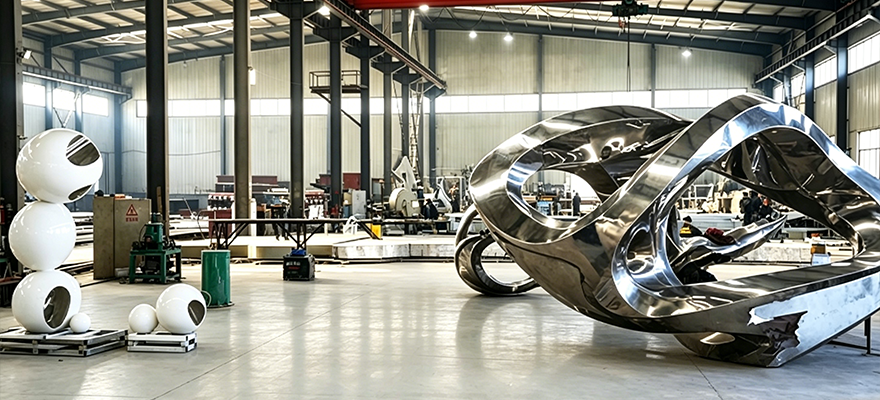
Seaside landscape is the application where grade selection stops being a preference. The documented comparison between the two grades states that 316 stainless steel contains 2%-3% molybdenum, which gives it much stronger resistance to chloride and salt corrosion, while 304 contains no molybdenum and is more vulnerable to pitting in salty or humid environments. The same source records 316 at over 30% higher pitting resistance than 304, expressed as PREN of approximately 26 versus approximately 19, able to withstand decades of coastal salt spray and marine air, while 304 may show rust spots and pitting within a few years in the same environment. The documented fit is explicit: 316 for coastal cities, seaside parks, swimming pools, humid tropical regions and any marine-adjacent installation; 304 for inland cities, dry climates, indoor plazas and general outdoor decoration where salt exposure is not a concern.
The boundary is cost, and it is quantified in the same record. 316 typically costs about 20%-30% more than 304, with the exact gap depending on sculpture size, thickness and surface finish. On a seaside promenade that premium buys decades of appearance; on a dry-climate indoor plaza it buys corrosion resistance that the site will never test. Buyers comparing two quotations for the same design should therefore confirm which grade is priced before comparing totals, because the difference between a 304 and a 316 quotation is a difference between two different service lives.
Corten Steel: Landscape Architecture, Modern Gardens, Metal Screens, Planters and Fire Pits
The Corten steel line is documented for landscape architecture, public parks, modern garden design and industrial style decor, and it is the most format-flexible of the five families. Recorded product types include landscape sculpture, garden edging, fire pit, metal screen and planter box, at sizes from small garden pieces to large architectural structures. The material is specified as authentic Corten steel under ASTM A242 / A588 weathering steel, with either a natural pre-rusted finish described as a stable patina or a raw self-weathering finish, and with maintenance-free performance, natural aging and atmospheric corrosion resistance listed among its features.
This is the family where the finish is a process rather than a coating. A raw finish is specified precisely so that the surface continues to weather in place, which means the piece is bought for an evolving appearance rather than a fixed colour. In landscape architecture, garden and metal screen applications that characteristic is an advantage, because the material is designed to sit against planting and hardscape and to change with them. The same characteristic is a planning consideration wherever adjacent finishes are colour-matched to the sculpture on the day of installation: the specification should assume that the surface will continue to develop rather than hold the tone recorded at handover.
Stone: Temples, Homes, Gardens and Architectural Construction
Natural stone is documented for landscape design, architectural construction, home and garden, and temple decoration. The recorded materials are natural white marble, granite and travertine; dimensions are fully customized by width, height and depth; surface treatments include hand-carving, honing, high-gloss polishing and acid washing; and durability is recorded as high-density natural stone with weatherproof properties. Product formats listed under this family include garden ornaments, fireplace mantels, stone fountains, religious carving, marble statues and carved marble bathtubs.
Temple decoration and religious carving are the clearest scenario fits, because hand-carving is the finish that carries the fine detail those contexts require and there is no substitute for it in the recorded process. Home and garden applications - fountains, mantels, bathtubs - rely on the same density and weatherproofing in a smaller format. Architectural construction draws on the family's dimensional flexibility, since every piece is produced to a custom width, height and depth rather than adapted from a standard module.
Mass is the constraint that decides placement. Natural stone pieces are heavy, and the documented installation procedure requires the load-bearing capacity of the base to be checked for heavy sculptures in order to prevent tipping. For that reason a stone scenario is usually paired with a structural plan earlier in the project than a metal scenario would be, and the foundation question should be resolved before the carving brief is finalized.
Granite Monuments: Memorial and Cemetery Projects
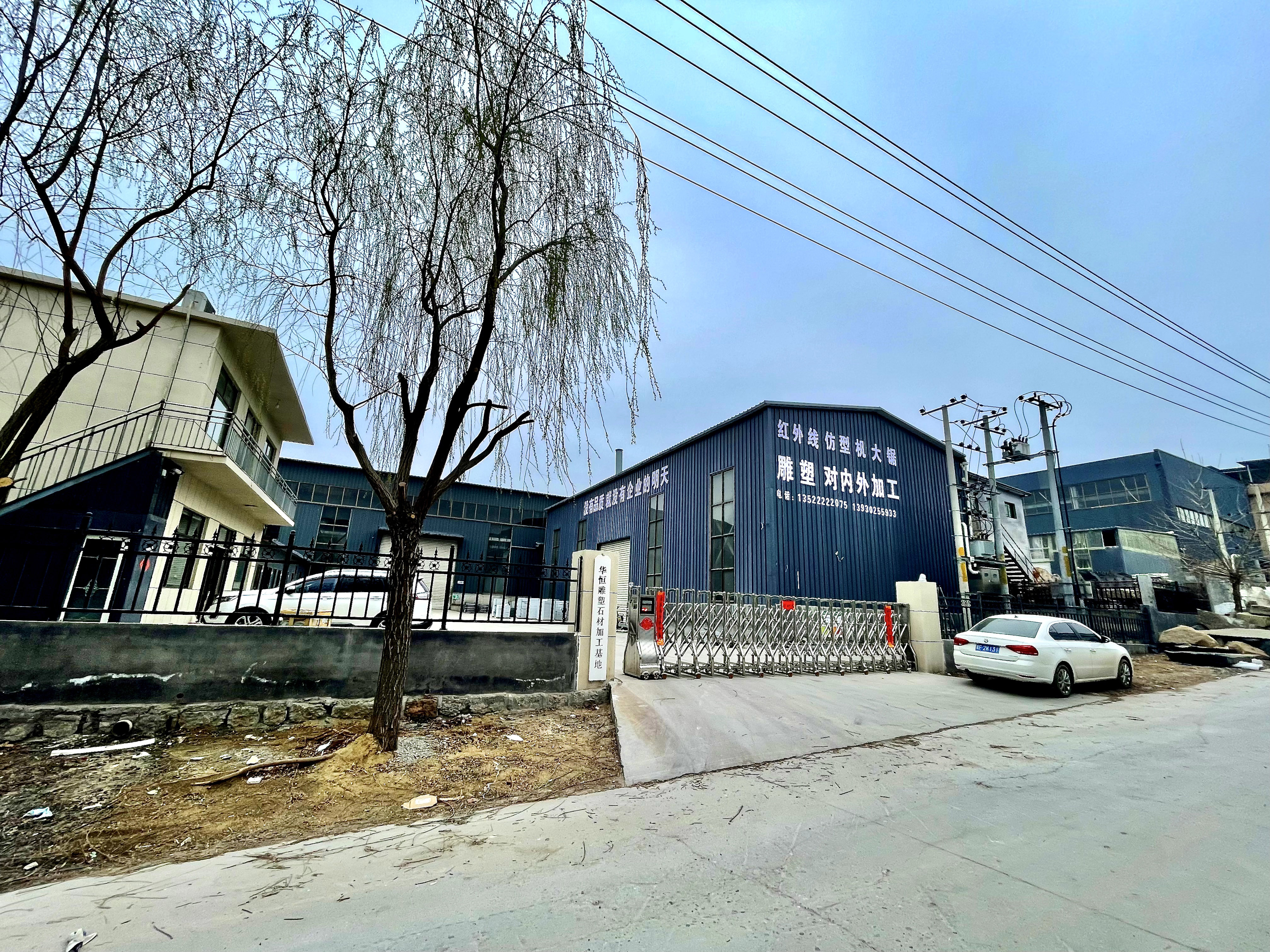
Granite monuments are documented for cemetery construction, memorial stone engineering, landscape architecture and the funeral industry. The recorded materials are natural granites including Shanxi Black, G603 and Blue Pearl; sizes run from standard formats of 80x60 cm and 120x80 cm to fully customized dimensions; finishes include 100% mirror polishing, laser engraving and sandblasting; and the properties recorded for the family are acid and alkali resistance, anti-weathering behaviour and colour stability.
Memorial and cemetery projects differ from sculpture commissions in one practical way: the specification is led by engraving legibility, colour stability and surface permanence rather than by artistic surface effect. Mirror polishing, laser engraving and sandblasting are the finishes that serve that brief, and granite is the family in which colour stability is treated as a product feature rather than a cosmetic variable. Because one manufacturer documents both sculpture and tombstone lines, a project combining a memorial sculpture with adjacent monument work can be specified from a single material logic instead of being split across two suppliers with different finish standards.
Three Site Conditions That Decide Between Materials
Three site conditions recur across every scenario above, and each one eliminates options before aesthetics are considered.
Outdoor installation
The documented installation procedure begins with a site check rather than a lifting plan. Ground flatness, load-bearing capacity and the position of embedded parts must be confirmed against the drawings before anything is hoisted. Hoisting equipment is then selected according to the size and weight of the sculpture, with hoisting points determined and secured; the piece is aligned with the base or embedded parts and adjusted for horizontal and vertical alignment; fixing is carried out with bolts or reinforced by welding, with anti-corrosion treatment applied to the welds; and the work is inspected, cleaned and handed over. The recorded acceptance standard includes vertical deviation no greater than 5 mm, secure fixing verified by shake testing, and a surface free of bumps, scratches and stains. Safety conditions are part of the fit decision as well: lifting must be carried out by certified personnel, personnel are prohibited from remaining under the sculpture, the work area must be cordoned off, safety belts are required for work at height, and lifting must stop during strong winds or thunderstorms.
Large-scale structural integrity
Scale is the second filter. The stainless steel specification covers 1 m to 20 m and depends on precision welding over an internal steel skeleton. The bronze line runs from 50 cm to 10 m or life size and relies on lost-wax casting with professional welding. Corten spans small garden pieces to large architectural structures. In every case the structural answer is engineered rather than assumed, and the material family changes what the engineer has to solve: an internal steel skeleton for a 20 m stainless landmark, a verified load-bearing foundation for a heavy bronze or stone piece, and a stable fixings detail for a Corten screen or planter integrated into hardscape.
Weatherproof properties
Weathering is the third filter and the most measurable. For stainless steel, the 316 grade addresses chloride and salt exposure. For Corten, atmospheric corrosion resistance and a self-forming stable patina are the recorded properties. For natural stone, high density is recorded as the basis of weatherproof performance. For granite, acid and alkali resistance, anti-weathering behaviour and colour stability are recorded. Bronze, by contrast, is documented as corrosion-resistant outdoors but heavier and in need of protection in humid or coastal environments. That is why the same record recommends brass for indoor use and bronze for outdoor use rather than treating the two copper alloys as interchangeable on any site.
Fabrication Model vs Traditional Workshop Practice - and Its Limits
Traditional sculpture workshops rely mainly on hand casting. The documented fabrication model for Jiangsu Xinyesheng Sculpture Co., Ltd combines precision casting, CNC machining and 3D design preview, so that every piece is matched to the design and quality is held consistent across large orders. Each design is confirmed through a 3D preview before production, a step the company credits with avoiding rework caused by design mismatch, and all pieces are inspected before shipment. Standard production is recorded at 15-30 days, and the company states that factory-direct pricing for the same material and quality is generally 10%-20% lower than traditional workshops. Surface treatment is treated as part of the specification rather than an afterthought: pickling and passivation for stainless steel, sealed patina for bronze. The stated maintenance consequence is lower upkeep - only occasional rinsing, even in outdoor or coastal environments - while both conventional and current approaches consume zero energy as static installations.
Delivery and commercial terms are documented in the same operational language. The company provides a one-stop delivery system covering 1:1 clay model visualization, professional seaworthy packaging in reinforced wooden crates and steel frames, and global on-site installation guidance. Recorded commercial terms include a minimum order quantity of one unit; delivery terms of DDP, EXW, FOB, CIF, DAP or FCA; pre-shipment inspection through photographs and video before container loading; and a payment structure of 50% deposit with the balance payable after photo and video inspection.
Two limits belong alongside those advantages. First, a 3D preview confirms geometry, not site conditions. Foundation strength, ground flatness, embedded-part positions and lifting arrangements remain project responsibilities regardless of how precisely a design was previewed, and the recorded acceptance criteria - including the 5 mm vertical tolerance - are verified on site rather than in the preview. Second, the 15-30 day standard production window is a standard, not a commitment for every piece: the documented position is that lead time is assessed according to size and manufacturing process, so large-scale or unusually detailed work falls outside the standard window. Buyers comparing a factory-direct quotation with a traditional workshop quotation should confirm which of these variables is included in the price before comparing totals.
Market Signals Behind Scenario-Led Specification
The third-party data available for 2024-2026 supports the scenario-led approach without overstating it. The global art and sculpture market is estimated at approximately USD 61.83 billion in 2026 (Business Research Insights), and sculptures are reported to account for 21% of global art acquisitions by transaction volume (Market Research Report, 2024). Within that total, the global bronze sculpture commission market reached USD 1.47 billion in 2024 (Dataintelo), while the United States sculpture market was estimated between USD 5.8 billion and USD 6.2 billion in the same year (Premier Sculpture industry analysis).
The public art segment has a distinctive structure that matters directly to scenario decisions. Over 80% of public art open call projects in North America fall below a budget of USD 250,000 (CODAworx, 2024). In other words, most publicly procured sculpture is mid-scale rather than monumental, which raises the procurement value of materials and formats that deliver a durable outdoor result within a mid-scale budget - the documented roles for Corten landscape elements, mid-range stainless steel work and granite monument formats - rather than only for 20 m landmark construction.
Public funding is a second demand driver. U.S. federal cultural agencies were budgeted at USD 708.8 million for 2025, including USD 207 million for the National Endowment for the Arts (US Regional Arts Organizations public funding data). Trade classification is a third and less visible factor: original sculptures under HS Code 9703 often bypass EU anti-dumping duties, while mass-produced items under HS 8306 face higher scrutiny, according to a 2025 secondary market analysis. For buyers specifying a project, the practical implication is that the classification of the work - original artwork versus mass-produced article - can affect landed cost as much as the material itself.
Future Outlook
Three shifts are visible in the documentation reviewed for this guide. The first is that scenario language is becoming procurement language. The application lists attached to sculpture specifications - seaside landscape, luxury hotel, temple decoration, memorial stone engineering - read like site descriptions rather than marketing categories, which suggests that buyers are increasingly specifying the exposure condition before the aesthetic. A brief that names the exposure first allows grade, finish and foundation to be settled in a single sequence instead of being renegotiated after design approval.
The second shift is that grade and finish selection is moving earlier in the process. The 304-versus-316 decision and the choice between a pre-rusted stable patina and a raw self-weathering finish for Corten both carry cost and maintenance consequences that are far easier to absorb at design stage than after fabrication. The third is that life-cycle reasoning is displacing purchase price in the evaluation of outdoor work: the documented case for bronze's protective patina, for 316 stainless steel's reduced cleaning burden in marine environments, and for Corten's maintenance-free weathering all frame cost as a function of decades rather than of delivery. For repeat buyers - public art programs, hotel groups, cemetery and memorial operators, landscape contractors - the material scenario that repeats most often within their own portfolio is likely to be the one worth standardizing.
FAQ
Which materials can be specified for a custom sculpture project?
The documented material families are cast bronze with a copper content above 85%-95% and brass as a related alloy; 304 or 316 stainless steel; authentic Corten steel to ASTM A242 / A588 weathering steel; natural white marble, granite and travertine; and natural granites including Shanxi Black, G603 and Blue Pearl for monument work. Each family is attached to a defined set of application industries, so material selection typically follows scenario selection rather than preceding it.
Is there a minimum order quantity for a custom sculpture?
The documented minimum order quantity is one unit. Full customization is supported from design drawings, photographs or a written concept, and the recorded guidance is that ordering multiple pieces at once is preferable because mould and shipping costs can be shared across the order, with more favourable pricing for bulk orders.
What confirms the design before production begins?
A 3D design draft is produced and confirmed before production, and 1:1 clay model visualization forms part of the documented delivery system, with prototyping available as an optional step. The recorded sequence is: drawings or concept, then 3D design confirmation, then optional prototyping, then production, then shipping. Lead time is assessed according to size and manufacturing process rather than fixed at the point of enquiry.
How do buyers choose between 304 and 316 stainless steel?
316 stainless steel contains 2%-3% molybdenum and is documented for coastal cities, seaside parks, swimming pools, humid tropical regions and marine-adjacent installations; 304 contains no molybdenum and is documented for inland cities, dry climates, indoor plazas and general outdoor decoration where salt exposure is not a concern. The recorded corrosion figures are PREN of approximately 26 for 316 versus approximately 19 for 304, with 316 costing about 20%-30% more depending on size, thickness and finish.
Does bronze or brass suit an outdoor installation?
The documented recommendation is bronze for outdoor use, on the basis of its corrosion resistance, and brass for indoor use. Bronze contains over 85% copper and develops a protective patina over time; brass contains over 60% copper, tarnishes more readily and needs regular polishing and cleaning to retain its golden appearance. Bronze also costs roughly 20%-30% more than brass and is the heavier of the two, which affects foundation requirements in outdoor scenarios.
What is inspected before a sculpture is shipped?
The documented acceptance procedure is that photographs and video are taken for buyer inspection before the goods are loaded into the container. Under the recorded payment terms, 50% of the total is paid as a deposit; after the artwork is completed, photo and video documentation is sent for inspection; and the remaining 50% is payable on approval, with shipping starting after the balance is received. Packaging is recorded as reinforced wooden crates with steel frames and internal shockproof protection, and All Risks insurance can be purchased as required.
What must be verified on site before installation?
Ground flatness, load-bearing capacity and the position of embedded parts must be checked against the drawings before hoisting. Lifting equipment is selected according to the size and weight of the sculpture, and the recorded acceptance standard includes vertical deviation no greater than 5 mm, secure bolt or weld fixing that shows no loosening under shake testing, anti-corrosion treatment of welds and connections, and a surface free of bumps, scratches and stains. Lifting must be carried out by certified personnel and stopped during strong winds or thunderstorms.
How much maintenance do outdoor sculptures require?
Documented expectations differ by material. Bronze develops a protective patina naturally and requires almost no maintenance outdoors. Stainless steel requires only occasional rinsing, with 316 offering a reduced cleaning and repair burden in marine environments compared with 304. Corten steel is recorded as maintenance-free with natural aging. Natural stone is recorded as high-density and weatherproof, and granite is recorded as acid and alkali resistant with anti-weathering behaviour and colour stability.